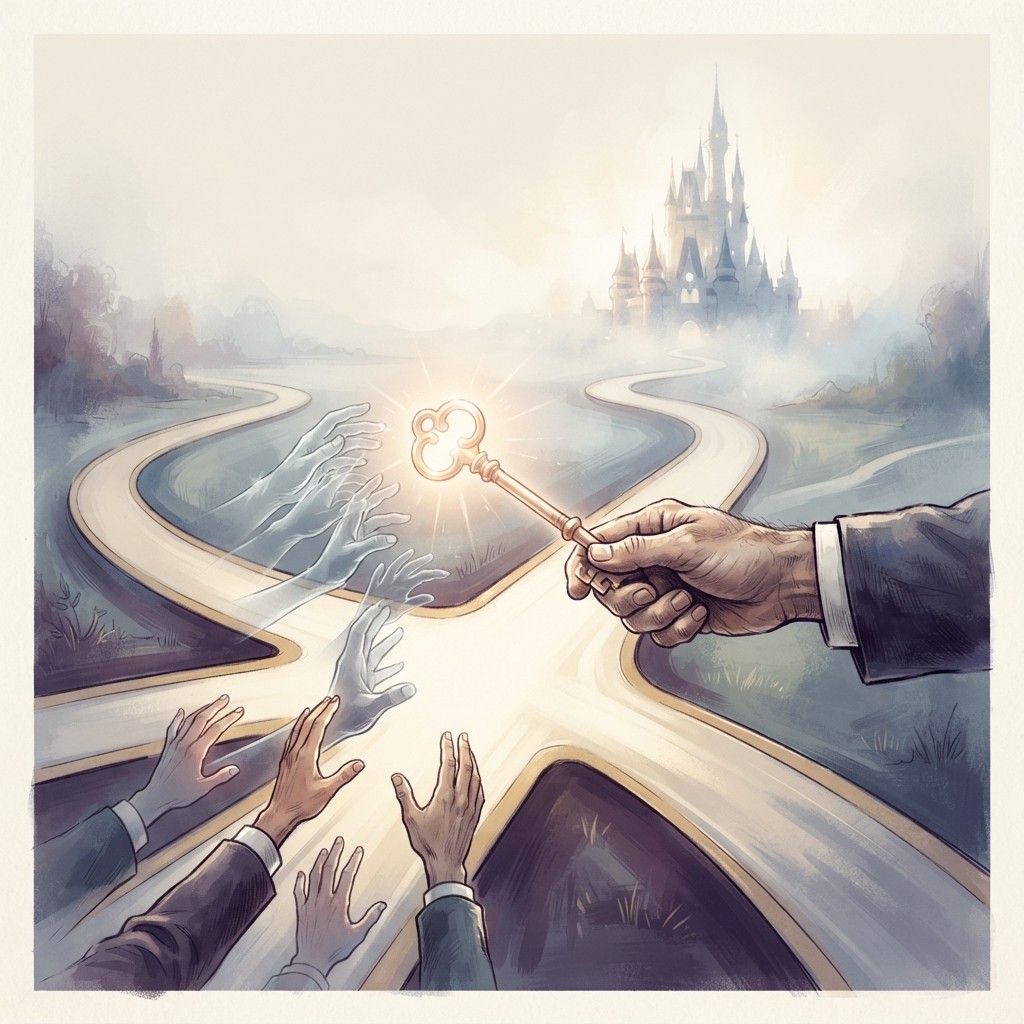
Pairs with the Succession Readiness Scorecard — a ready-to-use strategy tool. Included in the Succession Question Casebook →
“How long does your next chief executive actually get?”
On December 15, 1966, Walt Disney died in a Burbank hospital; his remains were cremated two days later, and with them, on paper, the company that bore his name lost its entire reason to exist.11 The myth that grew up afterward is tidy and false in equal measure: that the magic died with the man, that they froze his body in hope of bringing him back, that Disney went dark overnight. None of it holds. He was cremated within two days. And the animation studio he left behind kept making classics for years.1 The decline was real, but it was slow - the animation staff bled from roughly 500 people to 125 over the better part of a decade, with only 21 new animators hired across the entire stretch from 1970 to 1977.2 That is not a company that lost its genius. That is a company that never replaced him - and never quite learned how.
The story everyone tells is that Disney's recurring crisis is creative: a founder so singular that no one could follow him. The real crisis is governance. Disney's defining vulnerability has never been the death of a leader. It has been a board that keeps handing the question of who comes next back to the person who is supposed to leave.
The brother who couldn't retire, and the pattern he set
When Walt died, the person who held the company together was not a designated successor - it was his older brother. Roy O. Disney had been ready to retire. Instead he postponed it, stayed on to finish the Florida park, and insisted it be renamed Walt Disney World as a tribute to the brother who never saw it open. Roy died on December 20, 1971, two months after the gates opened.3 Look closely at that sequence and the shape of Disney's whole future is already visible: the company survives a leadership void not because it planned for one, but because someone who was already there refuses to leave. It is the most human response imaginable, and the most dangerous habit a board can develop - because it works just well enough to never get fixed.
Skip forward to 1984. The reshaping that brought in Frank Wells and Michael Eisner - the duo who would preside over one of the most dramatic corporate turnarounds in Hollywood history11 - was so consequential that two decades later, when Roy E. Disney and Stanley Gold resigned from the board to demand Eisner's removal, Gold's own resignation letter pointed back to his 'role in reshaping the Company in 1984 by bringing Frank Wells and Michael Eisner to the Company.'4 Read that twice. The same insiders who installed the savior had to mount a public revolt, twenty years on, to dislodge him. The arrival was personal; the exit had to be a war. A board that cannot replace its own choices without a proxy fight does not have a succession plan. It has a hostage situation.
“...my role in reshaping the Company in 1984 by bringing Frank Wells and Michael Eisner to the Company.”4
Iger broke his own succession twice before anyone noticed
Bob Iger is remembered as the steady hand - the operator who succeeded the embattled Eisner and ran a long, acquisitive golden age. What gets edited out of that story is that his own succession failed before it ever became a headline. In 2015, Disney publicly announced that Tom Staggs would become chief operating officer, the explicit heir-apparent post; as part of the same reshuffle, Bob Chapek was promoted to run the parks Staggs was vacating.9 Staggs quietly departed in 2016. The anointed successor was gone within a year, and the company simply moved on. The plan had already broken once - and the board treated it as an inconvenience rather than an alarm.
So when Chapek was named CEO on February 25, 2020, the structure all but guaranteed a second failure. Iger did not actually leave. The plan let him stay on as executive chairman for 22 more months, directing the creative side, while the new CEO reported to both Iger and the board.5 You cannot name a successor and keep the keys. That is not a handoff; it is a probation. And the probation went exactly as a probation goes: Iger had reportedly soured on his pick early, privately lobbying directors against Chapek as far back as a June 2020 board meeting conducted via Zoom — where, according to people familiar with the conversation, he told the board that Chapek wasn't exhibiting proper leadership qualities.10 The November 2022 dismissal that the press framed as a sudden firing was nothing of the kind - it was the slow-motion collapse of a handoff that was never allowed to complete. The board dismissed Chapek and reinstated Iger on November 20, 2022, then renewed Iger's contract through 2026.6 The man who was supposed to be retired was now CEO again, for the second decade running.
| What the board did | Who actually held power | |
|---|---|---|
| 1966-71 | No successor named | Roy O. Disney, who delayed his own retirement |
| 2015-16 | Named Staggs heir-apparent COO | Plan collapsed; he left within a year |
| 2020-22 | Named Chapek, kept Iger 22 more months | Iger, who lobbied against his own pick |
| 2022 | Fired Chapek, brought Iger back | Iger again, on a contract through 2026 |
The mechanism: why incumbents shouldn't pick their own replacements
Here is the causal core. A sitting CEO has a structural conflict of interest in choosing a successor, and the conflict runs deeper than ego. A strong successor threatens the incumbent's relevance; a weak one flatters it. Worse, the moment a CEO is handed the succession pen, the board gets to feel like the decision is handled - which lets it skip the slow, adversarial work of actually vetting candidates against each other. So the failure compounds: the incumbent has an incentive to choose someone who won't outshine him, and the board has an incentive to not check the incumbent's homework. Disney ran this exact experiment four times and got the same result each time - a handoff that either never completed or quietly reversed. The lesson the company kept refusing to learn is not 'find a better genius.' It is 'take the pen away from the person leaving.'
What finally changed in 2026 - and why it might be real this time
After the Chapek debacle, the board did something it had avoided for nearly six decades: it took ownership of the question. In January 2023 it formed a dedicated Succession Planning Committee - not a vague mandate to the CEO, but a standing committee that ran a multi-year process weighing both internal and external candidates before naming Josh D'Amaro CEO effective March 18, 2026.7 The pick itself is telling. D'Amaro is a 28-year Disney veteran who ran the Experiences division - the parks-and-resorts engine that generated $36 billion in revenue in FY2025 and employs 185,000 people worldwide.8 He is not a charismatic outside savior in the Eisner mold, and he is not a placeholder reporting to a chairman who won't leave. He is the head of the company's single most reliable cash machine, chosen by a committee whose entire job was to choose. For the first time, the board, not the incumbent, owned the decision.
The most common governance trap isn't a bad successor - it's letting the outgoing leader pick one. A CEO choosing his own replacement faces a conflict no amount of integrity erases: a strong heir threatens his legacy, a weak one protects it. And the instant the board delegates the choice, it stops doing the adversarial vetting that succession actually requires. The fix is structural, not personal: a standing committee that owns the process, evaluates real candidates against each other, and sets a hard date the incumbent cannot quietly extend. The danger sign to watch for is the 'executive chairman' parachute - if the person handing over the job keeps directing the work, the handoff hasn't happened. It's just been postponed.
The fair objection is that 2026 hasn't been tested yet - a clean process can still produce a CEO who falters, and a board committee is only as good as its nerve under pressure. True. The proof of a succession plan is the second handoff, not the first, and Disney won't know whether it has actually broken the pattern until the next time the pen has to change hands. But notice what's different about the failure mode it has finally escaped. Walt's death exposed a company with no successor. Eisner's exit required a revolt. Chapek's tenure was a handoff sabotaged by the man it was handed from. Each was a variation on the same flaw - the outgoing leader holding the keys too long, or the board never preparing anyone to take them. For sixty years Disney kept rediscovering, at enormous cost, that the question 'who comes next?' is the board's to answer and no one else's. The magic was never the thing at risk. The mechanism for replacing the magician was.
Succession Readiness Scorecard
A scorecard that turns 'we'll figure out succession later' into a number you can argue with. It rates the four things that decide whether a handover lands — bench strength, board alignment, knowledge transfer, and whether the incumbent can actually let go. Blank to grade your own readiness honestly; filled as the worked example diagnosing why the story's company was (or wasn't) ready when the moment came.
Included, filled and blank, in the Succession Question Casebook. See the set → · Preview the blank →
Sources
Where this comes from — the filings, records, and reporting behind it.
- 1Walt Disney died on December 15, 1966, aged 65, of circulatory collapse caused by lung cancer, at St. Joseph Hospital in Burbank, California; his remains were cremated and interred at Forest Lawn Memorial Park in Glendale.
- 2After Walt's death, Disney's animation staff declined from approximately 500 to 125 employees, with the company hiring only 21 people in animation from 1970 to 1977.
- 3Roy O. Disney postponed his own retirement after Walt's death to oversee construction of Walt Disney World, formally renamed as a tribute to his brother; Roy died on December 20, 1971, two months after the park opened.
- 4Roy E. Disney and Stanley Gold resigned from the Disney board in December 2003 and formally called for the removal of Michael Eisner as Chairman and CEO; Gold's resignation letter cited his 'role in reshaping the Company in 1984 by bringing Frank Wells and Michael Eisner to the Company.'
- 5Bob Chapek was announced as Disney CEO on February 25, 2020, succeeding Iger; Iger's succession plan allowed him to remain as executive chairman for 22 more months, directing creative endeavors, while Chapek reported to both Iger and the board.
- 6The Disney board dismissed Bob Chapek and reinstated Bob Iger as CEO on November 20, 2022, at the board's request; Iger's contract was later renewed through 2026.
- 7In January 2023, Disney's Board of Directors formed a special Succession Planning Committee; the committee undertook a multi-year process evaluating internal and external candidates before naming Josh D'Amaro as CEO effective March 18, 2026.
- 8Josh D'Amaro's Disney Experiences division generated $36 billion in annual revenue in FY2025 and employed 185,000 cast members and employees worldwide; D'Amaro is a 28-year Disney veteran.
- 9In 2015, Disney announced Tom Staggs would assume the COO role, positioning him as Iger's successor; Chapek was promoted to replace Staggs as head of parks as part of the same reshuffle.
- 10At the end of a June 2020 board meeting conducted via Zoom, Disney directors asked Iger — but not Chapek — to stay on the call; Iger told the board his relationship with Chapek had soured and that Chapek wasn't exhibiting proper leadership qualities.
- 11With Katzenberg overseeing the studio, the new management of Eisner and Wells presided over one of the most dramatic turnarounds in corporate history.
More like this — beyond Disney
New Strategically analyses as they publish: the defining moves in business, checked against the record. No noise, and one click to leave.