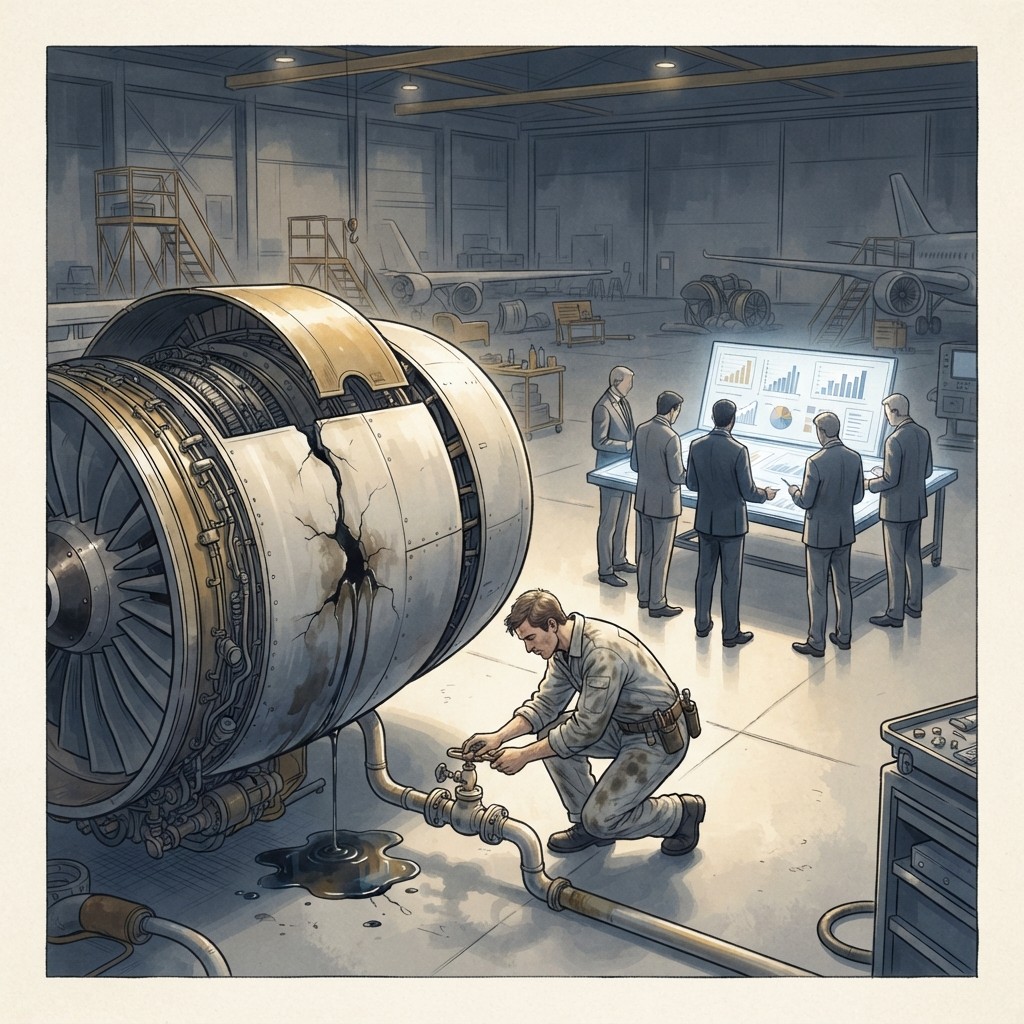
Pairs with the Succession Readiness Scorecard — a ready-to-use strategy tool, filled for Boeing. Included in the The Succession Question Casebook →
Count the years. Three of the four people who ran Boeing before Kelly Ortberg spent a combined seventy years at General Electric, and all three of them ran the same thing there: GE's jet-engines business.5 Calhoun alone logged more than twenty-five years at GE, leading its infrastructure, transportation, and aircraft-engines arms before he ever sat on Boeing's board.6 That is not a coincidence and it is not a hiring accident. It is a preference, repeated across two decades, by a board that kept reaching for the same kind of person to run a company whose entire product is whether an engineer got the math right.
The story everyone tells is that Boeing finally learned its lesson and hired an engineer to clean up the mess. That story is half true and the wrong half. Ortberg is an engineer — a real one, mechanical-engineering degree, started his career building things at a chip company.3 But the board that spent twenty years preferring the other archetype is still the board. The résumé changed. The institution that kept picking the résumé did not.
What the board kept choosing, and what it kept avoiding
Pull the pedigrees apart and the pattern is sharper than the headlines. Harry Stonecipher came to Boeing through the 1997 McDonnell Douglas merger after running Sundstrand and then McDonnell Douglas itself — his GE years ended in 1984.7 Jim McNerney ran GE's engines unit before Boeing. Calhoun ran it too.56 What unites them is not a single biography but a single instinct: the company should be led by someone fluent in the language of capital allocation, portfolio discipline, and quarterly delivery — the GE management gospel — rather than by someone who came up signing off on whether a part would survive a fatigue test.
| The financial operator | The engineer-builder | |
|---|---|---|
| Native language | Capital allocation, margins, portfolio | Tolerances, test data, manufacturing |
| How risk arrives | Pre-digested as a line in a deck | As a physical thing that can fail |
| The Boeing examples | Stonecipher, McNerney, Calhoun (GE trio) | Muilenburg, now Ortberg |
| Who the board favored 2003–2020 | These three | Sidelined |
Here is where the popular telling goes wrong, and the correction matters. Boeing did not run three straight 'finance guys' into the ground. Dennis Muilenburg, who ran the company from 2015 until the board fired him in December 2019, was an aerospace engineer with degrees in aerospace engineering and aeronautics — a thirty-year Boeing lifer, not a GE import.4 He was the engineer in the chair when two 737 MAX crashes killed 346 people, and the board removed him anyway.4 So the clean morality tale — finance broke it, an engineer will fix it — collapses on contact with the record. An engineer was already there for the worst of it. The deeper variable was never the CEO's degree. It was the system the board built around whoever held the title.
The churn that looked like accountability
Watch the cadence of departures and notice how much of it was theater of control. Muilenburg fired in 2019.4 Calhoun in, then out: on March 25, 2024, Boeing's SEC filing announced he would step down at year-end, the board chair would not stand for re-election, the head of Commercial Airplanes would retire, and a new chair would step in.1 A clean sweep, on paper. Except the same day, Calhoun told CNBC the decision was '100%' his own.8 The filing's own language — 'step down,' continue leading through year-end — is the vocabulary of a managed exit, not a firing.1 And then the managed timeline didn't even hold: Ortberg was named in July and took over August 8, 2024, roughly four months ahead of the year-end date the company had projected.2
“It was 100% my decision.”8
Strip away the choreography and what you have is a board cycling through CEOs while remaining, itself, the most stable thing at the top of Boeing. Every departure was framed as accountability arriving. But accountability for what, exactly, and assigned by whom? The directors who hired the GE trio, who set the incentives, who approved the strategy of squeezing the engineering organization for margin — those seats churned far less than the corner office did. Replacing the person you chose is the cheapest possible form of reform. It costs the chooser nothing.
Maybe Ortberg really is the fix
The fair objection is that this is too cynical — that Ortberg is precisely the right correction and the board deserves credit for making it. There's something to that. He is the first outsider in nearly two decades brought in with a hands-on engineering and manufacturing operating background rather than a financial one; the board itself led with '35 years of aerospace experience' and his engineering credentials, signaling it knew what it had been missing.3 An outsider-engineer can do what an insider-engineer like Muilenburg could not: he carries no loyalty to the decisions that broke the place. So the hire is genuinely better than the alternative, and pretending otherwise would be its own form of slop. But 'better CEO' and 'fixed company' are different claims. A board that learned the right lesson about the next CEO has still not been tested on whether it learned the right lesson about itself — and the only evidence that it has is that it picked, this once, a different kind of person. One good hire is a data point. It is not a governance reform.
When an organization churns leaders while the body that selects them stays intact, the visible drama can mask the immovable cause. The CEO is the most replaceable senior actor in any company — which is exactly why firing one is the reform of choice for boards that don't want to examine their own judgment. Before you read a high-profile hire as a turnaround, ask the harder question: did the entity that made the prior mistakes change, or did it just change its mind about one job title? If only the title moved, you're watching accountability performed, not accountability delivered.
Boeing spent the better part of twenty years preferring the financier's eye to the engineer's, then spent five more cycling through the wreckage one CEO at a time. Hiring Ortberg reverses the type. It does not retire the instinct, because the instinct never lived in the CEO — it lived in the room that keeps choosing one. The most important person in Boeing's recovery may not be the engineer who finally got the job. It may be whoever, on the board, is willing to ask why it took four firings, a managed exit, and 346 deaths to remember what the company actually builds.
When the people at the top become the story
Succession Readiness Scorecard
A scorecard that turns 'we'll figure out succession later' into a number you can argue with. It rates the four things that decide whether a handover lands — bench strength, board alignment, knowledge transfer, and whether the incumbent can actually let go. Blank to grade your own readiness honestly; filled as the worked example diagnosing why the story's company was (or wasn't) ready when the moment came.
Included, filled and blank, in the The Succession Question Casebook. See the set → · Preview the blank →
Sources
Where this comes from — the filings, records, and reporting behind it.
- 1On March 25, 2024, Boeing's SEC 8-K confirmed Dave Calhoun's intent to step down as CEO at year-end 2024, Larry Kellner's decision not to stand for re-election as board chair, Steve Mollenkopf appointed new chair, and Stan Deal's retirement with Stephanie Pope named Commercial Airplanes CEO.
- 2On July 31, 2024, Boeing's SEC 8-K announced Robert K. 'Kelly' Ortberg as president and CEO effective August 8, 2024 — replacing Calhoun roughly four months ahead of the year-end date originally announced.
- 3Boeing's board stated Ortberg has 'more than 35 years of aerospace experience,' holds a BS in mechanical engineering from the University of Iowa (1982), began his career as an engineer at Texas Instruments in 1983, joined Rockwell Collins in 1987, and became its president and CEO in 2013.
- 4Dennis Muilenburg, Boeing CEO from July 2015 to December 23, 2019, holds a BS in aerospace engineering from Iowa State and an MS in aeronautics from the University of Washington; he was fired by the board following two fatal 737 MAX crashes that killed 346 people and the subsequent global grounding. Despite being characterized as a 'resignation,' NBC News and CNBC contemporaneously reported the departure as a firing.
- 5Three of Boeing's four most recent CEOs before Ortberg — Harry Stonecipher (2003–05), Jim McNerney (2005–15), and Dave Calhoun (2020–2024) — were General Electric veterans who together spent a combined 70 years at GE; all three led GE's jet-engines business before coming to Boeing.
- 6David Calhoun spent more than 25 years at GE, including roles as president and CEO of GE Infrastructure, GE Transportation, and GE Aircraft Engines, before joining Nielsen and then Boeing's board in 2009; he became Boeing CEO in January 2020.
- 7Harry Stonecipher worked at GE from 1960 to 1984; he subsequently served as CEO of Sundstrand and McDonnell Douglas before joining Boeing via the 1997 McDonnell Douglas merger, and resigned as Boeing CEO in March 2005 after the board found he had a consensual relationship with a Boeing executive.
- 8Calhoun told CNBC in a March 25, 2024 interview that the decision to step down was '100%' his own choice, undercutting narratives of a purely board-forced firing.
More like this — beyond Boeing
New Strategically analyses as they publish: the defining moves in business, checked against the record. No noise, and one click to leave.