Pairs with the Succession Readiness Scorecard — a ready-to-use strategy tool. Included in the Succession Question Casebook →
“How long does your next chief executive actually get?”
In 1980, a co-op student arrived at GM's Pontiac Motor Division to inspect fender panels and check hoods.8 Thirty-four years later, on January 15, 2014, that same person ran the whole company.1 Mary Barra's path from the factory floor to the corner office is the kind of story GM loves to tell about itself. The harder story — the one the company keeps calling 'premature and speculative' — is who tells the next one.6
The official story is that GM is in steady hands and succession is a question for later. The real story is that the most consequential leader GM has had since Alfred Sloan is approaching the end of her run with a transformation half-built and no successor publicly named — and the gap between those two readings is exactly the risk.
Here is the thesis a smart friend could repeat: Barra rebuilt GM's discipline and balance sheet, but she has not resolved what GM is becoming — and that unfinished identity, not her age, is the real succession problem. Whoever follows her inherits a sturdier company pointed at a destination it never quite reached.
Why this is a Sloan-sized handoff, not a routine one
Most CEO transitions are housekeeping. This one is not, and the reason is in the company's own record: Barra is the second-longest-serving CEO in GM's history, trailing only Alfred Sloan, who ran the place from the 1920s into the 1950s.5 Sloan didn't just lead GM; he invented the modern shape of it — the divisions, the annual model, the financial controls that the rest of corporate America copied. A leader who sits in that company of one does not hand off a job. She hands off an era. And eras end badly when the institution has organized itself around a single person's judgment for more than a decade.
GM has, if anything, leaned into that concentration. Its 2024 proxy spells out that the board decided to keep the CEO and Chair roles combined under Barra, with an independent lead director as the counterweight.2 That is a structure built for one trusted operator, not a relay race. It works beautifully right up until the operator leaves — at which point the company discovers how much of its strategy lived in her head rather than on paper.
The unfinished business she's handing over
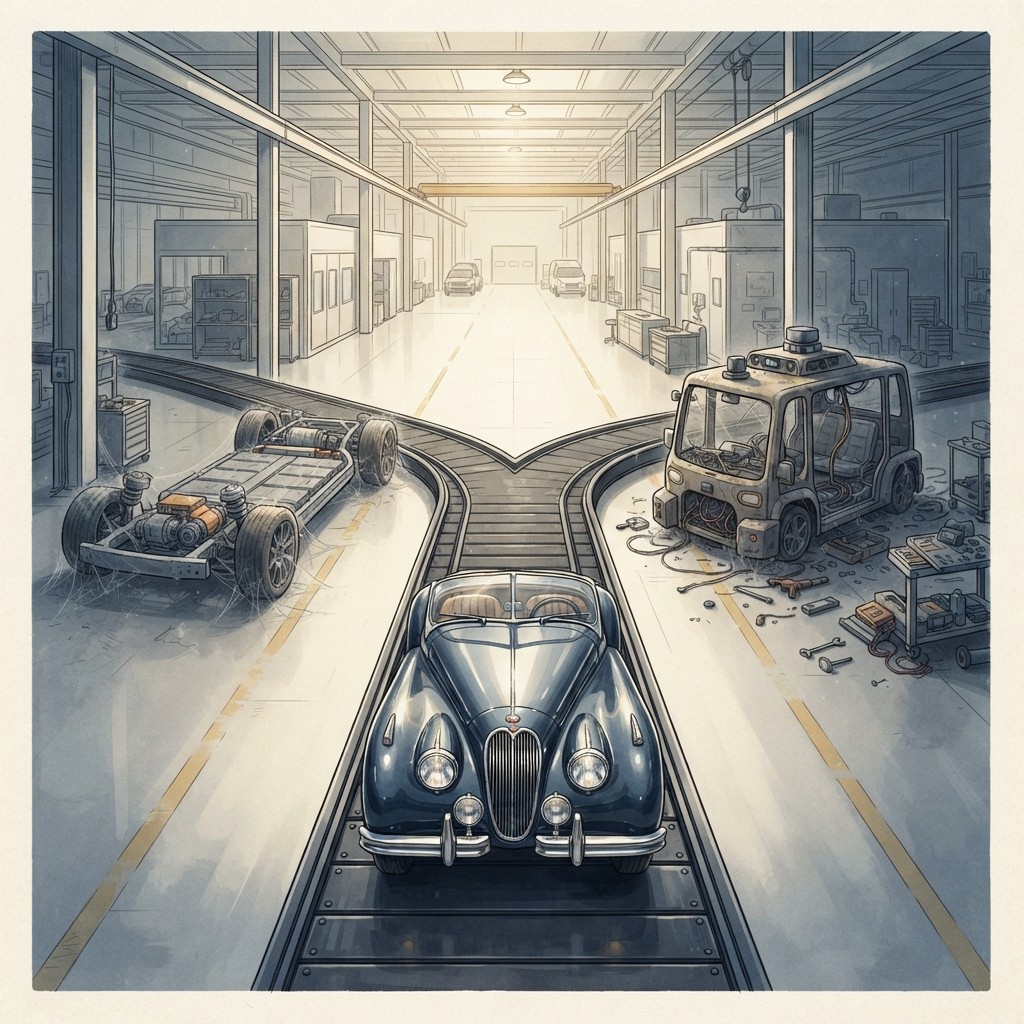
Succession is only frightening when the strategy is incomplete, and GM's is. Take the two boldest bets of the Barra years. The autonomous one is already over: on December 10, 2024, GM announced it would stop funding Cruise robotaxi development, after pouring more than $10 billion into the unit since 2016. The stated reasons were the time and resources needed to scale and an increasingly competitive market; killing it was expected to save more than $1 billion a year.4 That is a clean, disciplined retreat — and also an admission that a defining piece of GM's future, the self-driving business, will not be Barra's to deliver.
The electric bet is the other unfinished story. By early 2026, with Barra turning 65 and twelve years in the chair, her vision of an electric, autonomous GM had still not fully materialized.6 The transition arrived slower than the company promised the market. So the picture is not failure — GM is stronger than the company she inherited — but it is incompleteness: a robotaxi business shut down, an EV future running behind schedule, and a successor question still open. The next CEO doesn't get to coast on her wins. They get to finish her sentences.
| Settled | Open | |
|---|---|---|
| Autonomy | Cruise wound down, ~$1B/yr saved | No self-driving business to inherit |
| Electrification | Committed, capital deployed | Transition slower than promised |
| Leadership structure | CEO + Chair combined under one person | No publicly named successor |
| The strategic identity | Stronger balance sheet | What is GM becoming? |
The frontrunner who isn't a frontrunner
Into that gap walked Sterling Anderson. In June 2025 GM created a new role for him — Executive VP, Global Product and Chief Product Officer — reporting to President Mark Reuss.3 Within about six months he had become the most influential product executive at GM in more than fifteen years outside of Reuss himself, with oversight stretching across manufacturing engineering, battery, software, services, and product management, and he was being reported as a leading candidate to succeed Barra.7 You do not assemble that much authority for a caretaker.
His credential is the tell. The shorthand calls him 'ex-Tesla,' but that flatters the smaller part of his résumé: he spent roughly two years at Tesla, against far longer co-founding and leading Aurora Innovation — the company that put the first commercial driverless trucks on the highway between Houston and Dallas.9 In other words, GM imported a leader whose defining work was the very autonomous future it had just abandoned with Cruise. That is not a contradiction. It is a signal about which way the company intends to point next — even as it insists it has decided nothing.
“The board makes that decision, not me.”6
Isn't the heir already obvious — so where's the risk?
The fair objection is that this analysis is overcooked: Anderson clearly looks like the next CEO, his portfolio keeps growing, the press has all but crowned him, and GM is profitable and far more disciplined than the company that filed for Chapter 11 bankruptcy in 2009.10 If the heir is visible and the company is healthy, where is the crisis?
The honest answer is that an obvious heir is not the same as a settled succession — and GM's own language proves it. The company calls any talk of a future role for Anderson 'premature and speculative,' and Barra deflects the question to the board.6 A leader who concentrated the CEO and Chair roles and ran the place for twelve years has not publicly committed to a plan for the day she leaves. That's the risk: not that the wrong person is in line, but that the institution is steering by one person's judgment with no formal handoff for an unfinished strategy. Sloan's GM survived his exit because the system he built outlived him. The question for Barra's GM is whether the strategy outlives her — or leaves with her.
The danger in following a defining leader is rarely the candidate — it's the unfinished business. A long-serving CEO who concentrates authority and bets big leaves two things on the table at once: a transformation that isn't done, and a strategy that lives in their head rather than in the institution. Naming a successor early doesn't just reassure the market; it forces the open questions — what are we becoming, and who decides? — into the open while the outgoing leader can still answer them. Hiring the frontrunner is the easy part. Writing down the strategy they're supposed to finish is the part companies skip, and the part the next CEO pays for.
Barra started by inspecting fenders and ended by repairing a near-broken giant — fewer bets, cleaner books, a Cruise unit closed before it bled the company white. That is a real legacy, and a Sloan-scale one. But she also leaves the harder thing undone: she rebuilt the machine without finishing the answer to what it's for. The next CEO won't inherit a problem of money. They'll inherit a problem of meaning — and the first job will be to decide what GM is, because the leader who could most credibly have decided it chose, in the end, to leave that question open.
When the founder-grade leader prepares to leave
Succession Readiness Scorecard
A scorecard that turns 'we'll figure out succession later' into a number you can argue with. It rates the four things that decide whether a handover lands — bench strength, board alignment, knowledge transfer, and whether the incumbent can actually let go. Blank to grade your own readiness honestly; filled as the worked example diagnosing why the story's company was (or wasn't) ready when the moment came.
Included, filled and blank, in the Succession Question Casebook. See the set → · Preview the blank →
Sources
Where this comes from — the filings, records, and reporting behind it.
- 1Mary Barra has served as Chair and CEO of General Motors since January 15, 2014 (CEO) and January 4, 2016 (Chair); she succeeded Daniel Akerson who announced her appointment on December 10, 2013.
- 2GM's 2024 proxy (DEF 14A) confirms the Board has determined it is in the company's best interest to combine the roles of CEO and Chair with Mary Barra, with Patricia Russo serving as Independent Lead Director.
- 3Sterling Anderson was appointed GM Executive VP, Global Product and Chief Product Officer effective June 2, 2025; the role is newly created, reporting to GM President Mark Reuss. Before GM, he co-founded Aurora Innovation (2016/2017) and prior to that spent approximately two years at Tesla leading the Model X program and the team that delivered Autopilot. He holds a Ph.D. in robotics from MIT.
- 4On December 10, 2024, GM announced it would stop funding Cruise robotaxi development, citing the time and resources needed to scale and an increasingly competitive robotaxi market; GM expected the shutdown to save more than $1 billion annually. GM had invested over $10 billion in Cruise since acquiring it in 2016.
- 5Barra is GM's second-longest-serving CEO in the company's history, behind Alfred P. Sloan Jr. (president 1923–1937, chairman until 1956); as of January 2025 she had surpassed 11 years in the role.
- 6As of January 2026, succession speculation had been building for months around Anderson; pressed on Anderson's CEO potential, Barra stated 'the board makes that decision, not me.' GM called any discussion of a future role for Anderson 'premature and speculative.' Barra was turning 65 in 2026 and her vision for an electric, autonomous future had yet to fully materialize after a 12-year tenure.Axios, Mary Barra has unfinished business at GM ↗ · 2026-01-14
- 7After roughly six months as EVP and CPO, Anderson had become the most influential product executive at GM in more than 15 years outside of President Mark Reuss, consolidating oversight of manufacturing engineering, battery, software, services, and product management. Anderson is reported as a leading frontrunner to succeed Barra as CEO, per Bloomberg reporting cited by multiple outlets.
- 8Barra began her GM career in 1980 as a GMI (Kettering University) co-op student at the Pontiac Motor Division; she received her BS in electrical engineering in 1985 and her Stanford MBA in 1990 after a GM fellowship awarded in 1988.
- 9Aurora Innovation launched the first commercial driverless trucking service in the US, running between Dallas and Houston on the I-45 corridor, in May 2025.
- 10General Motors Corporation filed for Chapter 11 bankruptcy protection on June 1, 2009, in the US Bankruptcy Court for the Southern District of New York.
More like this — beyond General Motors
New Strategically analyses as they publish: the defining moves in business, checked against the record. No noise, and one click to leave.