Pairs with the Crisis Response Playbook — a ready-to-use strategy tool, filled for Boeing. Included in the The Crisis Response Casebook →
Six minutes after takeoff from Portland, climbing through roughly 14,830 feet, a chunk of the left side of a nearly new Boeing 737 simply left the airplane. The cabin depressurized in an instant; a teenager's shirt was torn off by the wind; oxygen masks dropped. Then the pilots turned around and landed, and out of 171 passengers and crew, the worst injuries were minor.1 The remarkable thing about Alaska Airlines Flight 1282 is not that a panel blew off a passenger jet in January 2024. It is that nobody died — and that the cause, when investigators found it, was not an exotic failure of metal but an ordinary failure of memory.
The official story Boeing wanted in the air was that this was a freak quality lapse on the road to recovery — a one-off, embarrassing, already fixed. The real story is that the blowout was the predictable output of a manufacturing and oversight system the company had been warned about for years and never repaired. The hole in the fuselage was the symptom. The hole in the paperwork was the disease.
Four bolts, and the most damning blank page in aviation
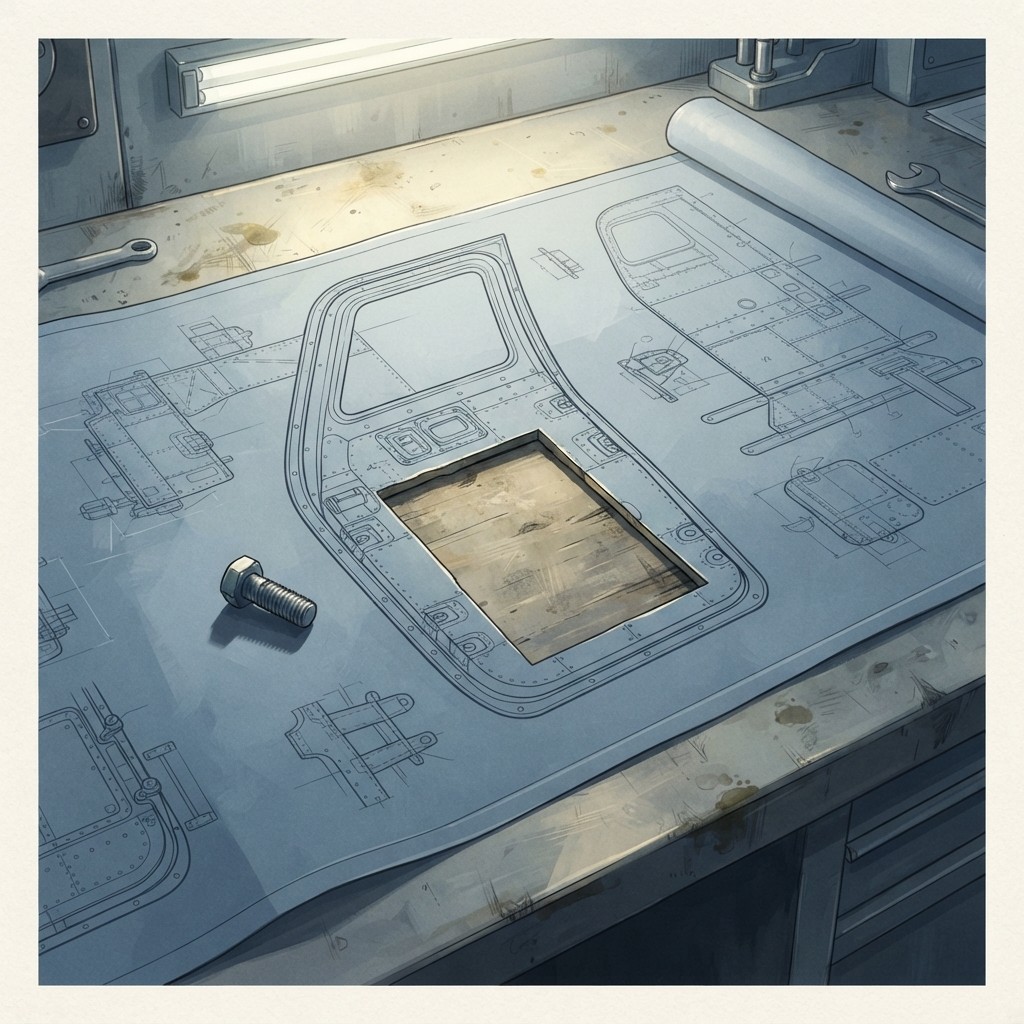
Strip the drama away and the physical cause is almost insultingly simple. The panel that left the airplane is not a door — it's a mid-exit door plug, a structural piece that fills a slot for an emergency exit some airlines don't need. It is held against the airframe by four bolts. When the jet rolled out of Boeing's factory, all four were missing.3 Investigators later found the plug had been quietly creeping upward, fraction by fraction, over 154 flights before it finally let go — and that any one of those four bolts would have held it.4 The plane was not killed by a design flaw or a supplier's bad part. It was killed by an absence.
Here is where the absence becomes a system rather than an accident. The NTSB traced the plug to a rivet repair at Boeing's Renton, Washington factory: it was opened on September 18, 2023, and closed the following day. None of Boeing's specialized plug-closure technicians were present for the closure. No quality assurance inspection happened. And — the detail that should keep an executive awake — Boeing had no record of who performed the work at all.2 There was no work order to violate, no signature to check, no inspection box left unticked, because the document that would have contained all three was never created. You cannot trace accountability through a page that doesn't exist.
“Boeing's failure to provide adequate training, guidance and oversight... FAA compliance enforcement was ineffective.”2
Read that finding twice, because most coverage missed half of it. The NTSB did not stop at Boeing. It put the FAA in the same sentence — compliance enforcement was ineffective. The regulator that is supposed to catch exactly this kind of undocumented work was, in the board's own judgment, co-equally culpable. That is the underreported story: a watchdog and the company it watches failing in the same direction, at the same time, on the same airplane.
Why the right people weren't in the room
The instinct after any disaster is to find the careless individual. But the NTSB's record makes that nearly impossible, and that impossibility is the point. Of Boeing's 24-person door team, only one technician had ever removed a plug like this before — and that person was on vacation during the closure.4 So a structurally critical task was handed to people without the specific experience to do it, with no specialist present, no inspection scheduled, and no paperwork generated to flag any of those gaps. None of that is a personal lapse. Every one of those holes is an organizational choice about staffing, training, and how much friction to allow into a fast-moving production line.
The deeper mechanism is that Boeing had already diagnosed itself. Its safety management system — the formal apparatus meant to catch undocumented, unsupervised work before it reaches an airplane — was initiated back in 2016, under a settlement resolving thirteen enforcement cases. By January 2024 it still had not been fully implemented.4 The company knew the shape of its own problem nearly a decade early, agreed to fix it as the price of settling enforcement actions, and then let the fix sit half-built until a door plug fell out of the sky to finish the argument.
The corner Boeing kept claiming to turn
Boeing's response had the choreography of a company that believed it could reorganize its way out. Within ten weeks, the board announced a clean sweep dressed as renewal: CEO Dave Calhoun would step down by year-end, the chairman would not stand for re-election, the head of Commercial Airplanes would retire, and a new independent chair was named — all of it tied, in Boeing's own filing, directly to the aftermath of the blowout.6 By July, the timeline had accelerated; Kelly Ortberg was named CEO effective August 8, 2024, succeeding the man who had run Boeing since January 2020.7 And the company moved to reabsorb the source of the troubled fuselages, agreeing to buy back Spirit AeroSystems in an all-stock deal valued at roughly $4.7 billion in equity — about $8.3 billion counting Spirit's net debt.5
| The recovery story | What the record shows | |
|---|---|---|
| The cause | An isolated quality slip | Missing bolts and a missing work record — a systemic gap[[cite:s2]] |
| The fix | New CEO, new chair, reorg | A safety system known since 2016, still not fully built[[cite:s4]] |
| Who failed | A factory process | Boeing and an FAA whose enforcement was ineffective[[cite:s2]] |
| The legal close | A guilty plea, case settled | Plea rejected; resolved by a $1.1B non-prosecution deal[[cite:s8]] |
Even the legal ending refused to give Boeing the clean line it wanted. After the blowout reopened a dormant fraud case from the earlier MAX crashes, Boeing agreed in July 2024 to plead guilty. A federal judge rejected that plea in December 2024. The matter finally closed in May 2025 not with a conviction but with a non-prosecution agreement and a payment of more than $1.1 billion.8 A guilty plea would have left a criminal record on the company. A non-prosecution agreement leaves a check. They are not the same thing — and the difference is the difference between accountability and a cost of doing business.
Isn't a near-miss with no fatalities actually a win?
The honest counter is real and worth stating plainly: nobody died. The pilots performed, the airframe held everything but one panel, and 164 passengers walked away uninjured.1 A fair reading is that Boeing's redundancy and crew training did exactly what they were designed to do, and that catching a defect through a survivable in-flight event — rather than a crash — is the system working, not failing. There's something to that. The blowout happened at low altitude, on a panel rather than a control surface, with belted passengers; a less forgiving combination would read very differently in the casualty count.
But that argument quietly concedes the thesis. If the only thing standing between an undocumented closure and a tragedy was altitude and luck, then safety was being supplied by chance, not by process. The plug crept upward for 154 flights — 154 chances for the geometry to be a little less forgiving.4 A system that depends on the failure happening at 14,830 feet instead of 35,000 isn't a robust system. It's a coin that landed the right way up, and Boeing was warned the coin was in the air long before it was flipped.
The most dangerous failure at Boeing wasn't four missing bolts — it was the missing work record that made the bolts invisible. When a critical task can be done without a document, an inspection, or a named owner, you haven't sped up the line; you've deleted the only mechanism that catches the error before it ships. Two lessons sit inside that. First, a known fix you haven't finished is worse than no fix, because it lets you tell the recovery story while the gap stays open — Boeing's safety system was agreed in 2016 and still half-built in 2024. Second, when your regulator's enforcement is as weak as your own controls, you have no second net; you are inspecting yourself, badly, twice. Build the trail that makes accountability traceable, then actually finish building it.
Boeing spent years insisting it was turning the corner, and the door plug answered the way only an airplane can: by leaving an exact, bolt-shaped record of what 'turning the corner' had actually meant on the factory floor. The fix was named in 2016, half-built by 2024, and finished — on paper — only after a panel fell out over Oregon and a federal judge refused the easy plea. The lesson is not that Boeing made a quality mistake. It is that a company can know precisely what's wrong with it, agree in writing to fix it, and still let the gap stand open until the gap, eventually, opens the airplane.
When the system fails the way it was warned it would
Crisis Response Playbook
A playbook for a crisis already in motion: who decides, which plays fire on which trigger, and what gets said to whom. It replaces panic and the all-hands meeting with a pre-agreed sequence each person can run alone. Blank to pre-load before a crisis hits; filled as the worked example reconstructing the plays the story's team ran — and the ones they should have.
Included, filled and blank, in the The Crisis Response Casebook. See the set → · Preview the blank →
Sources
Where this comes from — the filings, records, and reporting behind it.
- 1On January 5, 2024, a Boeing 737-9 operated as Alaska Airlines Flight 1282 experienced in-flight separation of the left mid-exit door plug and rapid depressurization while climbing through approximately 14,830 feet after takeoff from Portland International Airport; one flight attendant and seven passengers received minor injuries, and 164 passengers and all crew were uninjured.
- 2The NTSB's June 24, 2025 probable-cause determination states: the plug was opened without required documentation at Boeing's Renton, Washington factory on September 18, 2023, for rivet repair; it was closed the following day with none of Boeing's specialized plug-closure technicians present; no quality assurance inspection occurred; and Boeing had no record of who performed the closure. The NTSB found the probable cause was Boeing's failure to 'provide adequate training, guidance and oversight' and that FAA compliance enforcement was ineffective.
- 3The NTSB's February 6, 2024 preliminary report confirmed that four bolts were missing when the plane left Boeing's factory; photo evidence from Boeing showed three bolt locations visibly empty, and laboratory analysis confirmed the fourth. The report did not assign blame but established the bolts were absent at delivery.
- 4The NTSB final report (released July 10, 2025) found that the door plug had moved incrementally upward over 154 prior flight cycles before blowout; that even one of the four bolts would have prevented the separation; that only one of Boeing's 24-person door team had prior experience removing such a plug and that person was on vacation during the closure; and that Boeing's safety management system, initiated in 2016 under a settlement resolving 13 enforcement cases, had not been fully implemented.
- 5On July 1, 2024, Boeing announced a definitive all-stock agreement to acquire Spirit AeroSystems at $37.25 per share, representing an equity value of approximately $4.7 billion and a total enterprise value of approximately $8.3 billion including Spirit's net debt. Spirit became wholly owned by Boeing on December 8, 2025.
- 6On March 25, 2024, Boeing's Form 8-K announced that CEO Dave Calhoun would step down by year-end, Board Chair Larry Kellner would not stand for re-election, Steve Mollenkopf was appointed new independent chair, Stan Deal would retire as Commercial Airplanes CEO, and Stephanie Pope was named his successor — all attributed directly to the aftermath of the January door-plug blowout.
- 7On July 31, 2024, Boeing's Form 8-K confirmed Kelly Ortberg was elected president and CEO effective August 8, 2024, succeeding Dave Calhoun who had served since January 2020.
- 8In May 2025, Boeing and the DOJ reached a non-prosecution agreement requiring Boeing to pay more than $1.1 billion — covering fines, compliance commitments, and victim-family payments — to resolve the 737 MAX criminal fraud case. This followed: (a) a 2021 deferred prosecution agreement, (b) the door-plug blowout reopening DOJ action, (c) Boeing agreeing to plead guilty in July 2024, and (d) that guilty plea being rejected by U.S. District Judge Reed O'Connor in December 2024.
More like this — beyond Boeing
New Strategically analyses as they publish: the defining moves in business, checked against the record. No noise, and one click to leave.