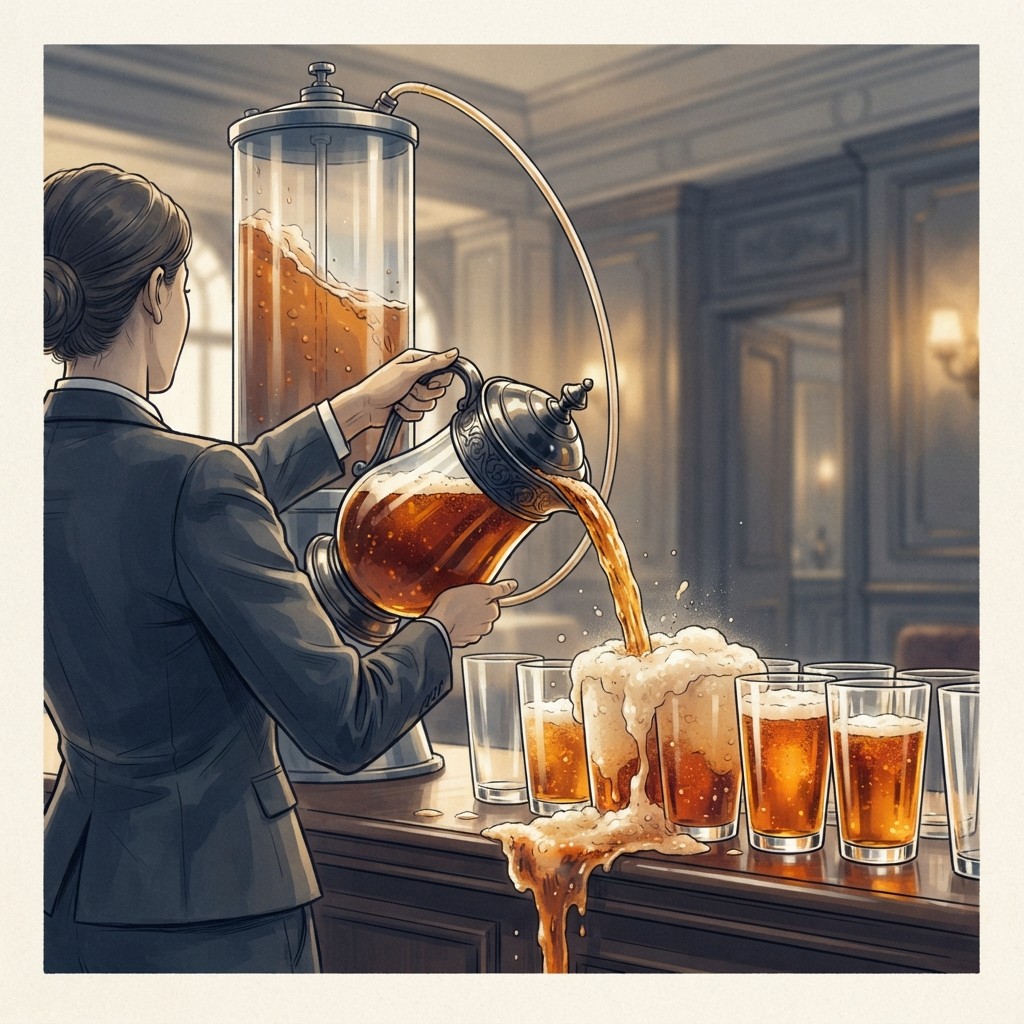
Pairs with the Pricing Power Diagnostic — a ready-to-use strategy tool. Included in the The Limit Casebook →
Walk down a grocery aisle in 2024 and you could watch a strategy hit its ceiling in real time: the same bag of Lay's that fit comfortably in a hand two years earlier now cost more, held less, and sat on the shelf a little longer while the shopper reached for the store brand. Multiply that single hesitation across a continent and you get the year PepsiCo finally learned the difference between the price it could charge and the price it could keep. Reported net revenue for full-year 2024 grew 0.4%. Organic revenue came in at 2% — against guidance that had opened the year at 'at least 4%.'15 The number held. The premise underneath it did not.
The official story is that PepsiCo's pricing power protected its revenue through a hard year. The truer story is that PepsiCo never had durable pricing power at all — it had a one-time loan against future volume, and 2024 was the year the loan came due.
What 2023's 9.5% was actually measuring
Pricing power, properly defined, is the ability to raise price and keep the customer. That is not what PepsiCo demonstrated. In fiscal 2023 it posted 9.5% organic revenue growth — a headline that looked like dominance.5 But that growth was driven overwhelmingly by price/mix, not by selling more units; full-year organic volume fell 1% at Frito-Lay North America, 5% at Quaker Foods North America, and 5% at PepsiCo Beverages North America.9 A company with real pricing power raises price and holds the cart. PepsiCo raised price while the cart quietly emptied, and the revenue line stayed up only because each remaining unit carried more dollars. That is not strength. It is substitution dressed as strength — a high organic number that frontloaded the elasticity payback it would face the moment shoppers got the chance to react.
Three guidance cuts, one falling thing
You can read the entire collapse of the thesis in a single sequence of SEC filings, because PepsiCo cut its own 2024 forecast not once but three times — and each cut chased the same falling thing. It opened the year affirming 'at least 4%' organic growth.2 After the first half it trimmed to 'approximately 4%.'3 After the third quarter it abandoned the 4 entirely and guided to 'low-single-digit,' as net revenue actually fell 0.6% and both the food and beverage divisions saw volumes drop 2%.4 The final answer was 2%.1 What makes this instructive is that the revenue miss was never about charging too little. It was about how much volume each price increase quietly cost — a number the company kept underestimating because price kept papering over it.
The volume drop was too broad to blame on one recall
The convenient explanation for 2024 was the Quaker recall, and it is partly true — the recall hit Quaker Foods North America hard, dragging that segment's operating profit by 14 percentage points6 and its volumes down 13% in Q3 2024 alone.7 But a recall in oats and cereal cannot explain what happened in chips and cola. In Q3 2024, Frito-Lay North America volumes fell 1.5% and PepsiCo Beverages North America fell 3% — segments the recall never touched.47 International convenient-foods volumes fell 2% in the same quarter.7 When units decline in every place at once, the cause is not a contaminated production line. It is a price the customer has decided is no longer worth it. The recall is a footnote on a chart whose slope was set by elasticity.
| Durable pricing power | What the filings show | |
|---|---|---|
| Price | Rises | Rose |
| Volume | Holds | Frito-Lay NA −1.5%, PBNA −3%, int'l food −2% |
| Revenue | Grows on units + price | Fell 0.6% even with price/mix |
| What's compounding | Customers | The elasticity payback |
When a company raises price into a soft market, revenue is the lagging, flattering number and volume is the leading, honest one. A revenue line held up by price/mix while units fall is not a sign of pricing power — it is a loan against future demand, and the interest is paid in lost shoppers who learned the store brand tastes fine. The tell is simple: if revenue is up but units are down across unrelated categories at once, you are watching an elasticity ceiling, not a moat. Price the elasticity, not just the cost.
The fair counter: isn't every CPG doing this?
The honest objection is that this was an industry-wide inflation cycle, not a PepsiCo failure — everyone took price, everyone is now giving some back, and PepsiCo still grew revenue and protected most of its profit. Fair. But notice what the company itself is now doing, because it reads like an admission. Heading into late 2025, PepsiCo is pivoting away from pricing as its primary growth lever — cutting roughly 20% of its SKUs, chasing supply-chain efficiency, and optimizing pack sizes to rebuild the value perception it spent two years eroding.8 You do not slash prices and cut a fifth of your SKUs if your pricing power was intact. And the deeper point survives the steelman: an industry that pulled volume forward together will pay it back together, and PepsiCo's three guidance cuts simply made its own payback legible quarter by quarter.234
“Operating profit decreased 11% for the full year, driven by organic volume decline and operating cost increases.”6
PepsiCo spent three years discovering that a price you can charge once is not the same as a price you can keep. The 9.5% looked like a fortress and was really a forward sale — the volume losses that began quietly in 2023 arrived fully legible in 2024 — in every aisle, in every region, in a guidance number that fell three times to meet it. The lesson is not that PepsiCo got pricing wrong. It is that 'pricing power' was always the wrong lens. The real test was never how high it could push the price. It was how much of the cart it could keep when it did — and the answer, written across every North American segment, was: less than it thought.
When the price meets the customer's limit
Pricing Power Diagnostic
A scored diagnostic of pricing power: brand pull, switching costs, substitutes, and how critical the product is to the buyer. Each dimension rated 1-5 so you can see, at a glance, whether a price rise sticks or sends customers running. Blank to grade your own offer; filled as the worked example scoring a story's business on its real ability to charge more.
Included, filled and blank, in the The Limit Casebook. See the set → · Preview the blank →
Sources
Where this comes from — the filings, records, and reporting behind it.
- 1PepsiCo FY2024 reported net revenue increased 0.4% and full-year organic revenue growth came in at 2%, well below the original guidance of at least 4%.
- 2PepsiCo Q1 2024: organic revenue growth 2.7%; guidance affirmed at 'at least 4%' organic revenue for full year 2024.
- 3PepsiCo Q2 2024: organic revenue growth 1.9% YTD; full-year guidance cut from 'at least 4%' to 'approximately 4%'; volume declines noted across North American convenient foods.
- 4PepsiCo Q3 2024: net revenue fell 0.6%; organic revenue 1.3%; full-year guidance cut again to 'low-single-digit' from approximately 4%; food and beverage division volumes each declined 2%; Frito-Lay NA volumes down 1.5%, PBNA volumes down 3%.
- 5PepsiCo FY2023 full-year organic revenue growth was 9.5%; Q4 2023 organic revenue grew 4.5%; FY2024 guidance initiated at 'at least 4%' organic revenue growth.
- 6PepsiCo Q4 2024 / Full-Year 2024: operating profit decreased 11% for the full year, driven by organic volume decline and operating cost increases; effective net pricing partially offset declines. Quaker Recall impacted Quaker Foods NA operating profit by 14 percentage points.
- 7PepsiCo Q3 2024: Frito-Lay NA volumes fell 1.5%; PBNA volumes fell 3%; Quaker Foods NA volumes fell 13%; international convenient foods also fell 2%; volume declines were broad-based, not confined to Quaker recall-affected categories.
- 8As of late 2025, PepsiCo was pivoting away from pricing as a primary growth lever, focusing instead on SKU rationalization (~20% of SKUs cut), supply-chain efficiency, and pack-size optimization to restore value perception and recover volume.
- 9In FY2023 full year, organic volume declined across core North American segments: Frito-Lay NA down 1%, Quaker Foods NA down 5%, PepsiCo Beverages NA down 5%; in Q4 2023 alone, FLNA down 2.5%, QFNA down 8%, PBNA down 7% — meaning the 9.5% full-year organic revenue growth was driven overwhelmingly by effective net pricing, not volume.
More like this — beyond PepsiCo
New Strategically analyses as they publish: the defining moves in business, checked against the record. No noise, and one click to leave.