Pairs with the Crisis Response Playbook — a ready-to-use strategy tool. Included in the The Crisis Response Casebook →
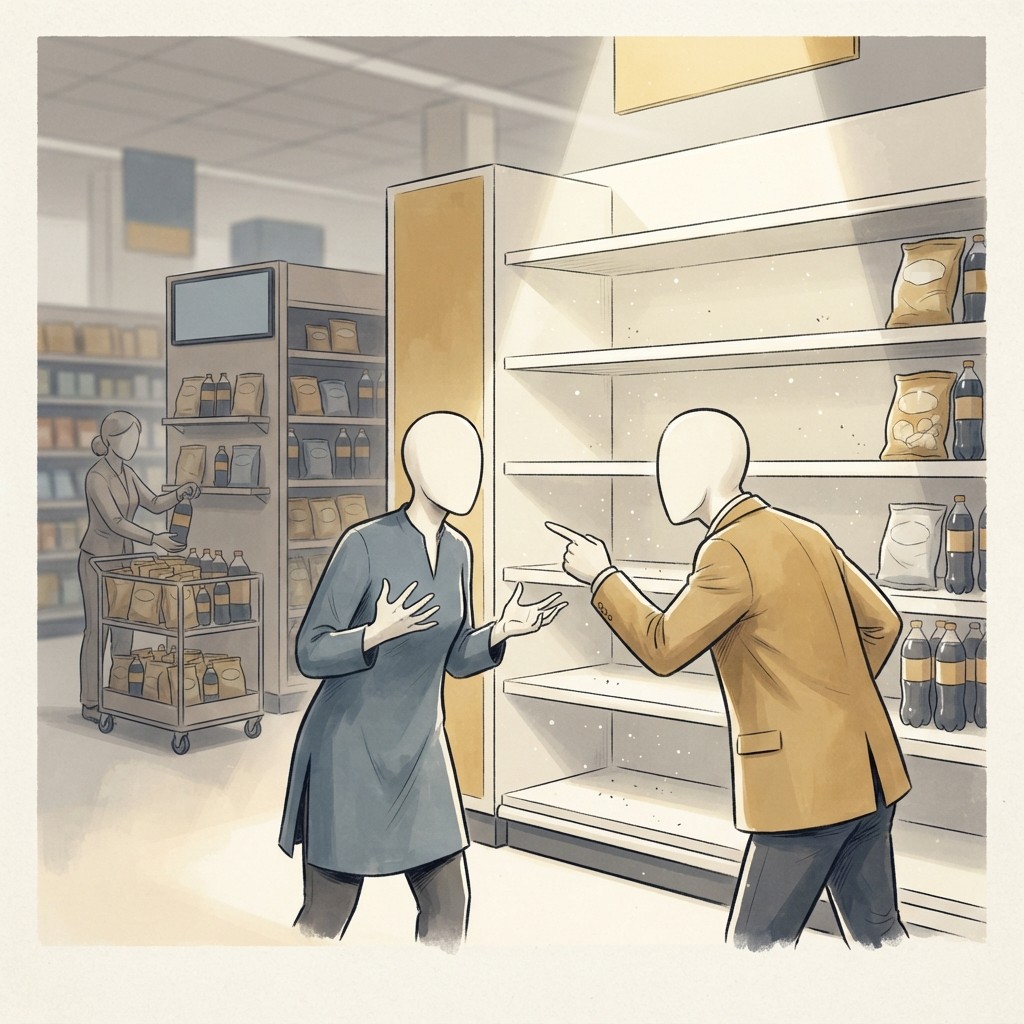
In the first days of January 2024, shoppers in France, Belgium, Italy, Spain, and Poland reached for a bag of Lay's, a bottle of 7Up, a box of Quaker - and found a hole on the shelf. Carrefour, Europe's largest food retailer, had stopped selling PepsiCo's brands across at least five countries, blaming 'unacceptable' price increases.1 The headlines wrote themselves: a giant retailer had stood up to a giant supplier on behalf of squeezed consumers. It was a clean, heroic story. It was also a story with two authors who could not agree on the first sentence.
The popular version: Carrefour pulled PepsiCo's products from its shelves to protect customers from price gouging. The contested record: two companies whose annual contract negotiation collapsed, each rushing to be the one who said it walked first. The shelf gap was real. Who created it - and who won - is the part nobody slowed down to check.
Who dumped whom is the whole fight
Carrefour's spokesperson was unambiguous: 'We, at the Carrefour Group, have taken this decision.'3 A retailer choosing to drop a marquee supplier reads as strength - it implies leverage, conviction, a willingness to absorb the lost sales of brands customers love. PepsiCo told a flatly contradictory story. It said Carrefour had 'mischaracterized the chain of events,' and that PepsiCo had already stopped supplying Carrefour at the end of 2023 because there was no new contract in place - before Carrefour could pull anything.2 Both cannot be true. And here is what makes the dispute strategically interesting: neither version is the obvious face-saving lie. A retailer wants to be seen choosing the breakup; a supplier wants to be seen refusing to sell at a loss. Each company picked the framing that flattered its own leverage, and the truth sits in a contract negotiation no one will publish.
“Regrettably, Carrefour has mischaracterized the chain of events.”2
Why Carrefour had been priming the story for months
The January shelf removal did not come from nowhere. In September 2023 - months earlier - Carrefour had plastered 'shrinkflation' stickers on at least 122 products from PepsiCo, Nestlé, and Unilever, warning shoppers that packages had quietly shrunk while prices held.4 The campaign was openly timed: it debuted on September 11, weeks before annual price negotiations were due to conclude by October 15.4 That is not consumer advocacy that happened to embarrass suppliers; it is negotiating leverage wearing the costume of consumer advocacy. By the time the shelves emptied in January, Carrefour had already trained the public to see PepsiCo as the villain. The shelf gap landed on ground that had been seeded. That is the real mechanism here - not a single dramatic act, but a months-long campaign to make the eventual breakdown look like a moral choice rather than a commercial one.
| September 2023 stickers | January 2024 removal | |
|---|---|---|
| What it was | Shrinkflation labels on 122 products | PepsiCo brands gone from shelves |
| Stated grievance | Shrinking packs, steady prices | 'Modest' price increases called 'unacceptable' |
| Real purpose | Leverage before the Oct 15 deadline | Endgame of a failed contract negotiation |
| Who it targeted | PepsiCo, Nestlé, Unilever | PepsiCo alone |
Notice what the trigger actually was. PepsiCo had signaled in October 2023 that it planned 'modest' price increases over the coming year - without naming markets or percentages.6 Carrefour deemed those increases 'unacceptable.'1 But the precise figure that was unacceptable has never been published. Not by Carrefour, not by PepsiCo, and not in PepsiCo's own SEC filings, which never quantify the dispute at all.8 The single number the entire fight supposedly turned on does not exist in the public record. A standoff sold as a stand on principle was conducted in figures nobody would disclose.
How PepsiCo refused to play the part written for it
Faced with a retailer narrating it as the greedy giant, PepsiCo's public response was almost aggressively boring: 'We've been in discussion with Carrefour for many months and we will continue to engage in good faith in order to try to ensure that our products are available.'5 No counter-attack, no consumer appeal, no shrinkflation defense. This is the discipline of a supplier that knows the math. Carrefour is one large customer; PepsiCo's brands are bought across every other retailer in those five countries. The company that owns the demand - the shopper who actively wants Doritos, not whatever the store substitutes - can afford to wait. PepsiCo's crisis response was to deny Carrefour the fight that would have validated the heroic-retailer frame, and to let the absence of Pepsi on Carrefour's shelves quietly irritate Carrefour's own customers. Silence was the strategy. The brand was the leverage.
When the resolution came, around late March or early April 2024, it covered France first - not all five countries at once. Talks for the other affected markets were still ongoing.7 PepsiCo France said it was 'pleased' and 'delighted' its products were returning.7 And the one detail that settles the whole episode: neither party disclosed the commercial terms.7 After a public war over a price, the price stayed secret. If Carrefour had won real concessions, the optics of the win would have been worth announcing. It announced nothing. The most likely reading is the dullest one - a face-saving compromise that let both sides return to the table and call it a victory.
When two negotiating parties go loud - stickers, shelf removals, dueling statements to the press - watch what they refuse to disclose. PepsiCo and Carrefour fought in headlines for three months over a price increase neither would ever specify, and resolved it on terms neither would reveal. That asymmetry is the tell: the public phase was a contest for the consumer's sympathy, fought to improve a private negotiating position. The lesson for any supplier facing a retailer's PR campaign is PepsiCo's: don't accept the role of villain by arguing the merits in public. Stay quiet, let demand for your brand do the pressuring, and negotiate the only number that matters where the cameras aren't.
The Carrefour standoff is remembered as a retailer pulling a supplier off its shelves to defend consumers. The documented record is a mutual contract breakdown, narrated twice, won on optics by the side with the louder PR and conceded on terms by neither. Carrefour got the headlines. PepsiCo got its brands back, in stages, at a price still locked in a drawer. The shelf was empty for a while. The story was never as clean as the gap looked - and the company that said the least about the price may have understood best that the price was never the point.
When the public story and the real one diverge
Crisis Response Playbook
A playbook for a crisis already in motion: who decides, which plays fire on which trigger, and what gets said to whom. It replaces panic and the all-hands meeting with a pre-agreed sequence each person can run alone. Blank to pre-load before a crisis hits; filled as the worked example reconstructing the plays the story's team ran — and the ones they should have.
Included, filled and blank, in the The Crisis Response Casebook. See the set → · Preview the blank →
Sources
Where this comes from — the filings, records, and reporting behind it.
- 1Carrefour removed PepsiCo products—including Pepsi, Lay's, Doritos, Cheetos, 7Up, Quaker, Lipton Tea, and Rockstar—from stores in France, Belgium, Italy, Spain, and Poland starting early January 2024, citing 'unacceptable' price increases.
- 2PepsiCo disputed Carrefour's framing, telling the Wall Street Journal: 'Regrettably, Carrefour has mischaracterized the chain of events.' PepsiCo said it had stopped supplying Carrefour at end-of-year 2023 due to a lack of a new contract agreement—asserting it, not Carrefour, initiated the split.
- 3Carrefour countered PepsiCo's claim, with its spokesperson telling the WSJ: 'We, at the Carrefour Group, have taken this decision.'
- 4In September 2023—months before the shelf removal—Carrefour launched a distinct 'shrinkflation' labeling campaign on at least 122 products from Nestlé, PepsiCo, and Unilever, debuting September 11, explicitly to gain leverage in upcoming annual price negotiations due to conclude by October 15.
- 5PepsiCo's official public response to the Carrefour shelf removal was: 'We've been in discussion with Carrefour for many months and we will continue to engage in good faith in order to try to ensure that our products are available.'
- 6PepsiCo signaled in October 2023 that it planned 'modest' price increases over the following year, without specifying affected markets or exact percentages; this was cited by Carrefour as the trigger for labeling its requested hikes 'unacceptable.'
- 7Carrefour and PepsiCo reached a deal for France in approximately late March/early April 2024—roughly three months after the standoff began—with negotiations for Belgium, Italy, Spain, and other affected markets still ongoing at that date. PepsiCo France stated: 'We are pleased to have reached an agreement and are delighted that our products are returning to Carrefour's shelves.' Neither party disclosed the commercial terms of the resolution.
- 8PepsiCo's FY2023 10-K (filed February 8, 2024, signed by CFO James T. Caulfield) and its Q4/FY2023 earnings release (February 9, 2024) do not specifically quantify revenue impact from the Carrefour dispute or disclose the pricing figures at issue; CEO Ramon Laguarta described 2023 as successfully navigating 'elevated levels of inflation, macroeconomic volatility, geopolitical tensions.'
More like this — beyond PepsiCo
New Strategically analyses as they publish: the defining moves in business, checked against the record. No noise, and one click to leave.