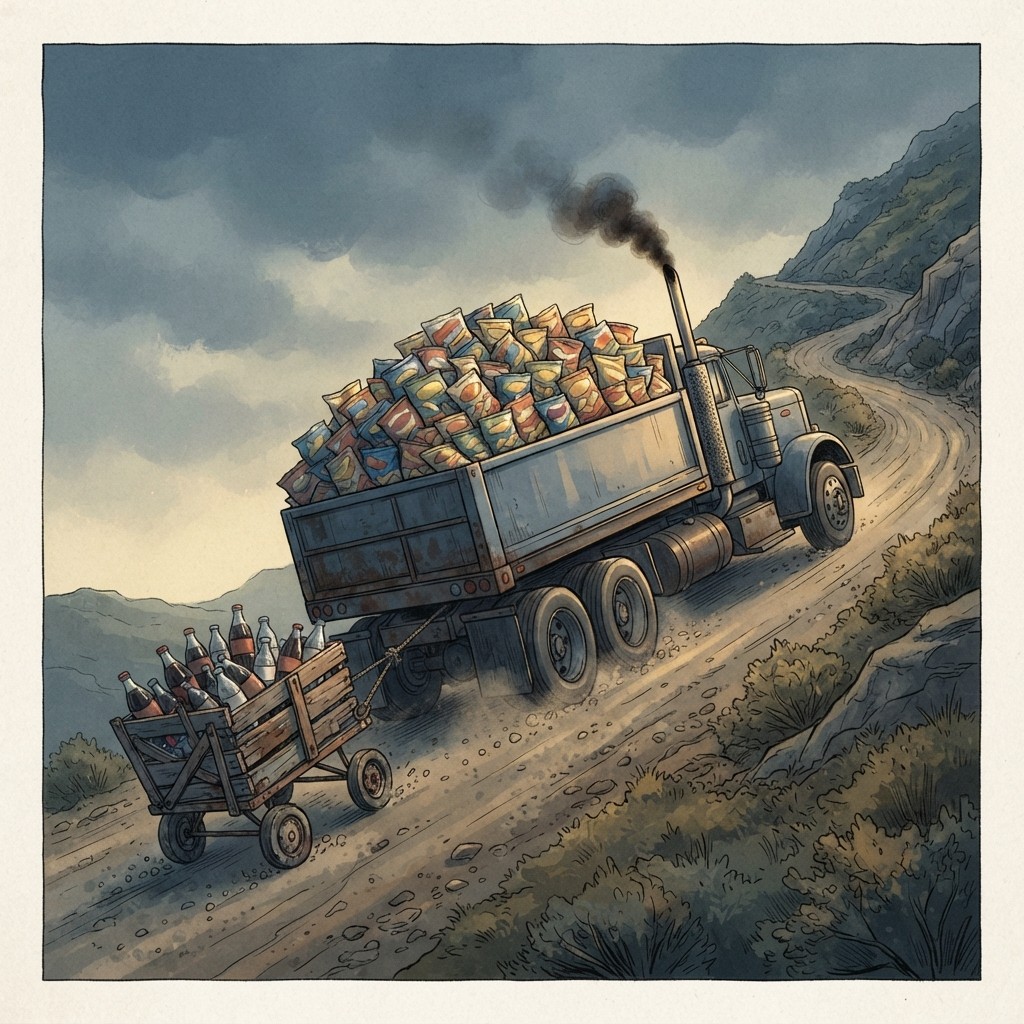
Pairs with the Cross-Subsidy Map — a ready-to-use strategy tool. Included in the The Cross-Subsidy Casebook →
A bag of Lay's costs almost nothing to make. Potatoes, oil, salt, air. PepsiCo turns that into one of the most profitable lines in consumer goods - Frito-Lay North America runs a segment operating margin of roughly 28 to 30 cents on every dollar of revenue.5 Now hold that against the can of Pepsi sitting next to it on the shelf. Same company, same trucks, same logo - and a meaningfully lower margin. The salty snack is doing something the soda cannot. For decades, it has been doing it quietly enough that almost nobody noticed who was actually paying the bills.
The official story is that PepsiCo is a beverage giant with a snacks arm - the name even leads with Pepsi. The real story runs the other way. PepsiCo is a snack company that happens to sell soda, and the snacks have been carrying the soda for years. In 2023, Frito-Lay North America generated 47% of all of PepsiCo's division operating profit - the single largest slice - while the beverages business produced 18% and Quaker just 3%.2 One segment, out of many, throwing off nearly half the profit. That is not a balanced portfolio. That is a cross-subsidy. (By 2024, PBNA's share had itself slipped to 15%3 — a point the rest of this piece returns to.)
Why a bag of chips out-earns a can of cola
The mechanism is structural, not lucky. Salty snacks are a near-monopoly aisle: Frito-Lay owns the shelf, the direct-store-delivery trucks, and the impulse buy, and that pricing power shows up directly in the numbers - in 2023 its operating profit rose 10%, driven by effective net pricing and productivity savings — even as higher commodity and operating costs partially offset those gains.4 Soda is a different physics entirely. It's heavier, cheaper per ounce, sold in fierce price competition against Coca-Cola, and weighed down by a beverage system that is expensive to run. So the two businesses sit under one roof but obey opposite economics: the chip is light, branded, and high-margin; the can is heavy, contested, and thin. PepsiCo's consolidated 13.1% operating margin in 20231 is not the average of two similar businesses - it's a blended figure propped up by one exceptional one. Strip Frito-Lay out and the company that remains looks ordinary.
| Frito-Lay North America | PepsiCo Beverages North America | |
|---|---|---|
| Share of division operating profit | 47% | 18% |
| Segment operating margin | ~28-30% | Roughly half of Frito-Lay's |
| What it sells | Branded impulse snacks | Contested commodity beverages |
| Role in the portfolio | Profit engine | Subsidized volume |
PepsiCo reported a 13.1% consolidated operating margin in 2023 on $91.5 billion of revenue.1 That number reads like a healthy, diversified food-and-drink conglomerate. It is really the arithmetic of one segment running near 30% margins5 dragging the average up over a beverage business running at a substantially lower margin — one that PepsiCo's CEO has flagged as a strategic improvement target.7 The cross-subsidy hides in the blend. The healthier the headline looks, the more it depends on the one part doing the heavy lifting.
The accident of 1965 that set the whole thing up
The arrangement wasn't designed as a subsidy - it was a marriage. Contrary to the common belief that PepsiCo simply bought Frito-Lay, the company was created in 1965 when shareholders of both Frito-Lay, Inc. and the Pepsi-Cola Company approved a merger on June 8 — a transaction in which each side's legacy shareholders received equity in the combined entity.6 Frito-Lay itself was already a combination, formed in 1961 from The Frito Company and H.W. Lay & Company.6 That origin matters, because it means the snack business never arrived as a bolt-on to be optimized away - it was half the foundation. The result was a company that, for sixty years, could run a price war in beverages while a structurally superior snack business quietly funded the fight. The soda kept the brand famous. The chips kept the brand profitable.
But isn't the soda business fixing itself - and the chips fine?
The fair objection is that this reads too tidily. The beverage business is not a permanent invalid: in October 2024 CEO Ramon Laguarta said PepsiCo has 'a good line of sight to mid-teens margins in a couple of years' for the North American drinks unit7 - meaning the subsidized side is being actively repaired, not left to bleed. That's true, and it's the optimistic read. The harder fact cuts the other way. The profit engine itself is losing power. Frito-Lay North America's share of division operating profit fell from 47% in 2023 to 43% in 2024 - even as total operating profit rose to $12,887 million.3 The engine didn't just slow; its share of the load shrank. A cross-subsidy is only stable while the subsidizer stays strong. When the strong side weakens at the same time you're spending to fix the weak one, the whole structure is under simultaneous pressure - which is precisely what the smart money noticed.
“...hurt by a lack of strategic clarity, decelerating growth and eroding profitability in its North American food and beverage businesses.”8
Elliott's $4 billion stake in September 2025 was, in effect, a bet that the cross-subsidy had quietly broken.8 The activist's diagnosis - eroding profitability across both North American businesses - is the same story told from the outside: the part that used to carry the company is no longer carrying it the way it did. PepsiCo's response confirmed the read. The company announced plans to cut nearly 20% of its SKUs and to actually lower prices on Lay's, Doritos, Tostitos and Cheetos8 - cutting price on the very products whose pricing power was the engine of the whole subsidy. When you have to discount your crown jewel to defend volume, the jewel is no longer doing what it used to.
When one segment quietly funds the rest, the company looks balanced and is anything but. The blended margin reads like resilience; it's actually concentration in disguise. Two warnings follow. First, watch the subsidizer's share over time, not just its absolute profit - Frito-Lay's profit rose while its share of the load fell, and the share is the tell. Second, the day you discount the high-margin product to protect volume is the day the subsidy ends, because the entire arrangement depended on that product keeping its pricing power. A profit engine that has to cut its own prices isn't an engine anymore. It's just another segment fighting for share.
For sixty years, PepsiCo enjoyed the rarest luxury in consumer goods: a famous business subsidized by a profitable one, hidden inside a single blended number that flattered both. The soda got the ads; the chips got the bill. That was never an accident of a single good year - it was the architecture. But architecture built on one load-bearing wall has one fatal property: it holds beautifully until that wall moves. Frito-Lay's share of the load slipped four points in a single year, an activist priced in the rest, and PepsiCo started discounting the very snacks that made the whole thing work. The cross-subsidy didn't fail because the soda was weak. It failed because the snack was finally asked to carry the whole company - and discovered it couldn't.
When one business quietly funds the rest
Cross-Subsidy Map
A map of the hidden plumbing inside a multi-line business: the cash-cow donor, the loss-making recipient it props up, and the strategic reason the subsidy exists. Use it to see who is really paying for what, and how exposed the whole structure is if the donor weakens. Blank to map your own portfolio's internal transfers; filled as the worked example of a business where one line secretly carries another.
Included, filled and blank, in the The Cross-Subsidy Casebook. See the set → · Preview the blank →
Sources
Where this comes from — the filings, records, and reporting behind it.
- 1PepsiCo FY2023 consolidated net revenue was $91,471M and consolidated operating profit was $11,986M, representing a 13.1% operating margin.
- 2On a reported basis, Frito-Lay North America accounted for 47% of PepsiCo's division operating profit in 2023 — the single largest segment share — versus 18% for PepsiCo Beverages North America and 3% for Quaker Foods North America.
- 3In 2024, Frito-Lay North America's share of PepsiCo's division operating profit declined to 43% (from 47% in 2023), while total reported operating profit rose to $12,887M. PepsiCo Beverages North America's share fell to 15%.
- 4For full-year 2023, Frito-Lay North America's operating profit rose 10%, driven by effective net pricing and productivity savings, though results were also impacted by increased operating costs and higher commodity costs.
- 5Frito-Lay North America does not file standalone earnings; its profitability is disclosed only at the segment operating profit level within PepsiCo's SEC filings. Its segment operating profit margin has been approximately 28–30% of net revenue.
- 6PepsiCo was formed on June 8, 1965, when shareholders of both Frito-Lay, Inc. and Pepsi-Cola Company approved their merger. Frito-Lay itself had been created in 1961 by the merger of The Frito Company and H.W. Lay & Company.
- 7PepsiCo CEO Ramon Laguarta stated in October 2024 that the company has 'a good line of sight to mid-teens margins in a couple of years' for PepsiCo Beverages North America, confirming PBNA margins are a strategic target being actively improved — not a static chronic loss.
- 8Elliott Investment Management took a $4 billion stake in PepsiCo in September 2025 and, in a letter to PepsiCo's board, stated the company is being 'hurt by a lack of strategic clarity, decelerating growth and eroding profitability in its North American food and beverage businesses.' PepsiCo subsequently announced plans to cut ~20% of SKUs, reduce snack prices on Lay's, Doritos, Tostitos and Cheetos, and target record productivity savings.
More like this — beyond PepsiCo
New Strategically analyses as they publish: the defining moves in business, checked against the record. No noise, and one click to leave.