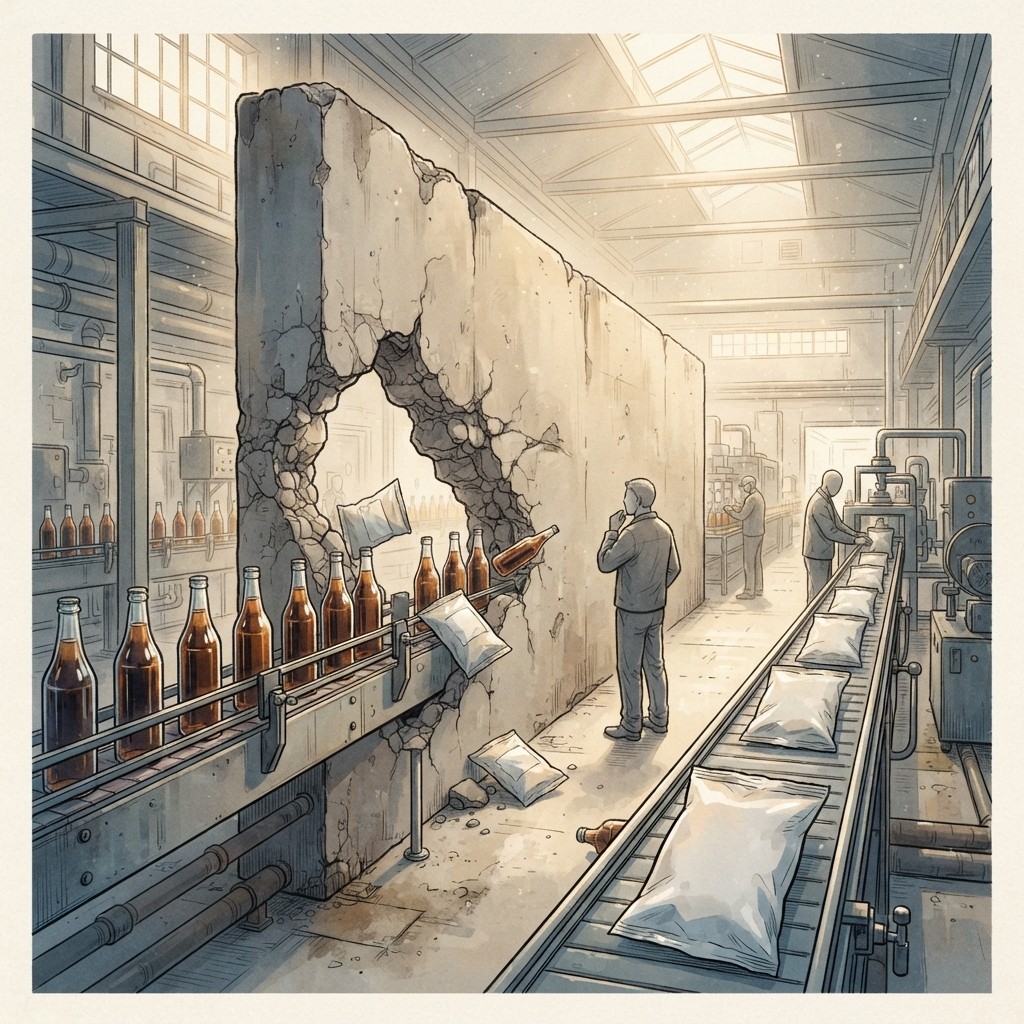
Pairs with the Cross-Subsidy Map — a ready-to-use strategy tool. Included in the Cross-Subsidy Casebook →
“Which unit pays for the others, and has anybody ever approved it?”
Put $100 into the newly merged PepsiCo at the end of 1965 and leave it alone. By the end of 2014, with dividends reinvested, that $100 was worth nearly $43,000.2 It is the kind of number that makes a story write itself: a beverage company saw the future, bought a bag of chips, and built an empire on the brilliant insight that salty snacks and sugary drinks belong on the same truck. The number is real. The story behind it is mostly fiction.
The official telling is that PepsiCo out-thought Coca-Cola by diversifying into snacks, executing a planned synergy Coke was too proud to copy. A visionary 1965 acquisition of Frito-Lay, engineered to make potato chips sell soda and soda sell chips. What actually happened is that a vulnerable company made a defensive deal, watched regulators ban the very synergy it was named for, wandered into a fast-food detour that nearly drowned the whole logic, and only stumbled into its real machine thirty-two years later — by selling off the mistake.
The merger that was half a hostage negotiation
Start with the deal itself, which is misremembered down to the calendar. In February 1965 the boards of Frito-Lay, Inc. and Pepsi-Cola announced a merger; shareholders of both companies approved it on June 8, 1965, and PepsiCo, Inc. was born.1 Not an acquisition — a merger of equals, with Frito-Lay's Herman Lay becoming chairman of the new entity.9 And the reason a soft-drink company in 1965 was so eager to fuse itself to a chip-maker had as much to do with fear as with foresight. Pepsi-Cola ran a distant second to Coca-Cola, and worse, almost none of its stock sat in management's hands — which made it a sitting target for a takeover.4 The Frito-Lay merger put a large, motivated insider on the cap table: after the deal, Herman Lay alone held 2.5% of the combined company.4 Synergy was the press release. Self-defense was the subtext.
“In 1965, we broke new ground by bringing a handful of iconic brands together in the merger of the Pepsi-Cola Company and Frito-Lay, Inc.”2
The synergy was banned before it ever ran
Here is the detail the brilliant-strategy version always skips. The whole point of putting chips and cola under one roof was the cross-sell: salty snacks make you thirsty, thirst sells soda, soda makes you reach for more chips. A self-licking flywheel. Except that in late 1968 — three years in — the FTC ruled that PepsiCo could not run tie-in advertising between Frito-Lay and Pepsi-Cola products across most of its advertising, and it barred PepsiCo from buying any snack or soft-drink company for ten years.3 The synergy the merger was supposedly built to capture was, almost immediately, crippled. PepsiCo spent its first decade owning both halves of a flywheel it was legally barred from advertising together — and forbidden from expanding through further snack or soft-drink acquisitions.3
So if the famous synergy was prohibited, what made the combination pay off anyway? Not advertising tricks — plumbing. Frito-Lay's enduring asset was never the cross-sell line; it was the route. The company runs 30-plus manufacturing facilities and more than 200 distribution centers across the U.S. and Canada, and operates the largest Direct Store Delivery network in North America.8 Its drivers don't drop pallets at a warehouse and leave; they stock the shelf themselves, store by store, several times a week. That physical moat — the ability to get a fresh bag of chips onto the right hook before the competition can — is what compounded for half a century. It just had nothing to do with the reason the merger was sold.
The detour that almost ate the logic
If PepsiCo had a coherent diversification thesis, it certainly didn't act like one in the years that followed. Freed from the FTC's acquisition freeze, it didn't double down on the snack engine — it bought restaurants. Pizza Hut in 1977, Taco Bell in 1978, KFC in 1986.6 On paper it looked like vertical integration: own the chains, pour your own soda. In practice it was a margin sinkhole. By the mid-1990s the restaurant businesses simply weren't producing the return on assets that beverages and snacks were, and the conglomerate was carrying three labor-heavy, real-estate-heavy chains that diluted the very returns the snack business was generating.6 The cross-subsidy story everyone tells couldn't be true yet — because for two decades, the snacks were quietly subsidizing the wrong thing.
The machine everyone admires didn't switch on until PepsiCo admitted the detour was a mistake. On October 6, 1997, it spun KFC, Pizza Hut, and Taco Bell off into Tricon Global Restaurants — later renamed Yum! Brands — keeping nothing but a supply contract to keep pouring Pepsi.7 Shedding the low-return chains is what finally let the high-margin snack business carry the corporation instead of propping up dead weight. The cross-subsidy was real all along; PepsiCo just spent thirty-two years pointing it at the wrong recipient.
| The visionary-strategy version | What the record shows | |
|---|---|---|
| The 1965 deal | A bold acquisition for snack-soda synergy | A merger of equals, partly a takeover defense |
| The famous synergy | Chips sell soda, soda sells chips | Banned by the FTC in 1968 for ten years |
| The real moat | Clever cross-promotion | Direct Store Delivery — the largest in North America |
| The 1977-1996 strategy | Smart vertical integration | A restaurant detour that diluted returns |
| When it cohered | By design, from day one | Only after the 1997 restaurant spin-off |
And the accidental machine, once aimed correctly, is staggering. In fiscal 2024, Frito-Lay North America threw off 43% of PepsiCo's total division operating profit — while PepsiCo Beverages North America, the soda business the company is named for, contributed just 15%.5 That is the cross-subsidy made plain: the chips earn the money, and the money funds the fight against Coca-Cola in the soda aisle PepsiCo will probably never win on its own. The mislabeled detail to retire here is the popular claim that Frito-Lay is some 60% of revenue. It isn't — food is 58% of net revenue across all segments.5 The snack story isn't a top-line story at all. It's a profit-pool story, and that distinction is the whole point.
PepsiCo gets credit for foresight it didn't have. The 1965 merger was half a takeover defense; the named synergy was outlawed within three years; the real engine — distribution logistics, not cross-promotion — was a quiet asset nobody put in the press release; and the structure only cohered after a painful 1997 divestiture of the wrong bet. The lesson for operators isn't 'diversify into adjacent profit pools.' It's that a durable advantage often hides inside a deal made for unrelated reasons, and your job is to notice which asset is actually compounding — then have the nerve to sell everything that isn't. PepsiCo's genius was not the merger. It was finally, three decades late, getting out of its own way.
So did Pepsi out-diversify Coke? Yes — but not the way the legend claims. It didn't out-plan Coca-Cola; it out-survived its own mistakes, and got rewarded for the one asset it never advertised. The honest objection is that intentions don't matter if the outcome is a 43%-of-profit snack empire and a near-43,000% return. Fair. But the difference between luck and strategy is whether you can repeat it, and a story that credits a banned synergy and skips the rescue divestiture teaches you to copy exactly the wrong move. The lasting truth is colder and more useful than the myth: PepsiCo didn't win the snack war because it saw the future. It won because, when the future finally showed up, it stopped fighting it. The toll road was always the truck route — not the tie-in ad.
When the real business isn't the one on the label
Cross-Subsidy Map
A map of the hidden plumbing inside a multi-line business: the cash-cow donor, the loss-making recipient it props up, and the strategic reason the subsidy exists. Use it to see who is really paying for what, and how exposed the whole structure is if the donor weakens. Blank to map your own portfolio's internal transfers; filled as the worked example of a business where one line secretly carries another.
Included, filled and blank, in the Cross-Subsidy Casebook. See the set → · Preview the blank →
Sources
Where this comes from — the filings, records, and reporting behind it.
- 1In February 1965, the boards of directors for Frito-Lay, Inc. and Pepsi-Cola announced a merger plan; on June 8, 1965, shareholders of both companies approved the merger and PepsiCo, Inc. was formed.
- 2PepsiCo's 2015 DEF 14A proxy filing states: 'In 1965, we broke new ground by bringing a handful of iconic brands together in the merger of the Pepsi-Cola Company and Frito-Lay, Inc.' and notes $100 invested at end of 1965 was worth nearly $43,000 at end of 2014 with dividends reinvested.
- 3The FTC ruled in late 1968 that PepsiCo could not create tie-ins between Frito-Lay and Pepsi-Cola products in most of its advertising, and PepsiCo was barred from acquiring any snack or soft drink maker for a period of ten years.
- 4Pepsi-Cola was considered a takeover target not only because it ran a distant second in soft drinks to Coca-Cola, but also because little of the company's stock was in the hands of management; following the PepsiCo merger, Herman Lay held a 2.5% stake.
- 5PepsiCo's 2024 Annual Report (10-K) shows Frito-Lay North America generated 43% of the company's total division operating profit in 2024, while PepsiCo Beverages North America generated only 15%. Food represented 58% of total net revenue mix.
- 6PepsiCo had purchased Pizza Hut in 1977, Taco Bell in 1978, and KFC in 1986. In 1997, PepsiCo's restaurant businesses were not producing the return on assets seen in beverages and snacks, and PepsiCo decided to exit the restaurant business entirely.
- 7On October 6, 1997, PepsiCo spun off KFC, Pizza Hut, and Taco Bell into Tricon Global Restaurants, Inc. (later renamed Yum! Brands in 2002). PepsiCo divested completely; the companies maintain only a beverage supply contract but no equity ties.
- 8PepsiCo's official Frito-Lay North America Fact Sheet confirms: 'In 1965, Frito-Lay, Inc. merged with Pepsi-Cola to form PepsiCo,' and that Frito-Lay operates 30+ manufacturing facilities and more than 200 distribution centers in the U.S. and Canada, with the largest Direct Store Delivery system in North America.
- 9Herman Lay was named chairman of PepsiCo upon the 1965 merger, a position he held until 1971.
Weighing outside help with a decision like this? Hiring a pricing strategy consultant
More from Stratrix
Strategy Decision Cases
879 strategic decisions with dated outcomes, ranked by how often each kind holds.
24 decision typesSee which decisions hold →The Strategist’s Craft
The methods behind the job: the planning cycle, initiative charters, decision rights, the memo that gets a yes.
Methods and templatesStart with the craft →Test a decision, free
Set a live decision against the companies that made it before you.
AcquisitionsThe Distance TestDivestituresThe Divestiture TestDiversificationThe Diversification TestMake or buyThe Make-or-Buy TestNew analyses, by email
The defining moves in business, checked against the record, as they publish.
More like this — beyond PepsiCo
New Strategically analyses as they publish: the defining moves in business, checked against the record. No noise, and one click to leave.