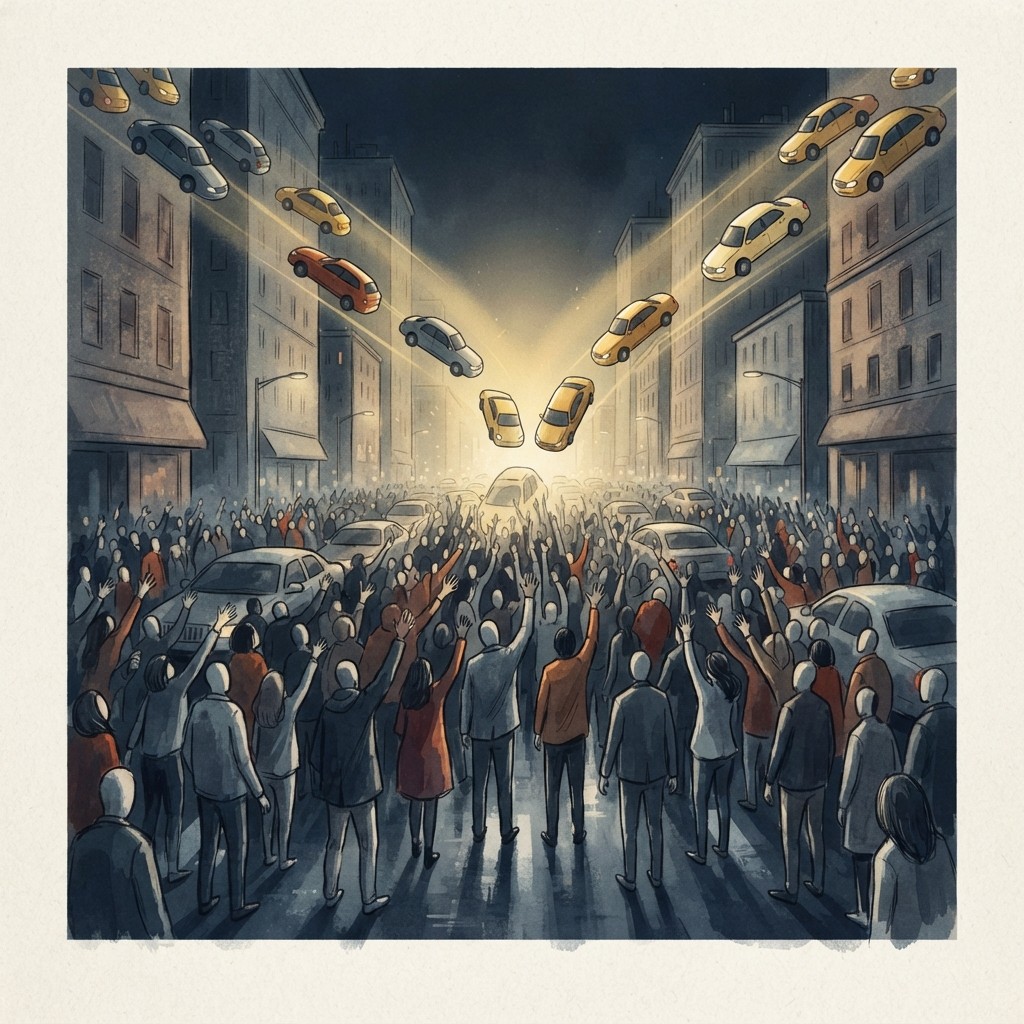
For twenty-six minutes one New Year's Eve, riders got exactly what they always wanted: the surge switched off. Then the service stopped working.
Pairs with the Pricing Power Diagnostic — a ready-to-use strategy tool, filled for Uber. Included in the The Pricing Lens Casebook →
Just after 1:24 in the morning on New Year's Eve, the most hated number in Uber's app quietly vanished. A glitch knocked out surge pricing across New York City, and for twenty-six minutes the fare multiplier that had been sitting near 2.7x dropped to 1.0x - ordinary price, on the busiest night of the year.3 For a moment it was every rider's fantasy: no surge, just a tap and a car. Then the floor fell out. Requests roughly doubled, wait times roughly doubled, and the share of people who actually got a ride collapsed to under 25 percent.3 Three out of four taps led nowhere. The price everyone wanted gone, gone - and the service stopped working.
The story everyone tells about surge pricing is that Uber waits until you're cold, late, or scared, and then charges you triple because it can. That is exactly how it feels. It is also, mechanically, the opposite of what is happening. Surge is not Uber reaching into a desperate moment to take more. It is the price doing the one thing a fixed fare cannot do at 2 a.m. on December 31st: clear the market.
What the high number is actually for: the figure on your screen is doing two jobs at once — one aimed at you, one aimed at every driver still on the couch
Hold a price still and you make a promise you can't keep. When far more people want a car than there are cars, something has to give, and at a fixed fare the thing that gives is availability - the queue lengthens until most requests simply fail. A moving price gives instead. Uber's own description is unromantic: surge kicks in 'when there are more riders in a given area than available drivers,' it 'encourages more drivers to serve the busy area,' and meanwhile 'rider demand decreases as some riders wait.'1 That is the whole machine. The number on your screen is doing two jobs in the same instant - one pointed at riders, one pointed at drivers.
Pointed at you, the rider, it asks a quiet question: do you need this car in the next four minutes, or can you wait twenty? Most nights, plenty of people can wait, and they do - which is the price rationing a scarce thing toward whoever needs it most right now. Pointed at the thousands of drivers who are home on the couch or finishing another fare across town, the same number is a flare: there is money over here, come now. That is the part the 'gouging' story leaves out entirely. A static markup just takes more from a fixed supply. Surge changes the supply. The higher fare is not the cost of the shortage; it is the cure being summoned in real time.
“Surge pricing has two effects: people who can wait for a ride often decide to wait until the price falls; and drivers who are nearby go to that neighborhood to get the higher fares.”2
The night the price worked exactly as designed: a sold-out arena let out and you could watch the mechanism summon cars in real time
If surge really summons supply, you should be able to watch it happen. In March 2015 you could. A sold-out Ariana Grande concert let out of Madison Square Garden into a wall of demand, and surge climbed to somewhere between 1.3x and 1.8x.4 Here is the tell: as the show ended, app openings jumped about fourfold, but actual ride requests rose only slightly - the price was already sorting the crowd, sending the patient ones to the subway and the willing ones to a car. At the same time, available cars nearly doubled as drivers converged on the arena. The result was the thing the angry version of the story insists is impossible: with prices up, the completion rate held near 100 percent and the average wait stayed around 2.6 minutes.4 Everyone willing to pay the surge got a ride, fast, on a night that would have been a guaranteed stranding at a flat fare.
| Surge OFF (NYE outage, ~1.0x) | Surge ON (MSG concert, ~1.3-1.8x) | |
|---|---|---|
| Drivers drawn to the demand | No new signal; supply stays put | Available cars roughly double |
| Riders who can wait | All pile in at once | Many self-select out or wait |
| Requests vs. app-opens | Requests roughly double | App-opens ~4x, requests rise only slightly |
| Trip-completion rate | Falls to under 25% | Holds near 100% |
| Who is served | Mostly no one - the queue collapses | Everyone willing to pay, in ~2.6 min |
Notice what this reframes. The complaint 'Uber is so expensive right now' is, almost always, information - it is the app telling you that demand has outrun supply at this spot this minute, and inviting both sides to react. Take the number away and you don't get cheap rides; you get the NYE outage, where the fare was honest and the service was broken. The price is high because the car is scarce. Removing the signal doesn't make cars appear. It just hides the scarcity until you're the one standing on the curb.
Why it still feels like a betrayal - and where the critics are right: a coordination signal becomes a moral statement the moment it's pointed at someone's fear
So why does a market-clearing mechanism feel like extortion? Because people don't experience a price as a coordination signal; they experience it as a moral statement about the moment. A hotel charging more on a holiday is abstract. A car charging triple when you are cold, late, or frightened feels personal - as if the seller has read your desperation and set a number to it. That reaction isn't stupidity to be educated away. It is the honest objection, and on its strongest ground it is correct. There is a real category - genuine emergencies - where 'whatever the market will bear' stops being neutral and starts looking like profiting from fear. The mechanism that rations a Friday-night bar rush is the same mechanism that, pointed at a disaster, prices a frightened person's escape.
Uber learned the difference the hard way, in public. When a gunman took hostages in a Lindt cafe in Sydney's central business district in December 2014, the algorithm did what algorithms do: it saw a spike in demand around the CBD and pushed fares up to four times normal, with the minimum fare hitting A$100. Then it made the failure worse by narrating it. Uber's own account tweeted, into a live hostage crisis, that 'Fares have increased to encourage more drivers to come online & pick up passengers in the area.'6 Mechanically true. Morally tone-deaf. The internet reacted exactly as you'd expect, and Uber reversed: free rides out of the CBD, refunds to everyone who'd paid the surge, and an apology that conceded the real error wasn't the algorithm but the failure to override it - 'We didn't stop surge pricing immediately. This was the wrong decision.'7
And here is the part that matters strategically: Uber didn't win the emergency argument - it conceded it, before Sydney even happened. After Hurricane Sandy turned a seven-mile ride into a $219 fare, New York's attorney general invoked a price-gouging statute written in the winter of 1978-79, and in July 2014 Uber agreed to cap surge during declared 'abnormal disruptions of the market' - emergencies and disasters - at the normal range of its prior-60-day prices, minus the three highest days.89 That carve-out is the tell. It marks the exact seam where a coordination tool turns into a moral hazard, and Uber chose to bind itself there. The market-clearing logic is genuinely powerful on a Saturday night. In a hurricane, it is also genuinely indefensible - and Uber agreed to switch it off.
The surge number is information disguised as an affront. It is telling you, precisely, that at this spot and this minute the cars are scarcer than the people who want them - and it's paying drivers to fix that while asking flexible riders to step aside. Hate it if you like, but understand what hating it implies: you are wishing away the very mechanism that puts a car at the curb instead of a 75%-empty promise. The same mechanism has a real limit, though. A clearing price assumes a buyer who can walk away; in a genuine emergency, that assumption breaks, and 'whatever the market will bear' curdles into gouging. The strategic move Uber eventually made - cap it in declared disasters, let it run the rest of the time - isn't a retreat from the logic. It's knowing exactly where the logic stops being true.
Isn't this just a clever story to sell expensive rides?: the most damning evidence came from a glitch Uber never planned and couldn't spin
The fair objection is that Uber published the case study, so of course the case study flatters Uber. True - and worth holding at arm's length. But the awkward fact for the cynical read is that the most persuasive evidence came from a glitch Uber didn't plan and couldn't spin: for twenty-six minutes the company accidentally ran the rider's preferred experiment - surge off, on the busiest night of the year - and the service broke.3 You can't fake a system failing. And the independent work points the same way: economists using nearly 50 million UberX trips and the natural breakpoints in Uber's own surge thresholds estimated the service produced roughly $6.8 billion in U.S. consumer surplus in 2015 - about $1.60 of value to riders for every dollar they paid.10 That is not the footprint of a pure extraction machine. It is the footprint of a market that mostly clears - with a sharp, real exception in emergencies that Uber was forced, correctly, to wall off.
The deepest thing about surge pricing is that the reason people hate it is the mirror image of the reason it works. It works because it refuses to pretend the cars are infinite - it tells the truth about scarcity and pays to relieve it. It is hated because nobody wants the truth about scarcity delivered at the exact moment they're feeling it. Travis Kalanick spent years insisting the discomfort was just unfamiliarity - that we accept it from airlines and hotels and would learn to accept it from a car.5 He was half right. We did learn to read the number. What he kept underestimating was the other half: that a price which is merely efficient can still feel like a verdict - and that in the moments people remember most, being clearing-accurate and being decent are not the same thing. Surge isn't greed. It's honesty about scarcity, priced by the second - and its genius and its curse are the very same trait.
More on the price as a strategic instrument
Pricing Power Diagnostic
A scored diagnostic of pricing power: brand pull, switching costs, substitutes, and how critical the product is to the buyer. Each dimension rated 1-5 so you can see, at a glance, whether a price rise sticks or sends customers running. Blank to grade your own offer; filled as the worked example scoring a story's business on its real ability to charge more.
Included, filled and blank, in the The Pricing Lens Casebook. See the set → · Preview the blank →
Sources
Where this comes from — the filings, records, and reporting behind it.
- 1Uber's own description of surge: it 'automatically goes into effect when there are more riders in a given area than available drivers,' which 'encourages more drivers to serve the busy area over time,' while 'rider demand decreases as some riders wait for more drivers to become available, and the marketplace rebalances.' Without it, 'when demand for rides exceeds the number of available drivers, riders would wait longer (or might not be able to get a ride at all).'
- 2Uber's engineering analysis of the New Year's Eve 2014-15 case study states: 'Surge pricing has two effects: people who can wait for a ride often decide to wait until the price falls; and drivers who are nearby go to that neighborhood to get the higher fares,' framed around the goal that 'you can push a button and get a ride within minutes - even on the busiest nights of the year.'
- 3In Uber's case study by Jonathan Hall, Cory Kendrick and Chris Nosko (University of Chicago Booth), a technical glitch knocked out surge pricing in New York City for 26 minutes around 1:24-1:50 a.m. on New Year's Eve into Jan 1, 2015. The fare multiplier, ~2.7x normal before and after, fell to 1.0x during the outage; ride requests roughly doubled, wait times roughly doubled, and the trip-completion rate fell to under 25 percent (about three-quarters of requests went unfulfilled).
- 4In the same case study, a sold-out Ariana Grande concert at Madison Square Garden (March 2015) drew surge multipliers of roughly 1.3 to 1.8x. As the show let out, app openings jumped about fourfold but actual ride requests rose only slightly, available cars nearly doubled as drivers moved toward the venue, and the request-completion rate stayed near 100 percent without drastically affecting wait times (about 2.6 minutes on average).
- 5Travis Kalanick, defending surge in a January 8, 2014 Wall Street Journal interview: 'If you're going and buying a hotel room, you know that prices can change... if you buy a flight on the day before Christmas, it's probably 10 times more expensive than two weeks after Christmas. You're OK with that and you understand it. But in ground transportation, there's been fixed pricing for 100 years. Because of that, there's an education process.'
- 6During the December 15, 2014 Lindt cafe hostage siege in Sydney's CBD, Uber's automatic surge pushed fares up to four times the standard rate, with the minimum fare reaching A$100. Uber's official Twitter account initially posted: 'We are all concerned with events in CBD. Fares have increased to encourage more drivers to come online & pick up passengers in the area,' which drew widespread outrage.
- 7After the backlash, Uber made rides out of central Sydney free and refunded passengers who had paid surged fares, and apologized: 'The events of last week in Sydney were upsetting for the whole community and we are truly sorry for any concern that our process may have added. We didn't stop surge pricing immediately. This was the wrong decision.'
- 8On July 8, 2014, New York Attorney General Eric Schneiderman announced an agreement with Uber to cap prices during 'abnormal disruptions of the market' - emergencies and natural disasters - consistent with New York's price-gouging statute (General Business Law section 396-r, enacted in the winter of 1978-79). The cap limits prices to the normal range charged in the preceding 60 days, excluding the three highest-priced days. Schneiderman: 'This agreement represents the thoughtful application of long-established law to new technology.' Kalanick: 'Our collaborative solution with Attorney General Schneiderman is a model for technology companies and regulators.'
- 9The price-gouging concern predated Sydney: during Hurricane Sandy in 2012, Uber's surge pricing produced fares such as $219 for a roughly seven-mile New York ride, and the policy drew criticism again during a 2013 winter storm, prompting the Attorney General's review.
- 10An NBER working paper using nearly 50 million UberX transactions and a regression-discontinuity design around Uber's surge-pricing thresholds estimated that UberX generated about $6.8 billion in consumer surplus in the United States in 2015 - roughly $1.60 of consumer surplus per dollar spent.
More like this — beyond Uber
New Strategically analyses as they publish: the defining moves in business, checked against the record. No noise, and one click to leave.