Pairs with the Moat Anatomy Canvas — a ready-to-use strategy tool. Included in the The Moat Casebook →
Two people inside Coca-Cola are said to know the complete formula. They are not allowed to fly on the same plane.4 It is a wonderful story, and the company has been telling versions of it since the 1890s, when Asa Candler first locked the recipe away.4 The implication is obvious: this liquid is the crown jewel, the one thing a rival could never get. But run the thought experiment all the way down. Suppose tomorrow you had the exact recipe - every drop, every order of operations. Could you build Coca-Cola? You could not. And the reason why is the most misunderstood thing about the most famous company on earth.
The official story is that the secret formula is the moat. It is the opposite of true. The formula is the part of Coca-Cola that is least protected, and least valuable on its own; the company itself never even patented it. The real wall is somewhere almost nobody looks.
“The 'secret formula' policy is more of a marketing strategy than an actual trade secret.”4
Why the recipe was never the thing worth guarding
Start with what the formula legally is. It is not a patent - and that was a choice. A patent demands public disclosure and expires, usually after about two decades; a trade secret can live forever as long as it stays quiet. Coca-Cola picked perpetual silence over temporary monopoly, which tells you it was always thinking about a century, not a quarter. But here is the part the legend skips: even perfect possession of the recipe buys a competitor nothing. They could not legally source the processed coca leaf that the genuine article uses, and - the decisive point - they could not sell the result as Coca-Cola.4 Call your identical cola whatever you like; the one word that moves it off the shelf is the word you can't use. The molecule is copyable. The meaning isn't. The vault and the no-shared-flight rule are a magnificent piece of theater, and theater is exactly what they were built to be.
The thing a company tells you protects it is often the thing it's happy for you to study - because the study leads nowhere. The secret formula is a decoy moat: dramatic, quotable, and irrelevant to whether you could actually compete. Coca-Cola is delighted for a hundred years of business writing to obsess over the recipe, because every hour spent there is an hour not spent on the contract architecture and the century-old distribution network that are the real, and far less photogenic, walls.
Where the real wall is: the contract and the century of bottlers
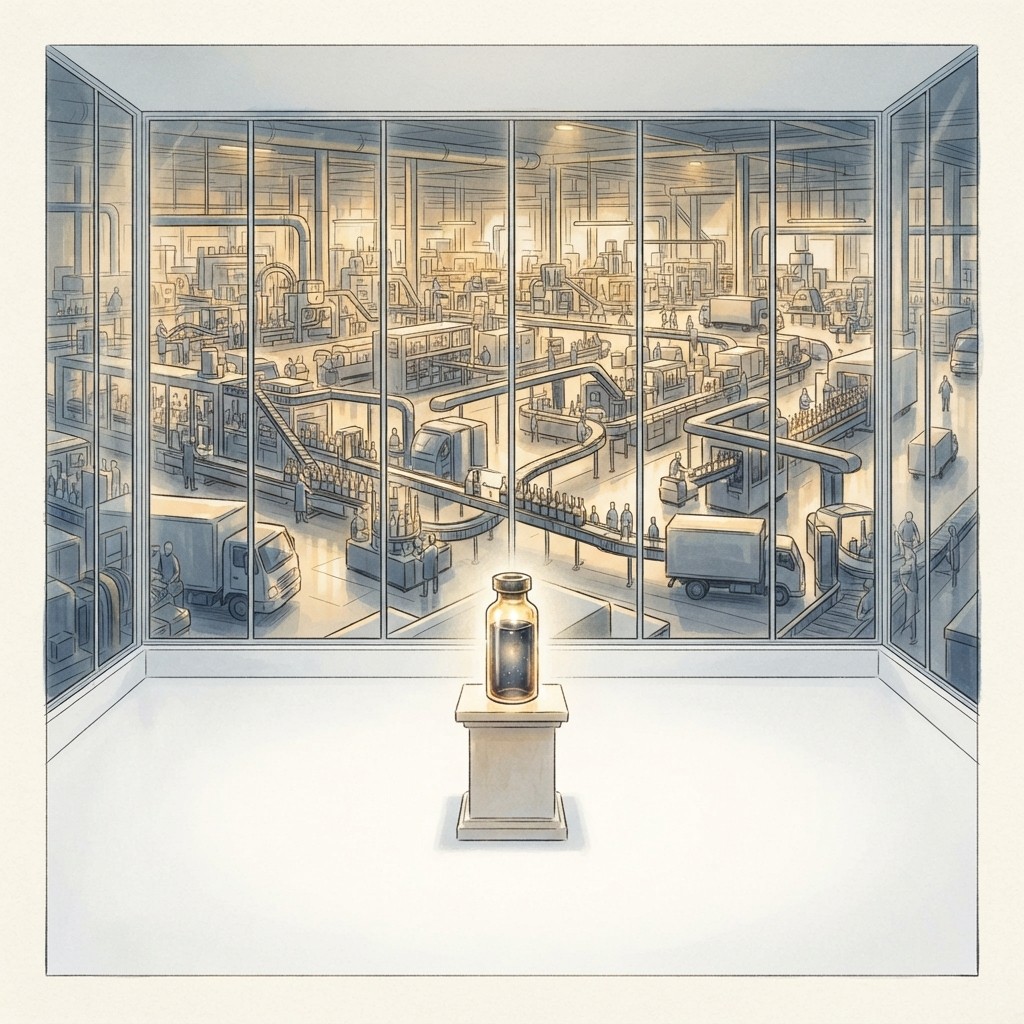
Coca-Cola does not, for the most part, make or move Coca-Cola. It sells concentrate to roughly 225 independent bottling partners spread across more than 950 production facilities, a network that employs over 700,000 people worldwide.5 Those partners pour the capital, run the lines, drive the trucks, and stock the coolers. The company keeps two things: the intellectual property and the concentrate. That division of labor is the engine. The bottlers carry the heavy, low-margin physical world; Coca-Cola sits upstream selling a high-margin syrup into a system it spent more than a hundred years assembling. You cannot order that network online. You cannot raise it in a funding round. It is the accumulation of a century of relationships, territory agreements, and installed infrastructure - and a century is the one input no amount of money compresses.
| The myth: the secret formula | The moat: the franchise system | |
|---|---|---|
| Legal nature | Unpatented trade secret | Trademarks, contracts, installed network |
| Could a rival copy it? | Yes - the recipe is reproducible | No - a century can't be re-run |
| Who bears the capital cost | Trivial | ~225 bottlers, 950+ plants[[cite:s5]] |
| What it actually protects | Almost nothing | The pricing power and the shelf |
Now read the contract that holds it together. Under the bottler agreements, each partner is obligated to buy its entire requirement of concentrate for the trademarked beverages from Coca-Cola - and there is no contractual ceiling on the price the company can charge for it.6 On paper, that is a toll road with no posted limit: every bottle the system makes must first pass through a syrup the company prices at its own discretion. Hold that thought, though, because the popular telling stops there and the truth has a second clause.
Because the company sells syrup rather than soda, the brutal, capital-heavy economics of glass, aluminum, refrigeration, and logistics live on the bottlers' books, not Coca-Cola's. The result shows up in the numbers: on FY2023 net operating revenues of $45,754 million, the company booked gross profit of $27,234 million1 and converted operations into $11.6 billion of operating cash flow and $9.7 billion of free cash flow.2 That is what an upstream toll on someone else's factory looks like.
The third wall is rented, and the rent is about $5 billion a year
The contract and the network explain the supply side. They don't explain why anyone reaches for the red can in the first place. That is the brand - and the brand is not a possession so much as a lease that must be paid every single year. In 2023, Coca-Cola spent roughly $5 billion on advertising and marketing, up from about $4.3 billion the year before.8 That is not growth spending. It is maintenance: the annual cost of keeping a meaning intact, of reminding billions of people of something they already know. On the balance sheet, the trademarks with indefinite lives carry a value of $14,349 million, with goodwill of $18,358 million stacked behind them.1 The brand sits on the books as an asset because it behaves like one - and like any asset of that kind, it depreciates the moment you stop reinforcing it. The $5 billion is the depreciation charge, paid in airtime instead of accounting entries.
If you ever doubted the brand outweighs the recipe, the company ran the experiment for you. In 1985 it changed the formula for the first time in ninety-nine years, after nearly 200,000 taste tests said the new version was better.3 The new liquid won on flavor and lost on meaning, and the company restored the original exactly 79 days later.3 The lab said the recipe was improvable. The market said the recipe was never the asset. That is the whole moat thesis, compressed into a single, expensive quarter.
The honest counter: how unbreachable is any of this, really?
The fair objection is that this all sounds too clean - a toll road, a century-old network, a brand on autopilot. Two cracks are worth naming honestly. First, the pricing power isn't the blank check it looks like. The same filing that confirms the company has 'complete flexibility' to price concentrate adds, as a 'practical matter,' that competitive conditions constrain it, which is why Coca-Cola moved to an incidence-based concentrate pricing model in most markets rather than simply charging what it likes.6 An uncapped price you can't actually raise without consequence is a softer moat than the toll-road metaphor suggests. Second, the brand's primacy is real but bounded: Interbrand's 2024 ranking put Coca-Cola seventh among global brands, behind a wall of technology and automotive giants7 - dominant within beverages, no longer the single most valuable name in the world. The moat is wide. It is not infinite, and a careful reader should resist the company's own preference for the tidy legend.
But notice that both cracks live downstream of the same point. Cap the price, and the bottler network still has nowhere else to buy. Knock the brand from first to seventh, and it still sits in 950-plus plants and seven figures of coolers that took a century to fill.5 The genius was never the liquid, and it was never even any one of the three walls alone. It was building a business where the recipe everyone tries to steal is the part that matters least - and the parts that matter most can't be stolen, only outlasted. You can have the formula. The hundred years are not for sale.
How durable companies actually defend themselves
Moat Anatomy Canvas
A one-page canvas that dissects a moat instead of asserting it: where the advantage comes from, how much of the market it covers, how long it would take to copy, and what keeps it from eroding. Blank to dissect your own claimed edge; filled as the worked example tracing the structure of the story's defensible advantage. Use it to tell a real moat from a head start.
Included, filled and blank, in the The Moat Casebook. See the set → · Preview the blank →
Sources
Where this comes from — the filings, records, and reporting behind it.
- 1Coca-Cola's FY2023 net operating revenues were $45,754 million; gross profit was $27,234 million; trademarks with indefinite lives were carried on the balance sheet at $14,349 million; and goodwill at $18,358 million.
- 2Coca-Cola's FY2023 cash flow from operations was $11.6 billion; full-year free cash flow was $9.7 billion; full-year EPS grew 13% to $2.47; comparable EPS (non-GAAP) grew 8% to $2.69.
- 3Coca-Cola introduced reformulated 'New Coke' on April 23, 1985 — the first formula change in 99 years. The original formula was restored as 'Coca-Cola Classic' on July 11, 1985, exactly 79 days later. The company conducted nearly 200,000 consumer taste tests before the change.
- 4The Coca-Cola formula is not patented — it is a trade secret. Asa Candler initiated the secrecy policy in 1891. Only two employees are said to know the complete formula at any given time; they are not permitted to travel together. Wikipedia's synthesis notes the 'secret formula' policy 'is more of a marketing strategy than an actual trade secret' because any competitor obtaining the recipe could not legally source processed coca leaf and could not market the product as Coca-Cola anyway.
- 5Coca-Cola operates through ~225 independent bottling partners across 950+ production facilities worldwide. The network employs more than 700,000 people globally. Coca-Cola focuses on concentrate production and R&D; bottling partners handle manufacturing, packaging, and distribution.
- 6Under Coca-Cola's bottler agreements, the bottler is obligated to purchase its entire requirement of concentrates or syrups for designated Trademark Beverages from the Company. There are no contractual limits on the price Coca-Cola can charge for concentrate, though in practice the company uses an 'incidence-based concentrate pricing model' subject to competitive market conditions.
- 7Interbrand's 2024 Best Global Brands report ranked Coca-Cola #7 globally, behind Apple, Microsoft, Amazon, Google, Samsung, and Toyota. Coca-Cola's brand value in 2024 was approximately $106.1–$106.45 billion per multiple secondary aggregations of the Interbrand data.
- 8Coca-Cola's advertising/marketing spending reached approximately $5.01 billion in 2023, up from $4.319 billion in 2022. The 10-K confirms SG&A (which includes marketing) of $13,972 million for FY2023.
More like this — beyond Coca-Cola
New Strategically analyses as they publish: the defining moves in business, checked against the record. No noise, and one click to leave.