
You can build almost anything with enough engineers. You cannot build 430 million people who already keep money in an app. That is the one asset Stripe is paying $53 billion for — and the reason isn't PayPal.
Pairs with the Moat Anatomy Canvas — a ready-to-use strategy tool, filled for Stripe. Included in the Moat Anatomy Casebook →
“What would it actually cost a challenger to take your customer?”
The buyer is beating the company it's buying: a healthy company paying a premium for a sick one — that's the part that doesn't add up
Start with the number that makes the deal look strange. In 2021, PayPal was worth about $360 billion — briefly on par with Mastercard, more valuable than Bank of America or Goldman Sachs. By early 2026 it had fallen to roughly $40 billion, worth less than eBay, the parent that spun it off.3 A drop of nearly 90%. This is the company Stripe just offered a 28% premium to own.2
Meanwhile Stripe, still private, was valued at $159 billion in a February 2026 employee tender, on payment volume of about $1.9 trillion in 2025 — up 34% in a year.4 PayPal moved about $1.79 trillion in the same period, on revenue growing about 4%.5 So the smaller-volume, faster-growing, more valuable company is paying a premium to buy the larger-volume, slower-growing, cheaper one. On the surface, that's a healthy company buying a sick one to eliminate a competitor.
Except Stripe and PayPal barely compete where it matters anymore. Stripe won the developer and merchant side of online payments — the checkout box, the API, the platform that new businesses reach for by default. PayPal's merchant arm, Braintree, competes there and has been losing ground for years. If all Stripe wanted was more merchant checkout volume, PayPal would be a strange, expensive way to get a little of it. You do not pay a 28% premium and raise $50 billion in debt to buy a business you're already beating. So the interesting question isn't why buy a rival — it's what Stripe is actually buying, because it plainly isn't the part of PayPal that overlaps with Stripe.
The one thing Stripe can't build: a consumer network isn't code — it's a decade of habit and a loaded balance
Here is what PayPal has that Stripe does not, and cannot manufacture at any price: people. About 430 million consumer accounts, and Venmo, the P2P network more than 90 million Americans already use to split dinner and pay the babysitter.56 Stripe is a colossus on the merchant side of the transaction and a near-nobody on the consumer side. It has no wallet in your pocket. It has never had a reason to.
That asymmetry is the whole story. Stripe can build almost anything — it out-engineered every incumbent in online checkout. But it cannot build 430 million consumer relationships, because a consumer network isn't code. It's a decade of habit, trust, and a balance you've already loaded. Venmo's own owner has spent years failing to fully monetize it, and it's still the single most valuable thing in this deal — because ubiquity on the consumer side is the one asset money can't conjure and engineering can't shortcut. Stripe isn't buying PayPal's business. It's buying PayPal's users, and skipping the ten years it would take to earn them.
The question is why a merchant-payments company suddenly, urgently needs the consumer side of the transaction. The answer is a bet it has been quietly funding for two years.
Why Stripe needs both ends at once: own the buyer and the seller, and the payment can skip the middle
Stripe has spent since 2024 assembling the plumbing for money that moves without banks or card networks in the middle — stablecoins. It bought the stablecoin infrastructure startup Bridge for $1.1 billion, announced in October 2024 and closed in early 2025 — then the largest acquisition in its history.78 It's building a stablecoin-tuned blockchain, Tempo, with the crypto investor Paradigm, and helping lead an "Open USD" standards consortium whose members include BlackRock, Mastercard, Coinbase, Ripple — and PayPal.9 Stripe didn't dabble in stablecoins. It built the rails.
But a rail is worthless if it only reaches one platform. Here's the mechanism that makes the PayPal bid rational. A card payment runs consumer to card network to merchant, and Visa, Mastercard, and the issuing banks take roughly 2–3% of the total on the way through.10 That toll is the most reliable tax in commerce. A stablecoin payment can run consumer to merchant directly, settling in seconds for a fraction of a cent — if and only if someone controls both ends of it. If the consumer's money and the merchant's till sit on the same network, the payment never has to touch a card at all.
Stripe already owns one end: the merchants. Bridge and Tempo give it the rails in the middle. The missing piece was always the other end — a consumer base big enough to matter, holding balances, willing to pay a merchant directly. PayPal, with 430 million wallets, Venmo's 90 million users, and its own PYUSD stablecoin, is that end. Buy it, and Stripe can, for the first time, run a payment from a person's wallet to a merchant's account entirely on its own stablecoin rails — keeping the 2–3% that used to leave the system as interchange.610
That's the trade. $53 billion is not the price of PayPal's declining business. It's the price of the last missing half of a closed loop — the half that turns Stripe's stablecoin rails from a science project into a way around the card networks.
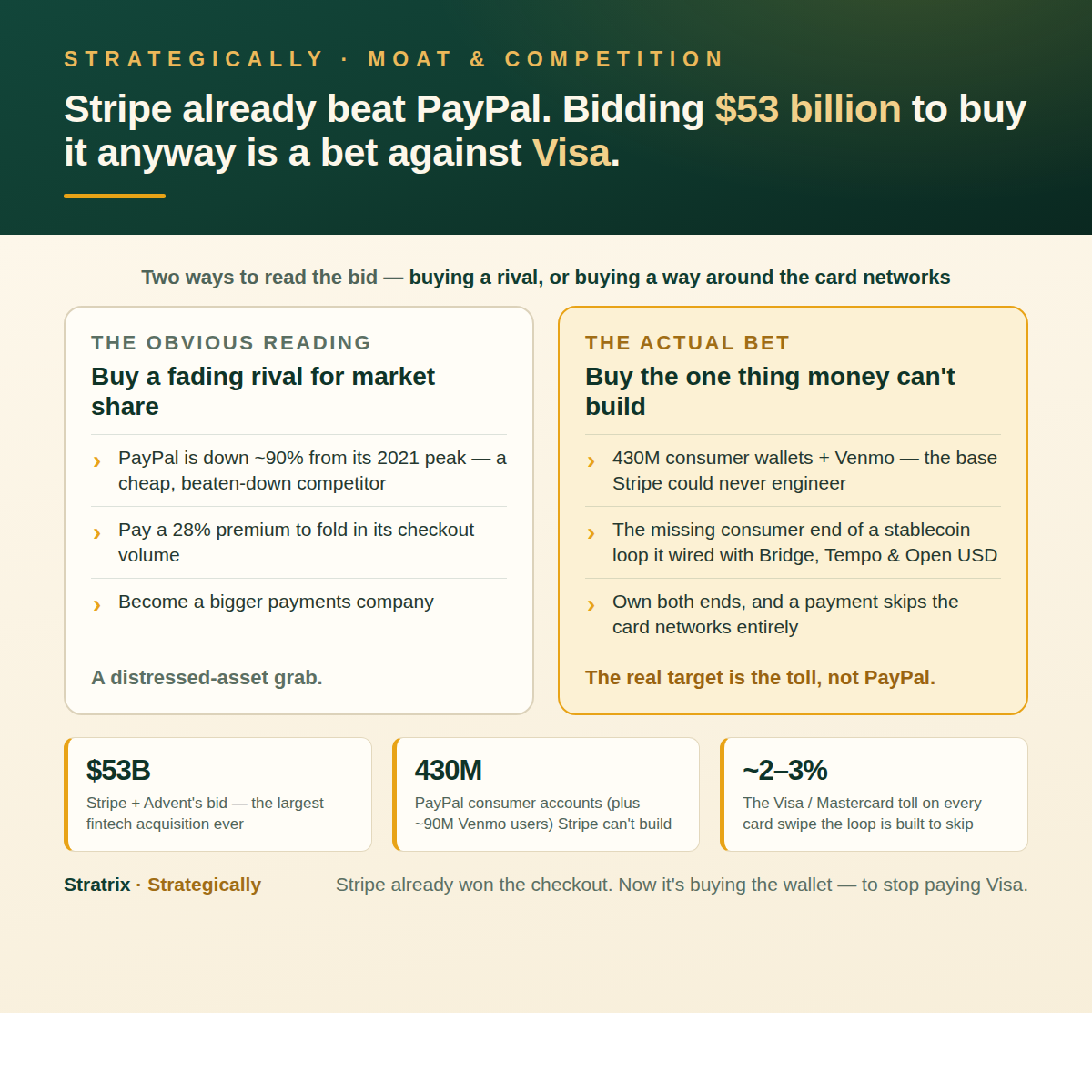
| The obvious reading | The actual bet | |
|---|---|---|
| What's being bought | A fading rival, for market share | The consumer half of a transaction Stripe already half-owns |
| Why pay a 28% premium | To eliminate a competitor in merchant checkout | For 430M wallets and Venmo — a base you cannot build from scratch |
| What Stripe was missing | Nothing — it's already winning online payments | A consumer network to pair with its merchant network and stablecoin rails |
| The real target | PayPal | The ~2–3% Visa and Mastercard take on every card swipe |
| What it unlocks | A bigger payments company | A loop that moves money consumer-to-merchant without touching the card networks |
The honest objections
"This is a distressed-asset grab, nothing so grand. PayPal is cheap and beaten down; Stripe and its PE partner are buying low and will fix the operations." Cheapness is surely part of it — you don't get 430 million accounts at a discount when the target trades near its 2021 highs' shadow for no reason. But the bargain-hunting theory can't explain the structure. A pure value play doesn't need a stablecoin blockchain, a $1.1 billion rails acquisition, and a standards consortium sitting behind it.79 Stripe spent two years building the thing that makes PayPal's consumer base uniquely valuable to Stripe specifically. The price made the deal possible. The rails made it make sense.
"Stablecoins won't actually dislodge the card networks — Visa and Mastercard keep winning, even in crypto, by putting themselves back in the middle." This is the strongest objection, and so far it's been right: stablecoin cards mostly route through Visa's network, and the incumbents have played down the threat.1011 But that's exactly the tension Stripe's bid is built to resolve. The reason stablecoins have kept touching the card rails is that no one controlled both the consumer and the merchant, so the card network stayed the neutral bridge between them. Owning both ends is precisely how you remove the need for that bridge. Stripe isn't betting stablecoins beat Visa on today's board. It's buying the pieces that let it change the board.
The read
The PayPal bid gets filed as a fallen unicorn being picked over — a $360 billion company reduced to a $53 billion buyout, the fintech darling of 2021 sold for parts. That framing mistakes the corpse for the point. Stripe isn't buying what PayPal became. It's buying what PayPal still has that Stripe, for all its engineering, cannot summon into existence: hundreds of millions of people who already keep money in an app.
For seventy years, every card payment paid a toll to sit between a buyer and a seller — because the buyer and the seller were never on the same network. Stripe is betting $53 billion that it can finally put them there.
That's the whole assembly: the merchant side it won, the rails it bought, and now the consumer side it's trying to buy. Put both parties on one network and let the payment skip the middle. The $53 billion isn't a wager on PayPal. It's a wager that the most dependable tax in commerce is, at last, optional — and that the company holding both ends of the transaction is the one that gets to stop paying it.
Before you pay a premium for a struggling company, separate what it does from what it has. The business may be broken; the asset underneath may be the only one of its kind. Run three questions. First: what can we build ourselves, and what can we only buy? (Stripe can build rails and checkout; it cannot build 430M consumer relationships.) Second: are we buying the target's business, or one asset trapped inside it? (The consumer network — not Braintree, not the declining margins.) Third: does this asset complete something we've already half-built? (Yes — it's the missing consumer end of Stripe's stablecoin loop.) If the thing you need is a network of people who already trust a product, you can't engineer your way to it — you can only buy the company that spent a decade earning it.
Stripe is privately held, so its valuation (~$159B) and volume (~$1.9T) figures come from its own investor letter and a February 2026 tender offer, not audited filings. The acquisition is a reported, unsolicited offer that had not been agreed or closed at publication; deal terms — the parties, the $60.50 price, the ~28% premium, and the ~$50B in committed financing — come from reporting citing people familiar with the matter, principally Reuters. The framing that the card networks, not PayPal, are the real target is this piece's strategic interpretation, supported by analyst commentary, not a stated aim of Stripe's.
More on what actually protects a business
Moat Anatomy Canvas
A one-page canvas that dissects a moat instead of asserting it: where the advantage comes from, how much of the market it covers, how long it would take to copy, and what keeps it from eroding. Blank to dissect your own claimed edge; filled as the worked example tracing the structure of the story's defensible advantage. Use it to tell a real moat from a head start.
Included, filled and blank, in the Moat Anatomy Casebook. See the set → · Preview the blank →
Sources
Where this comes from — the filings, records, and reporting behind it.
- 1In July 2026, Stripe and private-equity firm Advent International made a joint offer to acquire PayPal for more than $53 billion, sending PayPal shares higher; the bid was reported by Reuters and others.
- 2The Stripe/Advent offer was $60.50 per share — about a 28% premium to PayPal's prior close — backed by roughly $50 billion of committed bank financing; it would be the largest fintech acquisition ever, and a rare case of a venture-backed buyer acquiring an S&P 500 company, with Venmo cited as a key consumer-wallet asset.Axios, Stripe and Advent make $53B bid for PayPal ↗ · 2026-07-15
- 3PayPal's market value peaked around $360 billion in 2021 and had fallen to roughly $40 billion by early 2026 — below that of its former parent, eBay.
- 4Stripe was valued at about $159 billion in a February 2026 tender offer for employees and shareholders, on total payment volume of roughly $1.9 trillion in 2025, up about 34% year over year.
- 5PayPal had roughly 430 million active consumer accounts, total payment volume of about $1.79 trillion in 2025, and 2025 revenue growing in the low single digits (~4%).
- 6Coverage of the bid framed Venmo (used by more than 90 million Americans) and PayPal's ~430 million wallets and PYUSD stablecoin as the consumer side that complements Stripe's stablecoin push — Stripe's Tempo blockchain (with Paradigm) and the Open USD consortium (BlackRock, Mastercard, Coinbase, Ripple, PayPal).
- 7Stripe announced its acquisition of stablecoin-infrastructure startup Bridge for $1.1 billion in October 2024 — then the largest acquisition in Stripe's history.
- 8Stripe closed the $1.1 billion Bridge acquisition in early February 2025 and signaled an aggressive stablecoin push.
- 9Stripe is building a stablecoin-tuned Layer-1 blockchain, Tempo, with crypto investor Paradigm, and helps lead an "Open USD" standards consortium.
- 10Card payments carry an interchange-plus-fees toll of roughly 2–3% collected by the card networks and issuing banks, while stablecoin settlement can move value directly for a fraction of a cent — an economic gap that has drawn comparisons to Visa's processing volume.
- 11Mastercard and Visa have publicly played down the stablecoin threat, in part by routing stablecoin activity back through their own networks.
Weighing outside help with a decision like this? Hiring a commercial due diligence provider
More like this — beyond Stripe
New Strategically analyses as they publish: the defining moves in business, checked against the record. No noise, and one click to leave.