Pairs with the Moat Anatomy Canvas — a ready-to-use strategy tool. Included in the The Moat Casebook →
Write a check for $10,000 and you can run a restaurant that, if it's the right kind of store, will ring up more than $9 million a year.2 That is the deal that makes Chick-fil-A the most coveted franchise in America - tens of thousands apply for a handful of slots. It sounds like the cheapest path to wealth in fast food. It is one of the most misunderstood contracts in business, because the $10,000 doesn't buy you a restaurant. It buys you a job running one that will never be yours.
The official story is that Chick-fil-A's moat is the chicken sandwich, the famously gracious service, or the discipline of closing on Sundays. None of those is the moat. The moat is written, in flat legal language, in a document the company files every year and almost nobody reads to the end: the Franchise Disclosure Document. And what it describes isn't really a franchise at all.
The operator owns nothing, and that's the point
Here is what the FDD actually says. Chick-fil-A will only sign an agreement with an individual - not a partnership, not a corporation, not an LLC. It owns or leases every restaurant premises and subleases it to the operator. It owns all the equipment, furniture, and fixtures. The operator gets no exclusive or protected territory.3 Corporate, not the operator, picks the real estate.8 Read that list again and notice what's missing: equity. A McDonald's franchisee builds an asset they can sell. A Chick-fil-A operator builds nothing they can sell, because they own nothing to sell. They are, in the plainest terms, a carefully selected, exceptionally well-paid store manager with a revenue share - dressed in the language of ownership.
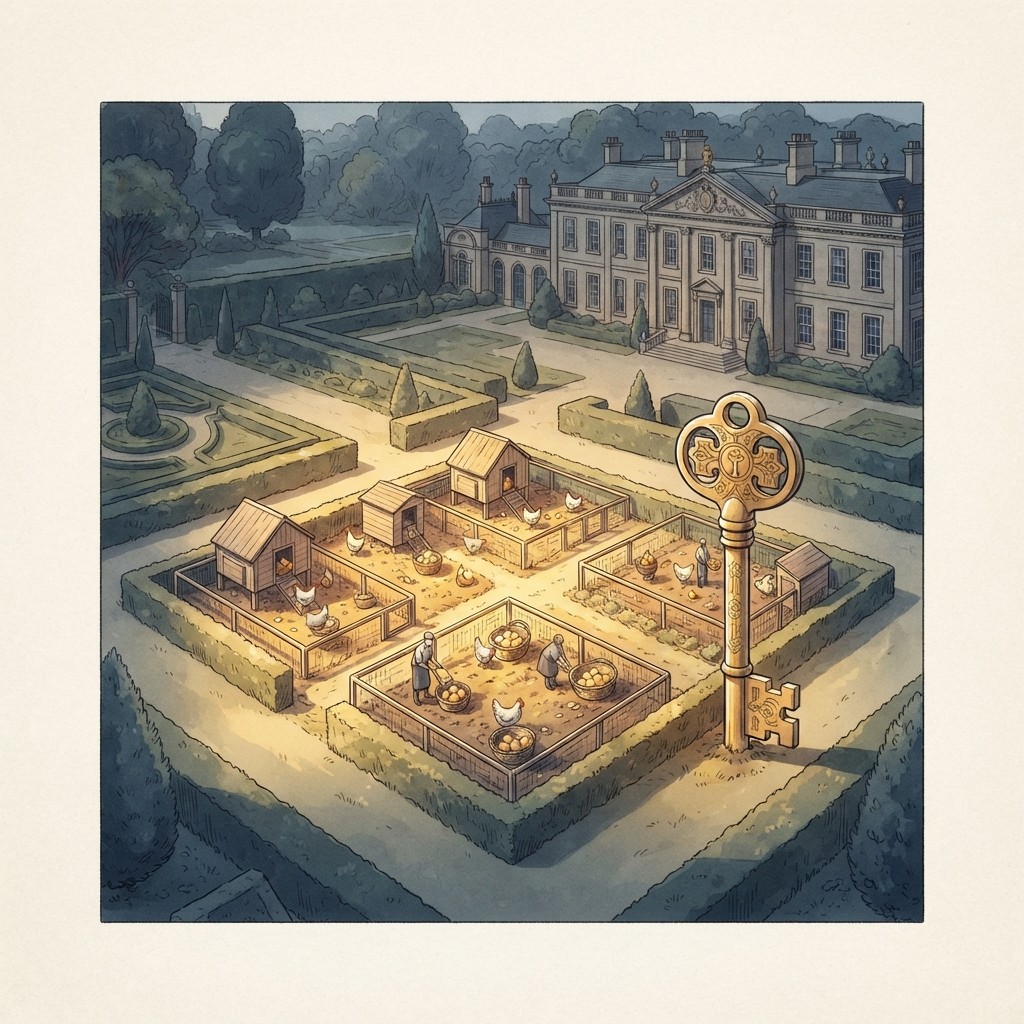
This is the reframe the word 'franchise' hides. In a normal franchise, the franchisor sells a business and collects a royalty for the brand. In Chick-fil-A's model, the company keeps the business, keeps the dirt, keeps the fryers, and rents out the running of it. The operator supplies the sweat and the local judgment. Corporate supplies - and retains title to - everything else.
“Chick-fil-A owns or leases all restaurant premises and subleases them to operators; it owns all equipment; operators receive no exclusive or protected territory.”3
Where the money actually goes
Now the economics. The headline most people repeat is a friendly-sounding '50/50 profit split.' It is true, and it is the smaller half of the truth. Before any split of profit, corporate takes a Base Operating Service Fee of 15% of gross receipts - off the top, before a single expense is paid. Then it takes an Additional Operating Service Charge of 50% of net profits on top of that.3 So the order of operations matters enormously: skim 15% of every dollar that comes through the door, then split what's left of the bottom line down the middle. On a low-margin restaurant, a 15% gross royalty is a very heavy load before you've even reached the profit line everyone's busy splitting.
The 15% runs on gross receipts, before expenses; the 50% runs on what's left after them.3 That sequencing is why the popular '50/50' framing inverts the reality - corporate has already taken a large bite before the profit split begins. The operator does well in absolute dollars not because the split favors them, but because the store is doing roughly $9 million a year in the first place.2
And the volume is the whole reason the structure works. Chick-fil-A's most recent FDD reports a median unit volume of about $9.2 million and an average of about $9.3 million - but only for the roughly 2,179 freestanding, non-mall units open a full calendar year.2 That qualifier matters; mall and delivery formats run far lower, so the blended number is smaller. Still, take 15% of gross plus half the profit on stores running at that volume across thousands of locations, and the arithmetic produces something striking: comprehensive after-tax earnings of about $946 million in a single year.2 The operator's $10,000 looks like a fee. From corporate's seat, it's the price of admission to a machine that monetizes volume at every store without ever surrendering equity or control.
| The operator | Chick-fil-A corporate | |
|---|---|---|
| Pays / receives at entry | Pays $10,000 | Funds most of the build-out |
| Owns the real estate | No | Owns or leases all premises |
| Owns the equipment | No | Owns it all |
| Protected territory | None | Controls site selection |
| Can sell it as an asset | No | Holds all the equity |
| Take on the sales | Profit share, after a 15% gross fee | 15% of gross + 50% of net profit |
Why a competitor can't simply copy the terms
A heavy take rate is easy to write into a contract. It is brutally hard to make anyone sign it. The reason Chick-fil-A can demand single-individual operators, no territory, no equity, and a 15%-plus-50% structure is that the deal still pays the operator handsomely in absolute dollars - because the average freestanding store does roughly $9 million.2 That volume is the leverage. A rival chain offering the same lopsided terms on a store doing a third of that revenue would attract no one. So the moat is circular in the best possible way: the high volume justifies the punishing terms, and the punishing terms - total corporate control over real estate, build quality, and operator selection - help produce the high volume. The flywheel runs on its own ownership.
Watch where the company is actively pushing the model and you can see what it values. Chick-fil-A is converting licensed campus and hospital locations to the owner-operator franchise structure, naming the 'local ownership business model' as the rationale - while pointedly excluding airports.7 Translation: even when a site is run by someone else's institution, corporate wants its own controlled operator in the seat. The structure isn't an accident of franchising. It's the asset.
Isn't the brand the real moat - and isn't Sunday a sacrifice?
The fair objection is that this is too clever by half - that the chicken and the culture, not the contract, are what people line up for. There's truth in it. A great brand is what fills the drive-thru, and you cannot extract 15% of gross from a store nobody visits. But notice what the brand alone doesn't explain: why corporate keeps the deed. Plenty of beloved chains let franchisees own their buildings and sell them for a profit. Chick-fil-A refuses to, and that refusal - not the sandwich - is what converts a popular brand into a durable, controlled, equity-hoarding machine. The brand fills the store; the contract decides who keeps the upside.
The Sunday closure cuts the same way. It's described as a costly competitive sacrifice, and the lost trading hours are real. But the framing is too tidy. The six-day week keeps operators from burning out, which protects the service quality and low turnover the brand depends on, and it manufactures a scarcity that does its own marketing. The cost is genuine; it is also partly an investment in the very consistency that keeps those average unit volumes where they are. A closed day, it turns out, can defend a moat as effectively as an open one.
The most defensible position in a distributed business is often not selling the franchise - it's keeping the assets and renting out the operation. Whoever holds title to the real estate, the equipment, and the right to terminate keeps the equity and the control while someone else supplies the daily labor and local judgment. Chick-fil-A monetizes every volume gain at every store without ever giving away a building. The caution: this only works when the unit economics are good enough that talented operators still line up for a job that builds them no sellable asset. Lopsided terms require a genuinely great deal underneath - take away the $9-million store, and no one signs.
Strip away the sandwich, the cows, the closed Sundays, and the gracious 'my pleasure,' and what remains is a real-estate and managed-services empire wearing a franchise costume. The genius was never the recipe - other people made chicken sandwiches first. The genius was deciding, store by store across more than three thousand locations,8 to own everything that appreciates and rent out everything that sweats. Chick-fil-A's competitors are busy guarding their recipes. Its moat was the title deed all along.
Moat Anatomy Canvas
A one-page canvas that dissects a moat instead of asserting it: where the advantage comes from, how much of the market it covers, how long it would take to copy, and what keeps it from eroding. Blank to dissect your own claimed edge; filled as the worked example tracing the structure of the story's defensible advantage. Use it to tell a real moat from a head start.
Included, filled and blank, in the The Moat Casebook. See the set → · Preview the blank →
Sources
Where this comes from — the filings, records, and reporting behind it.
- 1Chick-fil-A 2024 total revenue was $9,062,620,436; systemwide sales were $22,746,105,000; 2025 systemwide sales reached $23,918,208,000 and total consolidated revenue was $10,342,734,669
- 2Chick-fil-A's FDD (2025 filing) discloses: as of December 31, 2024, the chain operated 3,109 domestic restaurants — 55 company-owned, 2,629 franchised, 425 licensed; median AUV for 2,179 non-mall units was $9.227M; average was $9.317M; comprehensive after-tax earnings were $946,096,118
- 3Per the Chick-fil-A Operator Program FDD (primary document): Chick-fil-A will only enter into a franchise agreement with an individual, not a partnership, corporation, or LLC; the Base Operating Service Fee is 15% of gross receipts; an Additional Operating Service Charge of 50% of net profits is also payable; the operator leases all premises and equipment from Chick-fil-A; operators receive no exclusive or protected territory
- 4Per a partial FDD (2013, earliest publicly accessible version): the Additional Operating Service Charge is 'fifty percent of the Chick-fil-A Restaurant's net profits,' confirming this structure has been in place for over a decade; total investment ranged from $295,412 to $2,431,608 at that time, with only $10,000 paid directly to the franchisor
- 5Chick-fil-A, Inc. was formed as a Georgia corporation on March 23, 1964; the first Chick-fil-A restaurant opened in Greenbriar Mall, Atlanta, in 1967; the brand's origin traces to the Dwarf Grill opened by S. Truett Cathy on May 23, 1946 in Hapeville, Georgia — these are distinct dates for distinct entities
- 6Chick-fil-A confirms on its own corporate website that the first Chick-fil-A mall location opened in 1967 in Greenbriar Mall, Atlanta; the Dwarf Grill opened in 1946 is where the sandwich was developed
- 7Chick-fil-A's official press release confirms it is actively converting licensed campus/hospital locations to the owner-operator franchise model, citing 'local ownership business model' as the strategic rationale; airport locations are excluded from this conversion
- 8Chick-fil-A's corporate website confirms more than 3,000 restaurants in 48 states, Washington D.C., Puerto Rico, and Canada; real estate selection is controlled entirely by Chick-fil-A corporate, not by operators
More like this — beyond Chick-fil-A
New Strategically analyses as they publish: the defining moves in business, checked against the record. No noise, and one click to leave.