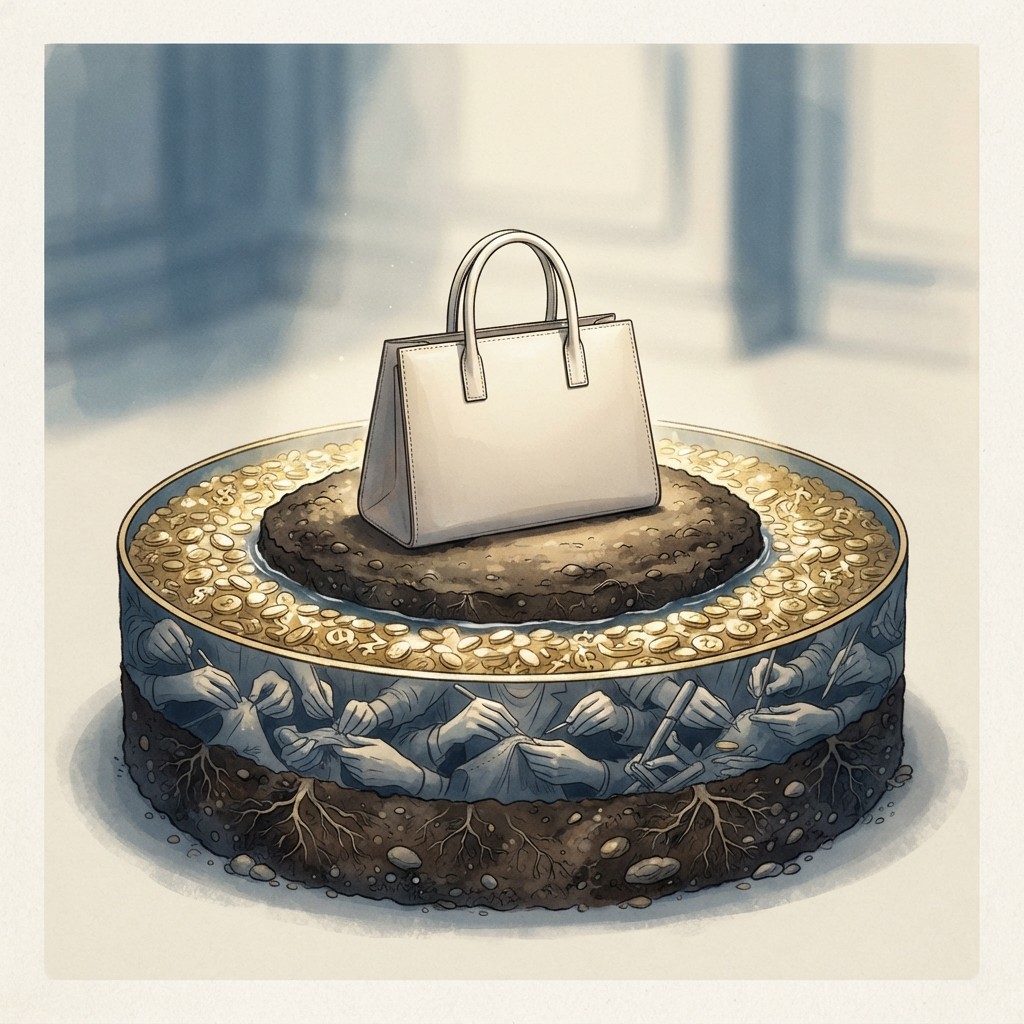
Pairs with the Moat Anatomy Canvas — a ready-to-use strategy tool. Included in the The Moat Casebook →
Champagne can only legally come from a small, finite stretch of chalky French soil. You cannot plant more of it, you cannot manufacture it, and almost none of it ever comes up for sale. LVMH's houses ship more than a fifth of everything that carries the name — over 22% of all Champagne-appellation shipments.8 That single fact tells you more about what protects LVMH than any number of ad campaigns. The moat is not really a feeling about a logo. It is dirt, and hands, and a chequebook nobody else can match.
The official story is that LVMH is protected by brand equity and heritage — that two centuries of Parisian mystique form a wall no rival can climb. That story is half right and dangerously incomplete. Heritage is the marketing; it is not the moat. The moat is structural: a stack of scarce physical inputs that can't be re-created at any price, welded to a capital machine that lets one man move money between houses at will.
Here is the thesis a smart friend can repeat at dinner: LVMH isn't protected by what it makes people feel. It's protected by what it owns and what it can fund. The brands are the storefront; the land, the ateliers, and the cross-subsidy are the foundations under it.
Scarcity you can't reprint
Most companies' advantages erode because someone can build a better version. LVMH's strongest advantages can't be built at all, because the inputs are geographically and historically fixed. Champagne land is the cleanest example — a legally bounded appellation with no expansion button — and LVMH's grip on it, north of 22% of all shipments, is a position a challenger literally cannot buy into without buying out an incumbent.8 The same logic runs through the historic ateliers and the multi-generational craft pipelines that supply leather goods: the bottleneck isn't capital, it's trained hands, and you cannot hire a fifty-year apprenticeship into existence next quarter. This is why the protection is real where the input is scarce — and conspicuously thinner where it isn't.
Watch the 2024 results split along exactly that line. Fashion & Leather Goods, the part of the empire built on the most irreplaceable inputs, posted €42 billion of revenue, broadly stable, with profit down only 10% and a segment margin still at historically high levels.2 The next year, that margin was still 'very high, at 35%.'3 Now look where the inputs are more fungible: Wines & Spirits profit fell 36% and Watches & Jewelry fell 28%.8 Spirits and watches are precisely the categories where LVMH competes against asset-light rivals with sharper, more focused craft stories — and where owning a name buys you less protection.
| Segment | Underlying input | 2024 profit move |
|---|---|---|
| Fashion & Leather Goods | Historic ateliers, scarce craft labor | Down 10%, margin still historically high |
| Wines & Spirits | Champagne land (scarce) + spirits (contestable) | Down 36% |
| Watches & Jewelry | Contestable craft, focused rivals | Down 28% |
| Selective Retailing (Sephora) | Distribution scale | Stable, double-digit growth |
The most durable moats sit on something that cannot be re-created — bounded land, finite licenses, a labor pipeline that takes a generation to grow. Brand sentiment feels like a moat, but sentiment is contestable: a focused competitor with a sharper story can chip at it, and the 2024 numbers show exactly that happening in watches and spirits. When you audit your own defenses, separate the parts a rival could rebuild from scratch from the parts they physically cannot. The second list is your real moat. The first is your marketing budget.
The second wall: one wallet behind seventy-five houses
Scarce inputs explain why no one can copy the inputs. They don't explain why no one can copy the conglomerate. That second wall is capital allocation — and it is the part the heritage story leaves out entirely. LVMH is not a federation of independent luxury brands; it is a centralized machine that pools the cash of dozens of houses and redirects it. The strong subsidize the weak indefinitely. In 2024 the group threw off €10.5 billion of free cash flow, up 29% even as profit fell,1 and that surplus is the ammunition: a struggling Maison inside LVMH never has to win on its own quarterly P&L, because the holding company can fund it through years a standalone rival would not survive.
Tiffany is the machine working as designed. LVMH closed the deal in January 2021 at $131.50 a share — about $15.8 billion, $425 million below the original 2019 price after a Delaware courtroom fight and a disputed French government letter.5 Then it poured in capital and method. By the FY2024 call, LVMH said Tiffany's high-jewelry revenue had quadrupled and its operating profit had doubled since acquisition; Arnault called it 'a sleeping beauty before our acquisition.'6 No standalone Tiffany could have funded that re-engineering at that scale. The asset was the same; the wallet behind it was not.
“Tiffany has seen revenue from high jewelry quadruple since the Maison's acquisition, and operating profit double.”6
This is also the truest thing about Arnault himself, and it corrects a persistent myth. He did not found LVMH. The group was assembled in 1987 by the merger of Moët Hennessy and Louis Vuitton, engineered defensively by their own executives. Arnault had earlier taken control of the Boussac conglomerate — and with it Christian Dior — committing roughly $15 million of family equity inside a deal capitalized at about $80 million, then restructuring it ruthlessly, including laying off some 9,000 workers.7 He was invited into LVMH as an investor and seized control through a hostile takeover by around 1989–90.7 He is not the creator of the houses. He is the architect of the wallet — the man who turned a collection of brands into a single allocation engine.
But isn't a 14% profit drop proof the moat is failing?
The honest objection cuts the other way: if the moat were as deep as claimed, profit wouldn't fall. In 2024 it did — down 14% to €19.6 billion on revenue of €84.7 billion, with the operating margin compressing from roughly 26.5% the year before — derivable from €22.8 billion profit on €86.2 billion revenue4 — to 23.1%.1 Every division except Sephora-led Selective Retailing posted a profit decline.8 In 2025 the margin slipped again, to 22% on €80.8 billion of revenue.3 That is not the profile of an impenetrable fortress, and a fair analyst should say so plainly: 2023 was a record — €22.8 billion of profit, up 8% — and the two years since have been a steady step down.4
But read the compression carefully and it confirms the thesis rather than breaking it. The damage clustered exactly where the inputs are contestable — spirits down 36%, watches down 28% — while the leather-goods core, sitting on the genuinely scarce inputs, held a margin still described as 'very high, at 35%.'38 A moat that bends under a cyclical downturn but doesn't break, and bends least where the underlying asset is least replaceable, is behaving precisely as a structural moat should. The mistake was never believing LVMH has a moat. The mistake is believing the moat is the same depth everywhere — believing the heritage extends the protection to every product with a famous name on it.
Strip away the campaigns and the couture and one thing remains that a competitor genuinely cannot replicate: a finite stretch of chalk soil, a generation of trained hands, and a single wallet deep enough to fund a sleeping beauty until she wakes. LVMH's defenders point to the magic. The numbers point to the ground beneath it. The brands are how LVMH gets paid. The land, the labor, and the cross-subsidy are why nobody can take the payment away — except in the few corners where LVMH owns the name but not the scarcity, and there, in 2024, the wall came up short.
Moats that aren't where you'd look for them
Moat Anatomy Canvas
A one-page canvas that dissects a moat instead of asserting it: where the advantage comes from, how much of the market it covers, how long it would take to copy, and what keeps it from eroding. Blank to dissect your own claimed edge; filled as the worked example tracing the structure of the story's defensible advantage. Use it to tell a real moat from a head start.
Included, filled and blank, in the The Moat Casebook. See the set → · Preview the blank →
Sources
Where this comes from — the filings, records, and reporting behind it.
- 1LVMH recorded revenue of €84.7 billion in 2024; profit from recurring operations came to €19.6 billion, equating to an operating margin of 23.1%, a decline of 14% year-over-year; free cash flow came to €10.5 billion, up 29%; group share of net profit was €12.6 billion.
- 2LVMH's Fashion & Leather Goods business group posted €42 billion in revenue in 2024 (broadly stable organically); profit from recurring operations was down 10%, mainly affected by exchange rate fluctuations; the operating margin for the segment remained at historically high levels.
- 3In 2025, LVMH's Fashion & Leather Goods operating margin remained 'very high, at 35%' even as segment revenue declined and profit from recurring operations fell 13% due to currency fluctuations; group-wide 2025 operating margin was 22% on €80.8 billion in revenue.
- 4LVMH recorded revenue of €86.2 billion in 2023 (organic growth of 13% vs. 2022); profit from recurring operations was €22.8 billion, up 8%; this was the group's record year for revenue and profit.
- 5The original LVMH–Tiffany merger agreement signed November 24, 2019 valued Tiffany at $135/share (~$16.2 billion). After LVMH attempted to walk away citing a French government letter (whose provenance was disputed, with reporting suggesting LVMH may have solicited it), both sides settled pending Delaware Chancery Court litigation and closed on January 7, 2021 at $131.50/share totaling $15.8 billion — a reduction of $425 million.
- 6LVMH itself stated that 'Tiffany has seen revenue from high jewelry quadruple since the Maison's acquisition, and operating profit double' — Arnault called Tiffany 'a sleeping beauty before our acquisition' in the FY2024 earnings call.
- 7Arnault acquired the Boussac Saint-Frères textile conglomerate (which owned Christian Dior) in 1984, contributing $15 million of family equity in a deal that raised ~$80 million total with Lazard Frères. He restructured ruthlessly — laying off 9,000 workers and selling non-core assets — before gaining control of LVMH by 1989–90 through a hostile takeover of the group formed by the 1987 merger of Moët Hennessy and Louis Vuitton.
- 8LVMH's Wines & Spirits profit from recurring operations fell 36% in 2024; the Watches & Jewelry segment profit fell 28%; only the Selective Retailing segment (led by Sephora with double-digit growth in both revenue and profit) held stable profit; LVMH's champagne houses maintained more than 22% of all Champagne-appellation shipments.
- 9LVMH is home to more than 75 distinguished Maisons rooted in six different sectors
More like this — beyond LVMH
New Strategically analyses as they publish: the defining moves in business, checked against the record. No noise, and one click to leave.