Pairs with the Market-Entry Gambit Canvas — a ready-to-use strategy tool. Included in the The Market-Entry Gambit Casebook →
In 2003, BMW signed a contract with a partner it did not fully control, in a country where it had been selling cars for less than a decade, to build sedans in the northeastern city of Shenyang. The deal was tiny — €450 million, split three ways.1 Twenty years later, that same factory was where BMW chose to build the Neue Klasse, the platform meant to carry the entire brand into its electric future.8 The bet had become the company. And the contract that holds it together does not expire until 2040.3
The official story is that BMW won China — first foreign carmaker to take majority control of a local venture, biggest market on earth, a triumph of patient capital. That is mostly true. What the triumph narrative leaves out is the other half of the sentence: BMW didn't just enter China, it married into it, and the prenup runs to 2040 with no clean way out.
The venture was never a tidy 50/50
Popular coverage calls the founding deal a 50/50 joint venture. It wasn't. The March 27, 2003 agreement gave BMW 50%, Brilliance Auto 40.5%, and — this is the part that gets dropped — the Shenyang municipal government 9.5%.1 The state was an equity partner from the first day, not a regulator standing off to the side. That structure was the price of admission to a protected market, and it tells you what kind of bet this always was: not a wholly-owned bridgehead BMW could pack up, but a partnership knitted into a local government's balance sheet. The shorthand '50/50' makes it sound like a clean split between two companies. It was a three-handed arrangement with a city hall in the room.
| 2003 founding | From Feb 2022 | |
|---|---|---|
| BMW | 50% | 75% |
| Brilliance Auto / China | 40.5% | 25% (indirect) |
| Shenyang government | 9.5% | — |
| BMW's control | Shared, three-way | Majority, consolidated into Group accounts |
The deepening came in two strokes, and the gap between them matters. In October 2018, BMW announced it would raise its stake to 75%, becoming the first foreign carmaker permitted to take majority control of a China venture; it pledged more than €3 billion in new plant structures and pushed the contract out to 2040.2 But the announcement was not the deal. The transaction only became legally effective on February 11, 2022, when the venture received a new business license — nearly three and a half years later — and only then did the venture's full financials fold into BMW Group's statements.3 BMW had spent the intervening years committing to a market it could not yet consolidate, on terms it had announced but not closed.
Why the depth paid off, and why it now bites
Here is the mechanism the triumph version gets right. Building in China, with a state-linked partner and growing local capacity, gave BMW something importers could not have: cars made where they were sold, priced for the market, and politically welcome. By 2023 the strategy looked vindicated — China was BMW's largest market at 32.3% of Group deliveries, with 824,932 BMW and MINI vehicles sold, up 4.2%, against Group revenues of €155.5 billion.4 Roughly 85% of the cars BMW builds in China are sold inside China.6 That is the definition of a localized business, not an export beachhead. The deep entanglement was the engine of the premium share.
But the same entanglement is the reason BMW can't pivot when the ground shifts. And in 2024 the ground shifted. China deliveries fell about 14% to roughly 715,200 units, and China's share of Group volume slid from 32.3% to 29.2%.6 It was still the largest single market — but a shrinking one, as German automakers faced weak consumer demand and a rapid shift to electric vehicles from local Chinese rivals10. When a quarter of your volume contracts and your factories there are tuned to serve it locally, you cannot redirect them to a healthier market overnight. The localization that captured the upside is the same thing that concentrates the downside. There is no quick exit ramp before 2040 because the whole point was to be impossible to remove.
“Continuing subdued demand in the Chinese market.”5
Wasn't 2024 just China — and isn't the JV unwinding anyway?
Two fair objections, and both need answering honestly. The first: maybe the whole story is just China demand collapsing, proof the bet went bad. Not quite. BMW's 2024 net profit fell 36.9% to €7.68 billion and its automotive EBIT margin dropped to 6.3%, below its 8-10% target — but that decline had two compounding causes, not one.5 Alongside subdued Chinese demand sat a faulty supplier-made Integrated Braking System (IBS) affecting over 1.5 million vehicles worldwide, which forced delivery stops and prompted BMW to cut its full-year guidance.9 Pin the entire crash on China and you overstate the China effect and miss that the localized business is wounded, not dead — China is still the largest single market by volume.6
The second objection: surely the partner is heading for the exit. In January 2024, reports surfaced that Brilliance's state successor was weighing a sale of its 25% stake. But on January 16, 2024, Shenyang Automotive sent BMW a letter flatly denying any such discussions, calling the reports 'false,' and no sale has been completed.7 That denial cuts against the easy 'the JV is unwinding' read — and it also underlines the trap. The partnership isn't dissolving; it is locked. BMW is committed to building its electric future in Shenyang, with the Neue Klasse entering local production from 2026 and RMB 10 billion sunk into a battery plant there.8 You don't lay those foundations if you're planning to leave.
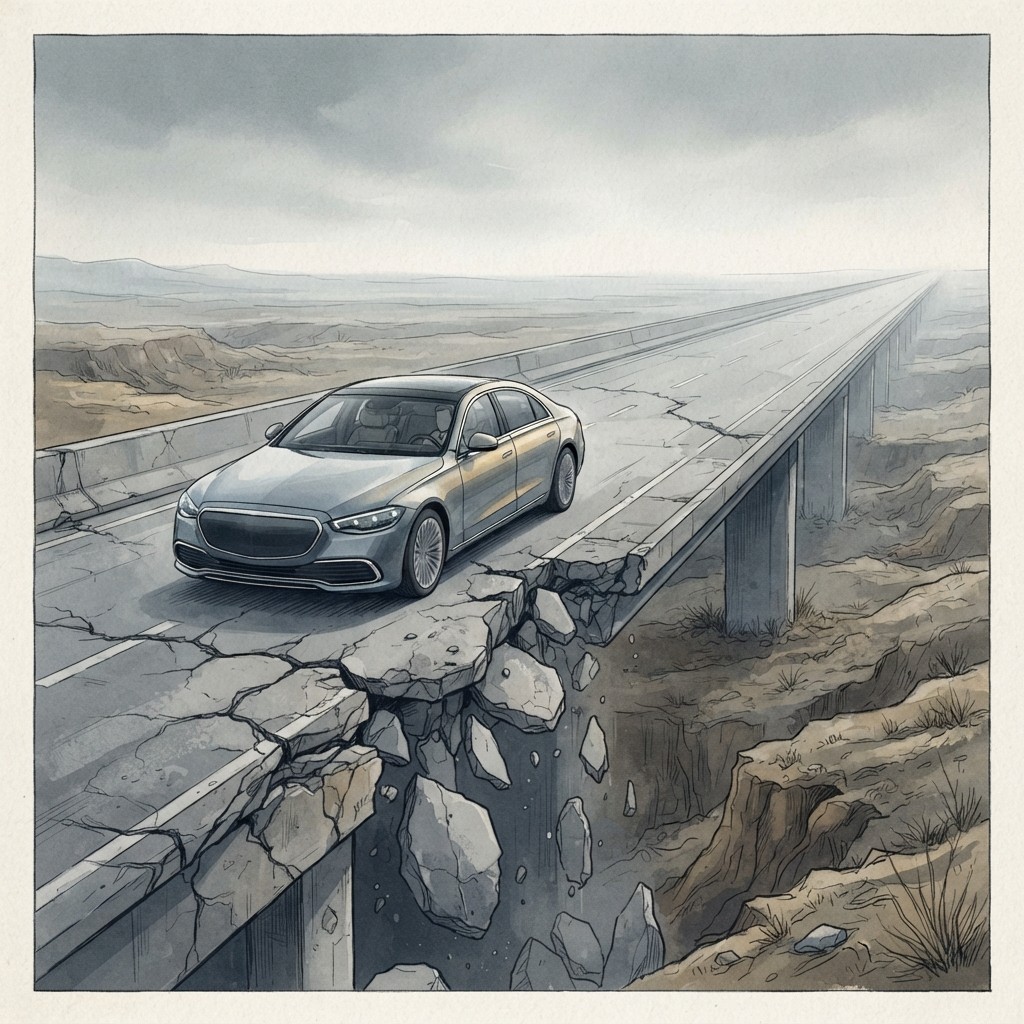
The deeper you embed in a market — local equity partners, local plants, your flagship platform built on the ground — the more of that market's upside you capture and the less optionality you keep when it turns. BMW's China bet was not wrong; it was, for two decades, exactly right. But a market-entry gambit that succeeds by becoming irremovable has quietly converted a choice into an obligation. The question for any company going all-in on a single geography isn't 'can we win here?' It's 'what happens to us if this market shrinks while we're contractually inside it until 2040?' The answer is the cost of the entry strategy — and it only arrives years after the strategy looks like genius.
BMW didn't just sell cars in China; it built a second home there, brick by brick, stake by stake, until the home and the company were the same structure. For twenty years that was the smartest thing it did — a localized premium machine no importer could match. Now the foundation is settling, the market is contracting, and the lease runs to 2040. The genius of the bet and its peril are the same fact: BMW is not a foreign carmaker doing business in China. It is, by contract and by concrete, a Chinese carmaker that also happens to be German — and there is no version of the future where it can simply walk back across the border.
When entering a market means belonging to it
Market-Entry Gambit Canvas
A one-page canvas for staging an entry into a market you don't own yet: the beachhead you take first, the wedge that gets you in cheaply, the sequence that turns a foothold into a position, and the incumbent's likely counter-move. Blank to plan your own entry; filled as the worked example showing how the story's challenger picked its landing spot and walked the rest in.
Included, filled and blank, in the The Market-Entry Gambit Casebook. See the set → · Preview the blank →
Sources
Where this comes from — the filings, records, and reporting behind it.
- 1On March 27, 2003, BMW and Brilliance Auto agreed to form BMW Brilliance Automotive Ltd., with BMW holding 50%, Brilliance Auto 40.5%, and the Shenyang municipal government 9.5%; initial investment was €450 million (US$483 million); the business license was issued May 22, 2003.
- 2In October 2018, BMW announced intent to increase its stake from 50% to 75%, making BMW the first foreign carmaker to take majority control of a China JV; JV contract extended to 2040; investment of more than €3 billion in new/existing plant structures announced; total production capacity to reach 650,000 units.
- 3The 75% stake increase and JV contract extension to 2040 became legally effective on February 11, 2022, when BBA received a new business license; BMW Group now holds 75%, Brilliance China indirectly holds 25%; BBA to be fully consolidated in BMW Group Financial Statements from that date.
- 4In 2023, China was BMW's largest sales market at 32.3% of Group deliveries; 824,932 BMW and MINI vehicles sold in China (+4.2%); Group revenues €155.5 billion; BBA invested RMB 10 billion in sixth-generation battery assembly plant; Neue Klasse local production in Shenyang confirmed from 2026.
- 5BMW Group full-year 2024 net profit fell 36.9% to €7.68 billion; automotive EBIT margin 6.3%, below 8-10% strategic target; BMW cited 'continuing subdued demand in the Chinese market'; 2025 guidance automotive margin 5-7%.
- 6China BMW and MINI deliveries fell 14% in 2024 to ~715,200 units; China's share of BMW Group total deliveries dropped from 32.3% (2023) to 29.2% (2024); China remained the largest single market by volume despite the decline; ~85% of cars built in China are sold locally.
- 7In January 2024, Automotive News Europe reported Brilliance's parent was considering selling its 25% BBA stake; on January 16, 2024, Shenyang Automotive (the state entity now controlling Brilliance) sent a letter to BMW explicitly denying any discussions of a stake sale and calling media reports 'false'; no sale has been completed.
- 8On the 20th anniversary of BBA (May 2023), BMW announced local Neue Klasse production in China from 2026; BBA investing RMB 10 billion in a sixth-generation battery assembly plant in Shenyang; BMW Group has had a presence in the Chinese market since 1994.
- 9A faulty supplier-made Integrated Braking System (IBS) affecting over 1.5 million vehicles worldwide led to delivery stops for new vehicles, impacting BMW's global sales in the latter half of 2024 and prompting BMW to cut its financial guidance.
- 10BMW and other German automakers suffered from a rapid shift to electric vehicles from local Chinese rivals, contributing to declining sales in China in 2024.
More like this — beyond BMW
New Strategically analyses as they publish: the defining moves in business, checked against the record. No noise, and one click to leave.