Pairs with the Market-Entry Gambit Canvas — a ready-to-use strategy tool. Included in the The Market-Entry Gambit Casebook →
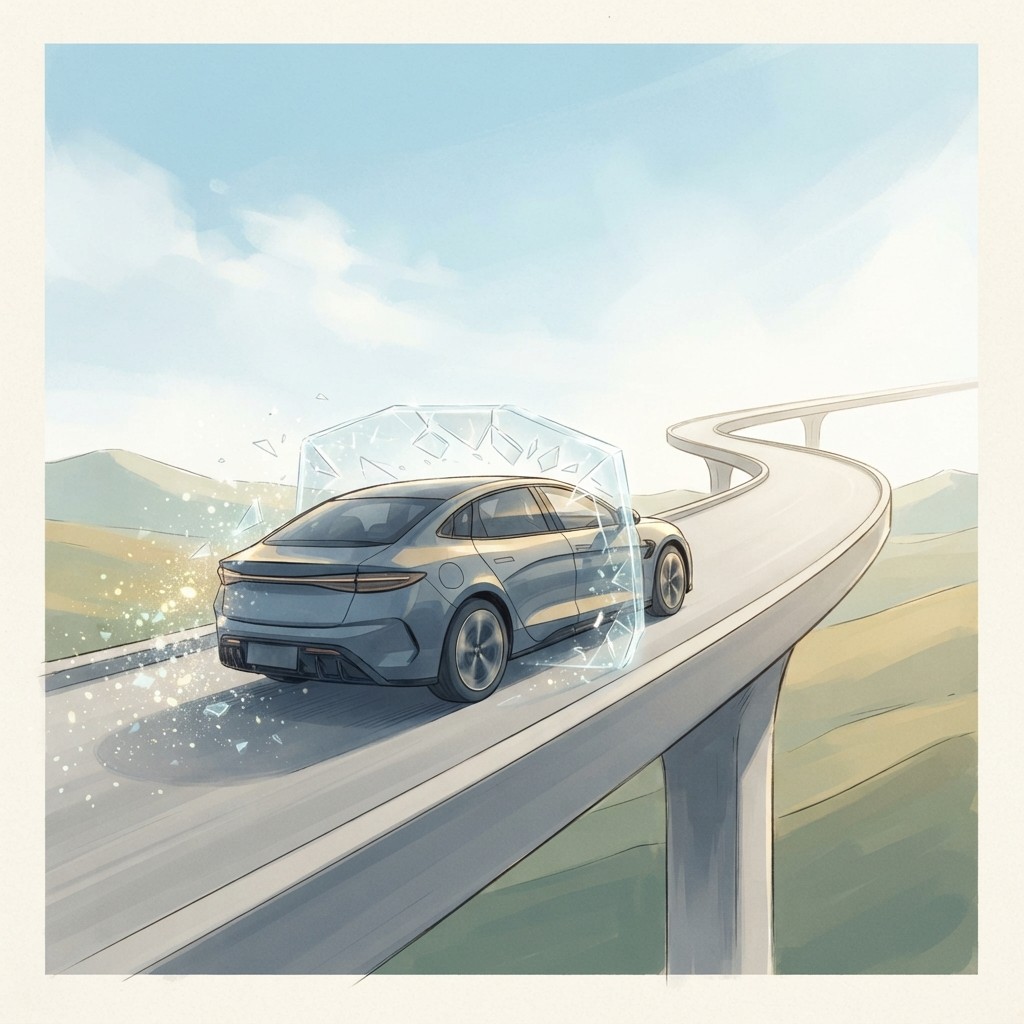
On 30 October 2024, the European Union switched on a tariff designed to slow a single company down: a 17% countervailing duty aimed squarely at BYD's electric cars, on top of the existing 10% import duty.3 The headlines reported a 45% wall going up against Chinese EVs and a continent bracing for the flood. Then something inconvenient happened. BYD's European sales kept climbing. By the next year its overseas revenue had surged 40%, and it shipped more than a million vehicles abroad for the first time.6 The wall went up. The water rose anyway.
The official story is that BYD is a subsidy-fueled dumping machine and that Western tariffs are the dam holding it back. Both halves are wrong. The tariff on BYD is 17%, not 45% - that bigger number belongs to a different company entirely.3 And the subsidies, while real, explain only a sliver of why BYD undercuts everyone. The backlash aimed at the wrong target, and missed.
The tariff that wasn't 45%
Start with the number everyone repeats. The EU's definitive duties came in three tiers, calibrated to how much each carmaker had cooperated with the subsidy investigation. SAIC, the maker of MG, drew 35.3%. Geely got 18.8%. BYD - the largest of the three, the one the panic was supposedly about - got the lowest rate of all: 17%.3 Add the standard 10% import duty and BYD's worst-case combined burden is 27%, not the 45% that dominated the headlines — a figure Bloomberg and others led with, which accurately describes SAIC's combined rate, not BYD's.10 The investigation did conclude that China's battery-electric value chain benefits from unfair government subsidies; that finding is legally on the record.3 But a finding of unfairness is not the same as a finding that subsidies are why BYD wins. Europe proved the first and assumed the second.
| BYD | Geely | SAIC (MG) | |
|---|---|---|---|
| Countervailing duty | 17% | 18.8% | 35.3% |
| Plus base import duty | 10% | 10% | 10% |
| Combined burden | 27% | 28.8% | 45.3% |
| The number that went viral | — | — | this one |
The cost edge isn't where the politics points
Now the second half of the myth. If the tariffs were meant to neutralize a subsidy advantage, they had to assume subsidies were the advantage. They are not. Rhodium Group ran the per-vehicle math and found BYD holds roughly a $4,700 cost advantage over Tesla on a comparable car. Of that gap, subsidies account for about 5%. Vertical integration and lower overheads explain at least three-quarters of it.4 BYD builds its own batteries, its own chips, its own motors - a legacy of a company that started in 1995 as a battery maker, when Wang Chuanfu set it up at 29 on a CNY 250,000 loan from his cousin and only got into cars in 2003.7 That is the moat: it makes the expensive parts itself, at scale, and books the margin everyone else pays to a supplier. A 27% tariff cannot tariff that away. It can raise the landed price, but it cannot rebuild a vertically integrated supply chain inside the structure of a competitor.
This is not a defense of subsidy-free virtue. The subsidies are large and growing: BYD took in €3.4 billion in direct government support from 2018 to 2022, peaking around €2.1 billion in 2022 alone.5 Its 2025 filing disclosed 12.47 billion yuan in operational government subsidies, up nearly 20% on the prior year - and the same filing shows those subsidies amounted to 38.2% of BYD's net profit attributable to shareholders for the year — material enough that stripping them out would substantially compress the bottom line.11 State support clearly fattens the bottom line. The point is narrower and harder to argue around: it is not what makes BYD's cars cheaper to build. Confuse the profit line with the cost line, and you aim your tariff at the wrong organ.
“BYD enjoys a roughly $4,700 per-vehicle cost advantage over Tesla; subsidies account for around 5% of that gap, while vertical integration and lower overheads explain at least three-quarters.”4
Why the export blitz is smaller - and smarter - than it looks
Even the phrase 'export blitz' oversells it. In 2024 BYD sold 417,204 vehicles outside China - a 72% jump, but still under 10% of its 4.26 million total deliveries.2 Overseas revenue was 221.9 billion yuan out of 777.1 billion, so the company is still overwhelmingly domestic.1 What makes the trajectory dangerous to rivals isn't its current size; it's how BYD is routing around the obstacles. The EU duties cover battery-electric cars only. So BYD has factories rising in Hungary, Turkey, Brazil, Thailand, Indonesia and Uzbekistan - localizing production to step inside the tariff wall rather than scaling it.8 A car built in Hungary is a European car. The toll booth is bypassed by moving the road.
Isn't this just a subsidized champion that hasn't been caught yet?
The honest objection is that this all sounds too forgiving - that any company taking €3.4 billion in state money is a subsidized champion, and the only reason it survives a tariff is that the state simply pays more. There is real force in that. But the evidence cuts against pure dependency. When China pulled back its subsidy regime, BYD didn't sail through untouched; its net profit fell 42% in 2019 alone as subsidies were scaled back, which is not the behavior of a company on a blank cheque.9 Scores of Chinese EV startups that did rely on state money have failed or ceased operations since 2018, with no rescue. And the comparison that ought to give the tariff hawks pause: Tesla was itself the second-largest recipient of Chinese purchase subsidies in 2022.55 Subsidies are a global EV game. BYD plays it harder than most, but the thing that actually wins - making your own batteries cheaper than rivals can buy them - is exactly the thing a subsidy line can't capture and a tariff can't remove.
Trade defense works only when it hits the real source of an advantage. The EU found genuine subsidies and built a tariff around them - but subsidies were the symptom, and structure was the disease. When a competitor's edge is built into its supply chain rather than its bank account, a duty raises the price without closing the gap, and a determined entrant simply localizes production to step inside the wall. The lesson for anyone defending a market: diagnose where the cost advantage actually lives before you pick the policy instrument. A 17% duty aimed at the wrong 5% is loud, satisfying, and almost entirely beside the point.
The tariff backlash treated BYD as a subsidy story with a price tag, and so it reached for the one tool that addresses price. But BYD's advantage was never mostly in the cheque from Beijing - it was in the decision, made decades ago by a battery company, to own the expensive parts of a car before anyone needed them to be cheap. You can tax a flood. You cannot tax the slope the water runs down. Europe built a wall against the wrong thing, and BYD is already building factories on the other side of it.
How companies enter a market they're not supposed to win
Market-Entry Gambit Canvas
A one-page canvas for staging an entry into a market you don't own yet: the beachhead you take first, the wedge that gets you in cheaply, the sequence that turns a foothold into a position, and the incumbent's likely counter-move. Blank to plan your own entry; filled as the worked example showing how the story's challenger picked its landing spot and walked the rest in.
Included, filled and blank, in the The Market-Entry Gambit Casebook. See the set → · Preview the blank →
Sources
Where this comes from — the filings, records, and reporting behind it.
- 1BYD's 2024 full-year revenue was 777.1 billion yuan (~$107bn), up 29% YoY; net profit attributable to shareholders was 40.25 billion yuan, up 34% YoY; total NEV sales were 4.27 million units, up 41% YoY; overseas revenue was 221.9 billion yuan.
- 2BYD exported 417,204 vehicles outside China in 2024, up 71.9% from 2023—less than 10% of its total 4.26 million deliveries. In 2023, exports were 242,765 units, up 334.2% YoY.
- 3EU Implementing Regulation 2024/2754 (in force 30 October 2024) imposed a definitive 17% countervailing duty specifically on BYD BEVs (18.8% for Geely, 35.3% for SAIC), on top of the standard 10% import duty, for five years. The investigation concluded the BEV value chain in China benefits from unfair government subsidies.
- 4Rhodium Group estimates BYD enjoys a ~$4,700 per-vehicle cost advantage over Tesla; subsidies account for roughly 5% of that gap. Vertical integration and lower overheads explain at least three-quarters. BYD's total government grants in 2024 reached approximately $1.4 billion.
- 5BYD received €3.4 billion in direct government subsidies from 2018–2022 per its own annual reports, peaking at €2.1 billion in 2022 alone—rising from 1.1% to 3.5% of revenues over that period. Tesla was the second-largest recipient of Chinese purchase subsidies in 2022 (~€0.4bn).
- 6BYD's 2025 annual report disclosed 12.47 billion yuan ($1.8bn) in operational government subsidies, up 19.8% from 10.41 billion yuan in 2024. Stripping subsidies, BYD's adjusted net profit would fall ~50%. Overseas revenue surged 40% to 310.74 billion yuan in 2025 (38.7% of total revenue). BYD exported more than one million vehicles for the first time in 2025.
- 7BYD was formally founded on 10 February 1995 as Shenzhen BYD Battery Company Limited with CNY 2.5 million capital; Wang Chuanfu started it at age 29 with a CNY 250,000 loan from his cousin Lu Xiangyang, targeting NiCd batteries vacated by Japanese producers. BYD Auto was established in January 2003 via acquisition of Xi'an Qinchuan Automobile.
- 8BYD's overseas passenger car sales reached 417,000 units in 2024, up 71.9% YoY. BYD targets 1.3–1.5 million overseas sales in 2026. The company is building/operating factories in Brazil, Hungary, Indonesia, Thailand, Turkey, and Uzbekistan to localize production and reduce tariff exposure.
- 9BYD's annual profit fell 42% in 2019 due to scaling back of state subsidies for new energy vehicles
- 10Bloomberg reported the EU imposed tariffs as high as 45% on EVs from China; the 45% figure was the dominant headline across major outlets covering the October 2024 tariff decision
- 11BYD's 12.47 billion yuan in 2025 operational government subsidies equated to 38.2% of net profit attributable to shareholders of 32.6 billion yuan, and 31.4% of total pretax profit of 39.73 billion yuan.
More like this — beyond BYD
New Strategically analyses as they publish: the defining moves in business, checked against the record. No noise, and one click to leave.