Pairs with the Profit-Engine Map — a ready-to-use strategy tool, filled for Charles Schwab. Included in the Loss Leader Casebook →
“What share of the units you sell cheap has to come back for the subsidy to be repaid?”
On October 1, 2019, Charles Schwab announced it was making online stock and ETF trades free, and three companies' shares moved that day in three very different directions. Schwab itself fell about 10%. E-Trade dropped 16.4%. And TD Ameritrade fell 25.8% — its worst single day since 1999.4 Same news, same morning, three wildly different verdicts. The market wasn't pricing a price cut. It was pricing who would survive one. And the spread between those numbers is the whole story.
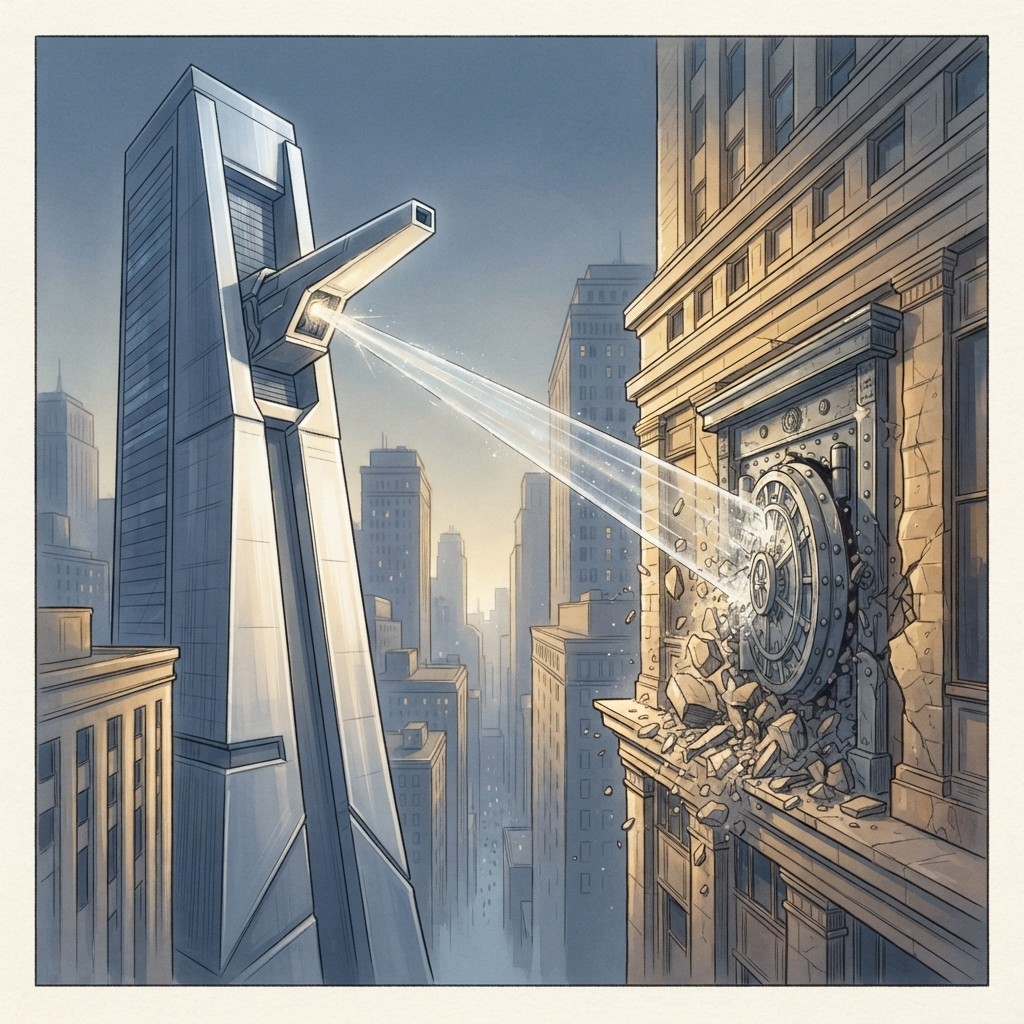
The official story is that Schwab democratized investing — removing 'the final pricing barrier to investing online,' as the press release put it.1 That is the version everyone repeats. It is also the version that misses what actually happened, because the move wasn't generosity. It was a weapon, fired with surgical knowledge of exactly whom it would hit hardest.
Here is the thesis a smart friend could repeat at dinner: Schwab didn't give away trading commissions because it loved its customers. It gave them away because commissions were almost nothing to Schwab and almost everything to its biggest rival — and 54 days later it bought that rival, cheap, after its own bullet had already done the damage.
A cut that costs you 4% and costs your rival 16%
The genius is in the asymmetry. Schwab's CFO disclosed the price tag openly: eliminating online commissions cost roughly $90–100 million per quarter, about 3–4% of total net revenue.2 For a company already living off net interest income on client cash, that was a rounding error — a fee that mattered far less to its earnings than its branding suggested. Schwab could swallow it without flinching.
TD Ameritrade could not. Trading commissions were an estimated 15–16% of its revenue — four times the share they represented for Schwab.4 When Schwab took commissions to zero, it didn't just cut its own price; it set the market price for everyone. TD Ameritrade now had two options, both ruinous: match the cut and detonate a sixth of its income, or refuse and watch its customers walk to a free competitor. There was no third door. That is the difference between a price war and an ambush — in a war, both sides can bleed and keep fighting; in an ambush, one side has already won before the other knows it's been hit.
| Charles Schwab | TD Ameritrade | |
|---|---|---|
| Commissions as share of revenue | ~3–4% | ~15–16% |
| Stock reaction, Oct 1, 2019 | Down ~10% | Down 25.8% (worst day since 1999) |
| Dominant earnings driver | Net interest income | Trading commissions |
| Strategic position after the cut | Wounded, standing | Crippled, for sale |
Where the money actually was
Calling this a 'loss leader' undersells how little was actually lost. Schwab wasn't surrendering a profit center; it was retiring a side fee to capture the thing it really wanted — assets. In the first full month of free trading, October 2019, Schwab added 142,000 new brokerage accounts, up 31% from September, and pushed client assets to a record $3.85 trillion.7 Every one of those new dollars could then earn what commissions never could: net interest on idle cash, the spread Schwab quietly takes between what it pays depositors and what it earns lending and investing their money.
And the trades themselves never became truly free to the system. Schwab's own 10-K notes that 'order flow revenue' — rebates paid by execution venues for the right to fill those orders — remained the most significant component of its 'other revenue.'3 The customer stopped paying a visible $4.95. The order kept paying, just less visibly. Free trading was never the product. It was the bait that fed the machine that actually makes money.
Schwab forfeited a fee worth $90–100M a quarter2 and replaced it with a flood of new assets — 142,000 accounts in one month, a record $3.85 trillion in client assets7 — that earn net interest income, plus order-flow rebates that the visible commission had partly masked.3 The 'sacrifice' was engineered to be small for Schwab while being catastrophic for a rival who depended on the fee.
Fifty-four days from price cut to takeover
This is where the two halves of the story turn out to be one. On November 24, 2019 — just 54 days after the commission announcement — Schwab signed an agreement to acquire TD Ameritrade for roughly $26 billion in stock.5 The deal closed on October 6, 2020, creating a combined firm with about $6 trillion in client assets across 28 million brokerage accounts.6 Treat the price cut and the acquisition as separate events and you miss the entire design. The first move depressed the target's value; the second move bought it at that depressed value. Schwab loaded the deal, then collected. It got to buy its largest competitor partly with the wound it had inflicted on it.
But wasn't Schwab just following Robinhood?
The honest objection cuts hard: Schwab wasn't even first. Robinhood had offered commission-free trading since 2013, and Interactive Brokers launched its own commission-free IBKR Lite days before Schwab's announcement.8 By that reading, Schwab was a cornered incumbent forced to match an inevitable trend — not a strategist firing a planned shot. And that reading is partly right: the trend was real and Schwab did not invent zero.
But being late to a trend and weaponizing it are different acts. The pressure was industry-wide; the timing, the target, and the follow-through were Schwab's. It chose the moment — the same week Chuck Schwab's memoir launched — and it chose to go all the way to zero on equities knowing the asymmetric damage that would land on TD Ameritrade specifically.1 A defensive company matches a price and hopes to survive. Schwab matched the price and had a $26 billion acquisition agreement signed inside two months.5 You don't accidentally turn a forced retreat into the deal of a decade. The trend was the cover. The acquisition was the point.
A price cut isn't a single number — it's a different number for every competitor, weighted by how much each depends on the fee. The strategic move isn't to cut the price that hurts you least in isolation; it's to cut the one where the gap between your pain and your rival's pain is widest. Schwab gave up 3–4% of revenue to take 15–16% out of TD Ameritrade's, and the difference became a takeover price. Before you call a competitor's price cut generous, check whose income statement it actually detonates — and ask what they plan to buy on the way down. The most dangerous loss leader isn't the one that wins customers. It's the one that bankrupts the seller next to you.
Schwab eliminated a fee that was costing its customers $4.95 and costing itself almost nothing — and in the same motion eliminated the independence of its largest competitor. The headlines said democratization. The income statements said something colder: that the cheapest weapon in a market is the fee you can afford to give away and your rival cannot. Schwab didn't lower a price. It found the one number where its own sacrifice and its rival's ruin were furthest apart — and it pulled the trigger.
Profit-Engine Map
A one-page map that pulls a business apart into the hook that gets the customer in the door and the engine that quietly earns the margin. Use it to see where the real profit lives, how the two halves are wired together, and what breaks if the link is cut. Blank to dissect your own P&L; filled as the worked example of a business whose advertised product is not where it makes its money.
Included, filled and blank, in the Loss Leader Casebook. See the set → · Preview the blank →
Sources
Where this comes from — the filings, records, and reporting behind it.
- 1On October 7, 2019, Charles Schwab eliminated online trading commissions for U.S. and Canadian-listed stocks and ETFs, reducing the per-trade commission from $4.95 to zero; options contracts continued to carry a $0.65 per-contract fee.
- 2Eliminating online commissions equated to approximately $90–100 million in quarterly revenue lost, or about 3–4% of Schwab's total net revenue, per CFO Peter Crawford's own disclosure at the time of the announcement.
- 3The 2019 Schwab 10-K confirms that effective October 7, 2019, CS&Co eliminated online trading commissions for U.S. and Canadian-listed stocks and ETFs, and that 'order flow revenue'—rebates from execution venues—continued to be the most significant component of 'other revenue,' documented as a distinct income stream alongside commissions.
- 4Schwab's stock fell approximately 9.7–10% on October 1, 2019; TD Ameritrade fell 25.8% (its worst single day since 1999); E-Trade dropped 16.4%—the asymmetric market reaction reflecting that commissions were ~15–16% of TD Ameritrade's revenue versus only ~3–4% of Schwab's.
- 5The Agreement and Plan of Merger between Charles Schwab and TD Ameritrade was signed on November 24, 2019—just 54 days after Schwab's commission cut announcement—and was amended on May 14, 2020.
- 6Charles Schwab completed its acquisition of TD Ameritrade on October 6, 2020, creating a combined company with approximately $6 trillion in client assets across 28 million brokerage accounts; the deal was an all-stock transaction valued at approximately $26 billion.
- 7In October 2019 (the first full month of zero commissions), Schwab added 142,000 new brokerage accounts—a 31% increase from September and 7% more than October 2018—bringing client assets to a record $3.85 trillion, demonstrating the asset-gathering strategy behind the move.
- 8Interactive Brokers launched its commission-free IBKR Lite service less than a week before Schwab's October 1, 2019 announcement, and Robinhood had offered commission-free trading since its 2013 launch—establishing that Schwab was a fast follower among large incumbents, not the industry's first mover to zero.
Weighing outside help with a decision like this? Hiring a pricing strategy consultant
More like this — beyond Charles Schwab
New Strategically analyses as they publish: the defining moves in business, checked against the record. No noise, and one click to leave.