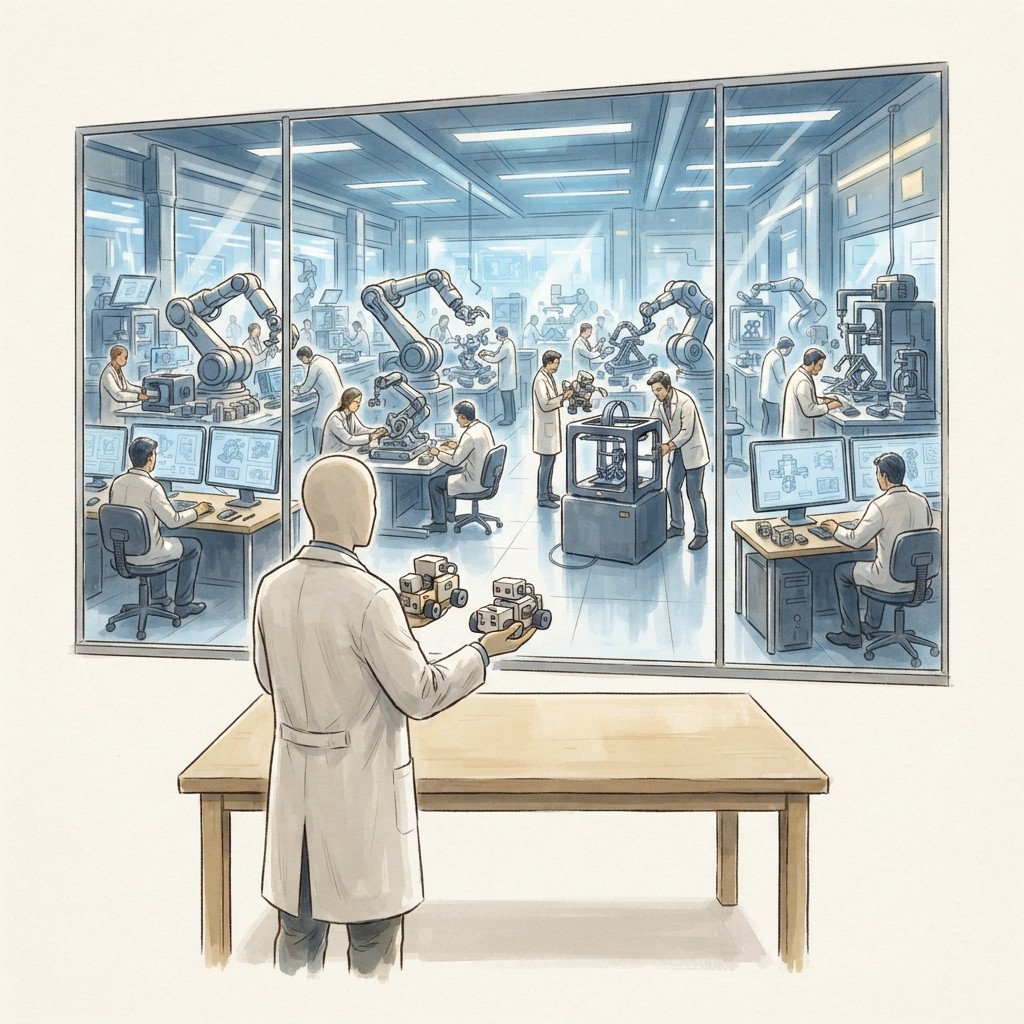
It spent frontier money to train a model, released the full weights for anyone to download, and then said out loud that better models exist. Every instinct says that's a company losing. It's a company selling something else.
Pairs with the Profit-Engine Map — a ready-to-use strategy tool, filled for Thinking Machines Lab. Included in the Loss Leader Casebook →
“What share of the units you sell cheap has to come back for the subsidy to be repaid?”
On July 15, 2026, Thinking Machines Lab did something a company fighting for the AI frontier is not supposed to do. It published a model it had trained from scratch — Inkling, 975 billion parameters, pretrained on 45 trillion tokens of text, images, audio, and video — put the full weights on Hugging Face for anyone to download, and then, in the same announcement, said plainly that it "is not the strongest overall model available today, open or closed."1 Not a leaked benchmark. Not a rival's jab. The lab's own words, on its own launch day. Spend frontier money to build a model, hand the result away for free, and then volunteer that better models exist — every instinct says that is a company losing. It is a company selling something else.
The announcement corrects itself: read as news it's odd; read as strategy it's the tell
Read as an announcement, the post undercuts itself. Read as strategy, that admission is the most important line in it. Because right after conceding Inkling isn't the best, Thinking Machines says what it is for: "a good open-weights base for customization" — "multimodal capabilities, efficient thinking, and availability on Tinker for fine-tuning."1 That last clause is the entire business. Tinker is the lab's actual product: an API for fine-tuning models that it launched nine months earlier, in October 2025.3 Inkling isn't the thing being sold. It's the thing that fills the funnel for the thing being sold.
So here is the thesis, stated once. Thinking Machines is not in the business of selling the smartest model. It is in the business of selling the means to make a model yours — and the free model is the bait. Give the weights away, drive the price of the base to zero, and you don't lose the asset; you enlarge the market for the paid layer that sits on top of it. Strategists have a name for this, borrowed from the software wars: commoditize your complement. Inkling is the complement. Customization is the product.
The factory came before the flagship: they built the paid layer first, then shipped a base tuned to feed it
Look at the order of operations, because it gives away the intent. Tinker shipped first, in October 2025 — "a flexible API for fine-tuning language models" that let teams take existing open-weight models, like Alibaba's Qwen, and bend them to a task while Thinking Machines ran the distributed training as a managed service underneath.3 The factory existed before the lab had a flagship of its own to run through it. Inkling is that flagship: released open, and "available for fine-tuning on Tinker today," with 64K- and 256K-token context options wired in from day one.1 Now the loop closes. The weights are free, so the installed base is as large as it can be. The customization runs on rails Thinking Machines owns and meters. The model is the razor it gives away; the fine-tuning is the blade you keep buying.
The bet underneath all of this is that the frontier is converging. When the best closed model and a strong open one are both good enough for most real work, being the single smartest system stops being a defensible position — the lead is measured in months and erased by the next release. What stays scarce isn't raw capability; it's fit — a model shaped to your data, your policies, your latency and cost budget. Thinking Machines is wagering that value in AI is migrating from the model to the mold: from owning the intelligence to owning the process that adapts it. If that's right, the durable business was never the checkpoint everyone downloads. It's the toolchain they can't easily leave.
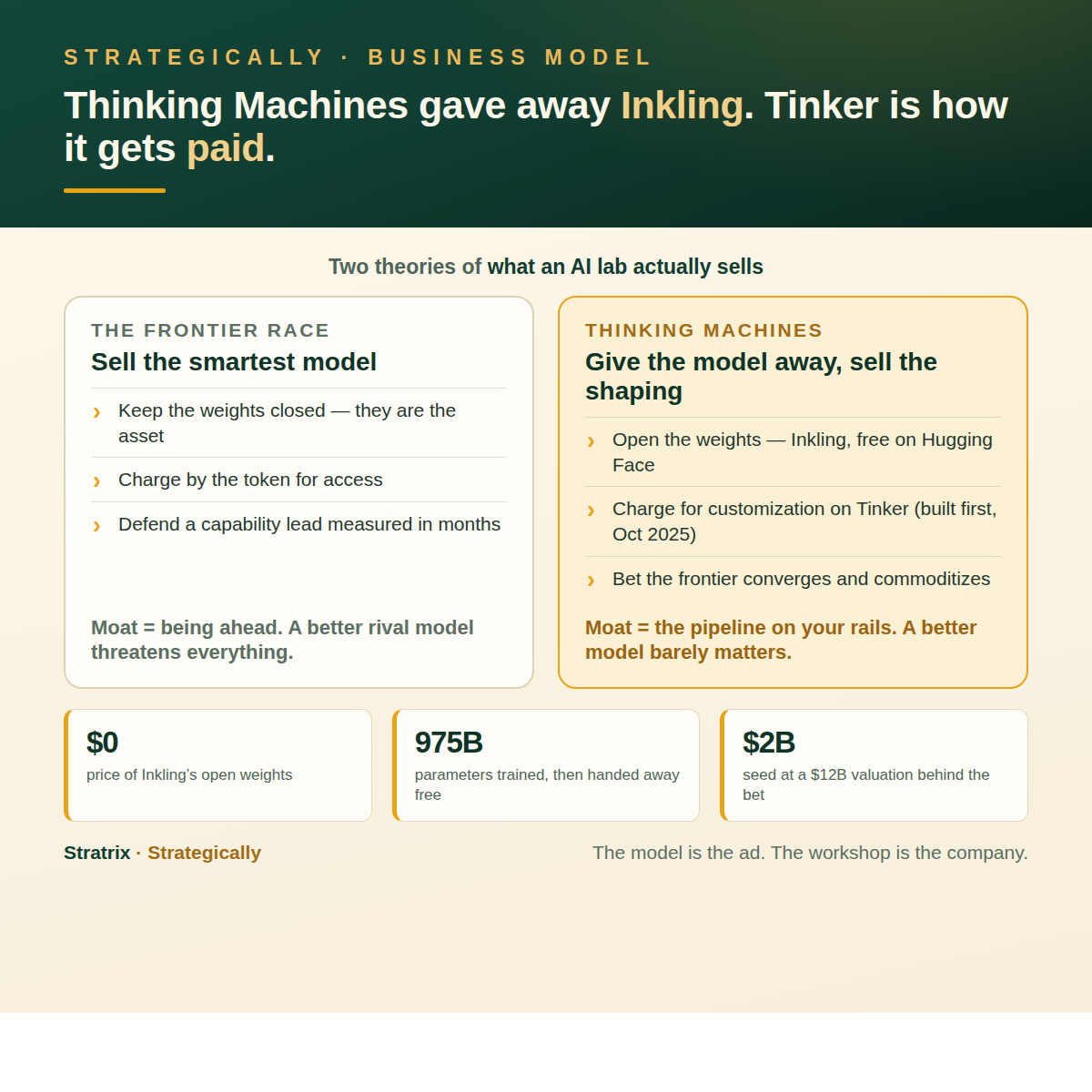
| Model-as-product (closed API) | Model-as-complement (Thinking Machines) | |
|---|---|---|
| What you sell | Access to the smartest model, by the token | The means to customize a model — tooling and compute |
| What you do with the weights | Keep them closed; they are the asset | Give them away; they are the bait |
| Where the moat sits | Being ahead on raw capability | The pipeline customers build on your rails |
| A better rival model does what to you | Threatens the whole business | Barely matters — you sell the shaping, not the model |
| The bet on the frontier | It stays scarce and ownable | It converges and commoditizes |
What this means for everyone else: the move pressures the idea that the model is the moat
This is why Inkling matters beyond Thinking Machines. A lab founded by OpenAI's former chief technology officer, sitting on a $2 billion seed raised at a $12 billion valuation, has looked at the frontier race and decided the defensible position is one layer up — not the model, but the machinery that shapes it.2 That's a vote, from someone who helped build the incumbent, on where the value is going. It splits the industry into two wagers. One camp sells intelligence as a product: keep the model closed, charge by the token, defend a capability lead. The other sells intelligence as a complement: open the model, and charge for the pipeline that adapts and runs it. Meta already gives Llama away — but for ecosystem gravity and recruiting, with nothing it directly sells on top. Thinking Machines' twist is that it built the paid layer first. That is the sharper version of the open bet, and if it works, the uncomfortable lesson for every lab guarding its weights is that the moat was never the weights.
The honest objection: maybe they opened it because they couldn't win the leaderboard
The strongest objection is the least flattering one: Thinking Machines open-sourced Inkling because it couldn't top the charts, and "a good base for customization" is the graceful way to ship a model that isn't the best. There's real weight here. By late 2025 the lab was reportedly in talks to raise at a valuation as high as roughly $50 billion — several times its seed price — and a company carrying that expectation is under enormous pressure to justify it.4 Conceding the benchmark and redirecting to fine-tuning is exactly what a lab does when it can't win on raw capability. Fair. But being behind and being deliberate aren't mutually exclusive — and the sequence rules out the lazy version of the cynical read. A lab merely losing the race does not build a fine-tuning API nine months before it has a model to sell. The constraint may be real; the position is still chosen. Sometimes the constraint is what forces the smarter position.
The second objection is blunter: open weights don't make money — ask Meta, which has given Llama away for years with no direct revenue from the model itself. True, and it's the right thing to be skeptical about. But it misreads the move. Thinking Machines isn't releasing Inkling for goodwill or the recruiting halo. It's releasing it onto a metered platform it owns. The download earns nothing. What you do after the download — the fine-tuning, the compute, the tooling — is the whole point. The weights are the free sample. Tinker is the store.
Thinking Machines' move is a repeatable play, not a one-off. Run it on your own business. (1) Name your complement — the thing customers must have alongside what you sell (for Thinking Machines, the base model; for a razor company, the razor). (2) Ask whether you can drive its price toward zero — open-source it, subsidize it, standardize it. (3) Check that doing so actually raises demand for the thing you charge for (here, customization and compute). (4) Make sure you own that paid layer before you give the complement away — they shipped Tinker first for a reason. It's filled in for them above; leave it blank and run it on yourself.
This piece reads Thinking Machines' strategy from its own public statements and the timing of its products; the company has not framed Inkling in these exact terms, and its internal rationale is not a matter of public record.
Inkling will mostly get filed as another entry in the open-model pile — decent, multimodal, not state of the art, next. That misses what it is. Thinking Machines spent frontier money to build a model, gave it away, and told you it isn't the best, because in its strategy none of that is a contradiction. The model is the advertisement. The workshop behind it is the company.
In a field racing to own the smartest model, Thinking Machines is betting the smartest model won't be the thing anyone pays for — and getting into position to sell the thing they will.
More on giving it away to win
Profit-Engine Map
A one-page map that pulls a business apart into the hook that gets the customer in the door and the engine that quietly earns the margin. Use it to see where the real profit lives, how the two halves are wired together, and what breaks if the link is cut. Blank to dissect your own P&L; filled as the worked example of a business whose advertised product is not where it makes its money.
Included, filled and blank, in the Loss Leader Casebook. See the set → · Preview the blank →
Sources
Where this comes from — the filings, records, and reporting behind it.
- 1Thinking Machines Lab released Inkling on July 15, 2026 — an open-weights, multimodal Mixture-of-Experts model with 975B total parameters (41B active), trained from scratch and pretrained on 45 trillion tokens of text, images, audio, and video, with full weights published on Hugging Face. The announcement states Inkling "is not the strongest overall model available today, open or closed," and positions it as "a good open-weights base for customization: multimodal capabilities, efficient thinking, and availability on Tinker for fine-tuning," adding that Inkling is "available for fine-tuning on Tinker today" with 64K- and 256K-token context options. Company mission: "to build AI that extends human will and judgment."Thinking Machines Lab, Introducing Inkling ↗ · 2026-07-15
- 2Thinking Machines Lab, founded by former OpenAI chief technology officer Mira Murati, raised roughly $2 billion in its seed round at about a $12 billion valuation, reported July 15, 2025 — one of the largest seed rounds in the industry, with investors including Nvidia, Accel, and a16z.
- 3Thinking Machines Lab announced its first product, Tinker, on October 1, 2025, describing it as "a flexible API for fine-tuning language models" that "lets you fine-tune a range of large and small open-weight models, including large mixture-of-experts models such as Qwen-235B-A22B." It is "a managed service that runs on our internal clusters and training infrastructure," handling "scheduling, resource allocation, and failure recovery."Thinking Machines Lab, Announcing Tinker ↗ · 2025-10-01
- 4In November 2025, Thinking Machines Lab was reported to be in talks with investors to raise at a valuation as high as roughly $50 billion — several times its seed valuation of five months earlier.
Weighing outside help with a decision like this? Hiring a pricing strategy consultant
More like this — beyond Thinking Machines Lab
New Strategically analyses as they publish: the defining moves in business, checked against the record. No noise, and one click to leave.