Pairs with the Founder Doctrine Canvas — a ready-to-use strategy tool, filled for Porsche. Included in the The Founder Doctrine Casebook →
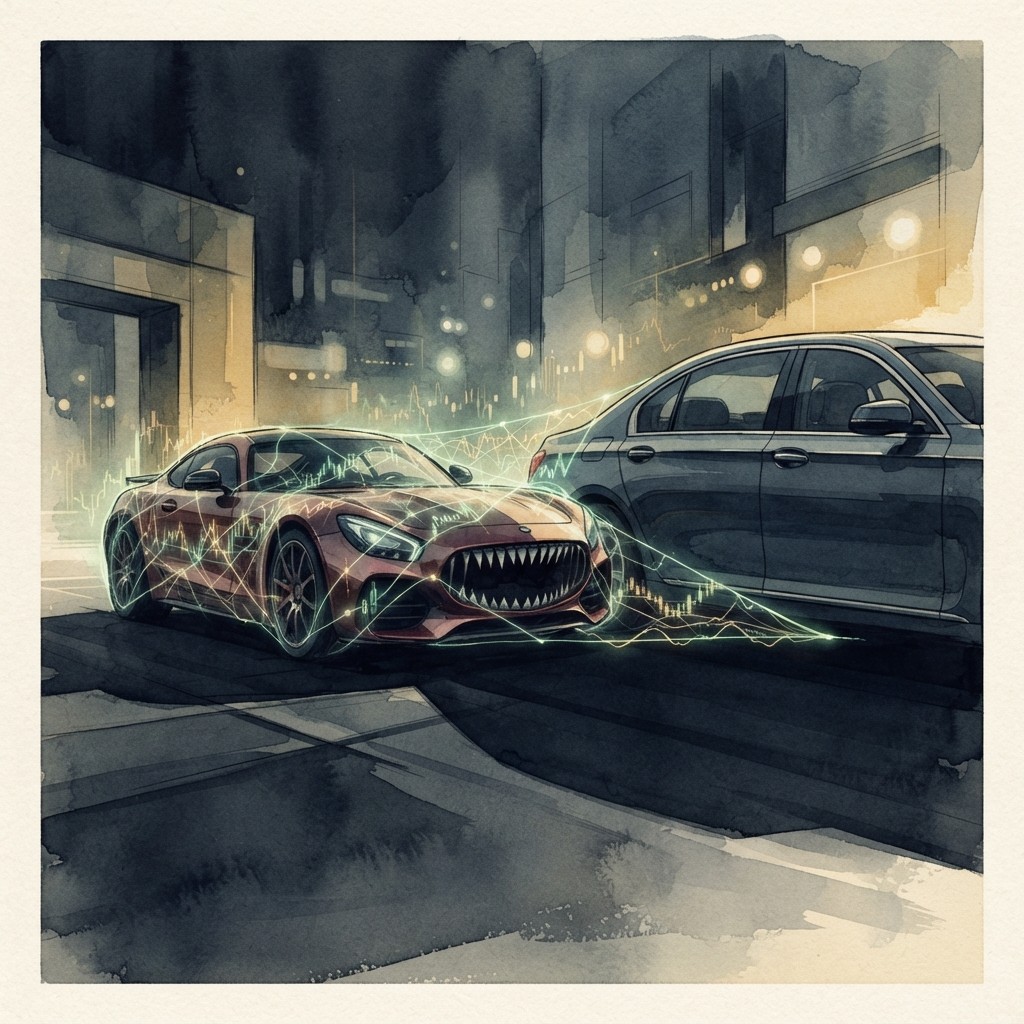
For a few hours on October 28, 2008, a maker of two-door sports cars was, on paper, the most valuable company in the world. Volkswagen shares spiked from around €200 to north of €1,000, briefly making VW worth more than any company on earth - not because VW had invented anything, but because the firm that built the 911 had quietly cornered the float.3 Hedge funds that had bet against VW found there were almost no shares left to buy back. They had been short-selling a stock that no longer traded freely, because someone else held the right to nearly all of it. That someone was Porsche - a company a fraction of VW's size, holding a leash no one could see.
The story everyone tells is that a bold sports-car company tried to swallow the giant that builds the Golf, got greedy, and crashed. Almost every beat of that is the wrong shape. It did not start as a takeover; it started as a defense. The 74% was not ownership; most of it was a bet. And the company that got swallowed in the end was Porsche - by the very giant it had stalked.
It began as a shield, not a sword
Porsche and Volkswagen were never strangers. Porsche GmbH was registered in Stuttgart in 1931 as an engineering and consulting office, and within a few years that office was commissioned to design the original people's car.1 The two companies share an engineering bloodline and a dynasty - the Porsche and Piech families - that runs through both. So when Porsche began buying VW shares in late 2005, it was not a stranger making a move; it was a relative tightening its grip. The first stated motive was defensive: a feared hostile takeover of VW by a larger rival. Porsche took 18.65%, then lifted it to 25.1% by mid-2006 - exactly the threshold that handed it a blocking veto under Germany's VW Law, sitting alongside the state of Lower Saxony.2 At 25.1%, you cannot run a company. But you can make sure no one else does either.
That is where a defensive doctrine quietly became something else. Once you hold the veto, the next logical question is not 'how do I stop a raider' but 'why don't I just take it?' The leadership pivoted from blocking to acquiring. And here the strategy did something genuinely clever and genuinely dangerous: instead of buying VW shares outright on the open market - which would have moved the price against itself and tipped its hand - Porsche built much of its exposure through cash-settled options. These contracts gave it the economics of owning the stock without forcing it to register as the owner.
“Porsche owned directly, or had the right under cash-settled options to purchase, 74.1% of Volkswagen's ordinary shares.”3
Why one sentence detonated the short-sellers
Read that sentence again, slowly, because the entire blow-up lives in the word 'or.' Owned directly, or had the right under options. Porsche's registered direct stake was a little over 42% of VW's ordinary shares. The state of Lower Saxony held roughly another 20% and was not selling. Add Porsche's options exposure and you reach 74.1% - which meant that the genuinely free-floating, buyable VW stock had shrunk to a sliver, perhaps single digits. Now consider the hedge funds. They had sold VW short, betting the inflated price would fall, which means they had borrowed shares they would eventually have to buy back. On October 26, 2008 they learned there were almost none to buy. Everyone trying to close the same trade at once, into a near-empty market, is the textbook definition of a short squeeze - and this was the cleanest one ever run on a major stock.3 The price did not climb; it erupted.
| What the headline said | What was really there | |
|---|---|---|
| The number | Porsche controls 74.1% of VW | Owned-or-optioned 74.1% |
| Registered ownership | Implied: three-quarters | Roughly 42% of ordinary shares |
| The rest | — | Derivative exposure, not shares |
| Effect on short-sellers | Nasty surprise | Almost no float left to buy back |
The squeeze did something the cars never could: it made the trade itself the business. Academic analysis of the episode estimates the squeeze produced a profit of at least €6 billion for Porsche - enough, the researchers argue, to have saved it from insolvency at the time - and concludes the maneuver amounted to a manipulation under German law that went unenforced.4 That figure is an estimate from a Harvard Law Forum paper working from hand-collected data, not a line item Porsche ever published. But the direction is clear: for one quarter, a sports-car maker's biggest product was a derivatives position.
The leash snapped back the other way
Here is the part the legend forgets. To build a 42% stake plus a wall of options on a company many times its size, Porsche had borrowed enormously. When credit markets froze in the financial crisis, the leverage that made the squeeze possible became the noose. By July 2009 Porsche SE was sitting on debts exceeding €10 billion.5 The hunter could no longer carry the gun. So the relationship inverted in the most humbling way available: rather than Porsche absorbing VW, VW's supervisory board signed an agreement in August 2009 to fold Porsche AG into an integrated group led by Volkswagen, and VW bought 49.9% of the car-making business that December for €3.9 billion.5 The remaining 50.1% followed - completed on August 1, 2012 - and, tellingly, it was structured not as a takeover but as a 'reorganisation,' executed by transferring a single share, precisely to sidestep a German tax liability.6 Even the endgame was an engineering trick.
So who actually won? It's still ambiguous
The fair objection is that this all reads too neatly as a morality tale - hubris punished, the giant restored, the upstart humbled. But the cleanest evidence against tidy framing is the law. Hedge funds that lost fortunes sued in German courts and lost. And in March 2016 the Regional Court of Stuttgart acquitted former CEO Wendelin Wiedeking and CFO Holger Härter of criminal market manipulation; the presiding judge said a conviction would not have been 'rationally justifiable.'7 The most aggressive trade in modern auto history was ruled, by a court, to be inside the lines. 'Manipulation' is the academic verdict, not the legal one.
And the deeper objection to 'VW won' is the one almost everyone misses: look at who holds the controls today. Porsche SE - the family holding company, the same vehicle that ran the squeeze - still holds roughly 53% of VW's voting rights, about 31.9% of its equity, plus a direct 12.5% stake in Porsche AG.8 So VW bought the sports-car company, but the family that owns Porsche SE still owns the votes that run VW. The acquirer is controlled by the company it acquired. 'Who owns whom' was never resolved; it was just relocated up one level, to a holding company most car buyers have never heard of.
The same leverage that lets a small player corner something huge is the leverage that destroys it the moment conditions turn. Porsche's options stake was brilliant precisely because it was borrowed - it controlled exposure far beyond its own balance sheet without tipping the market. But borrowed exposure has a second edge: when credit froze, the position that made Porsche the apparent victor became the debt that forced it to be sold. If your winning move only works while you can keep rolling the financing, you don't own the position - the position owns you. Ask not 'what does this control on a good day' but 'who's holding the leverage on the worst day.'
The legend says Porsche bit off more than it could chew and VW swallowed it whole. The truth is stranger and more useful: a sports-car maker turned itself into a hedge fund for one extraordinary quarter, won a trade that may have briefly saved it, then lost the company to the debt that trade required - while the founding family kept its hands on the wheel of everything. They didn't take over Volkswagen. They never let go of it. The cars were always the smaller part of the story; the control was the asset, and the control never moved. It just changed which floor of the building it was kept on.
When founders fight over who really owns the company
Founder Doctrine Canvas
A one-page canvas for the operating system inside a founder's head: the principles they hold, the formative experiences that forged them, and the specific strategic moves each principle produces. Blank to make your own decision rules legible to the people who execute them; filled as the worked example showing why the story's company keeps making the bets it makes — because the founder can't make any others.
Included, filled and blank, in the The Founder Doctrine Casebook. See the set → · Preview the blank →
Sources
Where this comes from — the filings, records, and reporting behind it.
- 1Porsche GmbH was entered in the commercial register in Stuttgart on April 25, 1931, co-founded by Ferdinand Porsche with Anton Piëch and Adolf Rosenberger, initially offering engineering and consulting services.
- 2In late 2005, Porsche took an 18.65% stake in VW to block a feared hostile takeover; by June 2006 this rose to 25.1%, giving Porsche the veto right under the VW Law alongside Lower Saxony.
- 3On October 26, 2008, Porsche SE announced it owned directly, or had the right under cash-settled options to purchase, 74.1% of VW's ordinary shares, triggering a short squeeze that drove VW stock from ~€200 to over €1,000 on October 28, 2008.
- 4Academic analysis estimates the short squeeze resulted in a profit of at least €6 billion for Porsche, potentially saving it from insolvency; the paper argues the squeeze was a manipulation under German law that was not effectively enforced.
- 5By July 2009, Porsche SE faced debts exceeding €10 billion; on August 13, 2009, VW's supervisory board signed an agreement to create an 'integrated automotive group' with Porsche AG led by Volkswagen. VW acquired 49.9% of Porsche AG in December 2009 for €3.9 billion.
- 6On July 5, 2012 VW announced a deal to acquire the remaining 50.1% of Porsche AG; full ownership completed August 1, 2012. The deal was structured as a 'reorganisation' (single share transfer) rather than a takeover under German law to manage tax liability.
- 7Former Porsche CEO Wendelin Wiedeking and CFO Holger Härter were acquitted by the Regional Court of Stuttgart of criminal market manipulation charges in March 2016; the presiding judge said a conviction would not have been 'rationally justifiable.'
- 8Porsche SE holds approximately 53% of VW voting rights and roughly 31.9% of equity (as of 2024), plus a direct 12.5% stake in Porsche AG — meaning the Porsche–Piëch family retains ultimate control of VW Group even after VW 'acquired' Porsche AG.
More like this — beyond Porsche
New Strategically analyses as they publish: the defining moves in business, checked against the record. No noise, and one click to leave.