Pairs with the Cannibalization Decision Tree — a ready-to-use strategy tool. Included in the The Cannibalization Choice Casebook →
In 1993, the most worshipped sports car in the world was a near-corpse. Porsche's global unit sales had fallen from more than 50,000 a year in the mid-1980s to just over 14,000, and in North America the company sold somewhere in the low thousands - one source pegs it at roughly 3,713 cars for the year.4 Industry experts expected Porsche to vanish, swallowed by Volkswagen or Daimler-Benz.3 The 911, the icon, the whole reason the brand had a soul, was the thing dragging it under. A decade later Porsche was building a heavy, tall, deeply un-sporty SUV - and that machine is what kept the 911 alive.
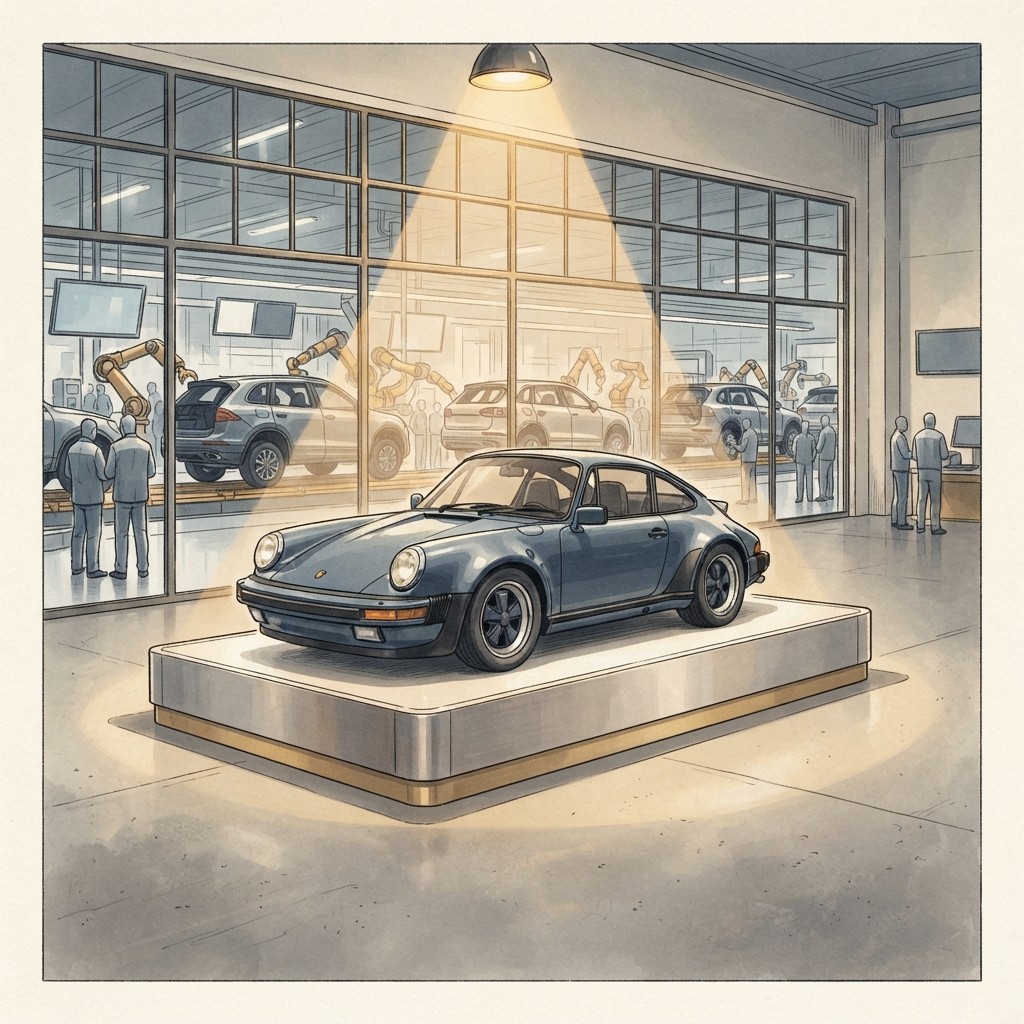
The story everyone tells is that the Cayenne cannibalized Porsche's identity to save its balance sheet - that the SUV betrayed the sports car. The truth runs the opposite direction. The 911 was never the cash cow the legend assumes; by 1993 it was the distressed asset. The Cayenne didn't disrupt the cash engine. It became one - so the 911 never had to be.
The icon was the patient, not the donor
When Wendelin Wiedeking took over as CEO in September 1992, his job was to keep Porsche from disappearing.3 The recovery came in two waves, and conflating them is how the myth got built. First the Boxster, in the late 1990s, stabilized the company - Porsche's own filings show group sales climbing from about €2.1 billion in 1996/97 toward €4.9 billion by 2005/06, a recovery that was already underway before the Cayenne existed.2 Then, in 2003, the SUV poured fuel on the fire. This sequencing matters because it kills the tidy 'Cayenne saved everything' narrative and reveals the real strategy: Porsche was deliberately building profit engines that were not the 911, so the 911 could be something other than a profit engine.
Porsche said as much itself, in plain corporate language. Management concluded that 'the legendary 911 and the new mid-engined model alone would not be able to lead the company into a secure future,' and the plan for a 'third Porsche' - the Cayenne - was a conscious management decision, not an accident of the market.8 Read that carefully. This is not a company stumbling backward into an SUV. It is a company that looked at its own crown jewel, judged it incapable of carrying the firm, and went looking for something that could.
“The legendary 911 and the new mid-engined model alone would not be able to lead the company into a secure future.”8
The math of a deliberate cross-subsidy
The Cayenne worked because it sold like nothing Porsche had ever made. The first generation was engineered seriously - around 300 engineers built its platform at Porsche's own Weissach facility, not a VW parts bin - and it went on to sell more than 275,000 units across eight model years, against an internal projection of just 25,000 a year.5 By FY2003/04 the ramp was already brutal: 41,149 Cayennes produced, up 65% in a single year, dragging group turnover up 13.9% to €6.359 billion and delivering €488 million in after-tax earnings.1 That is the donor organ. The 911, meanwhile, got to keep being the 911 — low-volume, uncompromising, a high-margin product by design but never required to carry the company's volume-driven costs on its own. The SUV's volume bought the icon its freedom.
| The 911 | The Cayenne | |
|---|---|---|
| Role Porsche assigned it | Halo / identity | Profit engine |
| Volume expectation | Low, protected | High, scalable |
| What it had to carry | The brand's soul | The brand's balance sheet |
| By the mid-2000s | Kept alive, uncompromised | The thing keeping it alive |
The structure held for twenty years. In 2024 Porsche posted €40.1 billion in group revenue at a 14.1% operating return on sales, and the single best-selling model in the lineup was - still - the Cayenne, at 102,889 deliveries.6 The same machine that was supposed to be a one-time rescue became the permanent foundation. The reframe is the whole point: Porsche never disrupted its cash cow. It manufactured a new cash cow on purpose, and turned the old icon into a monument it could afford to keep.
Then it tried the same trick before the engine was ready
Here is where the strategy that saved Porsche becomes the strategy that is now hurting it. The 2003 bet had a specific shape: the new profit engine arrived first, then the company leaned on it. The electric bet inverted that order. Porsche committed hard to electrification — and then acknowledged that its original EV targets had been too ambitious, abandoning an 80% full-electric sales target for 2030 — before the electric Cayenne successor had actually arrived to absorb the cost: the car premiered only in November 2025 and began reaching customers in 2026.1011 The result reads like 1993 with better fonts: 2025 profit after tax collapsed about 91% to €310 million, with revenue down roughly 10% to €36.3 billion.9 A company that once perfected the cross-subsidy made a single large product bet with no funded engine underneath it.
The Cayenne worked because the order of operations was right: build the profit engine, prove it sells, then use its cash to protect the thing you love. The danger isn't betting big on the future - it's betting big on the future before the cash engine meant to fund it is actually running. Porsche in 2003 had a 275,000-unit SUV in hand before it relaxed about the 911. Porsche in 2025 had ambitious EV targets and an electric Cayenne that would not reach customers until 2026.[[cite:s11]] Same company, same instinct, opposite sequence - and the sequence is the strategy.
Wasn't the SUV obviously the easy money all along?
The fair objection is that there was nothing clever here - SUVs print money, everyone eventually built one, and calling it a 'deliberate cross-subsidy' dresses up the obvious. Partly true. But the easy-money read misses what Porsche refused to do, which is the actual decision. A purely financial company would have let the Cayenne's profitability pull the whole brand toward volume and away from the unprofitable, uncompromising 911. Plenty of carmakers have quietly hollowed out their halo to chase margin. Porsche did the harder thing: it ring-fenced the icon and let the SUV pay the bill, treating the 911 as a permanent cost center worth subsidizing rather than a product to optimize. That is a choice, not an accident - and the 2025 stumble is the proof, because it shows the strategy can be run badly. If the cross-subsidy were automatic, the EV bet would not be faltering.
Porsche's real genius was never the sports car. It was the willingness to build something it didn't romanticize - a tall, heavy SUV - so that the thing it did romanticize could survive untouched. The Cayenne is the donor; the 911 is the patient who got to stay beautiful. The lesson is in the order: you can fund a monument with a money machine, but only if you build the machine first. Porsche learned that in 1993, perfected it in 2003, and seems to have forgotten it in 2025 - the same bet, run in the wrong sequence, costing 91% of the profit it was supposed to protect.
When a company has to feed one product with another
Cannibalization Decision Tree
A decision tree for the moment the new thing threatens the cash cow: is the disruption real, will someone else do it if you don't, and can you afford to bleed your own margin to own the future? Blank to run on your own line; filled as the worked example tracing how the story's incumbent chose to cannibalize — or flinched and got cannibalized.
Included, filled and blank, in the The Cannibalization Choice Casebook. See the set → · Preview the blank →
Sources
Where this comes from — the filings, records, and reporting behind it.
- 1In FY2003/04, Cayenne production was 41,149 units (up 65.1% from 24,925 units), group turnover rose 13.9% to €6.359 billion driven by Cayenne volume, and after-tax earnings were €488 million.
- 2Porsche AG group sales grew from €2,093.3 million in 1996/97 to €4,857.3 million by 2005/06, a trajectory that predates the Cayenne and began with the Boxster.
- 3In September 1992, Wendelin Wiedeking became CEO to rescue Porsche, which had experienced severe sales collapse; industry experts expected Porsche to disappear or be absorbed by Volkswagen or Daimler-Benz.
- 4Porsche's global unit sales fell from over 50,000 per year in the mid-1980s to just over 14,000 by 1993; North American sales in 1993 were approximately 3,713 vehicles.
- 5The first-generation Cayenne's PL71 platform was developed by ~300 engineers at Porsche's Weissach facility (not VW); the first generation sold over 275,000 units across eight model years, exceeding Porsche's own projection of 25,000 units per year.
- 6Porsche AG 2024 full-year results: group revenue €40.1 billion, operating return on sales 14.1%, Cayenne global deliveries led all models at 102,889 units.
- 7Porsche's 2025 profit after tax fell 91.4% to €310 million (from ~€3.6 billion in 2024), revenue dropped ~10% to €36.3 billion, and the company acknowledged its original EV targets were too ambitious — a direct structural repeat of 1990s-style over-reliance on a single product bet.Motor1, Porsche Sales Slipped Early In 2026 ↗ · 2026-04-12
- 8Porsche itself stated internally that 'the legendary 911 and the new mid-engined model alone would not be able to lead the company into a secure future' — and that plans for a 'third Porsche' (the Cayenne) were a deliberate management decision, not an accidental disruption.
- 9Porsche AG FY2025: group sales revenue €36.27 billion (down from €40.08 billion in 2024), group operating profit €413 million, profit after tax €310 million, group operating return on sales 1.1%.
- 10Porsche abandoned its ambitious target of achieving 80 percent full-electric sales by 2030, acknowledging a longer-than-expected transition phase in global markets.Finews, Porsche: 911 Remains Profit Engine ↗ · 2025-03-24
- 11The Cayenne Electric celebrated its world premiere on 19 November 2025, with production in Bratislava already started and global deliveries expected mid-2026.
More like this — beyond Porsche
New Strategically analyses as they publish: the defining moves in business, checked against the record. No noise, and one click to leave.