Pairs with the Founder Doctrine Canvas — a ready-to-use strategy tool. Included in the The Founder Doctrine Casebook →
In June 2019, a man on the internet bought about $53,000 of stock in a dying mall retailer at roughly $5 a share and started posting his account screenshots on a forum.6 Eighteen months later that position was worth nearly $48 million, hedge funds were down billions, and a chain of stores that sold used video games had become the most famous ticker on earth.6 The story got told as a revolution: the little guy beat Wall Street, the company was saved. Look at the income statement, though, and a different story shows up — one where the saga delivered GameStop almost everything except a working business.
The official narrative is that Ryan Cohen turned GameStop around. He didn't — not in the way that word usually means. He stabilized the patient and stopped the bleeding, and that is a real achievement. But the core retail business has shrunk every single year he has been near it. What got fixed was the balance sheet. What got hidden was the decline.
The squeeze was a financing event in disguise
Here is the mechanism almost everyone skips. By January 22, 2021, roughly 140% of GameStop's public float had been sold short — meaning some borrowed shares had been re-lent and shorted a second time, a configuration Goldman Sachs later noted had appeared only about fifteen times in the prior decade.4 When the price ran, those shorts had to buy back shares that, in effect, didn't exist, and the buying fed on itself. The closing high hit $347.51 on January 27, and the next day's intraday print reached roughly $483 before the whole structure collapsed.5 (The widely-repeated 'over $500' is a pre-market quote, not an exchange print.) The damage was real: Melvin Capital lost 53% of its assets in a month and took a $2 billion lifeline from Citadel and its partners, with Point72 adding $750 million separately.7
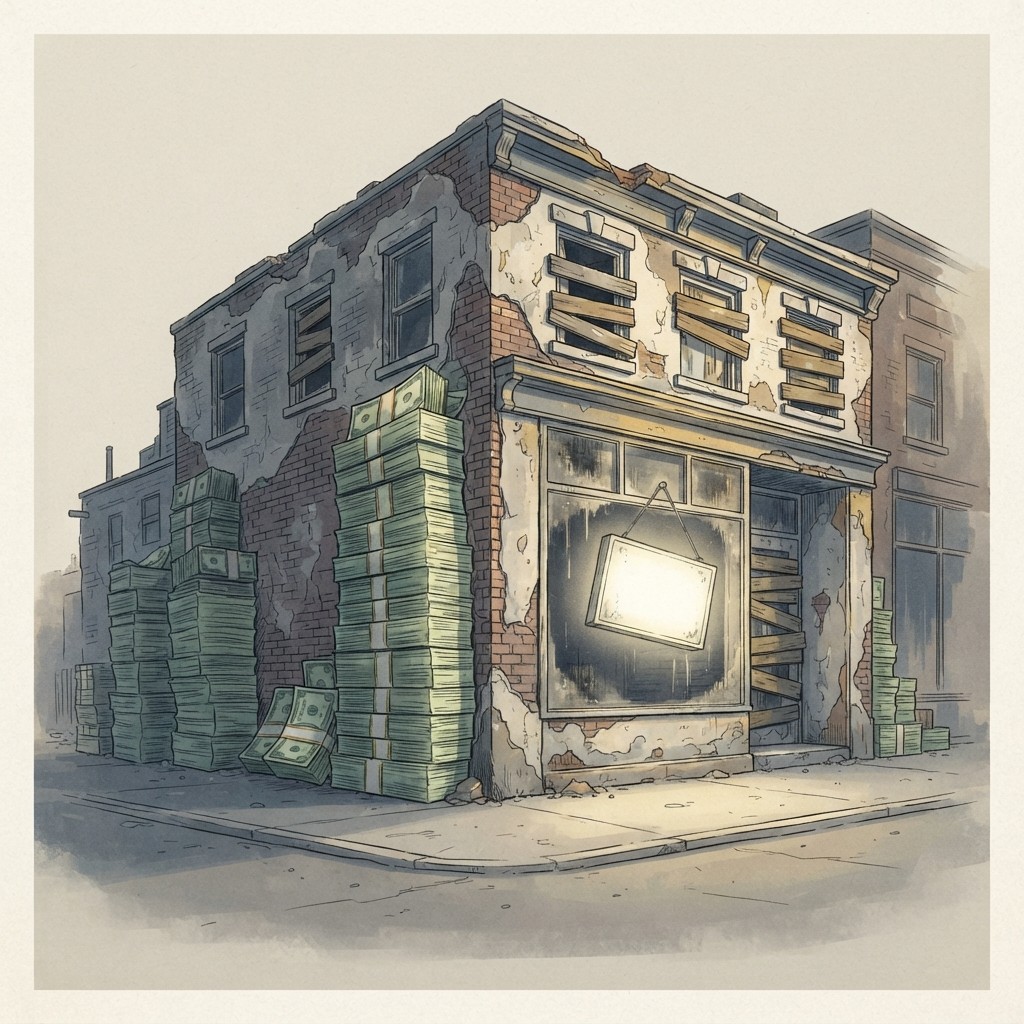
But the part that mattered for GameStop the company was quieter. A stock trading at fifty times its rational price is free capital waiting to be picked up, and management eventually did — selling new shares into the frenzy — twice in 2021, raising roughly $551 million in April and $1.13 billion in June through at-the-market equity offerings.910 The meme didn't save the stores. It handed the company a war chest. That distinction is the whole thesis.
“By March 2021, short interest had collapsed to roughly 15% of float — down from about 140% at the peak in late January.”5
The man who arrived a year before the headlines
The compressed legend says Cohen showed up as an activist in January 2021 and instantly took control. The filings say otherwise. RC Ventures disclosed an initial 9.98% stake on August 28, 2020, paying roughly $39 million for about 6.5 million shares.1 He raised it to 12.9% that December.2 The January 2021 milestone was a board seat — not his first share. He wasn't elected chairman until June 2021, and wasn't named CEO until September 2023, a two-and-a-half-year gap the popular telling erases.3 Cohen built his position before the meme, not because of it. The crowd that thought it discovered GameStop arrived after the smartest patient money was already inside.
| The popular story | What the filings show | |
|---|---|---|
| When Cohen first bought | January 2021 | August 2020 (9.98% stake) |
| What January 2021 was | His initial stake | His board seat |
| When he became CEO | Right away | September 2023 |
| Keith Gill | Amateur with $53k | Licensed adviser at MassMutual |
Even the folk hero was more than the costume suggested. Keith Gill held multiple FINRA licenses and worked as a registered representative6 — MassMutual was later fined $4 million for failing to supervise his trading and online activity.6 He really did turn ~$53,000 into ~$48 million, and no federal manipulation charges resulted from his trading.66 But 'amateur' was the brand, not the résumé.
What got fixed, and what kept falling
Now the income statement, which is where the turnaround thesis goes to die. Net sales were $6.01 billion in FY2021 and $5.93 billion in FY2022; they fell further to $5.27 billion in FY2023 and $3.82 billion in FY2024.11128 Every year Cohen has been involved, the top line has shrunk. What he genuinely did was cut: SG&A fell from roughly $1.7 billion to about $950 million, and the company swung from a $381 million net loss to net income near $422 million.8 That is not nothing. But you cannot shrink your way to growth forever, and a profit that comes from a smaller cost base plus investment income on a hoard of cash is not the same animal as a profit that comes from selling more games. One is operating recovery. The other is financial engineering on a melting asset.
Cohen's compensation tells you exactly which game he thinks he's playing. He takes no salary, no cash bonus, no time-vested stock; his January 2026 option award vests only if market cap hits $100 billion and cumulative EBITDA hits $10 billion.3 Those are not retail-turnaround numbers — they are venture-scale numbers. The wager isn't that GameStop sells more games. It's that the cash pile, funded by the squeeze, gets deployed into something that does.
The honest case that Cohen is right anyway
The strongest counter deserves a fair hearing: maybe a turnaround was never the point. Cohen may have looked at a structurally doomed retailer and concluded the smartest move was to monetize the one asset it suddenly had — a cult following willing to fund it — and convert dying stores into a balance sheet that buys time and options. By that logic, cutting SG&A in half while the meme financed a war chest isn't a failed recovery; it's a deliberate pivot from operating company to capital allocator, with the stores as a melting ice cube he is happy to let melt. His pay package, which rewards only a hundred-billion-dollar outcome, fits that reading exactly. The objection holds only if you keep grading him on a retail recovery he may never have been attempting. The trouble is that the optionality is unproven and the reflexivity is fragile: a cash hoard is potential energy, and so far the only thing it has reliably produced is interest income. The bet might pay. It just hasn't yet, and the core keeps shrinking while everyone waits.
When a struggling business gets a windfall — a meme rally, a SPAC, a bidding war — the windfall fixes the balance sheet, not the business. Those are two different patients. Cost-cutting and a cash cushion can buy years; they cannot manufacture demand for a product the market is leaving behind. Before you call it a turnaround, separate the two lines: is the company earning more because it sells more, or because it spends less and collects interest? GameStop's profit came from the second. A real recovery shows up on the top line — and that line has gone the wrong way every year. The cash bought optionality, which is valuable and entirely unproven. Grade the recovery on revenue, and grade the windfall on what it gets deployed into. Confusing the two is how a survival story gets mistaken for a comeback.
GameStop got the most improbable gift in modern markets: a crowd that loved it enough to hand it a fortune for stock in stores it never visited. Cohen took the gift seriously — he stopped the losses, banked the cash, and tied his own payday to an outcome that would dwarf the company's entire history. But strip away the cash hoard and the interest it throws off, and what's left is a retailer that sells a little less every year. The meme didn't reverse the decline. It bought the company a very expensive seat from which to keep watching it — and a single, enormous bet that the watching turns into something else before the melting finishes.
When the story and the numbers disagree
Founder Doctrine Canvas
A one-page canvas for the operating system inside a founder's head: the principles they hold, the formative experiences that forged them, and the specific strategic moves each principle produces. Blank to make your own decision rules legible to the people who execute them; filled as the worked example showing why the story's company keeps making the bets it makes — because the founder can't make any others.
Included, filled and blank, in the The Founder Doctrine Casebook. See the set → · Preview the blank →
Sources
Where this comes from — the filings, records, and reporting behind it.
- 1RC Ventures (Ryan Cohen) filed its initial Schedule 13D on August 28, 2020, disclosing 6,500,000 shares constituting approximately 9.98% of GameStop outstanding common stock, purchased for approximately $38,896,391.
- 2RC Ventures increased its GameStop stake to 9,001,000 shares constituting approximately 12.9% of shares outstanding, per Amendment No. 4 to the Schedule 13D filed December 2020.
- 3Ryan Cohen has been a Board member since January 2021, was elected Chairman in June 2021, and was appointed CEO in September 2023. He receives no salary, cash bonuses, or time-vested stock; his January 2026 option award vests only if market cap reaches $100 billion and cumulative EBITDA reaches $10 billion.
- 4On January 22, 2021, approximately 140% of GameStop's public float had been sold short (some shorted shares had been re-lent and shorted again). Goldman Sachs later noted short interest exceeding 100% of float had occurred only 15 times in the prior decade.
- 5GME's closing high during the January 2021 squeeze was $347.51 on January 27, 2021. The intraday high on January 28, 2021 was approximately $483; pre-market quotes briefly exceeded $500. By March 2021, short interest had collapsed to approximately 15% of float.
- 6Keith Gill ('DeepFuckingValue' / 'Roaring Kitty') posted a ~$53,000 long position in GameStop on r/wallstreetbets in September 2019; he began investing in June 2019 when the stock was ~$5/share. By January 27, 2021, his position was worth nearly $48 million. He held FINRA licenses and was employed at MassMutual, which was fined $4 million in September 2021 for failing to supervise his activities.Wikipedia, Keith Gill ↗ · 2024
- 7Citadel and partners invested $2 billion in Melvin Capital, while Point72 Asset Management separately invested $750 million, for a combined total of $2.75 billion, after Melvin lost 53% of its investments by end of January 2021.
- 8GameStop net sales: FY2020 $5,089.8M; FY2021 $6,010.7M; FY2022 $5,927.2M (per GameStop 10-K filed with SEC). GameStop transitioned from a net loss of $381.3M in FY2021 to net income of $421.8M for the trailing four fiscal quarters as of early 2026, with SG&A declining from ~$1.7B to ~$950.8M over the same period.
- 9GameStop completed its first at-the-market equity offering program in April 2021, selling 3,500,000 shares and generating approximately $551 million in gross proceeds, filed under SEC prospectus supplement dated April 5, 2021.
- 10GameStop sold 5 million additional shares in a second at-the-market equity offering completed June 22, 2021, raising $1.13 billion in gross proceeds to accelerate growth and strengthen its balance sheet.
- 11GameStop net sales for fiscal year 2023 (ended February 3, 2024) were $5.273 billion, down from $5.927 billion in fiscal year 2022.
- 12GameStop net sales for fiscal year 2024 decreased to $3.823 billion from $5.273 billion in fiscal year 2023.
More like this — beyond GameStop
New Strategically analyses as they publish: the defining moves in business, checked against the record. No noise, and one click to leave.