Pairs with the Founder Doctrine Canvas — a ready-to-use strategy tool, filled for WeWork. Included in the Founder Doctrine Casebook →
“What does holding control cost you, and what must it be worth?”
On August 14, 2019, WeWork's parent company filed the prospectus that was supposed to make it a public company, and buried inside the disclosures was a number that decided everything: 20. As in twenty votes per share. Adam Neumann held roughly 112.5 million of one supervoting class and all of another, which meant that on any question put to the company — who sits on the board, who runs it, whether to fire the man who built it — Neumann alone could outvote every other shareholder combined.1 WeWork is remembered as a real-estate company that lit money on fire. That is the symptom. The disease was that one person had wired himself a permanent override switch, and nobody could reach it.
The official story is that WeWork failed because its business model never worked — it signed long leases and sold short ones, and the math never closed. True enough, and not the point. Plenty of companies run bad math for years while a board, an investor base, or a public market quietly grinds the operator toward discipline. WeWork's structure disabled all three at once. The model didn't kill WeWork. The model was allowed to run unchecked because the controls had been switched off by design.
A company built to take orders from one shareholder
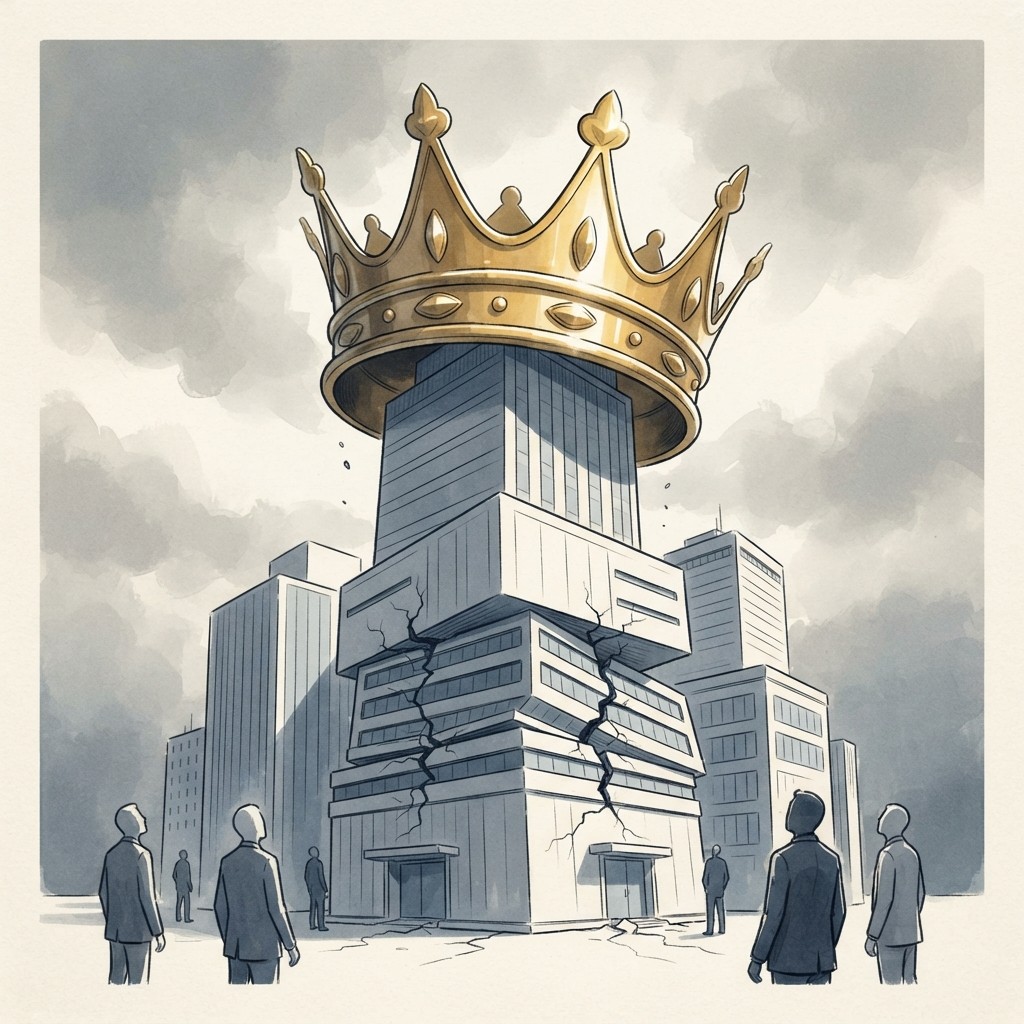
Here is the thesis, plainly: WeWork's collapse was a founder-control failure before it was a business-model failure. A multi-class share structure handed Neumann sovereignty over the board, the investors, and — had the listing gone through — the public market itself. The S-1 didn't just disclose risky economics; it disclosed a governance design in which the person whose judgment most needed checking was the one person who could not be checked.1 When the public read that filing, they were not asked to buy a company. They were asked to buy a monarchy and hope the king was sound.
The trademark episode is the whole doctrine in miniature. WeWork had paid $5.9 million for rights to the word 'We' — not in cash, but in partnership interests — and the money went to We Holdings LLC, a private vehicle where Neumann was managing member alongside co-founder Miguel McKelvey. The company called it fair market value, citing a third-party appraisal.3 The popular telling — that Neumann sold his own company a word for millions in cash — is wrong on the cash and wrong on the finality. But the structural truth underneath it is exactly right: a man with majority votes was on both sides of a deal with the company he controlled, and the only thing that unwound it was his own decision to unwind it. The interests were returned, the filing noted, 'at Adam's direction.'2 Not the board's. His.
“The $5.9 million in partnership interests was returned to the company at Adam's direction.”2
What the market did the instant it could push back
The mechanism reveals itself in the speed of the correction. The original filing gave Neumann's high-vote shares 20 votes each. Within weeks of investor backlash, the amended September filing cut that to 10 votes per share, added the board's first female director, and forced the trademark money back.2 Notice what every one of those concessions has in common: they are all reductions in founder control. The market wasn't haggling over the leasing math. It was haggling over the override switch. And it kept finding the price unacceptable — the S-1 was withdrawn on September 30, and the company that had been valued in the tens of billions could not be sold to the public at any price the public would pay.2 That is the tell. When the only variable a market will negotiate is how much power to strip from the founder, the founder's power was the thing being priced all along.
| Check | What it normally does | Why it failed at WeWork |
|---|---|---|
| The board | Hires and fires the CEO | Founder held majority votes; the board served at his discretion |
| Institutional investors | Demand discipline as a condition of capital | Could fund but not govern; their shares were outvoted |
| The public market | Prices risk, including governance risk | Refused the terms — the IPO was pulled before it could |
| The founder himself | Self-restraint | The trademark and lease deals showed the limit of that |
Sovereignty is free to grant and expensive to take back
Control of this kind is given away in a single clause of incorporation and recovered only at war. When SoftBank moved to remove Neumann in October 2019, the headline price of buying out his power was reported at $1.7 billion — roughly a billion to purchase his equity, a $500 million loan, and a $185 million consulting fee.4 That number entered legend as Neumann's payout. It was never that. SoftBank tried to walk away from the offer, WeWork and Neumann sued, and the fight ended in a February 2021 Delaware Chancery settlement on materially smaller terms — around $480 million in stock sold, $50 million in legal fees, a $50 million non-compete, and a loan extension.5 The lesson isn't the size of either figure. It's that the company had to spend hundreds of millions and a courtroom fight to undo a control structure it had created for free. That gap — between the cost of granting sovereignty and the cost of reclaiming it — is the entire economics of founder doctrine.
Watch what got rebuilt after he was gone, because architecture confesses what speeches won't. When SoftBank later took its dominant position, its own proxy agreement with WeWork capped its effective voting power at 49.90% — anything above that was automatically proxied out to a WeWork executive in proportion to how other shareholders voted.8 Read that again. The institution that had bankrolled the whole experiment voluntarily fenced itself below majority control. The company had lived through what unchecked sovereignty does, and the first thing it did with its new ownership was build a wall to keep any single holder from ever standing where Neumann had stood.
But didn't the lease math doom it anyway?
The honest objection is that none of the governance plumbing would have mattered if the unit economics were sound — and that founder control is a feature, not a bug, in the companies people actually celebrate. Both halves deserve a real answer. Yes, WeWork's mismatch between long leases and short revenues was genuinely broken, and it eventually carried the company into Chapter 11 with liabilities listed in the tens of billions.6 But a broken model is survivable; what isn't survivable is a broken model with no mechanism to force a course correction in time. As for founder control being a virtue — it is, exactly when the founder's judgment outpaces the institutions around them. The doctrine cuts both ways with equal sharpness. Concentrated control is a multiplier, not a direction. It made Neumann's expansion faster and his self-dealing easier in the same motion, and the market could not tell the multiplier to point the other way. That is why the structure, not the spreadsheet, is the root.
When you evaluate a founder-controlled company, the leasing math and the growth charts are downstream. The real question is upstream and structural: when this founder is wrong, who has the standing to stop them, and how fast? A multi-class structure with supervoting founder shares is not a detail in the governance section — it is a bet that one person's judgment will stay better than every check you've just disabled. That bet can win spectacularly. But notice that the market only ever negotiates over how much of that power to remove, never how much to add — which tells you which way the risk actually points. Read the share classes before you read the revenue.
WeWork's bankruptcy ended with all prior equity canceled and a real-estate software company, Yardi, taking 60% control by writing the largest check in a $450 million rescue.7 The founder's twenty-vote shares, the monarchy clause, the word 'We' bought and returned — all of it scrubbed off the cap table as if it had never been. Strip away the kombucha and the manifestos and the line is simple: WeWork didn't run out of buildings or even out of money first. It ran out of anyone who could tell its founder no. The override switch was given away in a clause and reclaimed in a courtroom — and the gap between those two prices is the only number in this whole story that markets never got wrong.
Founder Doctrine Canvas
A one-page canvas for the operating system inside a founder's head: the principles they hold, the formative experiences that forged them, and the specific strategic moves each principle produces. Blank to make your own decision rules legible to the people who execute them; filled as the worked example showing why the story's company keeps making the bets it makes — because the founder can't make any others.
Included, filled and blank, in the Founder Doctrine Casebook. See the set → · Preview the blank →
Sources
Where this comes from — the filings, records, and reporting behind it.
- 1WeWork filed its initial S-1 prospectus with the SEC on August 14, 2019, disclosing a three-class share structure. Neumann held approximately 112.5 million Class B shares (98% of that class) plus all ~1.1 million Class C shares, giving him majority voting control. High-vote shares carried 20 votes per share at original filing.
- 2After investor backlash, the amended S-1/A filed September 3–4, 2019 reduced Neumann's supervoting shares from 20 votes per share to 10 votes per share; Neumann also agreed to return the $5.9 million in partnership interests paid for the 'We' trademark; and Frances Frei joined as the board's first female director.
- 3The 'We' trademark payment of $5.9 million in partnership interests was paid to We Holdings LLC — a vehicle in which Neumann was managing member, alongside co-founder Miguel McKelvey — and was characterised by WeWork as 'fair market value' per a third-party appraisal. The amended S-1 confirmed the interests were returned 'at Adam's direction.'
- 4SoftBank's initial October 2019 exit package offer for Neumann was reported as $1.7 billion: ~$1 billion to buy out equity, a $500 million loan, and a $185 million consulting fee, leaving Neumann with an estimated 10% residual stake.
- 5The February 2021 Delaware Chancery Court settlement (case: In Re WeWork Litigation, 2020-0258) between Neumann, WeWork, and SoftBank produced materially lower economics than the original $1.7 billion offer: ~$480 million in stock sold, $50 million legal fees paid by SoftBank, $50 million non-compete, and a five-year loan extension on $430 million. Terms were partially undisclosed.
- 6WeWork filed for Chapter 11 bankruptcy in the United States District Court for the District of New Jersey on November 6, 2023, listing liabilities of approximately $10 billion to $50 billion. Locations outside the US and Canada and WeWork franchisees were excluded.
- 7Yardi Systems, through its wholly-owned subsidiary Cupar Grimmond LLC, contributed $337 million of a $450 million exit-financing package to acquire a 60% stake in a reorganised private WeWork. SoftBank retained ~16.5–20% equity (potentially rising to 36% on performance benchmarks). All prior equity was canceled. WeWork emerged from bankruptcy on approximately May 30–31, 2024.
- 8SoftBank's proxy agreement with WeWork (filed as SC 13D with the SEC) capped SoftBank's effective voting power at 49.90% at any stockholder vote, with excess shares automatically proxied to a WeWork executive in proportion to other stockholders' votes — a structural control cap imposed post-Neumann.
More like this — beyond WeWork
New Strategically analyses as they publish: the defining moves in business, checked against the record. No noise, and one click to leave.