Company profile
- Industry
- Flexible workspace / coworking
- Founded
- 2010
- Headquarters
- New York City, United States
- Ownership
- Privately held
Profiles are auto-generated and infrequently updated.
Decisions on record
2 verified Decision Records on WeWork, and the casebook each one belongs to.
| Fork date | Decision type | What WeWork chose | Where it stood | The story | Casebook |
|---|---|---|---|---|---|
| 2019 | The Fork | Withdraw the IPO | the 'We' trademark arrangement was unwound 'at Adam's direction,' with partnership interests returned (2019-09) | Read the story → | The Fork Casebook → |
| 2019 | Founder Doctrine | Grant founder supervoting control | amended September filing cut votes to 10 per share, added a director, forced trademark money back (2019-09) | Read the story → | Founder Doctrine Casebook → |
Videos on WeWork
Run one of these yourself
The decisions WeWork faced, as kits you can run.
Each pack takes one of these decisions and gives you the framework, a deck for the room, a model that resolves to one number, and the sourced cases behind it. $499, one-time.
Business ModelThe Money MachineWhere does the money actually come from, and who sets the rate it comes in at?See the pack →Decision ForksThe Road Not TakenWhat did the decision you did not take actually cost?See the pack →People & ControlThe Founder ControlWhat does holding control cost you, and what must it be worth?See the pack →
The analyses
The Money Machine · Business Model
WeWork's S-1 Ledger: $47 Billion in Lease Obligations, $4 Billion in Committed Revenue
WeWork signed 15-year leases and rented the space back by the month. Its own S-1 showed $47 billion in lease obligations against $4 billion in committed revenue - the gap scale couldn't close, because scale was what made it.
7 min
The Decision Fork · Decision Forks
WeWork Filed at $47 Billion; Six Weeks Later the Public Market Said as Low as $10 Billion
In August 2019, WeWork filed an S-1 carrying a $47 billion private valuation and a $1.9 billion loss. Six weeks later it withdrew, with public investors pricing it as low as $10 billion. The document didn't reveal a market mistake — it revealed that the valuation was never priced at all.
8 min
The Founder Doctrine · People & Control
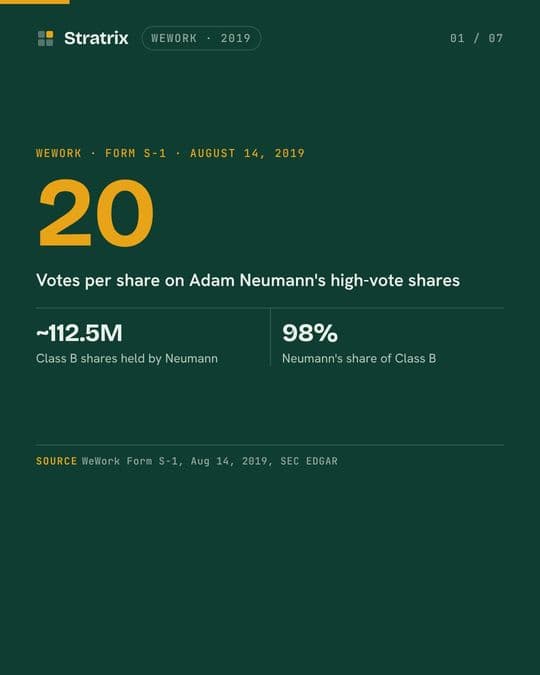
WeWork Gave Adam Neumann 20 Votes a Share — Then Markets Priced What Buying Him Out Costs
WeWork's S-1 handed Adam Neumann shares worth 20 votes each and majority control. The collapse that followed wasn't a business-model crash first — it was the moment markets discovered that founder sovereignty has a price only when someone finally has to buy it back.
8 min