Pairs with the Counterfactual Timeline Builder — a ready-to-use strategy tool, filled for Hershey. Included in the The Counterfactual Casebook →
Here is the story everyone tells. In 2002, the Wrigley gum company offered an enormous pile of money for Hershey, and a stubborn, sentimental Trust said no — refusing to let a Pennsylvania institution fall into outside hands. It is a lovely story about a company too principled to be bought. It is also almost exactly backwards. The Trust did not block the sale. The Trust announced it.
On July 25, 2002, the Milton Hershey School Trust — which controlled 77% of Hershey's voting power — said it wanted to explore selling the entire company, to diversify a fortune that was dangerously concentrated in a single chocolate stock.1 The Trust was not the wall. It was the wrecking ball. And when its board later voted to accept a $12.5 billion offer from Wrigley, the people who stopped the deal weren't on the board at all. They were a state attorney general and a county judge.
“Milton Hershey School Trust Explores Sale of Hershey Foods.”1
The fiduciary trap that made the seller want out
Understand why a trust would want to sell the very company it was built to own, and the whole episode flips. The Milton Hershey School Trust exists to fund a residential school for disadvantaged children, endowed by Milton Hershey himself when he gave it $60 million of his stock back in 1918.5 A century later, that endowment was a problem disguised as a blessing. A charitable trust's job is to protect and grow its assets prudently — and prudence means diversification. A trust whose wealth rides almost entirely on one consumer-goods company is one bad decade in chocolate away from a crisis it cannot fix. So the trustees did the textbook fiduciary thing: they tried to convert a concentrated bet into cash they could spread across the market. That is not betrayal of Milton Hershey's legacy. By the cold logic of trust law, it is the opposite.
And that is the first reframe. The Trust wasn't the romantic defender of independence. It was the rational seller trying to escape a concentration risk that any prudent fiduciary would lose sleep over.
Who actually pulled the deal off the table
If the Trust wanted to sell and voted to sell, who blocked it? The state. On August 23, 2002, the Pennsylvania Attorney General petitioned for an ex parte injunction, and the Dauphin County Orphans' Court — Senior Judge Warren G. Morgan — granted a preliminary injunction barring the Trust from entering any agreement to sell Hershey stock pending court approval.3 That is the actual mechanism that killed the Wrigley deal. Not sentiment. A court order. Under Pennsylvania charitable-trust law, a sale of this magnitude has to survive review by the Attorney General and the Orphans' Court, and in 2002 — with the town of Hershey, alumni, and politicians in revolt — that review came down hard against the sale.
Then came the price the sellers paid for trying. Hershey's board formally terminated the sale process in September 2002.2 And the trustees who had voted yes were not thanked for their diligence — they were purged. Seven trustees who had voted to sell to Wrigley were removed, ten of seventeen were ultimately forced out, and a former state attorney general was installed as the new chairman.7 The lesson the survivors learned was unmistakable: voting to sell Hershey is a career-ending act, regardless of whether it is the financially correct one.
| The story everyone tells | What the record shows | |
|---|---|---|
| Who wanted to sell | Outside raiders | The Trust itself, to diversify |
| Who said no | The Hershey Trust | The PA Attorney General + Orphans' Court |
| The mechanism | A principled board veto | An ex parte court injunction |
| What happened to the yes-voters | Vindicated | Seven removed, ten ultimately ousted |
The deed that makes the board almost beside the point
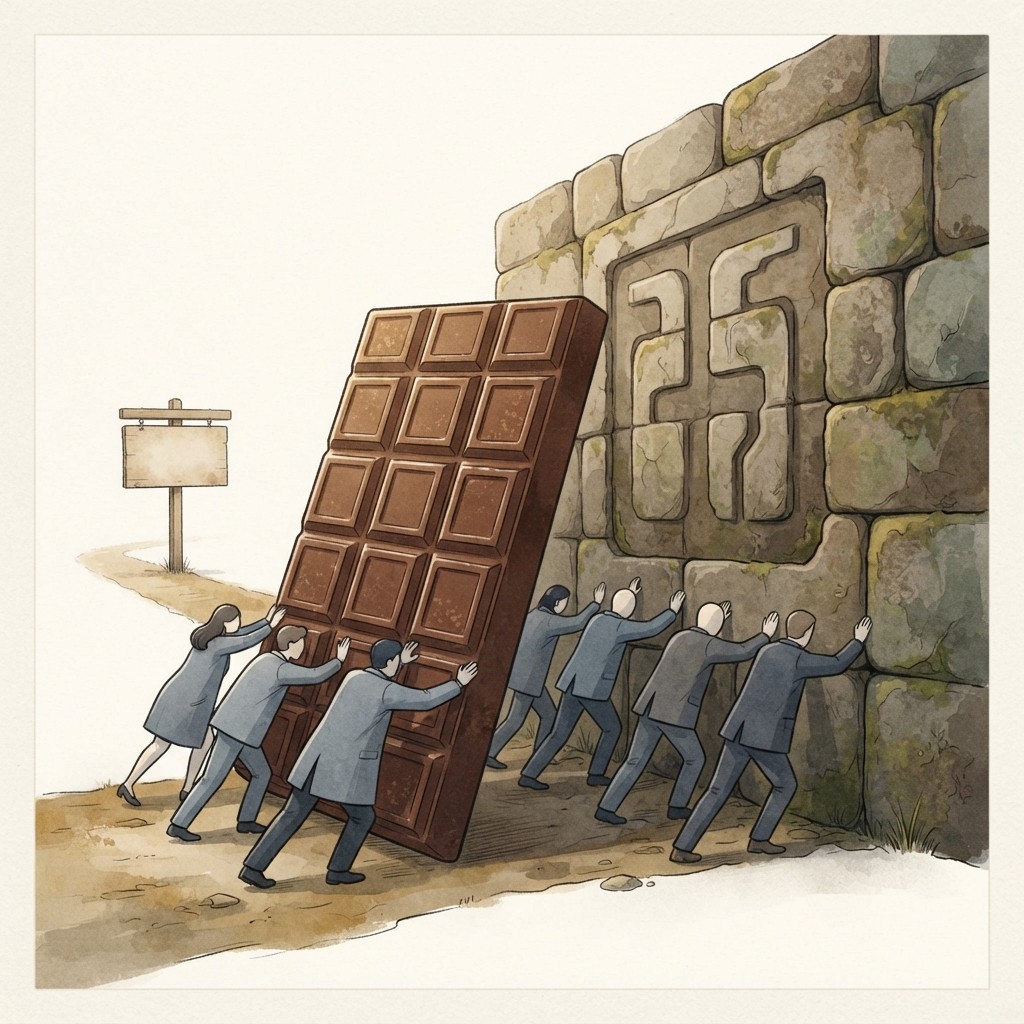
Now the thesis. Hershey is not unsellable because any particular board is brave or sentimental. Hershey is unsellable because of architecture Milton Hershey poured in stages — a corporate trustee chartered in 1905, a school-trust deed signed November 15, 1909, the stock endowment in 1918 — long before any modern acquirer existed.5 On top of that deed sits a dual-class share structure: the Trust's Class B shares carry ten votes each against one vote for common stock, so roughly 30% of the shares deliver about 80% of the voting power.6 There is no hostile path through that math. You cannot raid a company when one holder controls four-fifths of the votes — and that one holder is a charity whose every move is reviewable by a state attorney general.
Watch the pattern repeat. In 2007, an attempt to combine with Cadbury collapsed not in a clean veto but in governance chaos — the Trust's operational manager accused the CEO of withholding information, the CEO resigned, eight directors departed in what local press called 'the Sunday night massacre,' and by the time the dust settled the market had cooled.8 In 2016, Mondelez proposed acquiring Hershey and walked away the same year; in its own filing, CEO Irene Rosenfeld said there was 'no actionable path forward' after 'recent shareholder developments at Hershey.'4 Three different decades, three different suitors, three different proximate causes — and the same outcome, because the deep structure never changed.
The durable defense against being acquired is almost never a brave board — boards turn over, get pressured, and learn to fear the wrong outcomes. It's the wiring underneath: a controlling block of super-voting shares, a charter that requires an outside party's sign-off, a deed that predates the acquirers by a century. Once you've built that, the question 'will the board sell?' stops mattering. The 2002 board WANTED to sell and still couldn't. When you're designing for permanence, design the structure to outvote the people — including your own future successors. The flip side: the same lock that protects the institution can trap real value, because a structurally unsellable company is also a structurally unaccountable one.
But surely the board chose to reject Mondelez?
The fair objection is that this overcorrects. In 2016 there was no injunction and no judge — the Trust-controlled board simply turned Mondelez down, which looks like exactly the willful 'block' the popular story describes. True, and worth conceding: the board's preference is real, and on any given deal a determined board can say no faster than any court can. But the question isn't whether the board can say no — it's whether anyone can ever make it say yes. And the structure answers that. After 2002 the Trust rewrote its bylaws to make a future sale vote harder,8 every trustee now knows seven predecessors were purged for voting to sell,7 and the dual-class math means no acquirer can ever route around the board to the shareholders.6 The board's 'choice' to reject Mondelez was made inside a cage that only permits one answer. That isn't a decision. It's a structure wearing a decision's clothes.
So the counterfactual is sharper than it first appears. Run 2002 again with a board that wanted to sell even harder — you already have that board, and it failed. Run 2016 with a board open to Mondelez — the votes still aren't there, and the attorney general still gets a say. Milton Hershey's real legacy was never the chocolate or the school's sentiment. It was a piece of legal engineering so complete that it made his company permanent by making it impossible for anyone — including the people he trusted to run it — to give it away. The Trust didn't block the takeover. The deed did. The board was just the part you could see.
Companies built so the founder still wins the vote
Counterfactual Timeline Builder
A one-page canvas that runs two histories side by side: what actually happened, and the alternative that died at the fork. You pin the divergence point, trace each branch forward, and name the assumption that decided which one came true. Blank, it disciplines hindsight into a testable counterfactual instead of a what-if; filled, it shows the story's road-not-taken with enough rigor to argue about.
Included, filled and blank, in the The Counterfactual Casebook. See the set → · Preview the blank →
Sources
Where this comes from — the filings, records, and reporting behind it.
- 1On July 25, 2002, the Milton Hershey School Trust (controlling 77% of Hershey Foods voting power) itself announced it wanted to explore a sale of the entire company in order to diversify its holdings — it was the initiator, not the blocker, of the 2002 process.
- 2On September 18, 2002, Hershey Foods Corporation filed an 8-K formally announcing the termination of the sale process — confirming the deal was abandoned, not completed.
- 3The Pennsylvania Attorney General filed a petition for an ex parte injunction on August 23, 2002; the Dauphin County Orphans' Court (Senior Judge Warren G. Morgan) issued a preliminary injunction prohibiting the Trust from entering any sale agreement for Hershey Foods stock pending court approval — the legal mechanism that actually halted the deal.
- 4Mondelez's 2016 bid was described in its own SEC filing as a 'proposal to acquire Hershey' that Mondelez ultimately abandoned after 'additional discussions' and 'recent shareholder developments at Hershey,' with CEO Irene Rosenfeld stating there was 'no actionable path forward.'
- 5The Hershey Trust Company (the corporate trustee entity) was chartered by the Pennsylvania Department of State on April 28, 1905; the Milton Hershey School Trust deed was signed November 15, 1909; and Milton Hershey's $60 million stock endowment to the trust was made in 1918 — three separate founding events routinely collapsed into one in popular accounts.
- 6The Hershey Trust's dual-class share structure gives Class B shareholders (almost exclusively the Trust) 10 votes per share versus 1 for common stock, delivering roughly 80% of combined voting power from approximately 30% of outstanding shares — making any hostile acquisition mathematically impossible without Trust consent.
- 7In 2002, seven Hershey trustees who had voted to sell to Wrigley for US$12.5 billion were removed; ten of 17 trustees were ultimately forced to resign and four new locally-based members were appointed, with former PA AG LeRoy Zimmerman becoming the new chairman.
- 8Following the 2002 sale collapse, the Trust changed its bylaws making it harder for members to vote for a future sale; the 2007 attempt to combine with Cadbury ended when the Trust's operational manager accused CEO Richard Lenny of withholding information, resulting in Lenny's resignation and eight directors departing in what local press dubbed 'the Sunday night massacre,' after which market conditions had cooled.
More like this — beyond Hershey
New Strategically analyses as they publish: the defining moves in business, checked against the record. No noise, and one click to leave.