Pairs with the Moat Anatomy Canvas — a ready-to-use strategy tool, filled for Hershey. Included in the The Moat Anatomy Casebook →
In June 2016, Mondelez offered $107 a share for Hershey—about $23 billion in cash and stock for one of the most recognized brands on earth. Hershey's board didn't negotiate. It said the bid 'provided no basis for further discussion' and rejected it unanimously.7 Eight years later, with the company now worth roughly $45 billion, Mondelez came back. This time it never even got a formal offer on the table: the answer came back too low, and the suitor walked away to announce a $9 billion buyback instead.8 Two attempts, eight years apart, and the same wall. What almost no one notices is who built the wall, and why it cannot be bought down at any price.
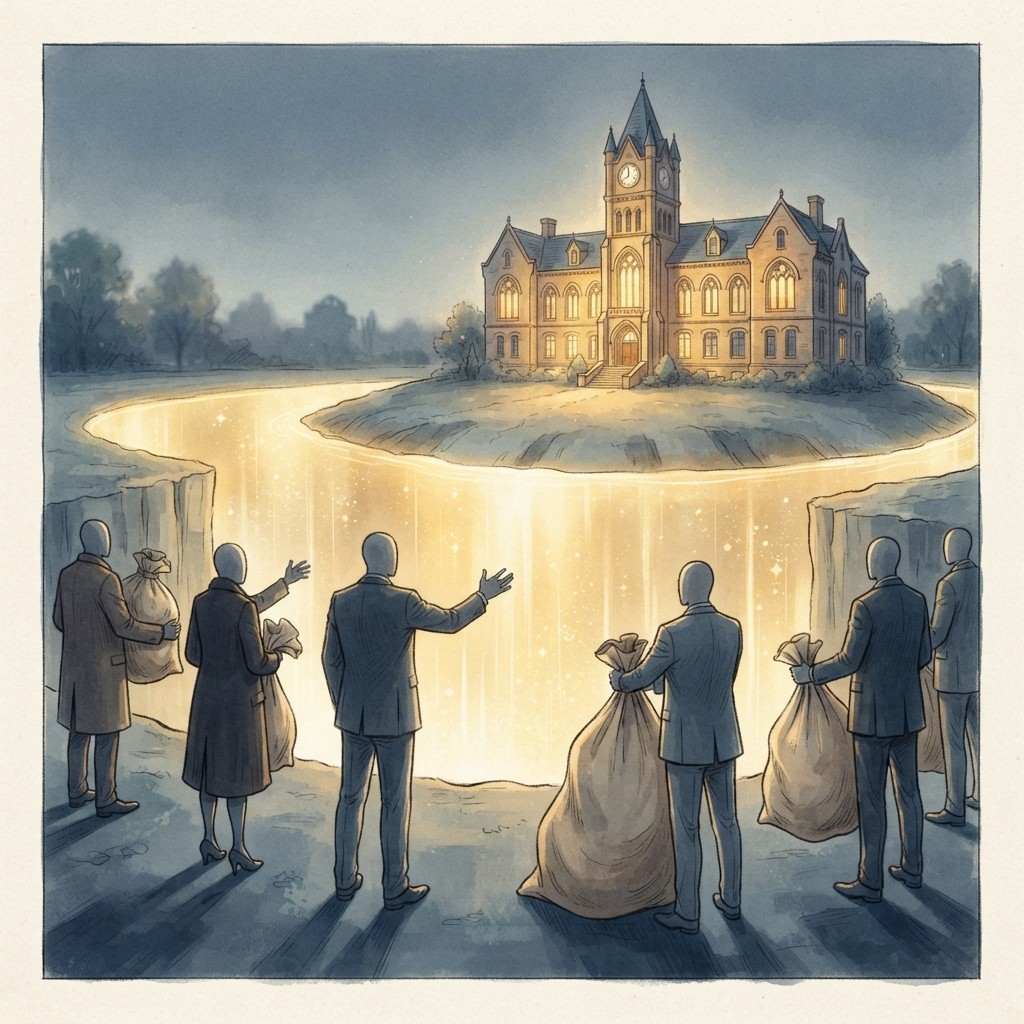
The official story is that Hershey is hard to acquire because of brand loyalty and a board that knows its worth. That's the cover. The real reason is that Hershey's controlling shareholder isn't a fund, a family office, or a market at all. It's a 107-year-old charitable trust that funds a free boarding school for low-income children—and that trust cannot sell its controlling stake without the permission of a Pennsylvania judge.
A secret gift that quietly took the company off the market
The wall went up in stages, almost invisibly. Milton Hershey signed the Deed of Trust establishing his industrial school for orphan boys on November 15, 1909. But the part that mattered for control came nine years later: on November 13, 1918, he transferred his Hershey Chocolate Company stock—worth roughly $60 million at the time—into the school's trust.1 He did it quietly, and the gift went unannounced for five years until November 1923, when The New York Times ran a front-page article headlined "M.S. Hershey Gives $60,000,000 Trust for an Orphanage" and Hershey gave interviews to several publications that month.10 A childless man had just made a school for poor children the owner of one of America's great companies, and the company would spend the next century discovering what that meant. The chocolate exists to fund the school. The school does not exist to flip the chocolate.
Here is the strategic point a casual reader will miss. The trust does not need to own most of Hershey to control it. As of mid-2026, the Hershey Trust Company holds about 54.6 million Class B shares and roughly 1.5 million common shares, against some 149 million common shares outstanding.23 On economics alone that's a minority—somewhere in the range of a fifth to a quarter of the company. But each Class B share carries ten votes to a common share's one. Run that multiplier and a minority economic stake becomes over 80% of the total shareholder vote.6 The trust isn't the biggest owner. It's the only owner whose 'yes' is required.
| The Hershey Trust | Everyone else | |
|---|---|---|
| Roughly how much of the company they own | ~20–30% economically | The majority of the shares |
| Votes per share | 10 (Class B) | 1 (common) |
| Share of the total shareholder vote | Over 80% | Under 20% |
| Can be outbid by a market | No | Yes |
| Answers to | A children's school and a state court | The stock price |
The year the moat held—because the state, not the trust, forced it
The legend everyone repeats is that the Hershey Trust nobly blocked a sale in 2002 to protect the company and the town. That story is exactly backwards, and the truth is far stranger. The trust didn't block the sale—it pursued one. On July 25, 2002 it announced its intent to sell, chasing a deal valued in the billions because its overseers worried that having nearly all the school's endowment tied up in a single chocolate stock was reckless diversification policy. The trustees voted to sell—the stated motive was to diversify a portfolio dangerously concentrated in a single stock.5 Then Pennsylvania's Attorney General, Mike Fisher—who was the Republican candidate for governor at the time—petitioned the Orphans' Court Division of the Court of Common Pleas of Dauphin County.11 On September 4, 2002, the court issued a special injunction prohibiting the trust from entering any agreement to sell its controlling interest. After 55 days of legal and political pressure, the trust abandoned the deal, and seven trustees who had voted to sell were removed.5
Sit with the mechanism, because this is the whole anatomy. A normal controlling shareholder can sell whenever the price is right. The Hershey Trust cannot, because it is a Pennsylvania charity supervised by an orphans' court whose only job is to protect the charitable beneficiaries—the schoolchildren. The trust's economic incentive in 2002 actually pointed toward selling. The thing that stopped it wasn't the trust's loyalty; it was a state official with standing to drag the trust into court and a judge with the power to freeze it. That is a moat no acquirer can ever cross with money, because the gatekeeper isn't selling a company—it's a public officer protecting a charity, and you cannot make a higher bid to a state attorney general.
“Over 3.8 million shares of common stock as well as over 60 million shares of B stock... over 80 percent of the total shareholder vote.”6
Why the wall is slowly thinning—but the gate stays locked
Notice what the trust said in 2025: it would sell off common shares to diversify, while keeping over 60 million Class B shares and over 80% of the vote.6 This is the genius of the structure laid bare. The trust can sell its economic exposure piece by piece—Form 4 filings show incremental lots being sold—to reduce its dangerous concentration in a single stock, while never touching the voting Class B shares that lock the company in place. It gets to de-risk the endowment and keep the kingdom. The 1969 Tax Reform Act established rules (IRC §4943) barring private foundations from owning more than 20% of the voting stock of any business enterprise; holdings held before May 26, 1969 receive special treatment under the grandfathering provisions of the same statute, and the Hershey Trust's position predates that threshold by half a century.9 The wall can lose bricks on the economic side and lose nothing on the control side.
Isn't this just a poison pill with a charity bolted on?
The fair objection is that plenty of companies have founder-controlled supervoting shares—Google, Meta, Berkshire. A dual-class structure isn't exotic, and on this view the trust is just a fancy anti-takeover device. There's truth in it, but it misses the load-bearing difference. A founder's supervoting block can always be sold; the founder can change their mind, take the check, and the acquirer wins by paying enough. The Hershey moat is sturdier precisely because the controller is a charity that legally cannot sell on its own judgment. In 2002 the controller wanted to sell, and still couldn't.5 That's the part no normal poison pill can replicate—the decision-maker is structurally incapable of being bought, because a higher price is irrelevant to a state court protecting orphans.
The honest counter is that the moat has a real cost, and the 2002 episode is also its warning. Concentrating an entire charitable endowment in one chocolate stock is genuinely risky stewardship, and the same court oversight that blocks a sale could, in a different fact pattern, compel diversification that loosens control over decades. The 2002 injunction was preliminary, not permanent—the trust withdrew before the court ever ruled on whether the state could block a sale forever, so the deepest legal question remains untested.5 The moat is enormously strong and slightly indeterminate at the same time. It has held for a century not because the law guarantees it will, but because no one has yet been willing to find out where its edge actually is.
Most moats protect a company's profits—a brand, a network, a cost advantage. The rarest moat protects the company itself from changing hands, and the strongest version isn't a clever bylaw the board can repeal. It's an owner who is structurally unable to sell. Founder voting shares can be bought when the founder relents; a charitable trust under court supervision answers to beneficiaries and a state, not to a price. When you map a company's defenses, ask the question acquirers learn the hard way: who actually has to say yes, and can they say yes at all? Hershey's chocolate is excellent, but its real fortress is that the deciding vote belongs to a school that legally cannot take the check.
Hershey throws off the cash that makes it a perpetual takeover target—$11.2 billion in net sales, $2.2 billion in net income, and a 380th consecutive quarterly dividend in 2025.4 By every conventional measure it should have been swallowed long ago by a hungrier conglomerate. It hasn't been, and it won't be at any number a market can write, because the one shareholder who has to agree isn't selling a company at all. She's running a school for low-income children, and the chocolate is just the endowment that pays for it. Milton Hershey's last and shrewdest invention wasn't a candy bar. It was a structure that made his company impossible to buy by making it owe everything to children who will never put it up for sale.
Other companies built to resist the market
Moat Anatomy Canvas
A one-page canvas that dissects a moat instead of asserting it: where the advantage comes from, how much of the market it covers, how long it would take to copy, and what keeps it from eroding. Blank to dissect your own claimed edge; filled as the worked example tracing the structure of the story's defensible advantage. Use it to tell a real moat from a head start.
Included, filled and blank, in the The Moat Anatomy Casebook. See the set → · Preview the blank →
Sources
Where this comes from — the filings, records, and reporting behind it.
- 1On November 13, 1918, Milton Hershey transferred his ownership of Hershey Chocolate Company stock—valued at approximately $60 million—to the Hershey Industrial School trust, effective retroactively from January 1, 1918; the Deed of Trust establishing the school had been signed November 15, 1909.
- 2As of May–June 2026, Hershey Trust Company (trustee for Milton Hershey School Trust) holds 54,612,012 shares of Class B Common Stock directly, plus approximately 1.5 million shares of Common Stock directly and 39,630 shares of Common Stock indirectly. Each Class B share carries 10 votes and is convertible 1-for-1 into Common Stock at any time. Hershey Trust Company is wholly owned by Milton Hershey School Trust.
- 3Hershey's 2023 10-K (filed February 2024) shows 149,336,442 shares of Common Stock outstanding as of February 16, 2024; Class B Common Stock is not listed on any exchange but is convertible into Common Stock share-for-share at any time.
- 4Hershey's 2024 10-K (FY2024, filed February 2025) reports net sales of $11,202.3 million (+0.3% vs. 2023), net income of $2,221.2 million (+19.3%), an annual common stock dividend of $5.480/share in 2024, and the 380th consecutive quarterly dividend declared February 2025.
- 5On September 4, 2002, a Pennsylvania Orphans' Court judge issued a special injunction prohibiting the Hershey Trust from entering into any agreement to sell its controlling interest in Hershey Foods Corporation, following a petition by Pennsylvania Attorney General Mike Fisher; the Trust had announced its intent to sell on July 25, 2002. After 55 days of pressure, the Trust abandoned the sale. Seven trustees who voted to sell were subsequently removed.
- 6Hershey Trust Company's own press release confirmed the Trust holds 'over 80 percent of the total shareholder vote' via Class B shares, with each Class B share carrying 10 votes versus 1 vote per common share. The Trust stated it would retain 'over 3.8 million shares of common stock as well as over 60 million shares of B stock' after a diversification sale of common shares.
- 7In June–July 2016, Mondelez International made a formal $107-per-share cash-and-stock takeover bid valued at approximately $23 billion; Hershey's board unanimously rejected it, stating it 'provided no basis for further discussion.' Mondelez abandoned the pursuit after approximately two months.
- 8In late November/early December 2024, Mondelez made a second preliminary approach to acquire Hershey; Hershey Trust Co. (holding ~80% of voting power) rejected the bid as too low. Mondelez did not raise its offer and instead announced a $9 billion share buyback. This was the second bid in eight years, with Hershey's enterprise value having grown from ~$25 billion in 2016 to ~$45 billion in 2024.
- 9The Tax Reform Act of 1969 established IRC §4943, limiting private foundations to 20% of the voting stock of any incorporated business enterprise (or 35% in certain circumstances); holdings predating May 26, 1969 receive special grandfathering treatment under §53.4943-4.
- 10The news of Milton Hershey's 1918 gift of stock to the school trust did not become public until November 1923, when The New York Times published a front-page article on November 9, 1923 headlined 'M.S. Hershey Gives $60,000,000 Trust for an Orphanage'; Hershey was subsequently interviewed by several publications that month.
- 11In 2002, Pennsylvania Attorney General Mike Fisher—then the Republican candidate for governor—petitioned the Orphans' Court Division of the Court of Common Pleas of Dauphin County to block the Hershey Trust's proposed sale of its controlling interest in Hershey Foods Corporation; the trust's stated motive for the sale was to diversify its heavily concentrated portfolio.
More like this — beyond Hershey
New Strategically analyses as they publish: the defining moves in business, checked against the record. No noise, and one click to leave.