Pairs with the Moat Anatomy Canvas — a ready-to-use strategy tool, filled for Hershey. Included in the The Moat Anatomy Casebook →
Walk into a US drugstore and pick up a Cadbury Creme Egg, a Kit Kat, or a Rolo. Every one of those wrappers carries a British or Swiss brand — and every one was made in America by a company that owns none of those names. Hershey doesn't own Cadbury in the United States. It doesn't own Kit Kat or Rolo either. It rents them, under license agreements signed decades ago.13 And that borrowed shelf, the one that looks like a vulnerability, turns out to be the single hardest thing about buying Hershey.
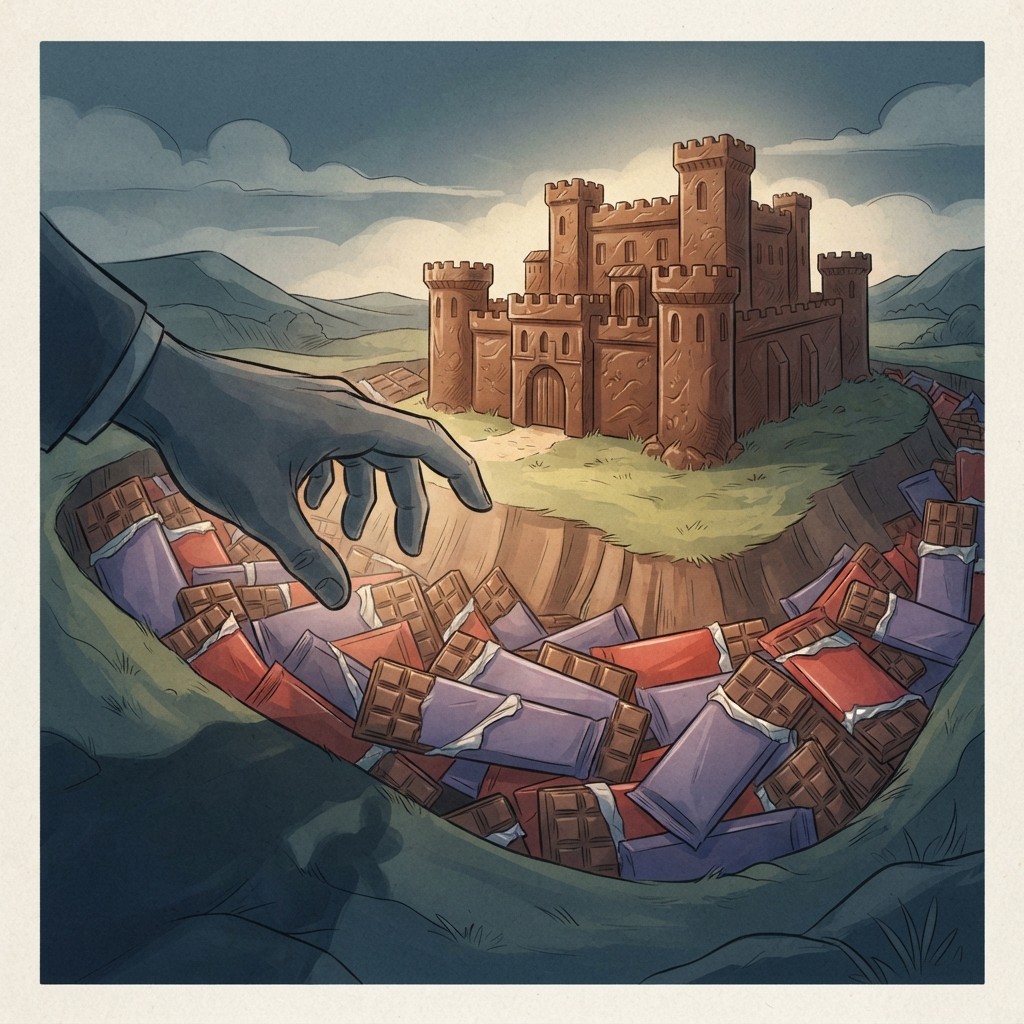
The official story is that Hershey is a powerhouse American brand that happens to make some foreign chocolates too. The truer story is stranger: Hershey's most valuable assets sit on someone else's balance sheet, and the contracts that let it use them double as a trap. The licenses are the moat. The licenses are also the poison pill.
Two deals, signed twenty years apart, that built a cage
In August 1988, Cadbury Schweppes sold its US confectionery operations to Hershey for $284.5 million in cash plus the assumption of $30 million in debt — not the tidy '$300 million' figure that circulates.5 Hershey bought the factories, the equipment, the going concern. What it did not buy was the Cadbury trademark. Instead it signed a Cadbury Trademark & Technology License Agreement, dated August 25, 1988, alongside a parallel deal for the Peter Paul and York brands.2 Hershey got the right to make and sell Cadbury in America. The name itself stayed with Cadbury — and after Kraft's 2010 acquisition and the 2012 spin-off, with Mondelēz International, Cadbury's corporate successor.
The Kit Kat arrangement runs the same way. Hershey holds an agreement with Société des Produits Nestlé that licenses it to manufacture and distribute Kit Kat and Rolo in the United States.3 Hershey makes a Nestlé global brand on American soil while Nestlé sells the same bar everywhere else on earth. In both cases the structure is identical: Hershey controls the product in one market, on paper that says the owner is somebody else.
“...extendible on a long-term basis at the Corporation's option, subject to certain conditions, including minimum unit volume sales.”3
Note the careful wording. Not 'perpetual.' Not 'owned.' The rights are extendible at Hershey's option — renewable, conditional, and contingent on hitting volume floors.13 That precision matters, because the conditions are exactly what turn a license into leverage. A license that only Hershey can renew, and only while certain conditions hold, is a license that travels poorly when the company changes hands.
The thesis: the license is a brand and a booby trap at once
Here is the mechanism worked all the way down. Upon a change of control at Hershey, the Kit Kat license would revert to Nestlé — for free.6 Think about what that does to an acquirer's math. You bid for Hershey at a price that values its entire US confectionery portfolio. The moment you close, a chunk of that portfolio — one of the best-selling chocolate bars in the country — walks out the door and back to Nestlé at no cost to Nestlé. You'd be paying full price for an asset that self-destructs at the closing table. The brand you most wanted is the brand you can't keep.
This is the elegance of it. Hershey didn't draft a defensive bylaw or pay a banker to design a takeover shield. The shield is the same contract that gives Hershey its shelf space. Every day the license earns money; the day someone tries to buy Hershey, the same license detonates. One clause, two opposite jobs.
| Owns outright | Holds under license | |
|---|---|---|
| Cadbury US trademark | No — controlled by Mondelēz | Yes, since 1988 |
| Kit Kat / Rolo US rights | No — controlled by Nestlé | Yes, extendible at its option |
| Factories, equipment, plants | Yes (bought in 1988) | — |
| What survives a change of control | The physical assets | Kit Kat license reverts to Nestlé for free |
What happened when Mondelēz tried to buy the company
The cage isn't theoretical. In 2016, Mondelēz — the very company that controls the Cadbury name Hershey licenses — made a roughly $23 billion run at Hershey.6 It was an almost poetic move: the trademark owner trying to absorb its own US licensee. The Hershey board unanimously rejected it, and on August 29, 2016, Mondelēz formally ended discussions after Hershey turned down a preliminary $107-per-share cash-and-stock bid.7 The Kit Kat reversion was cited as a major complication in the way.6 A buyer offering tens of billions had to reckon with a license that would partly vaporize the instant the deal closed.
And when outsiders tried to slip around the moat from the consumer side, Hershey enforced it just as hard. In 2014 it sued Let's Buy British Imports, a New Jersey importer, for bringing in UK-made Cadbury, Kit Kat, Rolo, and Maltesers and selling them to Americans.8 The press framed it as 'Cadbury banned in the US.' It wasn't a ban — it was a licensee defending exclusive territory. The case settled out of court and the importer agreed to halt the infringing imports.8 The lesson for any rival: the only legal way to put Cadbury on a US shelf runs through Hershey.
Isn't a borrowed moat a fragile one?
The fair objection writes itself. A moat made of contracts you don't own sounds like a moat on loan. The trademarks belong to Mondelēz and Nestlé; couldn't they simply decline to renew, or wait out the agreements, and reclaim their brands? It's a real risk, and worth stating honestly. But the structure cuts the other way more than it first appears. The renewals sit at Hershey's option, subject to volume conditions Hershey has every incentive to meet — and the same change-of-control trigger that scares away acquirers also discourages the most natural acquirer, the trademark owner itself, from simply buying Hershey to take the brands back. Mondelēz tried the direct route in 2016 and walked away.67 The licensor that wants its brand back can't easily buy the licensee, because buying the licensee triggers losses elsewhere. A borrowed asset can still be a defended one when the borrowing terms are this asymmetric.
Be precise about the limits, though. The public filings spell out the change-of-control reversion specifically for the Nestlé Kit Kat license; the Cadbury license's change-of-control terms are not documented the same explicit way.6 So this is one sharp clause inside a thicket of contracts, not a single tidy lock. The point isn't that Hershey is uncatchable. It's that the price of catching it includes destroying part of what you paid for.
Most takeover defenses are dead weight — they sit in the bylaws doing nothing until an attacker shows up, and they cost the company friction in the meantime. Hershey's is different: the same license agreements that fill its US shelves with Cadbury and Kit Kat are the thing that makes the company painful to buy. The asset and the armor are the same contract. The strategic lesson generalizes: when you must depend on someone else's intellectual property, negotiate the dependency so that any third party trying to take you over inherits the dependency's downside, not just its upside. A reversion clause that triggers on change of control turns a vulnerability — 'we don't own these brands' — into a defense — 'and neither will you, if you buy us.' The caution: it only holds while you keep meeting the volume floors and the licensor finds you a better steward than a fight. The toll survives only as long as you remain the best way through.
Hershey's neatest trick was never the chocolate. It was a pair of contracts — 1988 for Cadbury, the Nestlé deal for Kit Kat — that let it sell brands it doesn't own and, in the same breath, make itself nearly impossible to own. The licenses look like a confession of weakness: we had to borrow these names. Read them as a cage instead. The most valuable thing in Hershey's portfolio is something it merely rents, and the rental agreement is precisely what no acquirer can afford to disturb. Hershey didn't build a wall around its company. It built a brand that detonates if you try to take it home.
Moats that aren't where you'd look for them
Moat Anatomy Canvas
A one-page canvas that dissects a moat instead of asserting it: where the advantage comes from, how much of the market it covers, how long it would take to copy, and what keeps it from eroding. Blank to dissect your own claimed edge; filled as the worked example tracing the structure of the story's defensible advantage. Use it to tell a real moat from a head start.
Included, filled and blank, in the The Moat Anatomy Casebook. See the set → · Preview the blank →
Sources
Where this comes from — the filings, records, and reporting behind it.
- 1Hershey acquired the license to manufacture and market Cadbury and Caramello confectionery products in the United States in 1988, under agreements with Cadbury Beverages Inc. and affiliated companies, with rights extendible on a long-term basis at Hershey's option and subject to a minimum sales requirement.
- 2The Cadbury Trademark & Technology License Agreement between Hershey Foods Corporation and Cadbury Limited, and the Peter Paul/York Domestic Trademark & Technology License Agreement with Cadbury Schweppes Inc., were both dated August 25, 1988, and incorporated by reference from Exhibit 2(a) to Hershey's Form 8-K dated September 8, 1988.
- 3Hershey also has an agreement with Societe des Produits Nestlé SA which licenses Hershey to manufacture and distribute Kit Kat and Rolo confectionery products in the United States; rights are extendible on a long-term basis at Hershey's option, subject to certain conditions including minimum unit volume sales.
- 4The Hershey Company acquired the U.S. Cadbury license in 1988 and has manufactured Cadbury products in the US since then.
- 5In August 1988, Cadbury Schweppes sold its US confectionery operations to Hershey for $284.5 million cash plus the assumption of $30 million in debt — not the round '$300 million' figure widely cited.
- 6Upon a change of control at Hershey, the Kit Kat license would revert to Nestlé for free, depriving value for any potential acquirer — a dynamic cited as a major complication during the 2016 Mondelēz $23 billion takeover bid for Hershey.
- 7Mondelēz International formally ended discussions to acquire Hershey on August 29, 2016, after the Hershey board unanimously rejected its preliminary $107-per-share cash-and-stock bid.
- 8Hershey's 2015 lawsuit was brought against Let's Buy British Imports (LBB), a New Jersey-based US importer, in August 2014, alleging trademark infringement for importing UK-made Cadbury, Kit Kat, Rolo, and Maltesers products — the case was settled out of court and LBB agreed to halt all infringing imports.
More like this — beyond Hershey
New Strategically analyses as they publish: the defining moves in business, checked against the record. No noise, and one click to leave.