Pairs with the Counterfactual Timeline Builder — a ready-to-use strategy tool. Included in the The Counterfactual Casebook →
In November 2008, you could buy a share of AMD for $1.82.7 Two years earlier the same share had traded above $20, and had briefly touched $40.7 This was a company that designed the processors inside a meaningful slice of the world's computers, and the market had decided it might not survive the year. It very nearly didn't: AMD lost roughly $3.13 billion in fiscal 2008.7 So when, a few weeks earlier, AMD announced it would split off its factories and become a 'fabless' chip designer, the press called it bold. It was bold the way selling the house is bold when the mortgage is due.
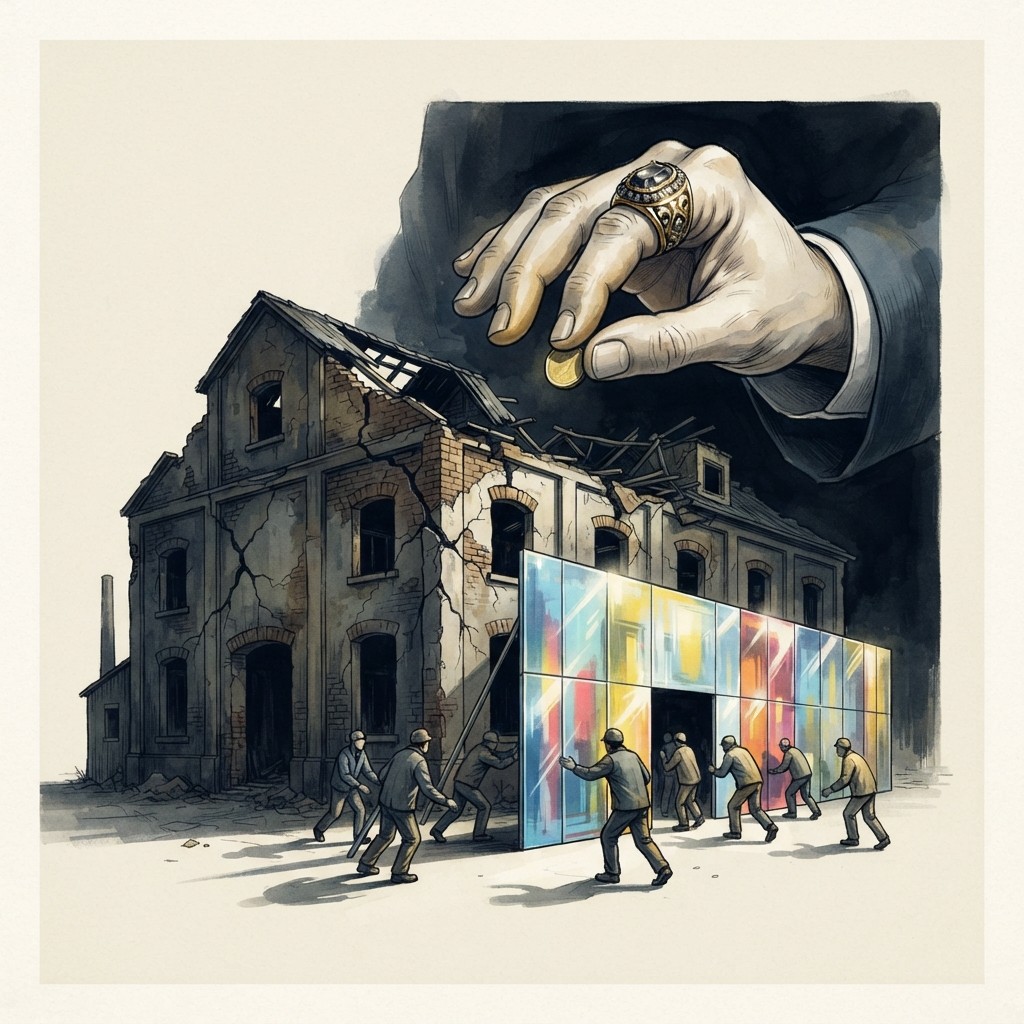
The official story is that AMD made a visionary strategic choice to shed the brutal economics of owning semiconductor fabs and focus on design. The real story is that a near-insolvent company sold its most valuable physical assets to Abu Dhabi's sovereign wealth machine, took on a punishing supply contract to do it, and spent the next four years quietly paying to undo the terms. The fabless pivot was the consequence. The cash was the point.
Read the timing, not the press release
AMD announced the spin-off on October 7, 2008 — the same autumn the global financial system was seizing up.2 A company with optionality does not pick the bottom of a credit crisis to reshape itself. A company with a balance-sheet problem does, because that is when the problem becomes unignorable. The structure of the deal tells you which AMD this was. ATIC, an Abu Dhabi investment vehicle, agreed to pay $700 million for a 55.6% stake in the new manufacturing company, and roughly $1.2 billion of AMD's own debt was to be transferred onto the new entity.2 A separate Abu Dhabi fund, Mubadala, put $314 million into AMD itself for 58 million new shares.2 When the transaction was consummated on March 2, 2009, AMD handed over its Dresden fabs, a slice of its patent portfolio, and that debt.1 This is not the cap table of a triumphant pivot. It is the cap table of a rescue.
| ATIC / Mubadala | AMD | |
|---|---|---|
| Total capital deployed | $2.1B by ATIC + $314M by Mubadala | — |
| Cash into GlobalFoundries | $1.4B direct | — |
| Cash to AMD | $700M | Received |
| AMD debt assumed | — | ~$1.2B shifted off AMD |
| What they got | 55.6% of the fabs | A balance-sheet reprieve |
Notice the gap in the table. ATIC committed $2.1 billion in total, but only $700 million of it reached AMD — the larger $1.4 billion went straight into GlobalFoundries, the very factories AMD was giving up control of.1 AMD's real benefit was the debt relief: roughly $1.2 billion of obligations that simply stopped being its problem.1 That is the trade a company makes when it cannot raise money on its own terms. You don't sell the crown jewels for the use of the cash inside them; you sell them because someone else's credit is the only credit left in the room.
The contract that turned a sale into a leash
Here is the part the visionary-pivot story leaves out. AMD didn't just sell its fabs; it agreed to keep buying from them. The spin-off came with a Wafer Supply Agreement that locked AMD into manufacturing exclusivity with GlobalFoundries. Selling the factory and then being contractually required to buy back its output is the worst of both worlds: you lose the asset and keep the dependence. The proof of how binding the terms were is what it cost to escape them. In 2012, AMD paid $703 million to exit the exclusivity commitments — $425 million in cash plus its remaining equity stake, valued at roughly $278 million.8 Set that figure next to the original consideration: AMD had taken in $700 million of cash at the 2009 spin-off, and then paid effectively the same amount back to be free of the strings attached to it.8 The deal that 'raised cash' was, on a net cash-out basis, close to a wash — with the fabs gone for good.
ATIC got 55.6% of the manufacturing company for $700 million to AMD, plus a customer it had effectively pre-signed through the Wafer Supply Agreement.2 AMD got a balance-sheet reprieve and a leash. When AMD finally bought back its freedom in 2012 for $703 million in cash and equity8, it confirmed the asymmetry: the value transferred ran from AMD's shareholders toward the sovereign buyer, not the other way around.
The patent overhang nobody mentions
There was a second problem hiding in the formation documents, and it was nearly existential. AMD's right to make x86 chips rested on a patent cross-license with Intel — and that license did not automatically extend to a newly independent GlobalFoundries manufacturing AMD's chips. The deal contained a 'Reconciliation Event' clause: ATIC would only get full board voting rights once AMD secured GlobalFoundries' right to manufacture under the Intel cross-license. That condition was not satisfied at the March 2009 closing. It was resolved on November 11, 2009 — the same day AMD and Intel reached their comprehensive antitrust settlement.4 For roughly eight months, in other words, the factories AMD had just spun off were producing AMD chips under an unresolved legal overhang. The 'clean break' had a fault line running straight through its core.
That same-day timing is not a coincidence; it is the architecture. The Intel settlement and the GlobalFoundries patent license were structurally linked — Intel paid AMD $1.25 billion and, in the same agreement, separately licensed GlobalFoundries, with AMD dropping all litigation and regulatory complaints worldwide.4 The settlement money is remembered as a clean win, and the $1.25 billion was real. But part of what it bought, on the same day, was the legal certainty that the spin-off needed to actually function. The two halves of AMD's 2009 — the rescue and the windfall — were the same story told from two ends.
“Intel agreed to pay AMD $1.25 billion and entered into a new five-year patent cross-license; Intel simultaneously entered into a license agreement with GlobalFoundries.”4
Wasn't it the right call anyway?
The strongest counter is that the outcome vindicated the decision. AMD survived, eventually thrived, and the fabless model — letting TSMC and others carry the crushing capital cost of leading-edge fabs — turned out to be exactly the structure a recovering AMD needed. There is truth in this. Owning fabs you cannot afford to upgrade is its own slow death, and AMD even booked a $325 million one-time gain when it deconsolidated GlobalFoundries in 2010.6 Fair. But 'it worked out' and 'it was a good deal for shareholders' are different claims. The fabless model AMD ended up benefiting from is the one it reached after paying $703 million to dismantle the exclusivity it accepted in 2009.8 The version of going fabless that helped AMD was not the version it signed. And a decision forced by insolvency that happens to land well is not the same as a decision made from strength — it just gets remembered that way, because winners write the case study. The right counterfactual question is not 'did AMD survive?' It is 'on whose terms?' — and the answer is Abu Dhabi's.
When a company sells a crown-jewel asset during a crisis, read the structure, not the headline. The tells are everywhere: the buyer's cash mostly stays inside the asset rather than reaching the seller; the seller's real gain is debt relief, not proceeds; and a long-term supply or exclusivity contract quietly converts the sale into a leash. The clean strategic narrative arrives later, written backward from the survival. The discipline is to separate two questions that crises blur together: did it work, and was it a good deal? A distressed seller can answer yes to the first and no to the second — and usually does, because the price of capital when you have none is everything you're trying to keep.
AMD's fabless turn is taught as foresight. It was triage. A company worth $1.82 a share sold its factories to the only buyer with a deep enough balance sheet, accepted a contract that kept it tethered to the asset it had just given up, and operated for months with a patent fault line running under the whole structure — then spent the next three years and $703 million buying its way back to the freedom the story credits it with having all along.8 The lesson isn't that AMD failed; it didn't. It's that survival and strategy are not the same word, and the gap between them is exactly where the value goes. AMD lived. The terms belonged to someone else.
Counterfactual Timeline Builder
A one-page canvas that runs two histories side by side: what actually happened, and the alternative that died at the fork. You pin the divergence point, trace each branch forward, and name the assumption that decided which one came true. Blank, it disciplines hindsight into a testable counterfactual instead of a what-if; filled, it shows the story's road-not-taken with enough rigor to argue about.
Included, filled and blank, in the The Counterfactual Casebook. See the set → · Preview the blank →
Sources
Where this comes from — the filings, records, and reporting behind it.
- 1GlobalFoundries was formed on March 2, 2009; AMD contributed manufacturing assets including Dresden fabs, a portion of its patent portfolio, and approximately $1.2 billion in AMD debt was assumed by GlobalFoundries; ATIC contributed $2.1 billion total, with $1.4 billion invested directly into GlobalFoundries.
- 2AMD announced its plan to go fabless on October 7, 2008; ATIC agreed to pay $700 million for a 55.6% stake in the manufacturing spin-off; Mubadala invested $314 million for 58 million new AMD shares; and $1.2 billion of AMD debt was to be transferred to the new entity.
- 3AMD's FY2008 10-K was filed February 24, 2009; as of mid-2008 AMD's market cap of non-affiliate shares was approximately $3.6 billion; the filing covers the fiscal year ended December 27, 2008 and references the GlobalFoundries formation transaction.
- 4Intel and AMD entered a comprehensive settlement on November 11, 2009; Intel paid AMD $1.25 billion; both parties entered a new 5-year patent cross-license; Intel simultaneously entered a license agreement with GlobalFoundries; AMD dropped all pending litigation and withdrew all regulatory complaints worldwide.
- 5Intel's Form 8-K confirmed the $1.25 billion settlement payment to AMD and disclosed that Intel's Q4 spending outlook increased from $2.9 billion to $4.2 billion to absorb the charge.
- 6AMD recognized a one-time gain of $325 million from the deconsolidation of GlobalFoundries, recorded at fair value as of the deconsolidation date of April 7, 2010; prior to that date GlobalFoundries had been a joint venture between AMD and ATIC.
- 7AMD shares fell to a low of $1.82 in November 2008 during the financial crisis; the company had traded above $20 in 2006 and briefly touched $40 in February 2006; AMD lost approximately $3.13 billion in FY2008.Nasdaq.com, Could AMD Go Bankrupt? ↗ · 2012-10-19
- 8AMD paid $703 million in 2012 to exit GlobalFoundries exclusivity commitments: $425 million in cash plus its remaining equity stake (valued at ~$278 million); AMD received only $700 million in cash at the original 2009 spin-off — less than the $1.25 billion Intel settlement paid the same year.
More like this — beyond AMD
New Strategically analyses as they publish: the defining moves in business, checked against the record. No noise, and one click to leave.