Pairs with the Vertical-Integration Assessment — a ready-to-use strategy tool. Included in the The Vertical Integration Bet Casebook →
Walk through any IKEA and the story tells itself: the maze, the meatballs, the BILLY bookcase you'll carry out in a box and curse at with an Allen key. It feels like a place that makes things — a furniture factory with a showroom bolted on. The number that breaks the spell is small and flat: IKEA manufactures roughly 10% of its own product range. The other 90% is bought from more than 800 outside suppliers.1 The company everyone files under 'vertically integrated manufacturer' makes about one item in ten.
The official story is that IKEA's edge is that it makes its own furniture. It's the wrong place to look. IKEA mostly designs and contracts; the factory it owns is a sliver. The thing it really owns — the asset that actually does the strategic work — isn't a sawmill at all. It's a corporate structure built so that no one can ever force it to sell the slow stuff.
The factory story arrived 30 years late
The founding myth is tidy: Swedish furniture makers boycotted the upstart discounter in the late 1950s, so IKEA was forced to design and build its own furniture, and a vertically integrated giant was born. Half of that is true. The boycott did push IKEA to do its own design work and to contract with foreign suppliers — first in Denmark and Poland.8 But it did not push IKEA to own factories. The manufacturing subsidiary, Swedwood, wasn't founded until 1991 — roughly three decades after the boycott — and was only renamed IKEA Industry in 2013.4 The in-house factory isn't the origin story. It's a late chapter the myth quietly back-dates to make the company sound more self-sufficient than it ever was.
Even the format people credit IKEA with inventing isn't an invention. IKEA's own history page is blunt about it: flat-pack furniture already existed and simply 'hadn't really taken off in Sweden yet.' IKEA adopted it in 1953.3 Notice the pattern. The popular IKEA — inventor of flat-pack, maker of its own furniture, founded as a furniture company — is consistently a more vertical, more self-made company than the records describe. It was registered in 1943 selling pens, wallets and household goods, and didn't add furniture until 1948.3 The legend keeps reaching for ownership; the facts keep handing back contracts and adoptions.
| The myth | The record | |
|---|---|---|
| Makes its furniture | Builds what it sells | ~10% in-house, 90% from 800+ suppliers |
| Invented flat-pack | IKEA originated it | Adopted it in 1953; it 'already existed' |
| Founded as furniture co. | 1943, furniture from day one | 1943 trading firm; furniture added 1948 |
| In-house manufacturing | Born of the 1950s boycott | Swedwood founded 1991, ~30 years later |
The asset that actually does the work
If the factory isn't the moat, what is? Follow the money and the ownership. IKEA runs on a deliberate split: Inter IKEA Group is the worldwide franchisor — it owns the brand and the system — and the stores are run by franchisees who pay it an annual fee of 3% on their net sales.7 In FY24, IKEA retail sales reached €45.1 billion, while Inter IKEA Group's own revenues were €26.5 billion, reflecting wholesale and franchise income rather than a simple cut of every till.2 Sitting above all of it: a foundation. Since 31 August 2023, Inter IKEA Foundation has been the ultimate owner of Inter IKEA Holding.7 There are no public shareholders. There is no stock to defend, no quarter to beat, no activist to placate.
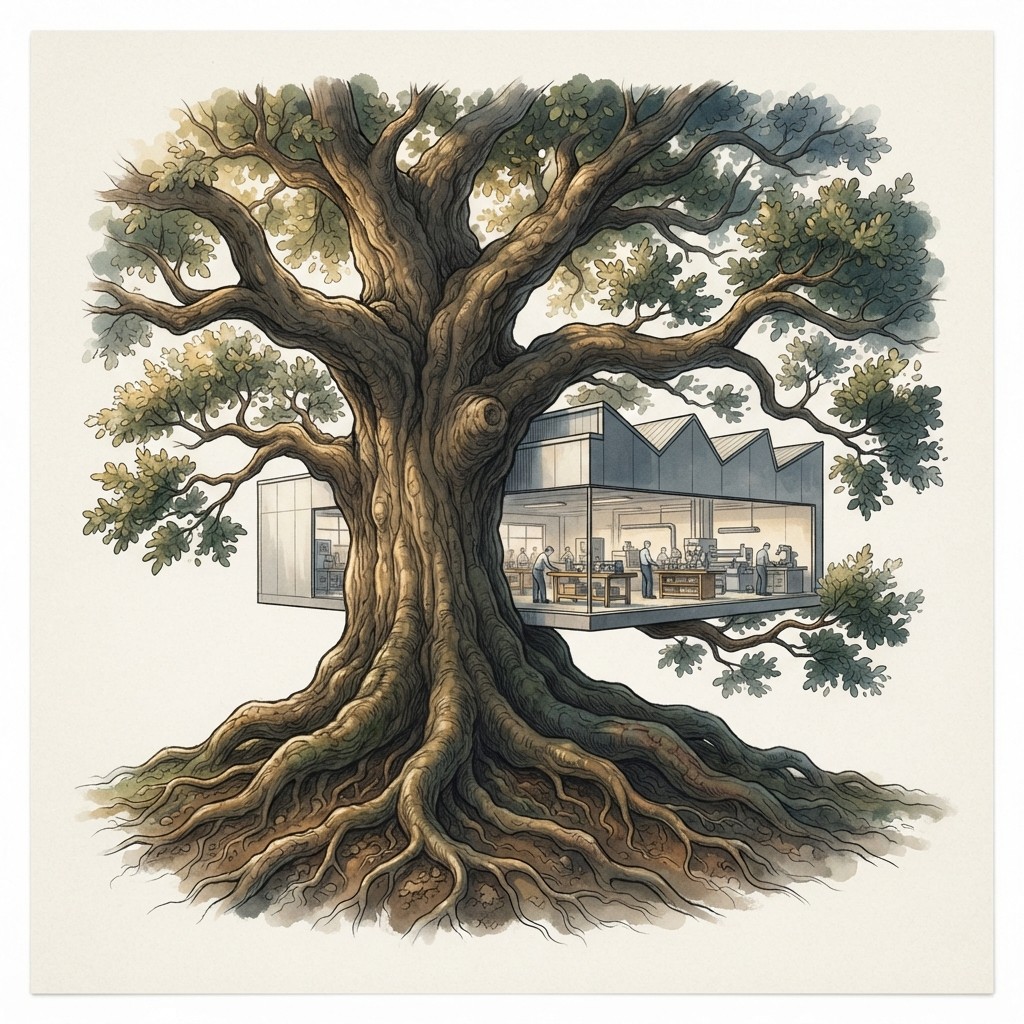
That structure is the real integration bet — not integration of factories, but integration of time horizon. A listed retailer that bought 331,500 hectares of forestland would be asked, the very next earnings call, why it was parking billions in an asset that pays back over a generation. IKEA's investment arm, Ingka Investments, holds exactly that — over 331,500 hectares across seven countries.5 And here is the tell that proves these aren't even feedstock for the factories: IKEA states plainly that 'Ingka Group-owned forests do not currently directly supply raw material for the IKEA product range.'6 The forest isn't a supply chain. It's a long-cycle financial and sustainability holding that only a patient owner could justify keeping.
“Ingka Group-owned forests do not currently directly supply raw material for the IKEA product range.”6
So the vertical integration that matters runs upward, into ownership, not downward, into the sawmill. The foundation-owned franchisor supplies one scarce thing the public market can't: permission to wait. That permission is what funds a new BILLY factory in Slovakia, a PAX expansion in Sweden, and a forest you might harvest in forty years.5 The 10% IKEA does manufacture is real and useful — concentrated in high-volume wooden staples where owning the line keeps a tight grip on cost and quality. But it's a tool, not the moat. The moat is that IKEA can hold assets that nobody under quarterly pressure could ever afford to keep.
Isn't 10% just enough, and isn't this structure a dodge?
The fair objection cuts two ways. First: maybe 10% is precisely the point — IKEA owns the small, strategic slice of manufacturing where in-house control matters most and rents the rest, which is smart capital allocation, not a failure to integrate. That's true, and it's the strongest defense of the model. But it also concedes the thesis: if owning the factory were the source of advantage, you'd expect IKEA to own far more of it. The fact that 90% can safely sit with 800-plus contractors tells you the leverage lives elsewhere.1 The second objection is sharper: a foundation atop a franchisor, owning forests and collecting a 3% fee, looks less like patient stewardship and more like a structure engineered to minimize tax and entrench control. That criticism has teeth, and IKEA's ownership has long drawn exactly that scrutiny. But the two readings aren't in conflict. A structure can be tax-efficient and still produce a genuine strategic good — the freedom to hold long-cycle assets without a shareholder demanding they be sold for cash. The mechanism is real regardless of the motive behind it.
Most companies think about vertical integration as a question of what to make versus what to buy. IKEA's more durable move was integrating upward into an ownership structure that changes what it's allowed to wait for. Forestland, energy infrastructure, and long-cycle capacity all reward patience and punish anyone who has to explain themselves every ninety days. If your real advantage is in slow-paying assets, the most important thing to own may not be a factory at all — it's an owner who can never be forced to sell the slow stuff. The catch: the same structures that buy patience also concentrate control and invite scrutiny, so the advantage only holds if the patience is actually spent building something, not just held.
IKEA looks like a company that wins by making its own furniture, and it barely makes any. It wins by owning the one thing a listed competitor can't put on a balance sheet: the right to be slow. The factory is a tool. The forest is a holding. The Allen key is theater. The actual machine is a foundation that sits above a franchisor and quietly removes the one pressure that forces most companies to sell their future for this quarter's number. IKEA didn't vertically integrate the supply chain. It vertically integrated patience — and that turned out to be the part worth owning.
Companies whose real asset isn't the obvious one
Vertical-Integration Assessment
A make-vs-buy assessment for a single stage of the value chain: rate the forces that argue for owning it and the forces that argue for renting it, then read the verdict off the gap. Blank to run on a stage you're deciding now; filled as the worked example showing why the story's company pulled a stage in-house — or pushed it out.
Included, filled and blank, in the The Vertical Integration Bet Casebook. See the set → · Preview the blank →
Sources
Where this comes from — the filings, records, and reporting behind it.
- 1Inter IKEA Group manufactures approximately 10% of the IKEA product range and sources the remaining 90% from over 800 external suppliers (FY24).Inter IKEA Group, FY24 Financial Results ↗ · 2024-11-07
- 2Total IKEA retail sales in FY24 reached €45.1 billion; Inter IKEA Group total revenues were €26.5 billion, including wholesale, franchise fees, and the IKEA Delft store.
- 3IKEA was first registered as a trading company on 28 July 1943; furniture was added to the range in 1948; flat-pack was adopted in 1953 (IKEA acknowledges flat-pack 'already existed').
- 4IKEA Industry AB (formerly Swedwood International AB) was founded in 1991; the name was changed to IKEA Industry AB in September 2013; it produces 10–12% of the IKEA range, primarily wooden furniture.
- 5Ingka Investments manages over 331,500 hectares of forestland in seven countries; the new BILLY factory in Slovakia and PAX expansion in Hultsfred, Sweden are among FY24 manufacturing investments.
- 6Ingka Group-owned forests do not currently directly supply raw material for the IKEA product range (forestland is a financial/sustainability investment, not a production feedstock).
- 7IKEA franchisees pay Inter IKEA Group an annual fee of 3% over their net sales; Inter IKEA Group is the worldwide IKEA franchisor via Inter IKEA Systems B.V.; Inter IKEA Foundation became ultimate owner of Inter IKEA Holding following a demerger from Interogo Foundation on 31 August 2023.
- 8The Swedish furniture supplier boycott occurred in the late 1950s; IKEA responded by undertaking its own design work and contracting with foreign suppliers, first in Denmark and Poland; Swedwood was set up later as a manufacturing subsidiary.
More like this — beyond IKEA
New Strategically analyses as they publish: the defining moves in business, checked against the record. No noise, and one click to leave.