Pairs with the Profit-Engine Map — a ready-to-use strategy tool, filled for Kroger. Included in the The Money Machine Casebook →
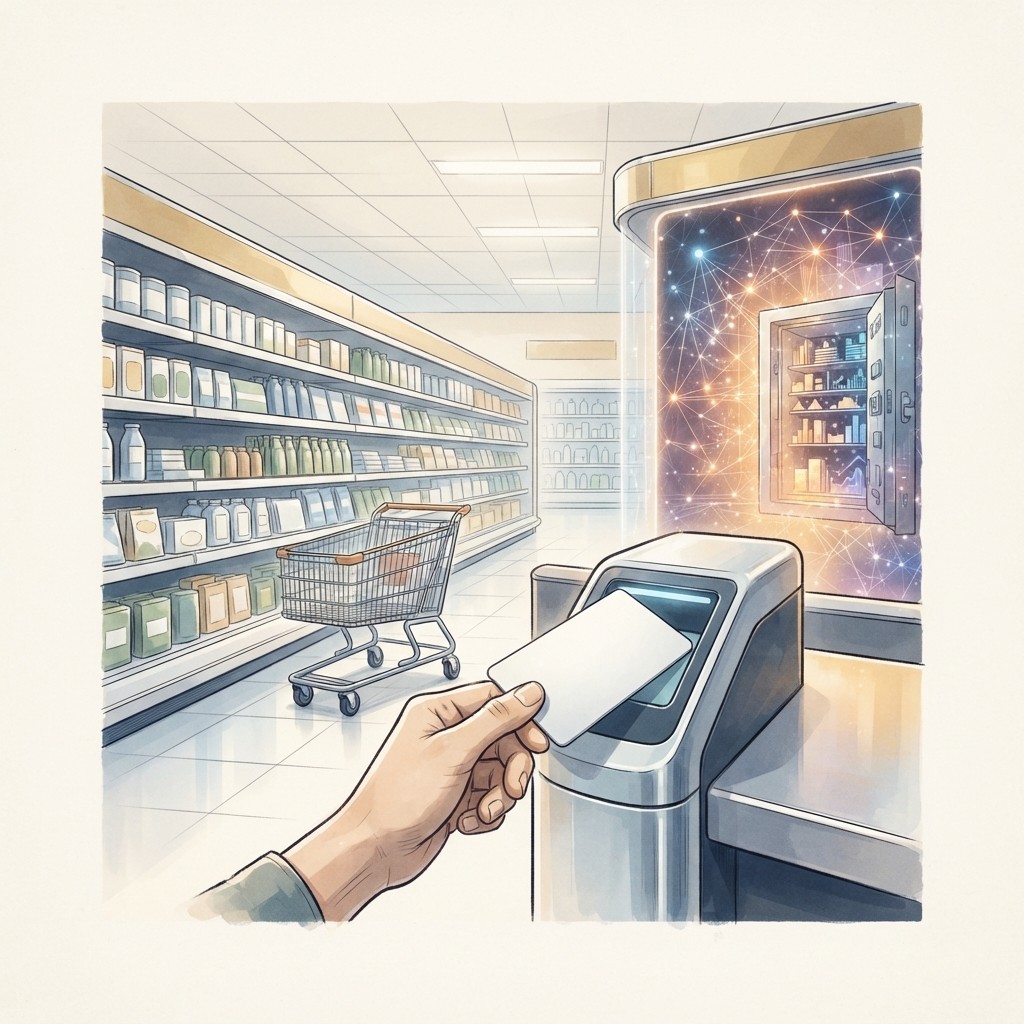
Swipe your Kroger Plus card to shave a dollar off a gallon of milk, and a small bargain happens that you can see. A much larger one happens that you cannot. The dollar you saved is the price Kroger pays to log exactly what you buy, when, how often, and what you'd switch to — and then to sell that knowledge, at a margin no head of lettuce could ever earn, to the brands fighting for the shelf. Over 95% of Kroger's transactions ride a loyalty card3. The discount is the lure. The data is the catch.
The official story is that Kroger is a grocer — the second-largest in America, running stores on the wafer-thin margins the trade is famous for. That story is true and almost beside the point. The most profitable thing Kroger does isn't bagging groceries. It's selling the record of who bought them.
The aisle that runs on what the other aisles record
In April 2015, Kroger formed a data company and gave it a strange name: 84.51°, the longitude line that runs through its Cincinnati headquarters.2 The common shorthand — that Kroger bought dunnhumby and rebranded it — is wrong in a way that matters. Kroger acquired only certain assets from the dunnhumbyUSA joint venture and replaced the old exclusive deal with a long-term license and service agreement; dunnhumby Ltd. kept operating on its own.1 What Kroger really bought was the in-house capability to do the one thing a grocer is uniquely positioned to do and an outsider never can: read its own register tape at the level of the individual household. It started that venture with roughly 500 people.2 The store became the sensor; 84.51° became the brain.
Here is the mechanism, worked down. A consumer-goods company is essentially blind: it ships cereal to a distributor and loses sight of who actually eats it. Kroger is not blind — it knows, household by household, who buys the cereal, who used to and stopped, who buys the rival brand, and which coupon would move them. That asymmetry is the whole engine. 84.51° packages it two ways: as insight (telling a brand what its real customers do) and as advertising. Kroger Precision Marketing, launched separately in 2017, sells the brand the chance to put a message in front of the exact households the data says will respond — and to measure, against real sales, whether they did.8 The brand pays for certainty. Kroger sells certainty at near-software margins because the data was a free byproduct of ringing up groceries it was going to ring up anyway.
The raw material — purchase behavior across approximately 62 million households, over 95% of it tied to a loyalty card3 — is collected as a side effect of the core grocery business. So the cost of producing the data is effectively already paid. What 84.51° and Kroger Precision Marketing layer on top — insight and advertising — sells at margins the grocery floor can't approach, which is why a relatively small revenue line throws off such outsized profit.
The master plan was real. The straight line was not.
It is tempting to tell this as a flawless act of foresight: in 2015 Kroger saw the future of retail media, built the machine, and watched the billions roll in on schedule. That legend is tidied after the fact. In October 2017, under its 'Restock Kroger' plan, the company set a public target of adding $400 million in alternative-profit operating profit by 2020. In September 2019 — less than two years later — it quietly rescinded that target, with CEO Rodney McMullen acknowledging the program was proving harder than planned.6 The business that today throws off well over a billion dollars once missed its own first checkpoint badly enough to take the goalpost off the field.
| The clean story | What actually happened | |
|---|---|---|
| Origin | Kroger bought dunnhumby | Bought certain assets; signed a new license deal[[cite:s1]] |
| The target | Hit $400M on plan | Set in 2017, rescinded in 2019[[cite:s6]] |
| The trajectory | A straight line up | A miss, then a later surge past it[[cite:s4]][[cite:s5]] |
| The number today | Inevitable | $1.3B in 2023, $1.35B in 2024[[cite:s4]][[cite:s5]] |
What got the machine over the line wasn't the original timeline. It was a pandemic that drove an enormous wave of measurable digital and at-home shopping, and a retail-media advertising market that matured years after the 2017 plan assumed it would. Alternative profit eventually blew past $400 million — reaching $1.3 billion in 2023 and $1.35 billion in 202445 — but it arrived late, and partly on tailwinds Kroger didn't author. The asset was real. The straight-line narrative is retrofitted.
“Kroger rescinds target to add $400M to operating profit by 2020.”6
Isn't this just selling surveillance — and how long can it last?
The fair objection is blunt: this is a grocer monetizing the surveillance of its own shoppers, and a discount card is the bait. There's truth in it. A 2025 Consumer Reports investigation dug into how Kroger builds shopper profiles, and noted that 84.51° quietly removed a '60 million households' figure from at least one marketing page after the data practice drew scrutiny.7 When a company starts editing the size of its data brag, it's a tell that the asset is also a liability — the same scale that makes the pitch to brands compelling makes the pitch to regulators alarming. The honest counter is that the profit is genuinely defended utility, not pure extraction: brands really are blind without it, the targeting really does work, and Kroger really does own the one dataset no advertiser can replicate without owning the stores. But the defense is narrower than the grocery moat that protects it. Privacy scrutiny, shifting consent rules, and a household's growing awareness of what the card actually costs are all pressing on the same point — and Kroger's response of pulling numbers off a webpage is the clearest sign that the toll is being collected on contested ground.
The most valuable thing a business produces is often not the thing it sells — it's the data thrown off as a byproduct of selling it. Kroger sells groceries at near-break-even and sells the record of those sales at near-software margins; the loyalty card is the meter that converts one into the other. The strategic lesson is to find the exhaust your core operation already produces for free, and ask who would pay for it. But two cautions earned in plain sight here: first, a byproduct business that grows faster than your plan will still miss its first targets — patience and tailwinds matter as much as foresight, so don't mistake the eventual number for a straight line. Second, monetizing customer data attracts regulators and erodes trust precisely in proportion to how well it works. Defend it with genuine utility and restraint, not just scale, because the moment you're quietly deleting your own numbers, the meter is already running on borrowed time.
Kroger makes its quietest, richest money the way a casino makes it from the floor it gives away — not from the loss leader at the door, but from everything that loss leader lets it watch. The grocery business is the price of admission; the data is the game. In 2024 that game paid $1.35 billion in operating profit on information the checkout collected for free.5 The genius was never the discount. It was realizing that the dollar off your milk buys Kroger something worth far more than a dollar — and that the only company allowed to know what you really buy is the one already ringing it up.
Companies that profit where you'd never look
Profit-Engine Map
A one-page map that pulls a business apart into the hook that gets the customer in the door and the engine that quietly earns the margin. Use it to see where the real profit lives, how the two halves are wired together, and what breaks if the link is cut. Blank to dissect your own P&L; filled as the worked example of a business whose advertised product is not where it makes its money.
Included, filled and blank, in the The Money Machine Casebook. See the set → · Preview the blank →
Sources
Where this comes from — the filings, records, and reporting behind it.
- 1On April 27, 2015, Kroger acquired certain assets from dunnhumbyUSA and formed 84.51°; it did NOT acquire dunnhumby Ltd. outright—the JV was replaced with a long-term license and service agreement, and dunnhumby Ltd. continued operating independently.
- 2The name '84.51°' is a reference to the longitude of Kroger's Cincinnati headquarters; at formation it included dunnhumby's technology and approximately 500 employees.
- 3Kroger's FY2024 10-K states the company serves approximately 62 million households annually and over 95% of customer transactions are tethered to a Kroger loyalty card; it also notes 20 years of investment in data science capabilities.
- 4Kroger delivered $1.3B in Operating Profit from Alternative Profit Businesses in full-year 2023.
- 5Kroger delivered $1.35B in Operating Profit from Alternative Profit Businesses in full-year 2024, driven by a 17% increase in Media (excluding the 53rd week in 2023).
- 6Kroger formally rescinded its $400M alternative-profit operating-profit target under Restock Kroger in September 2019; the target had been introduced in October 2017. CEO McMullen acknowledged the program was proving harder than planned.
- 784.51°'s own marketing materials claim first-party retail data from over 60 million U.S. households sourced through the Kroger Plus loyalty card program, with approximately 2 billion annual transactions; Consumer Reports (2025) noted that 84.51° subsequently removed the '60 million households' reference from at least one marketing page after scrutiny.
- 8Kroger Precision Marketing (KPM) launched in 2017 and combines loyalty data to personalize advertising for CPG brands; KPM and 84.51°'s retail media, consumer insights, and loyalty marketing divisions were unified into a single organizational unit in July 2025.
More like this — beyond Kroger
New Strategically analyses as they publish: the defining moves in business, checked against the record. No noise, and one click to leave.