Pairs with the Adjacency / Synergy Map — a ready-to-use strategy tool, filled for Kroger. Included in the The Adjacency Expansion Casebook →
When Kroger and Fred Meyer combined on May 27, 1999, the new company sold groceries, prescription drugs, electronics, clothing, gas, sandwiches at the corner store—and fine jewelry. Fred Meyer brought 284 specialty jewelry stores under names like Merksamer, Fox's, and Littman, plus a supercenter format stocking apparel and home electronics.7 On paper, here was a grocer that had decided it could sell you a diamond ring and a gallon of milk in the same parking lot. The official label for the deal was 'the largest supermarket company' in America—$43 billion in sales, 2,200 supermarkets, 800 convenience stores, 37 states.1 What it really was: a sprawling collection of businesses that happened to live near each other, most of which Kroger would spend the next two decades figuring out whether it actually wanted.
The tidy story is that Kroger ran a clever adjacency strategy—move outward from groceries into fuel, pharmacy, convenience, and data, each step logically next to the last. The messier truth is that Kroger accumulated non-core businesses opportunistically and then pruned them when discipline was enforced. The interesting question isn't what it added. It's what it kept.
The 762 stores Kroger walked away from
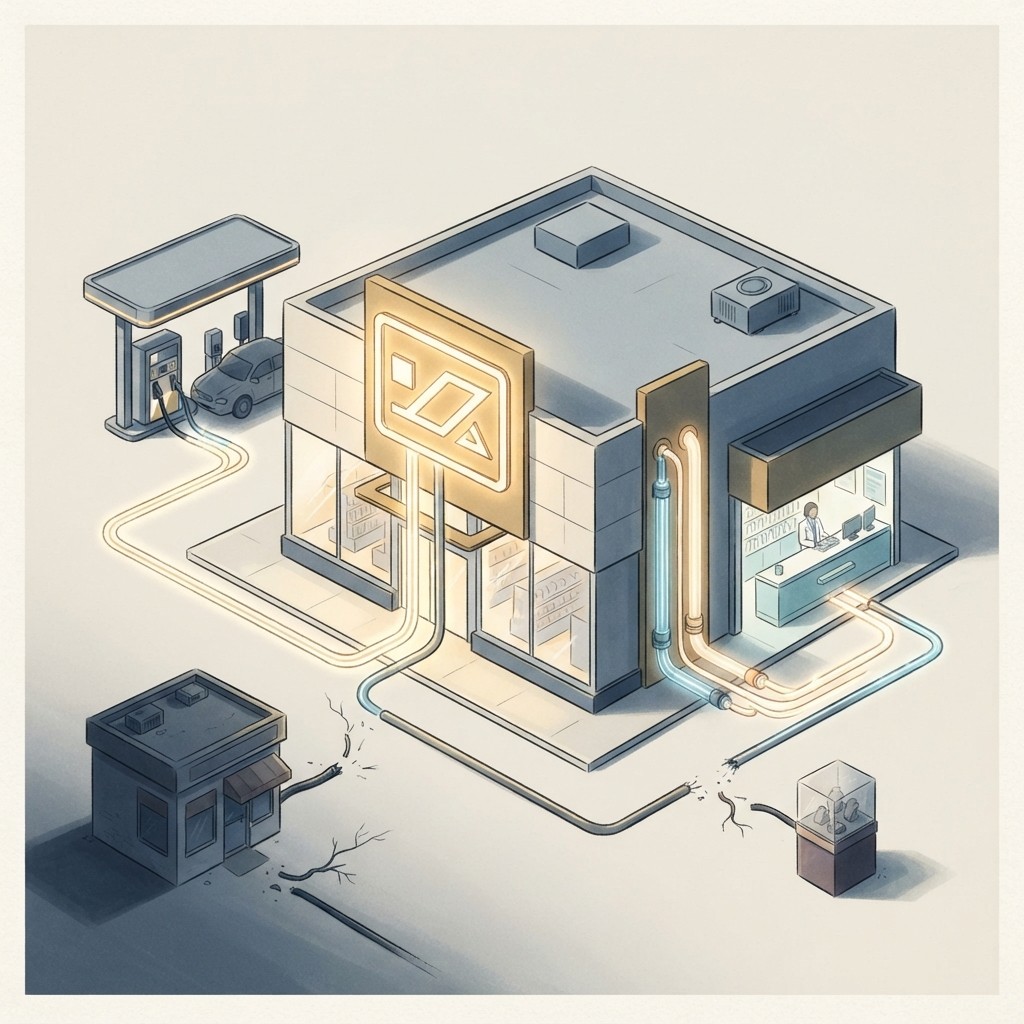
On April 20, 2018, Kroger sold its entire convenience store business to EG Group—762 stores across 18 states, operating under Turkey Hill, Loaf 'N Jug, Kwik Shop, Tom Thumb, and Quik Stop—for $2.15 billion.6 These were profitable, established, real-estate-rich businesses. A footprint-first strategist would have defended them: they were the original adjacency, the kind of small-format gas-and-snacks play that everyone says is a defensive growth lever. Kroger let all of them go. But notice the one thing it explicitly carved out of the deal: its supermarket fuel centers were not included.6 The standalone gas-and-snack stores left. The pumps in the grocery parking lot stayed. That single line in the press release is the whole strategy in miniature.
Here is the mechanism, worked down. A Turkey Hill on a county road and a Kroger fuel center in the grocery lot sell almost the same things—gas, drinks, snacks. Economically they look identical. Strategically they are opposites. The standalone store transacts with an anonymous stranger and forgets them the instant they drive off. The supermarket fuel center transacts with a loyalty cardholder: it knows who pumped the gas, ties the purchase to a grocery profile, and—critically—lets the grocery basket earn the fuel discount and the fuel discount pull the next grocery trip. One adds a transaction. The other deepens a relationship Kroger already owns. When capital discipline arrived, the businesses that merely added footprint were sold, and the ones that fed the loyalty loop were kept. Same gas. Opposite math.
| Standalone convenience store | Supermarket fuel center | |
|---|---|---|
| The customer | Anonymous stranger | Known loyalty cardholder |
| Feeds the data loop | No | Yes |
| Links to the grocery basket | No | Discount earned and redeemed across both |
| Verdict | Sold to EG Group, 2018 | Carved out and kept |
The adjacencies that earned their keep
Run the same test across everything Kroger bolted on, and a clean line appears. The survivors are the ones plugged into the customer-data loop. By the fiscal year ending February 2024, Kroger ran 2,722 supermarkets—2,257 of them with pharmacies and 1,665 with fuel centers built right in.3 These aren't side businesses; they're load-bearing. In the prior fiscal year, supermarket fuel was $18.6 billion of sales and pharmacy was $13.4 billion, against $148.3 billion total.4 But the revenue is almost beside the point. A pharmacy gives Kroger a recurring, high-frequency reason for the same household to return on a known schedule, all of it logged. A fuel center turns a grocery trip into two linked purchases. Both are adjacencies that make the core stickier, not adjacencies that simply sit beside it.
The purest expression of the strategy is the one with no shelves at all. In April 2015, Kroger restructured its long-running U.S. relationship with the British data firm dunnhumby—acquiring certain assets of the DunnhumbyUSA joint venture and licensing dunnhumby's tools to stand up a wholly owned subsidiary called 84.51°.5 The popular shorthand—'Kroger bought dunnhumby'—overstates it; Kroger did not acquire dunnhumby Ltd. or its global operations. What it bought was the apparatus for turning loyalty-card data into shopper insight, loyalty marketing, and a retail-media advertising business. 84.51° is credited with helping push Kroger to $10 billion in digital sales in 2020.8 A grocer had quietly built itself a data company—not next to the store, but underneath it.
Wasn't this just buying low and selling high?
The fair objection is that this is a story told backwards. Kroger didn't design a loyalty-loop doctrine and then prune to it—it grabbed businesses when they were available and sold the convenience stores in 2018 because c-store valuations were rich and a strategic buyer was paying $2.15 billion.6 That's partly true, and worth conceding: there was no master plan, only opportunistic accumulation followed by capital discipline. But opportunism doesn't explain the carve-out. If Kroger were simply harvesting a high price, it would have sold the fuel centers along with the convenience stores—same products, same buyer, more money. It didn't. It paid the price of a less clean transaction precisely to keep the pumps attached to the grocery data. The plan may have been discovered rather than authored, but the discrimination at the moment of sale was deliberate. Discipline revealed which adjacencies the company actually believed in—and they were the ones wired to the loyalty card, every time.
Every expanding company accumulates businesses that sit next to the core. Most aren't strategy; they're proximity. The way to tell the difference is to ask which one you'd part with under capital pressure—and watch what gets carved out of the deal. Kroger sold 762 convenience stores and kept the chemically identical fuel pumps in its own parking lots, because one fed the loyalty loop and one didn't. A true adjacency makes the core harder to leave; a false one just makes the map bigger. When you prune, you're not cutting costs—you're declaring which businesses were ever really yours. Footprint is the thing that looks like growth. The data loop is the thing that is.
Kroger spent two decades looking like a grocer that couldn't stop buying things next to groceries—jewelry counters, gas pumps, sandwich shops, a British data firm's American arm. The expansion that mattered was never the footprint. It was the loop: a loyalty card that turned a fuel stop into a grocery trip, a prescription refill into a known schedule, and twenty years of basket data into an advertising business that helped move $10 billion online. The convenience stores left in 2018 for a clean $2.15 billion. The pumps stayed for free. That is the whole tell. Kroger didn't expand beyond its core. It expanded the things that made the core impossible to walk away from—and sold everything else.
When a company grows into the businesses around it
Adjacency / Synergy Map
A one-page canvas for an adjacency play: the new business next door, the shared assets that justify entering it, the synergies that actually transfer versus the ones that evaporate on contact, and the dis-synergies nobody put on the deck. Blank to test your own expansion; filled as the worked example showing where the story's 'natural adjacency' was real and where it was wishful.
Included, filled and blank, in the The Adjacency Expansion Casebook. See the set → · Preview the blank →
Sources
Where this comes from — the filings, records, and reporting behind it.
- 1Kroger's merger with Fred Meyer closed on May 27, 1999 (not 1998), via a stock-for-stock deal; the combined company was described as having $43 billion in annual sales, 2,200 supermarkets, 800 convenience stores, and 381 fine jewelry stores across 37 states.
- 2On May 27, 1999, Kroger issued 312 million shares of common stock to acquire Fred Meyer Inc. The company operated retail food and drug stores, multi-department stores, jewelry stores, and convenience stores.
- 3As of fiscal year ending February 3, 2024, Kroger operated 2,722 supermarkets of which 2,257 had pharmacies and 1,665 had fuel centers. Fuel (supermarket fuel) represented 11.1% of sales and pharmacy 9.5%.
- 4For Kroger's fiscal year ending January 28, 2023, total sales were $148.258 billion. Supermarket Fuel accounted for $18.632 billion (12.6%), Pharmacy $13.377 billion (9.0%), and Non-Perishable grocery $74.121 billion (50.0%).
- 5In April 2015, Kroger and dunnhumby Ltd. replaced their exclusive joint venture with a new license and asset-acquisition arrangement; Kroger acquired certain assets of DunnhumbyUSA and created a wholly-owned subsidiary called 84.51°. Kroger did NOT acquire dunnhumby Ltd. itself.
- 6On April 20, 2018, Kroger completed the sale of its convenience store business — 762 stores (including 66 franchise operations) operating in 18 states under Turkey Hill, Loaf 'N Jug, Kwik Shop, Tom Thumb, and Quik Stop banners — to EG Group for $2.15 billion. Kroger's supermarket fuel centers were NOT included in the sale.
- 7Fred Meyer operated 284 specialty jewelry stores under names including Fred Meyer Jewelers, Merksamer Jewelers, Fox's, Littman, and Barclay Jewelers at the time of the Kroger merger. Fred Meyer stores sold food, apparel, home electronics, general merchandise, and fine jewelry — a full supercenter format.
- 884.51°, Kroger's data analytics subsidiary, is credited with helping Kroger reach $10 billion in digital sales in 2020; it encompasses shopper insights, loyalty marketing, and retail media advertising and was built on the workforce and assets of the former DunnhumbyUSA joint venture.
More like this — beyond Kroger
New Strategically analyses as they publish: the defining moves in business, checked against the record. No noise, and one click to leave.