Pairs with the Profit-Engine Map — a ready-to-use strategy tool. Included in the Money Machine Casebook →
“Where does the money actually come from, and who sets the rate it comes in at?”
A teenager drops onto an island with a hundred strangers and never pays a cent for the privilege. The game is free. The download is free. The hundred rounds they will lose this week are free. And then, between matches, they spend $8.99 on a dance their character does after a kill - a purchase that changes nothing about whether they win or die. Multiply that by a few hundred million players and you get one of the most profitable games ever made, where the game itself is the loss leader and the real product is a number stored in an account. Fortnite isn't selling a game. It's selling V-Bucks, and the game is just the reason you keep buying them.
The official story is that Fortnite is a wildly successful free game. That's the part that hides the trick. Free is not the business model - free is the funnel. The business is a private currency that sits between the player's wallet and the store shelf, and that currency does something quietly powerful: it makes you stop thinking in dollars.
The two-week decision that built a billion-dollar machine
Fortnite's money machine almost never existed in this form. The Battle Royale mode was hacked together in roughly two months in 2017 using assets borrowed from Epic's paid game, Save the World - and the plan was to ship it as part of that paid bundle. Two weeks before launch, Epic flinched. Worried that charging up front would strangle growth before it started, it cut Battle Royale loose as a separate, free release.6 On September 26, 2017, it went live on PC, PlayStation 4, and Xbox One, free for everyone, with one promise printed plainly: 'we will not sell items that give a competitive advantage.'1 That last line is not a marketing nicety. It is the whole architecture. By refusing to sell power, Epic forced itself to sell something else entirely - and what it landed on was vanity, sold through a currency.
“we will not sell items that give a competitive advantage.”1
Why a private currency is the actual product
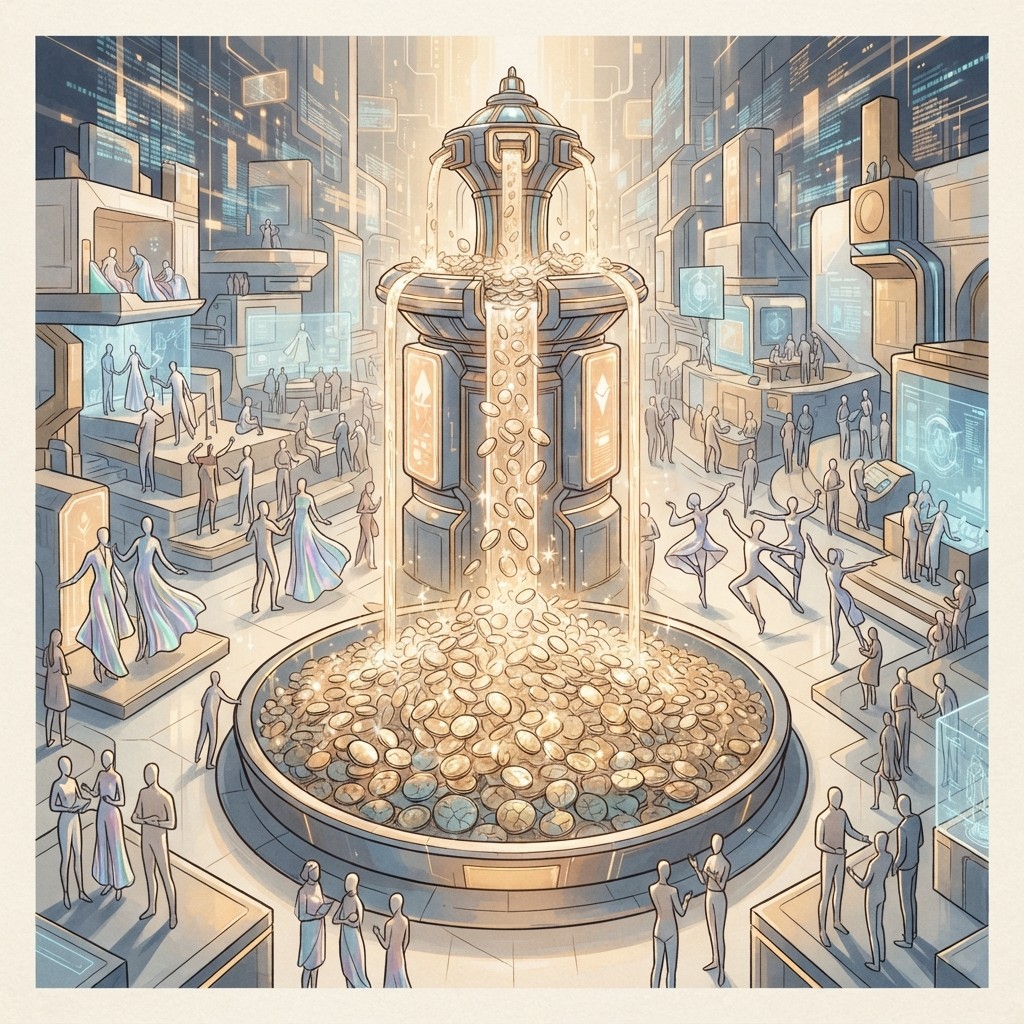
Here is the mechanism, worked all the way down. You cannot buy a skin in Fortnite with dollars. You buy V-Bucks with dollars, then buy the skin with V-Bucks.4 That extra step looks like friction. It is the opposite - it is an abstraction layer that severs the link between what you spend and what it costs. A skin priced at '1,500 V-Bucks' has no obvious dollar figure attached; the player has already converted their money into game-money, and game-money spends like Monopoly cash. The conversion happens once, in bulk, often padded with a 'bonus' that leaves an awkward remainder in the account - just enough to nudge the next top-up. The store, meanwhile, runs on scarcity: items rotate, vanish, and return, so the decision is never 'do I want this?' but 'do I want this before it's gone?' Each piece is small. Together they form a system engineered to make spending feel like playing.
| Dollars | V-Bucks economy | |
|---|---|---|
| What you buy with it | V-Bucks (once, in bulk) | Skins, emotes, Battle Passes |
| Price perception | Clear: '$8.99' | Abstracted: '1,500 V-Bucks' |
| Affects who wins a match | No | No - cosmetic only |
| Leftover balance | — | Engineered remainder, nudging the next purchase |
The payoff of this design is the kind of number Epic doesn't have to lend you to earn. Because Epic is privately held and publishes no audited financials, every figure in circulation is an estimate triangulated from court records and analysts. But those estimates are striking: Epic's revenue is put at roughly $5.7 billion in 2024, and Fortnite is reckoned the engine behind around 80% of it - an estimated $3.5 billion in 2023 alone.3 No box price. No subscription wall at the door. Just a free game and a currency the world keeps topping up.
The tell: when Epic made V-Bucks worth less
A currency you control is a price you control - and you can change it without ever printing the word 'increase.' In March 2026, Epic did exactly that, reducing V-Bucks purchasing power for the first time ever: the $8.99 pack that once bought 1,000 V-Bucks now bought 800.4 That is a 20% price hike, executed entirely on the game-money side of the abstraction, where most players track value loosely if at all. The move is the clearest confession of how the model works. When demand needs propping up, you don't reprice the skins - you reprice the currency, and let the layer absorb the blow. But it cuts both ways. A currency you can quietly devalue is also a currency that quietly tells the market when the underlying engine is straining.
And the engine was straining. The devaluation didn't arrive in a vacuum. The valuation on Epic itself had already retraced hard: when Disney bought a $1.5 billion stake in February 2024, it did so at a $22.5 billion post-money valuation - down sharply from the $31.5 billion the company commanded in its April 2022 round.5 A cosmetic-only model lives or dies on attention, and attention is the one input no amount of currency design can manufacture.
Isn't 'cosmetic-only' just the honest, ethical version of free-to-play?
The fair objection is that Fortnite is the good guy here. It refuses to sell power, so the playing field stays level; it sells only vanity, which is harmless; it pours money back into its ecosystem - Epic paid Fortnite creators $352 million in 2024, with the creator base nearly tripling to 70,000.7 All true, and the fairness is genuinely load-bearing: a level field is precisely what keeps the player base broad enough to monetize. But 'cosmetic' does not mean 'gentle.' In December 2022, the FTC reached settlements totaling $520 million with Epic - a $275 million penalty for children's-privacy violations, the largest such penalty in the agency's history, and a separate $245 million earmarked to refund consumers harmed by deceptive billing dark patterns.2 Those dark patterns lived inside the very purchase flows the model depends on. The honest read is that the abstraction layer is double-edged: the same design that makes spending frictionless also makes accidental and manipulated spending frictionless, and regulators have now priced that in. The model isn't dirty because it's free-to-play. It's exposed because it monetizes attention through a layer built to soften scrutiny - and scrutiny found it anyway.
The most durable consumer-spending machines rarely charge for the product directly - they insert a currency between the wallet and the purchase, because an abstraction layer lets you control price perception, scarcity, and remainder balances all at once. Casinos sell chips; airlines sell miles; Fortnite sells V-Bucks. The player converts real money into game-money once and then spends in a unit that no longer feels like money. Two cautions, though. First, a currency you can quietly reprice is one regulators and players will eventually learn to watch - the very softening that makes it work makes it suspect. Second, this only holds while the thing the currency buys still commands desire. Cosmetic-only monetization has no floor: when attention fades, there is no utility left to charge for, only vanity nobody wants anymore. The currency layer amplifies a healthy business and accelerates a fading one.
Fortnite gave away the one thing everyone assumed it was selling - the game - and got rich on the one thing nobody thinks of as a product: the act of converting dollars into a number. That was the genius, and it is also the fragility. A free game with a paid currency makes billions as long as the world keeps wanting to be seen on the island. The moment it stops, there is no box price to fall back on, no subscription locked in, no power left to sell - only a currency growing quietly worth less, telling on the empire that printed it.
Companies that profit where you'd never look
Profit-Engine Map
A one-page map that pulls a business apart into the hook that gets the customer in the door and the engine that quietly earns the margin. Use it to see where the real profit lives, how the two halves are wired together, and what breaks if the link is cut. Blank to dissect your own P&L; filled as the worked example of a business whose advertised product is not where it makes its money.
Included, filled and blank, in the Money Machine Casebook. See the set → · Preview the blank →
Sources
Where this comes from — the filings, records, and reporting behind it.
- 1Fortnite Battle Royale was announced as free-to-play on September 26, 2017, available on PC, PlayStation 4, and Xbox One, with Epic explicitly stating 'we will not sell items that give a competitive advantage.'
- 2On December 19, 2022, the FTC announced two settlements totaling $520 million with Epic Games: $275 million civil penalty for COPPA violations (the largest COPPA penalty ever obtained by the FTC) and $245 million for dark-pattern deceptive billing practices to be refunded to consumers.
- 3Epic Games estimated revenue was $5.7B in 2024 (up ~10% from $5.2B in 2023), with Fortnite as the primary driver at an estimated $3.5B in 2023 (~80% of Epic total). These are estimates; Epic does not publish consolidated financials.Sacra, Epic Games revenue, valuation & funding ↗ · 2026-04-26
- 4Fortnite monetizes through V-Bucks (in-game currency), cosmetic items, Battle Passes, and subscriptions; purchasable items do not provide competitive advantages. In March 2026, Epic reduced V-Bucks purchasing power for the first time (e.g., the $8.99 pack dropped from 1,000 to 800 V-Bucks).Sacra, Epic Games revenue, valuation & funding ↗ · 2026-04-26
- 5Disney acquired a $1.5 billion equity stake in Epic Games in February 2024 at a $22.5 billion post-money valuation, down from the $31.5 billion valuation in Epic's April 2022 funding round.
- 6Fortnite Battle Royale was developed in approximately two months mid-2017 using assets from Save the World; Epic originally planned it as part of the paid game but switched to a separate free-to-play release two weeks before launch, concerned the paid model would hinder growth.
- 7Epic paid creators $352 million from Fortnite in 2024, with $324 million flowing through Unreal Editor for Fortnite (UEFN); total UEFN payouts since launch reached $722 million by 2025, with the creator base nearly tripling to 70,000.
- 8In August 2020, Epic deliberately triggered its removal from the iOS App Store and Google Play by adding a direct payment option to bypass platform fees; Apple ultimately prevailed in a bench trial (September 2021), while a jury found Google's conduct monopolistic (December 2023).
Weighing outside help with a decision like this? Hiring a pricing strategy consultant
More like this — beyond Epic Games
New Strategically analyses as they publish: the defining moves in business, checked against the record. No noise, and one click to leave.