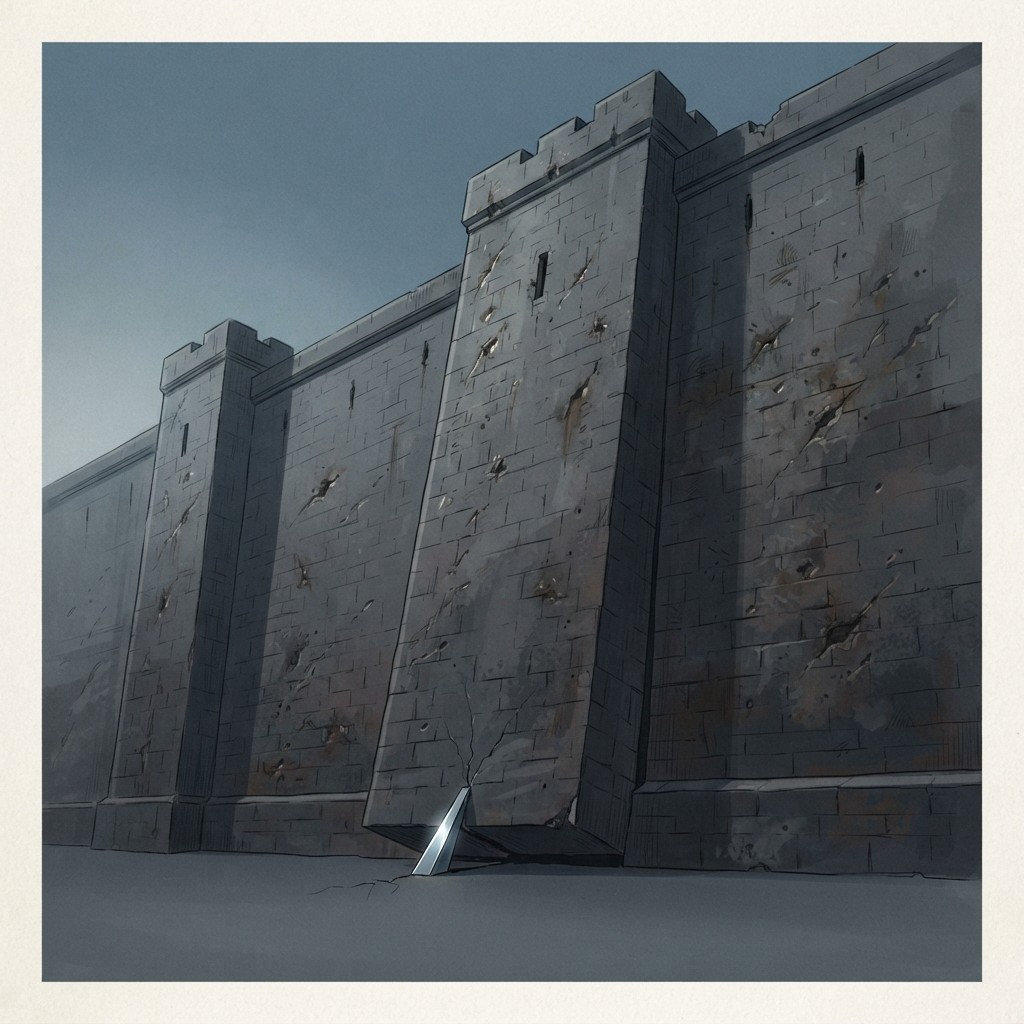
Pairs with the Standards-War Battle Map — a ready-to-use strategy tool, filled for Epic Games. Included in the The Standards War Casebook →
On August 13, 2020, a Fortnite player who bought in-game currency was quietly offered a cheaper price — paid straight to Epic, bypassing Apple's checkout and Apple's 30% cut. That offer was not a bug, a negotiation, or a leak. It was a tripwire. Epic had buried a direct-payment system inside a patch Apple had already approved, then flipped it on with a hotfix that needed no further review.3 The same day, Apple yanked Fortnite. The same day, Epic filed a 60-page federal complaint and released a parody of Apple's famous '1984' ad.12 None of that timing was luck. Epic didn't get caught breaking the rules. It spent months building the trap and then walked Apple into it.
The popular story is David versus Goliath: a beloved game-maker, suddenly cut off, fighting for every developer against a trillion-dollar gatekeeper. Strip the costume off and a different thing is standing there. Epic is a multi-billion-dollar company that deliberately violated a contract it had signed, lost almost everything in court, and is still — slowly, expensively — getting the outcome it wanted. This was never a consumer crusade. It was a leverage play.
The lawsuit was the product, not the reaction
The detail that breaks the David-and-Goliath frame is hiding in plain sight in Epic's own complaint. Epic stated it was 'not seeking monetary compensation' — only injunctive relief, a court order changing how iOS distribution and payments work.2 A company genuinely wronged and out real money asks for damages. A company running a strategy asks for a rule change. Epic told CNN exactly how the trap was built: a project named 'Project Liberty,' a payment bypass smuggled into an approved update, a hotfix chosen precisely because it sidestepped Apple's approval, and a lawsuit and video sitting ready for the moment Apple did the predictable thing.3 The 30-40 million daily Fortnite logins Epic cited weren't an audience to protect.2 They were the hostage that made the confrontation big enough to matter.
“Epic is not seeking monetary compensation... Epic is seeking injunctive relief to allow fair competition.”2
Epic walked into court and lost almost everything
If this were a crusade, the verdict was a rout. In September 2021, Judge Yvonne Gonzalez Rogers ruled for Apple on 9 of the 10 counts. She found Apple was not a monopolist under federal antitrust law — the entire intellectual spine of Epic's case. And because Epic had broken a contract it freely signed, she ordered Epic to pay Apple $3.6 million, the 30% Apple would have collected on the revenue Epic withheld.4 The headline anyone would have predicted — 'Epic proves Apple is an illegal monopoly' — never arrived. Epic won exactly one thing: a state-law claim under California's Unfair Competition Law that struck down Apple's 'anti-steering' rules, the provisions barring developers from even telling users a cheaper option existed outside the app.4 One count out of ten. Not a federal antitrust win at all. A side door.
| Epic's framing | The September 2021 ruling | |
|---|---|---|
| Apple is a monopolist | Yes — the core claim | No — Apple not a monopolist[[cite:s4]] |
| Federal antitrust counts | Win | Lost 9 of 10[[cite:s4]] |
| Money | Not seeking compensation[[cite:s2]] | Epic owes Apple $3.6M[[cite:s4]] |
| Anti-steering rules | Must be struck down | Struck down — the one win[[cite:s4]] |
The narrow win turned out to be the whole game
Here is where the loss starts paying off. That lone anti-steering injunction looked like a consolation prize — until you trace what it forces. The order said Apple must let developers point users to cheaper payment outside the app. In January 2024 the Supreme Court declined to hear either side's appeal, which sounds like an ending but was actually a lock: it left the original judgment and that injunction standing.5 Apple's response was to comply on paper and gut it in practice — it would allow the outside link, then charge a 27% commission on those very purchases, nearly the same toll it was supposedly being forced to release. And that is where Apple made the strategic error Epic never could have scripted.
When the court ordered document production, the 27% justification fell apart. Apple had pointed to an outside consultant's report as the basis for the fee. The documents showed the 27% decision was already made in 2023 — before the report it cited as cover existed.6 In April 2025 Judge Gonzalez Rogers found Apple had 'willfully' violated her injunction, referred the matter to the U.S. Attorney for possible criminal contempt, and found that an Apple executive had perjured himself on the stand.6 The Ninth Circuit affirmed the contempt finding in December 2025; in May 2026 the Supreme Court declined to pause the contempt order even as Apple filed a fresh petition arguing the injunction now sweeps in millions of developers far beyond Epic.78 Epic lost the monopoly case. Apple is the one being investigated for a crime.
Isn't this just Apple's self-inflicted wound, not Epic's strategy?
The honest objection is that Epic's plan ran on luck. The strategy as designed was a near-total failure: 9 of 10 counts lost, Apple cleared of monopoly, a $3.6 million check written to the opponent. The structural change Epic is now extracting flows almost entirely from Apple's own post-injunction choices — the 27% fee, the manufactured justification, the perjury. Epic didn't engineer that. So calling this a brilliant long-game looks like crediting the arsonist for the fire department. That's fair. But it misses what the strategy actually secured. Epic's job was never to win the monopoly argument outright; it was to get any durable hook into Apple's commission and then keep the litigation alive long enough for Apple to overreach. The anti-steering injunction was that hook. A company confident in a fair fee complies cleanly and the matter dies. Apple, unable to let go of the toll, reached for a near-identical 27% and lied about why — and a live injunction was sitting there to catch it. Epic didn't need to be right about everything. It needed to keep the door open and let Apple's instinct to defend its 30% do the rest.
Epic teaches the uncomfortable version of platform warfare: the headline ruling is often the least important thing you win. A standards war over a gatekeeper's terms is rarely settled in one judgment — it's settled in the years of compliance, contempt, and re-litigation that follow. Epic lost the monopoly case and still bent the platform, because it secured one durable injunction and refused to let the matter close. The lesson isn't 'sue your platform.' It's that incumbents defending a lucrative toll will keep reaching for it under pressure, and every reach is a chance to be caught. Keep a credible legal hook alive, keep the clock running, and let the incumbent's own attachment to its margin write your evidence for you. The danger, of course, is that this only works if you can afford to lose 9 of 10 counts and still be standing — which is exactly why this is a billion-dollar company's strategy, not a developer's.
Epic walked into court to prove Apple was a monopolist and walked out having proven the opposite — then handed Apple a $3.6 million check on the way. By every scoreboard that mattered in 2021, it lost. Yet six years on, Apple is the party fighting a contempt order, a perjury finding, and a criminal referral, while the rule Epic actually needed quietly stands. The fight was never about the taste of the verdict. It was about owning a hook that wouldn't let go, and trusting that a company that built an empire on a 30% toll would never willingly hand the toll back. Epic didn't win the war. It just refused to let it end — and waited for Apple to lose it for them.
When the fight is the strategy
Standards-War Battle Map
A one-page canvas for a winner-take-most format war: who's fighting, which platforms and partners back each side, where the installed base sits today, and which forces will tip the market before it locks. Blank to map a standards fight you're entering; filled as the worked example charting the battle the story describes. Use it to spot which side has already won and which is still spending to lose.
Included, filled and blank, in the The Standards War Casebook. See the set → · Preview the blank →
Sources
Where this comes from — the filings, records, and reporting behind it.
- 1Epic Games, Inc. v. Apple Inc. was filed on August 13, 2020 in the U.S. District Court for the Northern District of California, docket 4:20-cv-05640, assigned to Judge Yvonne Gonzalez Rogers.
- 2Epic's original complaint explicitly states it was 'not seeking monetary compensation' but only injunctive relief to allow fair competition in iOS app distribution and payment processing markets; the complaint also cites 30-40 million daily Epic game logins and the 1984 Apple ad framing.
- 3Epic premeditated the confrontation via 'Project Liberty': it secretly embedded a direct-payment code in an Apple-approved patch, triggered it via a hotfix on August 13, 2020 not requiring prior approval, and had a 60-page lawsuit and a parody '1984' video prepared in advance. Sweeney confirmed this to CNN.
- 4Judge Gonzalez Rogers ruled in favor of Apple on 9 of 10 counts in September 2021, found Apple was NOT a monopolist under federal antitrust law, required Epic to pay Apple $3.6 million (30% of withheld in-app revenue), but permanently enjoined Apple's anti-steering provisions under California's Unfair Competition Law.
- 5On January 16, 2024, the Supreme Court declined to hear appeals from both Apple and Epic, leaving the original judgment — largely a win for Apple — and the anti-steering injunction in place.
- 6In April 2025, Judge Gonzalez Rogers found Apple 'willfully' violated the 2021 anti-steering injunction by imposing a 27% commission on off-app purchases, referred the case to the U.S. Attorney for potential criminal contempt, and found that an Apple executive had perjured himself — documents showed the 27% commission policy was decided in 2023, before the external consultant report Apple cited as justification.
- 7The Ninth Circuit affirmed Apple's civil contempt finding in December 2025 but allowed Apple to argue for a 'reasonable fee'; as of May 2026 Apple filed a new Supreme Court petition, and the Supreme Court declined to pause the contempt order.
- 8Apple filed a new Supreme Court petition in May 2026 seeking review of the contempt finding and scope of the injunction (which Apple argues applies to millions of developers beyond Epic); this is the primary-court document confirming the case citation as No. 4:20-cv-05640 (N.D. Cal.) and No. 25-2935 (9th Cir.).
More like this — beyond Epic Games
New Strategically analyses as they publish: the defining moves in business, checked against the record. No noise, and one click to leave.