Pairs with the Asset-Light vs Asset-Heavy Comparator — a ready-to-use strategy tool. Included in the The Asset-Light Operator Casebook →
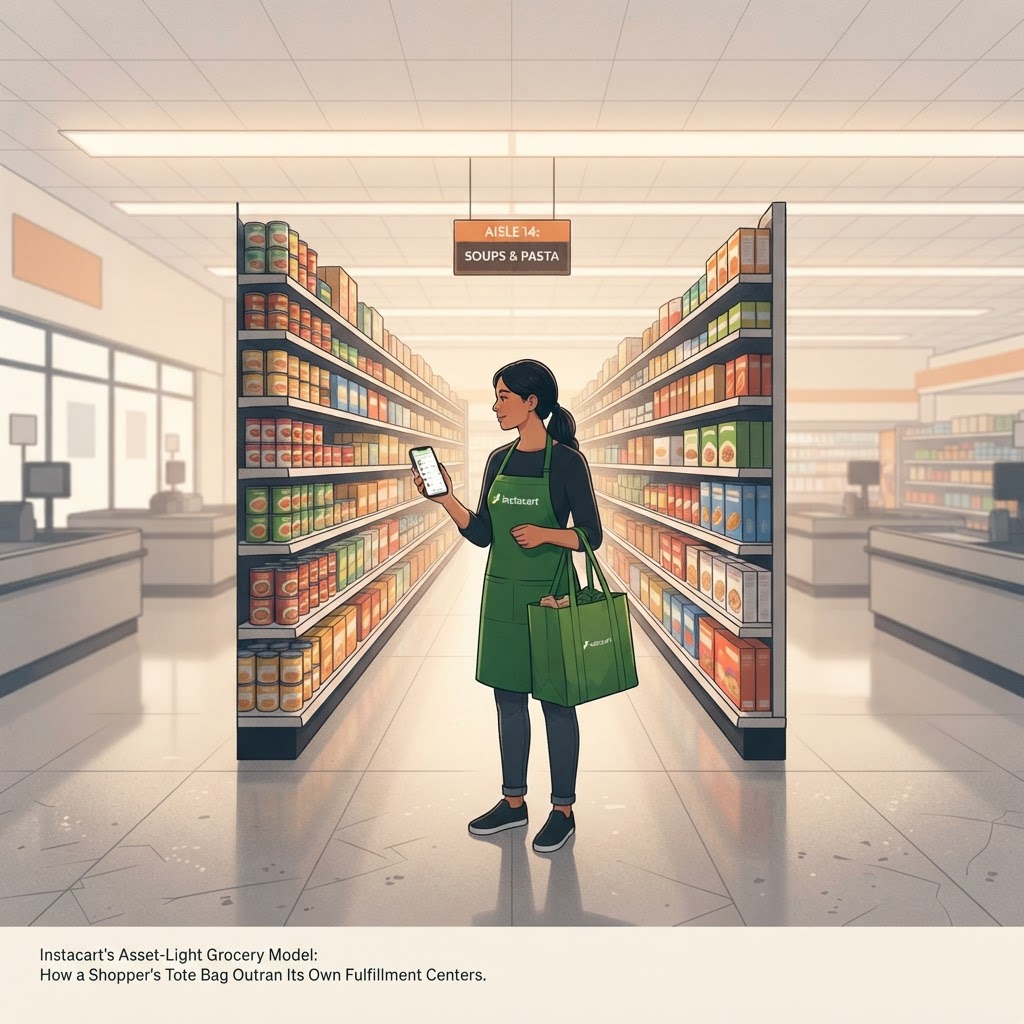
Walk into any grocery store in America and try to find the part Instacart owns. You can't. Not a shelf, not a freezer, not a forklift, not a delivery van, not a single banana in the produce bin. The shopper filling your order is an independent contractor using their own car and their own gas. The store belongs to Kroger or Costco or Wegmans. The inventory belongs to them too. Instacart shows up to no warehouse and stocks no SKU — it sells software and a logistics layer, and lets everyone else hold the heavy, depreciating things. That is the asset-light dream in its purest form: own the demand, rent everything else.
The official story is that this makes Instacart a low-risk, high-margin compounding machine — a marketplace that grows without capital. The truth is narrower and stranger. Instacart didn't eliminate risk by going asset-light. It traded one kind of risk for another. It swapped warehouses and trucks for a labor-classification liability sitting in courtrooms, a delivery business that barely earns its keep, and a valuation that fell roughly 75% the moment public markets priced it honestly.
The delivery business is the loss leader. The ads are the business.
Here is the part that breaks the standard mental model. Most people assume Instacart makes money on delivery — fees on the order, a cut of the basket. It does collect those fees, but they are thin. Per its own S-1, transaction revenue ran about 6.3% of gross transaction value in 2022, and that figure has to cover the entire cost of fulfilling an order: paying the shopper, supporting the app, eating the chargebacks.2 What actually makes the model print money is the second line item — advertising. In 2023, Instacart's advertising and other revenue hit $871M, up 18% year over year on a GAAP basis, and it is the company's highest-margin business by a wide stretch.912 The S-1 says the quiet part plainly: a failure to grow advertising would negatively impact the company's financial condition. Translation: the delivery core does not stand on its own. It is the bait that assembles the audience the real product — ad placement — is sold against.
| The delivery business | The advertising business | |
|---|---|---|
| What it sells | Groceries fetched and delivered | Brand placement on the basket |
| Margin profile | Thin — must cover shoppers, app, support | High — the company's best line |
| Take rate (% of GTV, 2022) | ~6.3% transaction revenue | ~2.6% advertising revenue |
| Role in the model | Builds the audience | Monetizes the audience |
Read those two take-rates again. Advertising is roughly 2.6% of GTV and delivery transaction revenue is roughly 6.3%2 — so ads look like the smaller line (and the transaction figure is gross revenue, not net economics after fulfillment cost). But the size that matters is profit, not revenue, and almost the entire margin lives in the ad column. Instacart is, structurally, a retail-media company that happens to run a grocery-delivery service to generate the inventory it sells. The picking and the driving are the cost of acquiring eyeballs. The eyeballs are the product. Same app. Opposite economics.
Asset-light didn't kill the risk. It moved it into a courtroom.
The seductive promise of asset-light is that without inventory or real estate, there's nothing left to go wrong. But capital risk doesn't vanish when you refuse to own things — it migrates to wherever you pushed the work. Instacart pushed the labor onto gig shoppers, more than 90% of whom are classified as independent contractors.7 That classification is the load-bearing wall of the entire unit economics: contractors mean no payroll taxes, no benefits, no minimum-wage floor, no overtime. Reclassify them as employees and the cost of fulfilling every order rises company-wide, all at once. This is not theoretical. In October 2022, Instacart agreed to a $46.5M settlement of a lawsuit filed by the City of San Diego over exactly that claim — that its California workers were misclassified.10 The S-1 lists worker-classification regulation as an ongoing risk. So the company that proudly owns no trucks carries a contingent liability that no balance sheet line captures cleanly: the possibility that a regulator redefines what its workers are. That is the asset it can't see on a map.
When a model claims to be 'capital-light,' the right question isn't 'where are the assets?' — it's 'where did the risk go?' Instacart offloaded inventory risk to grocers and fleet risk to gig drivers, but the savings were funded by a single legal assumption: that its shoppers are contractors, not employees. Any business that wins by reclassifying a cost off its books is exposed the moment a court or regulator reclassifies it back on. The cleanest balance sheet can hide the heaviest contingent liability — and a model is only as light as its most contestable assumption.
What the market paid for the story, then paid to unwind it
During the pandemic, the asset-light narrative ran hot. In March 2021 Instacart raised $265M at a $39B valuation, co-led by Andreessen Horowitz, Sequoia Capital, D1 Capital Partners, Fidelity, and T. Rowe Price — more than double the $17.7B it had been worth five months earlier.13 That number was the market pricing the dream: ubiquitous grocery delivery, capital-free growth, a compounding moat. Then the world reopened, lockdown ordering normalized, and Instacart had to face public markets. When it filed to go public in August 20231 its initial IPO range of $26–$28 a share implied a fully-diluted valuation of $8.6–$9.3B3 — and even after the range was lifted and the IPO priced at $30, the roughly $9.9B valuation was still a fall of about 75% from the 2021 peak.11 That is a drop — a near-total deflation of the pandemic premium. The asset-light story didn't get cheaper. It got re-priced as a real, thin-margin logistics business with a good ad engine bolted on.
But it did turn profitable — doesn't that vindicate the model?
The fair objection is that Instacart is now genuinely profitable: $457M of net income in 2024 on $33.5B of GTV, and an ad business that third-party analysts projected to surpass $1B for the first time.8 That is real, and it matters — the model does work. But look at what it works on. The profit is not the asset-light marketplace earning its keep; it's the high-margin advertising business carrying the thin-margin delivery business on its back. And the 2024 profit followed a $1.622B net loss in 20238 — the company's first full year as a public entity. So the honest read is neither 'durable compounder' nor 'failed flop.' It's a retail-media business wearing a grocery-delivery costume, whose profitability depends on advertising continuing to outrun the cost of fulfillment, and whose largest off-balance-sheet risk is a regulator's pen. The vindication is partial. Asset-light produced a viable business — just not the risk-free, capital-free moat the $39B price tag was paying for.
“The 85% figure represents the share of total 2022 U.S. grocery sales made by retail banners partnered with Instacart — not the share of grocery transactions Instacart processes.”3
Instacart told a clean story: own nothing, risk nothing, grow forever. The first half is true — it owns no stores, no fleet, no inventory. The second half was never the deal. Going asset-light didn't abolish the risk in grocery delivery; it relocated it into a labor classification, a margin structure that needs ads to survive, and a valuation the pandemic inflated and the market quietly let down by three-quarters. The lightest balance sheet in retail still carries the heaviest assumption in the building — that the people doing the shopping never become employees. That's the thing about renting everything: you can keep the assets off your books, but you cannot keep the risk off your future.
When the business isn't the business you think
Asset-Light vs Asset-Heavy Comparator
A side-by-side matrix that pits owning the assets against renting or orchestrating them, dimension by dimension. Blank to weigh your own model choice; filled as the worked example showing why the story's company went capital-light — or planted its money in concrete and steel.
Included, filled and blank, in the The Asset-Light Operator Casebook. See the set → · Preview the blank →
Sources
Where this comes from — the filings, records, and reporting behind it.
- 1Maplebear Inc. d/b/a Instacart filed its Form S-1 with the SEC on August 25, 2023, for a proposed IPO on the Nasdaq under the symbol CART, with Goldman Sachs and J.P. Morgan as lead book-running managers.
- 2The S-1 states Instacart's revenue consists of transaction revenue (fees from retail partners and customers) and advertising and other revenue (fees from brand partners); in 2022 and H1 2023, transaction revenue was ~6.3% and 7.2% of GTV respectively, and advertising revenue was ~2.6% and 2.7% of GTV respectively.
- 3The S-1/A filed September 11, 2023 set an IPO price range of $26–$28/share for 22 million shares, implying a fully-diluted valuation of $8.6–$9.3B; the 85% U.S. grocery market figure is based on total grocery sales in 2022 excluding alcohol, and represents the share of sales made by retail banners partnered with Instacart — not Instacart's transaction market share.
- 4Instacart's 10-K for fiscal year ended December 31, 2023 was filed with the SEC on March 5, 2024; the company is the issuer Maplebear Inc.
- 5Instacart raised $265M at a $39B valuation in March 2021, led by Andreessen Horowitz, Sequoia Capital, D1 Capital Partners, Fidelity, and T. Rowe Price — more than doubling from the prior $17.7B valuation set in October 2020.CNBC, Instacart's valuation doubles to $39 billion ↗ · 2021-03-02
- 6Instacart's advertising revenue reached $940M in 2023 (up 27% YoY from $740M in 2022) and was projected to surpass $1B for the first time in 2024; advertising is the company's highest-margin business line.
- 7In October 2022, Instacart settled with the city of San Diego for $46.5M over claims that California workers were improperly classified as independent contractors rather than employees; over 90% of Instacart shoppers are independent contractors.
- 8Instacart reported a net income of $457M in 2024 versus a net loss of $1.622B in 2023 (which included large one-time items); GTV reached $33.461B in 2024, up 10% YoY, and 2024 revenue was $3.3B, an 11% increase over 2023.Sacra, Instacart revenue, valuation & funding ↗ · 2026-05-17
- 9For fiscal year 2023, Instacart recorded $871 million in advertising and other revenue, up 18% year over year.
- 10Instacart agreed to pay $46.5 million to settle a 2019 lawsuit filed by the City of San Diego claiming the company misclassified its workers as independent contractors instead of employees; the settlement was reached in October 2022.
- 11Instacart priced its IPO at $30 a share on September 18, 2023 — the top end of a $28–$30 range raised from an earlier $26–$28 range — giving it a fully diluted valuation of about $9.9 billion.
- 12Instacart's advertising and other revenue for full-year 2023 was $871 million, up 18% year-over-year, representing 2.9% of GTV — as reported in the company's Q4 and full-year 2023 earnings release.
- 13Instacart's $265M March 2021 financing round was co-led by Andreessen Horowitz, Sequoia Capital, D1 Capital Partners, Fidelity Management & Research Company LLC, and T. Rowe Price Associates, Inc.
More like this — beyond Instacart
New Strategically analyses as they publish: the defining moves in business, checked against the record. No noise, and one click to leave.