Pairs with the Vertical-Integration Assessment — a ready-to-use strategy tool. Included in the The Vertical Integration Bet Casebook →
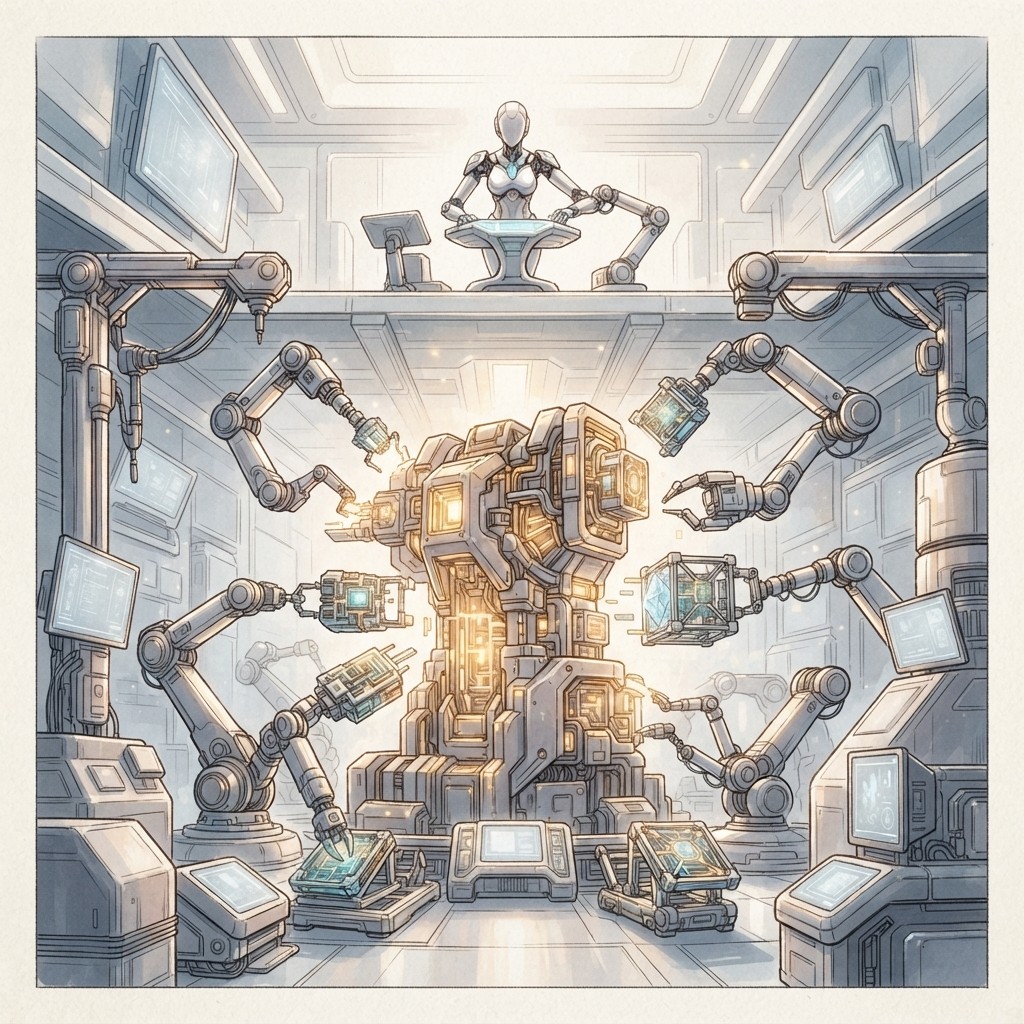
ASML's machine is the most complex object regularly manufactured by humans, and ASML does not build most of it. It buys it. Roughly four-fifths of what goes into a system that prints the circuitry of the entire modern world arrives from outside the company - from a network of about 5,150 suppliers that ASML coordinates rather than owns.47 The company calls itself, in its own filings, a 'system integrator' that focuses on final assembly and systems engineering.7 That is a polite way of saying it is an assembler with a very good address book.
The official story is that ASML won by vertically integrating - by bringing the hard physics in-house and refusing to depend on anyone. The real story is almost the reverse. ASML was born an outsourcer, stayed an outsourcer, and turned outsourcing into the deepest moat in technology. The trick was not making the parts itself. It was making sure no one else could buy them.
It started with no money to make anything
ASML did not choose to be lean; it had no choice. Founded on 1 April 1984 as a joint venture between Philips and ASM International - each partner putting in 2.1 million guilders, a little over four million between them - it was a thinly capitalized spin-out tasked with commercializing a Philips lithography project.6 There was no money to build optics, no money to build motors, no money to build the light sources. So it bought all of it. The outsourcing model wasn't a stage the company grew out of; it was the foundation it was poured on. The famous image - a leaky shed in Eindhoven - is the founders' own telling. The point of it is the same in either version: this was a company that began with nothing to integrate.
Which raises the obvious question. If ASML never owned its supply chain, how does it hold a position no competitor has dented in decades - sole production of EUV lithography systems, and the dominant share of the advanced DUV immersion machines that ran the world before EUV arrived?
Don't build the supplier. Capture it.
ASML's answer is the thing almost everyone misreads as vertical integration. It is something stranger and harder to copy: a proprietary ecosystem of captive, co-invested, sole-source partners. When the EUV light source became the single hardest problem standing between ASML and the next generation of chips, ASML did not try to grow that capability in-house. It bought the company that already had it. In October 2012 it announced the acquisition of Cymer, the light-source specialist, in a deal valued at EUR 1.95 billion, explicitly to accelerate EUV; the deal closed in May 2013.12 Cymer wasn't a supplier anymore. It was inside the tent.
Zeiss is the more revealing move, because ASML deliberately stopped short of owning it. The optics inside an EUV scanner - mirrors polished to tolerances measured against the size of an atom - come from Carl Zeiss SMT, which ASML calls its most important strategic partner.8 ASML could have tried to acquire it. Instead, in late 2016 it took a 24.9% minority stake for €1 billion, closing in 2017, and left Carl Zeiss AG as the majority owner.38 That number is not an accident. A quarter is enough to co-invest, co-develop the High-NA optics, and bind Zeiss's roadmap to ASML's; it is small enough to avoid owning Zeiss's factories, its balance sheet, and the antitrust headaches of swallowing your only optics supplier whole. ASML bought the relationship, not the company.
| True vertical integration | Arm's-length outsourcing | ASML's captured ecosystem | |
|---|---|---|---|
| Who owns the factory | You do | They do | They do (or you, selectively) |
| Who carries the capital cost | You | Them | Mostly them, shared where it matters |
| Can a rival buy the same parts | N/A - it's yours | Yes | No - the supplier is captive |
| Roadmap alignment | Total | Weak | Locked by co-investment |
| Example | Owning Zeiss outright | Buying off-the-shelf lenses | Cymer acquired; 24.9% of Zeiss SMT |
Vertical integration gets the glory, but it is expensive: you fund the factories, you carry the inventory, you own every problem. ASML found the back door. It controls the handful of suppliers that are genuinely irreplaceable - the light source, the optics - and lets the other thousands stay at arm's length. A rival can copy ASML's blueprints; it cannot buy Cymer's EUV source or Zeiss's mirrors, because those are spoken for. The moat isn't what ASML makes. It's what ASML has quietly made unavailable to everyone else.
Why the assembler keeps the profit
If ASML buys most of its machine, you'd expect the value to leak out to the suppliers. It doesn't. In FY2024 ASML reported €28.3 billion in net sales at a 51.3% gross margin, with €4.3 billion poured back into R&D and 44,027 employees on the books.4 In 2023 it turned €27.6 billion of sales into €7.8 billion of net income.5 That is not the margin profile of a middleman. It is the margin of a company that owns the one thing in the system that cannot be sourced: the architecture itself - the systems engineering that decides how a light source from one captive partner, optics from another, and parts from five thousand more become a single machine that prints at the atomic scale. The components are bought. The integration is the product.
“The company focuses on final assembly and systems engineering while coordinating a global supplier network that supplies ~80% of components.”7
Isn't this just vertical integration with extra steps?
The fair objection: ASML owns Cymer outright and a chunk of Zeiss, so what's the difference from integrating - other than semantics? The difference is structural, and it is the whole point. True vertical integration would mean owning all of it - every supplier, every factory, every balance sheet - and carrying that capital weight forever. ASML owns almost none of it. It owns the two suppliers whose secrets are the bottleneck, and it stays an arm's-length customer to the thousands whose work is hard but substitutable. Co-investment buys roadmap control without buying the roadmap's cost. That is harder to replicate than integration, not easier: a rival can in principle build its own factories, but it cannot un-acquire Cymer or un-bind Zeiss. The honest caveat is that this design carries a risk a true integrator avoids - dependence. ASML's machine has single points of failure it does not fully own, and the relationships have to hold. They hold because ASML made itself the indispensable customer at the exact moment each partner needed one. Captured, not coerced.
ASML is praised for making the impossible machine. It would be closer to the truth to say it made the impossible supply chain - and then quietly closed it. It never needed to own the optics or the light source. It needed to be the only company those suppliers could afford to say yes to, and the only one anyone else could not. The genius was never in the manufacturing. It was in deciding which 20% to keep, which 80% to coordinate, and which two suppliers to make sure no competitor would ever get a turn with.
More companies that win by controlling the right slice
Vertical-Integration Assessment
A make-vs-buy assessment for a single stage of the value chain: rate the forces that argue for owning it and the forces that argue for renting it, then read the verdict off the gap. Blank to run on a stage you're deciding now; filled as the worked example showing why the story's company pulled a stage in-house — or pushed it out.
Included, filled and blank, in the The Vertical Integration Bet Casebook. See the set → · Preview the blank →
Sources
Where this comes from — the filings, records, and reporting behind it.
- 1ASML announced the acquisition of Cymer in a cash-and-stock transaction valued at EUR 1.95 billion on 17 October 2012, for the stated purpose of accelerating EUV technology development. The deal closed 30 May 2013.
- 2Cymer Form 8-K (filed same day) corroborates: ASML agreed to acquire all outstanding Cymer shares; each Cymer share would convert to $20.00 cash plus 1.1502 ASML ordinary shares. Completion announced 30 May 2013.
- 3ASML agreed to acquire a 24.9% minority stake in Carl Zeiss SMT GmbH from Carl Zeiss AG for €1 billion in cash (announced 3 November 2016; closed after German antitrust clearance 28 June 2017). Carl Zeiss AG retains majority ownership. The stated objective was developing High-NA EUV optics.
- 4ASML's Form 20-F for FY2024 (filed 5 March 2025) reports: total net sales of €28.3 billion, R&D costs of €4.3 billion, gross margin 51.3%, 44,027 employees (FTEs), and a total supplier count of 5,150.
- 5ASML's FY2023 results press release (filed with SEC as Form 6-K, 24 January 2024) reports: net sales of €27.6 billion and net income of €7.8 billion for 2023.
- 6ASML was founded 1 April 1984 as a joint venture between Philips and ASM International, with each partner contributing 2.1 million guilders (total 4.2 million guilders). It was established to commercialise a Philips in-house lithography project. The original outsourcing-based business model—lacking capital for vertical integration, ASML outsourced motors, optics, and other major components—was foundational, not incidental.
- 7ASML describes itself explicitly as a system integrator: 'The company focuses on final assembly and systems engineering while coordinating a global supplier network that supplies ~80% of components.' The 2025 Annual Report's supply-chain section describes a strategy of 'co-developing solutions' with suppliers rather than owning production.
- 8Carl Zeiss SMT is majority owned by Carl Zeiss AG; ASML holds a 24.9% minority stake—corroborated independently by Wikipedia's Carl Zeiss SMT article and by the MarketScreener deal-closing report (June 2017). Zeiss is described by ASML as its 'most important strategic partner' for EUV optics.
More like this — beyond ASML
New Strategically analyses as they publish: the defining moves in business, checked against the record. No noise, and one click to leave.