Pairs with the Standards-War Battle Map — a ready-to-use strategy tool, filled for ASML. Included in the The Standards War Casebook →
Every advanced chip in your pocket was etched by a machine that exists in exactly one place in the world: the catalog of a single Dutch company. There is no second supplier. If you want to print circuits a few nanometers wide using extreme ultraviolet light, you buy from ASML or you do not build the chip at all. In 2023 alone, ASML recognized €9.1 billion in EUV system revenue on 53 machines.1 It is one of the cleanest monopolies in modern industry — and the standard story of how it was won is almost entirely a story about how it was given.
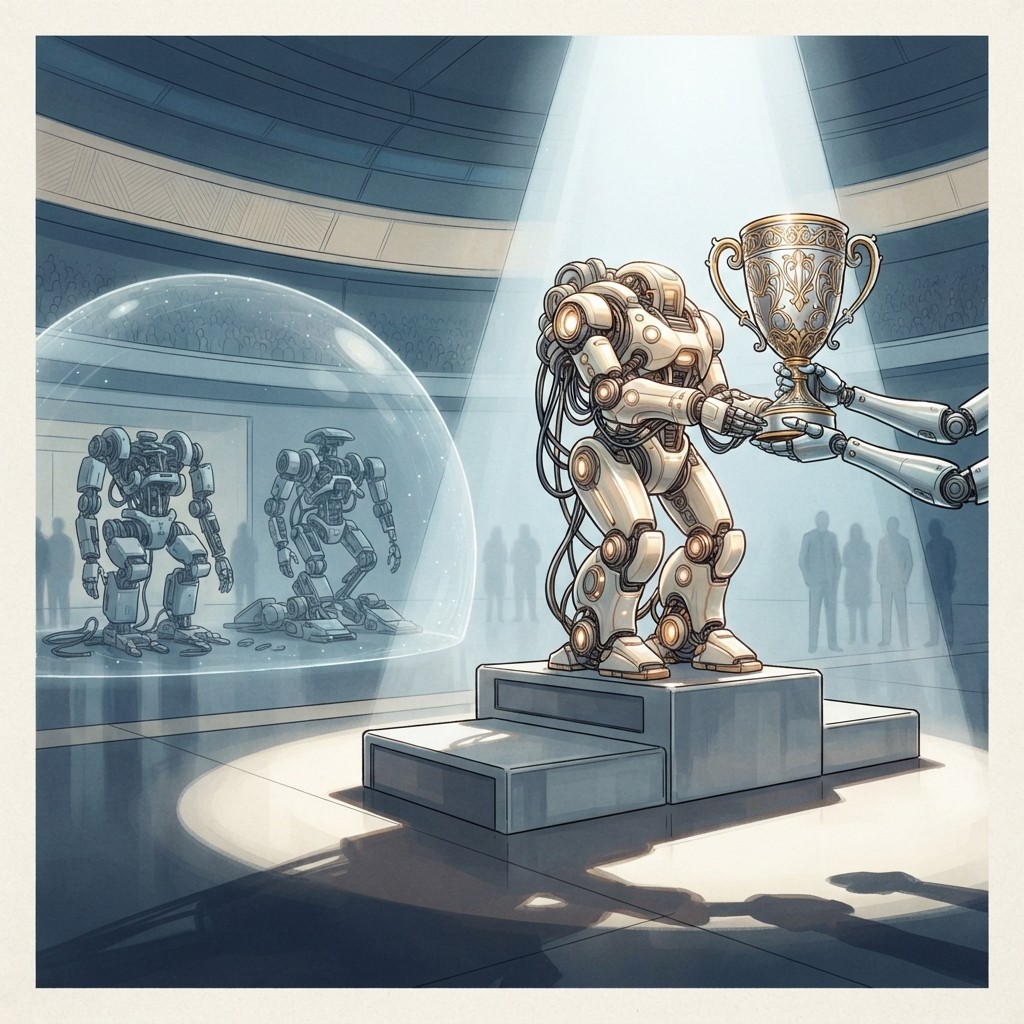
The official version is that ASML beat Nikon and Canon in a brutal three-decade engineering race because it was simply better. That is the part everyone gets backwards. The two Japanese giants were not out-engineered. One declined the contest amid political controversy; the other was blocked from entering it. ASML didn't win the standards war so much as it was selected to inherit a standard that other people had built — and that someone else had paid for.
Who actually paid for the science
Start with the part that dissolves the myth fastest: ASML did not invent EUV. The foundational science was pioneered inside America's national laboratory ecosystem — Lawrence Livermore, Lawrence Berkeley, and Sandia — through a consortium called EUV LLC, with funding largely underwritten by Intel.54 This was public American money and public American physics, chasing a way to keep Moore's Law alive when conventional light hit its limits. The deepest, hardest, most uncertain work — figuring out whether you could even use 13.5-nanometer light to print a circuit — was done before ASML held the relevant license. ASML's genuine and enormous contribution came later: turning a lab demonstration into a machine you could buy. It spent more than €6 billion on EUV R&D over seventeen years and bought Cymer to crack the light source.9 That is real. But commercializing a standard and originating it are not the same act, and the popular narrative quietly merges them.
“The technology was pioneered in America's national laboratory ecosystem and largely funded by Intel, yet commercialized by a Dutch company — with important lessons for export-control policymakers.”5
Why the two best rivals never reached the start line
Here is the move that decided the standards war, and it happened in a conference room, not a clean room. To join EUV LLC and gain access to the national-lab work, you had to be admitted. Nikon — at the time the dominant force in lithography — declined to join amid political controversy. Canon, the other Japanese contender, was blocked by the US government outright. ASML, a relatively small Dutch outfit founded in 1984 as a joint venture between Philips and ASM International, was admitted on different grounds entirely: it was neutral ground in the US-Japan semiconductor rivalry of the era.43 Read that again. The decisive qualification was not the best optics or the most patents. It was nationality. A company gets to commercialize the next foundational standard in chipmaking because it sits outside the trade war the two strongest engineers are caught inside. The standards war was settled by selection before it was ever contested on merit.
| Nikon | Canon | ASML | |
|---|---|---|---|
| Entered EUV-LLC consortium | Declined (political controversy) | Blocked by US government | Admitted as 'neutral ground' |
| Access to US national-lab science | No | No | Yes |
| Backed by Intel investment | No | No | Yes (later, $4B stake) |
| EUV machines sold today | Zero | Zero | All of them |
The terms of admission tell you how deliberately this was engineered. In return for its 1999 license, ASML agreed to open a US R&D center and to source 55% of the components in machines sold in America from US suppliers — conditions it never fully met.3 To shore up its American footprint, ASML then acquired Silicon Valley Group in an all-stock deal valued at $1.6 billion, a 58% premium that gave SVG holders roughly a tenth of the combined company.6 That deal had to pass a US foreign-investment review and was cleared only with conditions, including divesting Tinsley Laboratories.7 None of this looks like an open contest. It looks like a managed transfer, with the receiving party agreeing — on paper — to keep enough of the value inside the United States.
The monopoly was real — and it nearly didn't arrive
If the standard was handed over, why hasn't anyone else built one? Because commercializing EUV turned out to be so punishingly hard that the head start became unassailable. The first production system, the NXE:3300, shipped in 2013, but the first commercial chips made with EUV didn't arrive until Samsung began series production on its 7-nanometer node in October 2018, with the first consumer device — Samsung's Galaxy Note10 — landing in 2019.98 One of ASML's own engineers put the gap bluntly: volume production arrived '13 years late' against the original 2006 target.8 That delay is the whole moat. A rival starting from the same lab science would have had to survive the same brutal decade of failure, with no revenue and no guaranteed market, against an incumbent that had already absorbed the cost. By the time the machines actually worked, the race was over because no sane competitor would start it. The machines now sell for up to $200 million in the prior generation and more than $300 million for High-NA, and ASML's three biggest customers made up roughly 84% of its business in 2021.10 In 2024 the company posted €28.3 billion in net sales and €7.6 billion in net income.2 The thinness of the standards war is exactly what makes the position so fat.
Doesn't all of this just mean ASML earned it?
The honest counter is strong, and it deserves to be stated at full force. Being handed a license is worthless if you can't execute, and Nikon and Canon had the same chance to commercialize EUV from their own research positions — they did not. ASML spent the €6 billion and the seventeen years.9 Access to lab science is not a working machine; the gap between them is precisely the part that bankrupts everyone who underestimates it, and ASML is the only firm on earth that crossed it. By that reading, the selection in 1999 merely opened a door, and ASML alone walked all the way through. That is fair, and it is why the company deserves real credit. But it doesn't rescue the 'won on merit' story — it just relocates the merit. The competitive achievement was execution, not victory in a standards contest, because the contest was never run head-to-head. The deeper point is the one CSET and others keep circling: a foundational, publicly-funded American technology ended up monopolized by a single foreign firm — and that firm's machine is now the chokepoint at the center of the most consequential export-control fight of the decade.5 The strategy worked beautifully right up until the geopolitics it was built to dodge came back through the front door.
The instinct is to assume the best technology wins the standard. Frequently the standard is decided earlier and quieter — by who is admitted to the consortium, who gets the license, whose nationality is acceptable to the funder. ASML's true edge was not better optics in 1999; it was being the politically neutral party that two stronger rivals could not be, and then surviving the decade of execution that turned a granted license into an unbreakable monopoly. Two cautions follow. First, selection is necessary but never sufficient: a handed-over standard still bankrupts whoever can't commercialize it, so the moat is built in the lab even when the war was won in a meeting. Second, a position engineered around geopolitics inherits geopolitics — a monopoly on publicly-funded strategic technology is exactly the kind of asset governments eventually reach for.
ASML 'won' the EUV standards war the way a relay anchor wins a race the first three legs already decided. American labs ran the science; Intel paid for it; the US government cleared the field of the two runners who could have caught up; and a small Dutch company, chosen precisely because it threatened no one, was handed the baton and asked to sprint the final, agonizing leg. It sprinted brilliantly — for thirteen years longer than anyone planned. But the genius was never only the machine. It was being the one party everyone could agree to trust with a technology nobody could afford to share. That trust built the monopoly. And now that the same machine has become a weapon in a bigger fight, ASML is discovering the cost of having been chosen: when you are handed the only road, everyone eventually wants to control who you let drive on it.
Standards-War Battle Map
A one-page canvas for a winner-take-most format war: who's fighting, which platforms and partners back each side, where the installed base sits today, and which forces will tip the market before it locks. Blank to map a standards fight you're entering; filled as the worked example charting the battle the story describes. Use it to spot which side has already won and which is still spending to lose.
Included, filled and blank, in the The Standards War Casebook. See the set → · Preview the blank →
Sources
Where this comes from — the filings, records, and reporting behind it.
- 1ASML's 2023 total net sales were €27.6 billion, with EUV system sales of €9.1 billion (recognized revenue on 53 systems); the first High-NA EUV EXE:5000 system modules were shipped before year-end 2023.
- 2ASML's 2024 total net sales were €28.3 billion, gross margin 51.3%, net income €7.6 billion; Q4 2024 net bookings were €7.1 billion of which €3.0 billion was EUV.
- 3ASML was founded in 1984 as a joint venture between Philips and ASM International; in 1999 it was admitted to the US EUV-LLC consortium on condition of establishing a US R&D center and sourcing 55% of US-sold components from American suppliers — conditions it did not fully meet. In July 2012 Intel purchased a 15% stake for $4.1 billion; Samsung and TSMC also bought stakes, totaling ~23% sold under the co-investment program.
- 4The EUV LLC consortium was funded by US DOE national laboratories (Lawrence Livermore, Lawrence Berkeley, Sandia). Nikon declined to join EUV-LLC due to political controversy; Canon was blocked by the US government. ASML was admitted as 'neutral ground.' Silicon Valley Group was bought by ASML in 2001. TSMC, Samsung, and Intel invested $1B, $1B, and $4B respectively in ASML in 2012.
- 5ASML is the sole supplier of EUV machines, winning a 30-year race for a monopoly. The technology was pioneered in America's national laboratory ecosystem and largely funded by Intel, yet commercialized by a Dutch company — with important lessons for export-control policymakers. First commercial EUV-enabled electronics were released in 2019.
- 6ASML announced acquisition of Silicon Valley Group in an all-stock transaction valued at $1.6 billion on October 2, 2000, representing a 58% premium for SVG stockholders who would own ~10% of the combined company; merger agreement announced October 2, 2000.
- 7SVG stockholders voted 99.4% in favor of the ASML merger; the deal was subject to Exon-Florio (CFIUS) review because it involved acquisition of a US company by a foreign entity. The SVG acquisition's CFIUS review was ultimately cleared with conditions including divestiture of Tinsley Laboratories.
- 8Samsung first started series EUV production on a 7LPP (7nm) commercial chip in October 2018. The first EUV-enabled consumer product was the Samsung Galaxy Note10/Note10+ in 2019. ASML's own engineer admitted EUV volume production was '13 years late' versus the original 2006 target.
- 9ASML invested more than €6 billion in EUV R&D over 17 years. It acquired Cymer to accelerate EUV source development. The first EUV production system (NXE:3300) was shipped in 2013. The first High-NA EUV system was delivered in December 2023. ASML is the only EUV supplier; in DUV it competes with others.
- 10TSMC claims it was the first to deliver high-volume EUV chips in 2019. ASML's EUV machines sold for up to $200M circa 2022 (NXE generation); High-NA pricing cited as 'more than $300M' by then-CEO Wennink. As of 2022 ASML had sold ~140 EUV systems total. The three top customers (TSMC, Samsung, Intel) made up ~84% of business in 2021.
More like this — beyond ASML
New Strategically analyses as they publish: the defining moves in business, checked against the record. No noise, and one click to leave.