Pairs with the Vertical-Integration Assessment — a ready-to-use strategy tool, filled for Samsung. Included in the The Vertical Integration Casebook →
Open a Galaxy phone and you are holding a vertically integrated dream. The screen is an OLED panel Samsung Display built. The memory is Samsung's. In many markets, even the brain - the application processor - is a Samsung-designed Exynos chip baked in a Samsung fab. One company supplies itself, floor to ceiling, in a business where almost everyone else has to go shopping. It is the model strategists draw on whiteboards and rarely get to see in the wild: own the stack, capture every margin, depend on no one.
The official story is that this makes Samsung the unbeatable chip-to-phone empire - the one company that designs and manufactures its own everything. That story is half true, and the half it leaves out is the half that's losing money. Because the same integration that makes Samsung formidable in memory and displays also hides a business unit in open distress, one whose problem is not that it can't supply Samsung, but that nobody else wants to buy from it.
The thesis: owning your demand is not the same as earning it
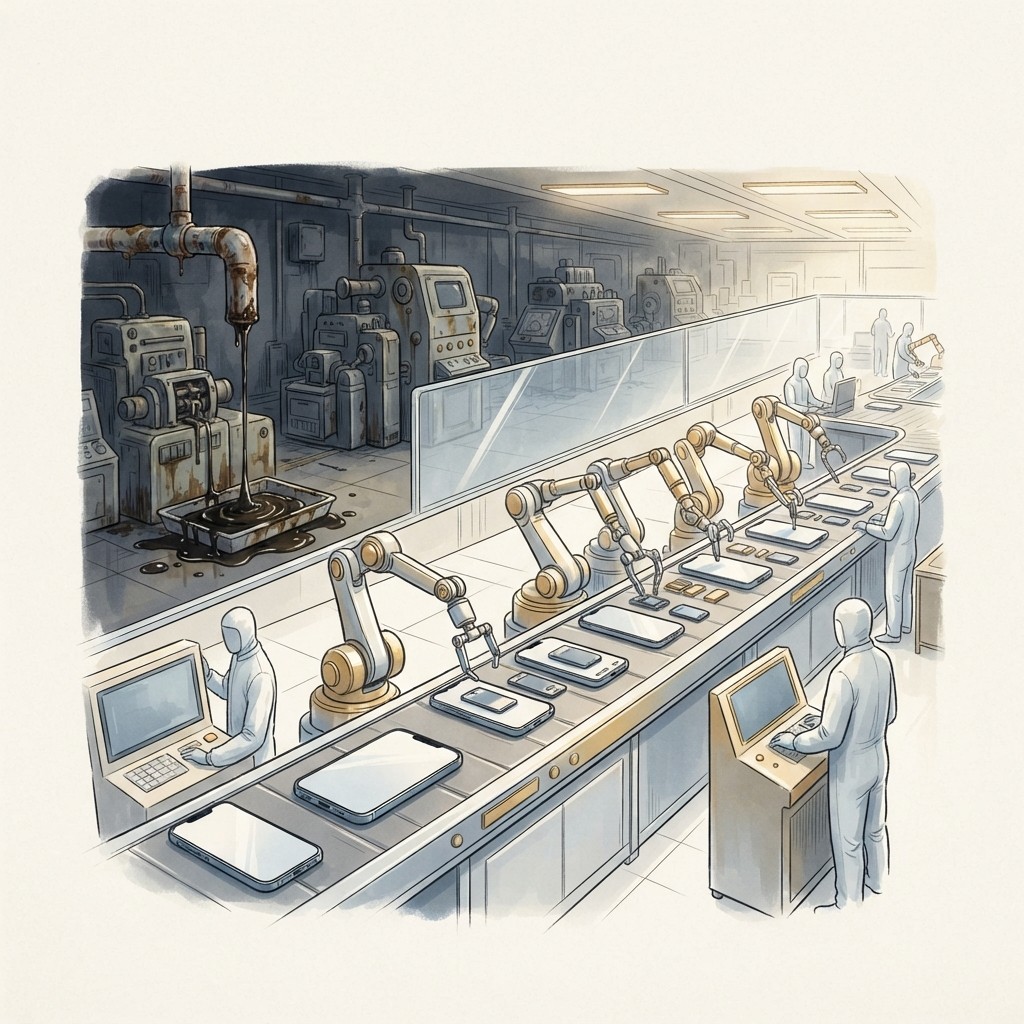
Samsung's empire splits cleanly into two kinds of vertical integration, and they behave like opposite businesses. In memory and displays, Samsung is genuinely dominant on the open market - it sells to the world and happens to be its own customer too. In contract chip manufacturing, the foundry, it is a distant runner-up that leans on internal orders precisely because external ones keep walking away. The first kind of integration is a fortress. The second is a crutch. And the danger is that the fortress hides the crutch - that a glance at the consolidated empire mistakes a leg that can't stand on its own for one more reason it's strong.
Where the integration is real: memory and the screen on your competitor's phone
Start with the parts that work, because they are spectacular. In NAND flash, Samsung held roughly 36.9% of global revenue share in mid-2024 - first in the world.5 And it doesn't just sell memory; it sets the weather for the whole category. When prices collapsed in 2023, Samsung deliberately cut wafer output by about half, a move only the market leader can make, and watched prices rebound more than 50%.5 That is not the behavior of a captive supplier. That is a producer with the scale to discipline an entire industry's supply. Owning its own demand is a footnote; the real asset is that everyone else has to buy from it too.
Displays tell the same story with a sharper twist. Samsung Display held more than half of the global smartphone OLED market by revenue in mid-2024.6 But here is the move that detonates the simple 'captive moat' framing: Samsung Display's single largest smartphone customer is Apple. It shipped 124 million OLED panels to Apple in 2024 - 64 million of them for the iPhone 16 alone - making it Apple's biggest OLED supplier.6 Read that again. The crown jewel of Samsung's vertical stack earns its richest profits by financing the production of the phone that competes most directly with the Galaxy. The integration is commercially real and strategically schizophrenic: the screen on your rival's flagship is your own best margin.
| Memory & Displays | Foundry | |
|---|---|---|
| Open-market position | #1 in NAND; >50% smartphone OLED | ~8.1% share vs. TSMC's 67.1% |
| Who buys it | The whole world, including rivals | Mostly Samsung itself |
| Pricing power | Cuts output, moves global prices | Loses customers to a rival fab |
| What it does for the empire | A fortress that funds everything | A crutch the empire props up |
Where the integration is a crutch: the foundry nobody chooses
Now the part the empire narrative skips. A foundry exists to manufacture chips other companies design - it lives and dies on outside customers. By that measure Samsung Foundry is not winning; it is hemorrhaging. In the final quarter of 2024 it held about 8.1% of the global contract-chip market - down from 9.1% - against TSMC's 67.1%.3 In raw dollars the gap is brutal: roughly $3.26 billion in quarterly foundry revenue, down slightly, versus TSMC's $26.85 billion, up double digits.4 And it doesn't just lag - it loses money. Samsung Foundry posted an operating loss exceeding 2 trillion won, about $1.4 billion, in that single quarter.3
Here is the mechanism, the why beneath the why. A foundry is a trust business before it is a manufacturing business. A fabless designer hands over its most valuable secret - the chip itself - and bets a multi-year product cycle on the fab hitting its yields and timelines. Samsung carries a structural disadvantage TSMC never had: it also designs chips and sells phones. A customer like Qualcomm or Nvidia must weigh whether handing its crown-jewel design to Samsung means feeding a competitor's roadmap. TSMC, which makes nothing of its own, is a pure neutral utility. That neutrality is the product. So when Samsung's advanced nodes stumbled on yield, customers had both a performance reason and a trust reason to leave - and Qualcomm, among others, moved exclusively to TSMC for its leading-edge chips.3
The captive demand makes this worse, not better. Because Samsung can route its own Exynos volume into its own fab, the foundry can post respectable utilization while its external pipeline withers - and even that captive demand is partial, because a large share of Galaxy flagships still ship with Snapdragon chips made by TSMC. Samsung's own phones don't fully trust Samsung's own fab. When you cannot win the customer sitting inside your own building, the 8.1% is not a floor. It is a warning.
“Samsung made only $3.26 billion in foundry revenue in Q4 2024, down 1.4%, versus TSMC's $26.85 billion, up 14.1%.”4
The same crack is opening in the crown jewel
It would be tidy to say memory is the fortress and foundry the crutch and leave it there. But the foundry's disease - yield problems compounding into lost trust at the exact moment a market inflects - is now visible in memory's most important new segment. High Bandwidth Memory, the stacked DRAM that feeds AI accelerators, is where the money is moving. And in HBM during 2024–2025, Samsung trailed SK Hynix in both share and profitability, held back by yield and quality hurdles, and is now scrambling to claw back the segment with next-generation capacity aimed at Nvidia's roadmap.8 The world's #1 memory maker by volume slipped to second or third in the part of memory that matters most for the future. Scale is not the same as readiness, and the integration empire does not automatically deliver either.
The fair counter: isn't a loss-making fab the price of strategic independence?
The honest objection is that judging Samsung Foundry on quarterly profit misses the point. Owning advanced manufacturing is a strategic asset that doesn't show up cleanly in a P&L: it guarantees supply when the world is short of chips, it keeps Samsung at the frontier of process technology rather than dependent on a single Taiwanese supplier, and in a geopolitical era where chip sovereignty is a national-security question, a money-losing fab can be a bargain. There is real weight here. Samsung's semiconductor division alone absorbed roughly 48 trillion won of capex in 2023 - this is a company that thinks in decades, not quarters.1 A second leading-edge foundry on the planet has value beyond its income statement.
All true - and all beside the deeper point. Strategic independence is only worth funding if the asset can eventually stand on its own demand. A foundry that survives on internal orders and subsidy is not insurance; it's a dependency dressed as one. The test of a real second-source is whether outside customers choose it - and they are choosing the other one, by a margin of 67 to 8.3 The capex doesn't disprove the thesis; it sharpens it. Samsung is pouring fortune-sized investment into a unit whose core problem money can't fix, because the missing ingredient is trust, and you cannot capex your way to neutrality you've structurally forfeited.
Vertical integration captures margin and guarantees supply - real advantages, visible in Samsung's memory and display dominance. But it carries a quiet trap: internal demand can prop up a business unit long after the external market has rejected it, so utilization stays high while competitiveness rots. Before you celebrate a vertically integrated arm, run the cruel test: strip out every internal order, and ask whether outside customers would still choose it on the merits. If the answer is no - as it is for Samsung's foundry at 8.1% share - then the integration isn't a fortress wall. It's a life-support line, and the longer it stays attached, the longer you avoid the question the open market already answered.
Samsung built the most complete vertical stack in consumer electronics, and most of it is magnificent: a memory business that disciplines the world's prices, a display business so good its biggest customer is its biggest rival. But the same architecture that makes those arms unstoppable on the open market is exactly what makes the foundry a captive that no one else will adopt. The empire's strength was always that the world had to buy from it. The foundry's weakness is that the world finally found somewhere else to go - and Samsung's own phones quietly went there too. Owning the whole stack is not the same as winning it. The market only counts the customers you didn't already own.
When the structure tells a different story than the brand
Vertical-Integration Assessment
A make-vs-buy assessment for a single stage of the value chain: rate the forces that argue for owning it and the forces that argue for renting it, then read the verdict off the gap. Blank to run on a stage you're deciding now; filled as the worked example showing why the story's company pulled a stage in-house — or pushed it out.
Included, filled and blank, in the The Vertical Integration Casebook. See the set → · Preview the blank →
Sources
Where this comes from — the filings, records, and reporting behind it.
- 1Samsung Electronics reported KRW 258.94 trillion in full-year 2023 revenue and KRW 6.57 trillion in operating profit; capex reached KRW 53.1 trillion, including KRW 48.4 trillion in the DS (semiconductor) division and KRW 2.4 trillion in Samsung Display.
- 2In Q3 2023, Samsung's total consolidated revenue was KRW 67.40 trillion (up 12% QoQ), driven by new smartphone launches and premium display sales; operating profit was KRW 2.43 trillion, with memory losses narrowing but system semiconductor earnings impacted by delayed demand recovery.
- 3TSMC held 67.1% of the global contract foundry market in Q4 2024 while Samsung's share fell from 9.1% to 8.1% in the same period; Samsung Foundry posted an operating loss exceeding 2 trillion won (~$1.4 billion) in Q4 2024, and key customers including Qualcomm have moved exclusively to TSMC for advanced nodes.
- 4TrendForce data (cited by WCCFtech) confirms TSMC's Q4 2024 market share at 67.1% and Samsung's at 8.1%; Samsung made only $3.26 billion in foundry revenue in Q4 2024, down 1.4%, versus TSMC's $26.85 billion, up 14.1%.
- 5Samsung held approximately 36.9% of global NAND flash revenue share in Q2 2024, ranking first among suppliers; Samsung also deliberately cut wafer output by ~50% in 2023 to arrest price collapse, triggering a rebound of more than 50%.
- 6Samsung Display (SDC) shipped 124 million OLED panels to Apple in 2024 (64 million for iPhone 16), making it Apple's largest smartphone OLED supplier; SDC held over 50% of the global smartphone display panel market by revenue in Q2 2024 per TechInsights.
- 7Samsung Electronics was named #1 in the global OLED monitor market in 2023 with 34.7% revenue share and 28.3% unit share, per IDC's Q4 2023 Worldwide Quarterly Gaming Tracker — confirmed directly by Samsung's own newsroom citing the IDC source.
- 8Samsung trailed SK Hynix in HBM market share and profitability during 2024–2025 due to yield and quality issues; its 2026 strategy is focused on regaining the HBM segment via 1c DRAM capacity for HBM4, targeting integration into Nvidia's Rubin accelerators.
More like this — beyond Samsung
New Strategically analyses as they publish: the defining moves in business, checked against the record. No noise, and one click to leave.