Pairs with the Vertical-Integration Assessment — a ready-to-use strategy tool, filled for Toyota. Included in the The Resilience Layer Casebook →
In February 2021, while Ford and GM were idling assembly lines for lack of a chip the size of a fingernail, Toyota's CFO got on an earnings call and said, in effect, we're fine. He explained why: the company had quietly arranged 'one to four months of stocks as necessary' for various components, chips among them.1 The financial press wrote it up as a stunning reversal - the company that invented just-in-time had broken its own rule just in time. It was a great headline. It was also wrong about the most important word in it.
The story everyone told was that Toyota saw the shortage coming and stockpiled chips. Almost none of that is true. Toyota did not start stockpiling for the shortage - it had been requiring the stockpile for roughly a decade. And it never broke its rule, because the rule it kept and the rule it bent are two different rules sitting in two different places.
The buffer was a scar from 2011, not a bet on 2021
On March 11, 2011, the Tohoku earthquake and tsunami tore through Japan's industrial heartland, and Toyota's famously lean supply chain - built to carry almost no slack - had almost no slack to absorb it. Output collapsed; global production fell roughly 78% year over year that April.8 The very thing that made the system efficient made it fragile. A pull system with no buffers is a chain of dominoes: knock out one obscure microchip supplier and the whole line stops downstream.
Toyota's response was not to apologize for lean. It was to engineer around its single failure mode. A senior executive told Reuters that September the company was building a five-year plan to make the supply chain recover within two weeks of any future disaster - including standardizing parts so a missing component could be sourced more than one way.5 Out of that effort came a Business Continuity Plan with a deceptively simple instruction: for roughly 500 priority parts with long lead times and concentrated supply - semiconductors explicitly on the list - someone must always hold two to six months of inventory.6 When the chip shortage arrived a decade later, Toyota wasn't reacting. It was collecting on insurance it had been paying for since 2011.
“One to four months of stocks as necessary.”1
Why Toyota's factory floor stayed lean while the chips piled up
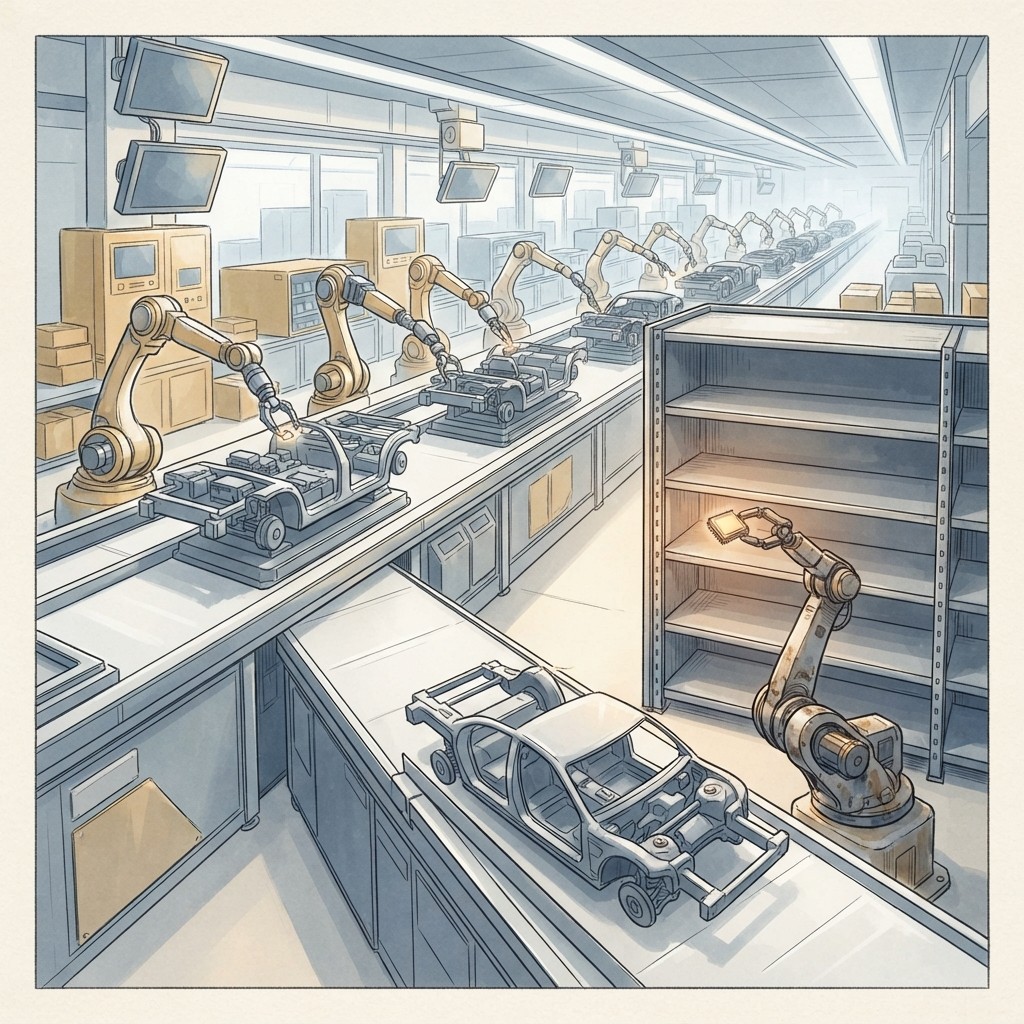
Here is the part the 'Toyota broke JIT' headlines missed entirely. The buffer was never on Toyota's factory floor. The inventory sits upstream - at parts suppliers like Denso, at the chip makers, at the traders in between.6 Toyota's own plants kept running on pure pull, pulling parts only as cars came down the line, exactly as just-in-time dictates. The slack lives one or two tiers back in the supply chain, where Toyota can mandate it without ever carrying a single extra chip on its own books.
This is the whole trick, and it is subtle. Toyota didn't choose between lean and resilient. It split its parts list in two. For the vast majority of components - cheap, fast to make, available from many sources - it kept the relentless thinness of classic JIT. For a critical minority - the 500 priority parts that can halt a line and can't be re-sourced overnight - it pushed a mandatory buffer upstream and helped fund the cost of carry by returning cost-down savings to suppliers. Call it stratified just-in-time: a single system with two settings, calibrated by how much damage each part can do if it goes missing.
| The ordinary parts (the majority) | The ~500 priority parts (incl. chips) | |
|---|---|---|
| Inventory rule | Pure pull - near-zero buffer | Suppliers hold 2–6 months upstream |
| Where the slack sits | Nowhere - just-in-time | At Denso, chip makers, traders |
| Toyota's own factory floor | Lean | Lean |
| Who funds the carry | No one - there is none | Shared, via returned cost-down savings |
| Why this part | Cheap, fast, multi-sourced | Long lead time, concentrated supply, line-stopping |
The instinct after a supply shock is to hold more of everything, which quietly kills the cash efficiency that made lean worth running in the first place. Toyota did the opposite: it asked which specific parts can stop a line and can't be re-sourced fast, found a few hundred of them, and bought slack only there - and even then pushed the cost upstream rather than onto its own balance sheet. Resilience isn't the opposite of efficiency. It's efficiency aimed at your single points of failure instead of spread across everything.
Then the shortage outlasted the buffer
The tidy version of this story ends in early 2021 with Toyota looking like a genius. The honest version keeps going - and gets worse. A two-to-six-month buffer is a clock, not a wall. It buys time against a disruption that ends; it does nothing against one that doesn't. And the chip shortage didn't end. By August 2021 the clock had run out, and Toyota's own SEC filings record what happened next in flat regulatory prose.
So didn't the failure prove JIT was finished?
The fair objection runs like this: if the buffer eventually broke and Toyota cut production anyway, doesn't that just prove just-in-time was too brittle and should have been scrapped? It's the conclusion a lot of people reached in late 2021. Toyota's executives flatly rejected it, and so did the Harvard Business Review's reconstruction of what actually happened. Their point: the Toyota Production System 'is alive and well,' and it was a reason Toyota outperformed rivals through the worst of the shortage, not a reason it stumbled.7 The buffer was a targeted overlay, never a wholesale retreat from lean.
And the logic holds. A buffer that delays a disruption by months while competitors take it on the chin immediately is not a failure - it is a partial success that ran into a once-in-a-generation shortage longer than any reasonable buffer would be sized for. The alternative wasn't a magic inventory level that would have made Toyota immune for two straight years; carrying that much slack on hundreds of parts would have wrecked the economics in every normal year for the sake of one abnormal one. Toyota didn't get the resilience question wrong. It got it exactly as right as a buffer can be, and then reality kept going.
The myth of the great JIT rethink is appealing because it makes a clean morality tale: lean was hubris, the shortage was the comeuppance, and the smart move is to hold more of everything. Toyota's actual record says something quieter and harder to copy. It never abandoned just-in-time, because the lesson it learned in 2011 wasn't 'hold more inventory.' It was 'know which parts can kill you, buy slack only there, and put it where it costs you least.' The chip buffer wasn't a rethink of the system. It was the system, applied to its own worst day - and the day the buffer finally ran out only proved how narrowly, and deliberately, it had been drawn.
When the system behind the system does the real work
Vertical-Integration Assessment
A make-vs-buy assessment for a single stage of the value chain: rate the forces that argue for owning it and the forces that argue for renting it, then read the verdict off the gap. Blank to run on a stage you're deciding now; filled as the worked example showing why the story's company pulled a stage in-house — or pushed it out.
Included, filled and blank, in the The Resilience Layer Casebook. See the set → · Preview the blank →
Sources
Where this comes from — the filings, records, and reporting behind it.
- 1Toyota CFO Kenta Kon stated on the February 10, 2021 earnings call that Toyota had secured 'one to four months of stocks as necessary' for various components including chips as part of its Business Continuity Plan.
- 2Toyota's September 2021 Form 6-K filing confirms production cuts of ~70,000 units in September and ~330,000 units in October 2021 due to parts shortages caused by COVID-19 spread in Southeast Asia and tighter semiconductor supplies; full-year forecast cut from 9.3M to 9.0M units.
- 3Toyota's October 15, 2021 Form 6-K confirms repeated production plan adjustments since August 2021; global production in September and October 2021 was approximately 500,000–600,000 units each month, well below plan, and a further shortfall of 100,000–150,000 units was announced for November.
- 4Toyota's January 18, 2022 Form 6-K confirms a further ~150,000-unit global production cut for February 2022 due to continuing semiconductor demand across all industries, reducing the full-year forecast below 9 million units.
- 5Following the March 2011 Tohoku earthquake — which forced Toyota to halt large portions of production for months — Toyota Executive VP Shinichi Sasaki told Reuters in September 2011 that Toyota was developing a five-year plan to enable supply-chain recovery within two weeks of a future disaster, including standardizing parts across Japanese automakers.
- 6Toyota's post-2011 Business Continuity Plan requires suppliers — not Toyota's own plants — to carry 2–6 months of inventory for approximately 500 priority parts including semiconductors; the chip inventories are held by Denso, chip makers, and traders, keeping Toyota's own factories lean/JIT-compliant.
- 7HBR (November 2022) reported that Toyota executives explicitly rejected the conclusion that JIT was 'over' after the chip shortage, stating the Toyota Production System 'is alive and well' and a key reason Toyota outperformed rivals; the inventory buffer was a targeted overlay, not a wholesale abandonment of lean.
- 8Toyota's global output fell approximately 78% year-over-year in April 2011 after the Tohoku earthquake, a figure referenced in contemporaneous Congressional Research Service analysis and later cited in academic work by Hirofumi Matsuo (Kobe University, 2015 in International Journal of Production Economics).
More like this — beyond Toyota
New Strategically analyses as they publish: the defining moves in business, checked against the record. No noise, and one click to leave.