Pairs with the Culture Doctrine Canvas — a ready-to-use strategy tool. Included in the The Culture Doctrine Casebook →
The most studied corporate culture on earth fits in your jacket pocket. The Toyota Way 2001 is thirteen pages, written in English and Japanese, distributed to associates worldwide in April 2001, and known inside the company as the 'Green Book.'1 It is mostly a collection of quotations - one independent count puts the total at 73, and all but two of the quoted executives were retired or already dead at the time of publication.9 Consultants have built entire careers on it. Business schools assign whole semesters to it. And yet the document itself is a slim reader that, handed to an outsider with no context, is hard to tell apart from any other company's wall of inspirational values.
The official story is that Toyota cracked the code of management - a transferable system any disciplined company could install. The real story is the opposite. The Green Book wasn't written to teach outsiders. It was written because Toyota was growing so fast it could no longer trust the apprenticeship to do the teaching for it. The doctrine was always tacit. Putting it on paper was a confession that the old way of transmitting it had started to fail.
“values and business methods that had been passed on as implicit knowledge”3
A culture you absorb, not a manual you install
Here is the thesis, and it is uncomfortable for everyone who has bought a Lean transformation: the Toyota Way is not a management system. It is organizational DNA - context-dependent, transmitted by apprenticeship, and inseparable from the people who carry it. Even the famous machinery underneath it is multi-generational and multi-author. Toyota's own history credits just-in-time to founder Kiichiro Toyoda, jidoka to Sakichi Toyoda's automatic looms, and the synthesis of it all to Taiichi Ohno, who worked it out by trial and error at the Honsha Machinery Plant across the late 1940s and early 1950s.2 The West shrank that lineage to one genius and a binder of tools. Toyota built it over decades, on the shop floor, person to person.
That distinction is the whole game. A management system is portable because it lives in documents. A doctrine that lives in people travels only as fast as you can train people - and you cannot accelerate apprenticeship the way you can accelerate a factory line. Toyota would discover the cost of forgetting that the hard way.
The growth that outran the teaching
Starting in 1995, under a strategy aimed at 15% of the global car market, Toyota nearly doubled its workforce - from 183,000 to 321,000 people in a single decade.7 Read that number slowly. To hold the doctrine constant, Toyota needed to socialize roughly one new employee into its philosophy for every existing one, while running flat out. The peer-reviewed post-mortem is blunt about what happened: it became increasingly difficult to bring new hires into the Toyota way of thinking, and the heavy use of temporary workers who never entered Toyota's career and training system proved 'highly problematic.'7 The transmission mechanism - the slow apprenticeship - simply could not keep pace with the hiring.
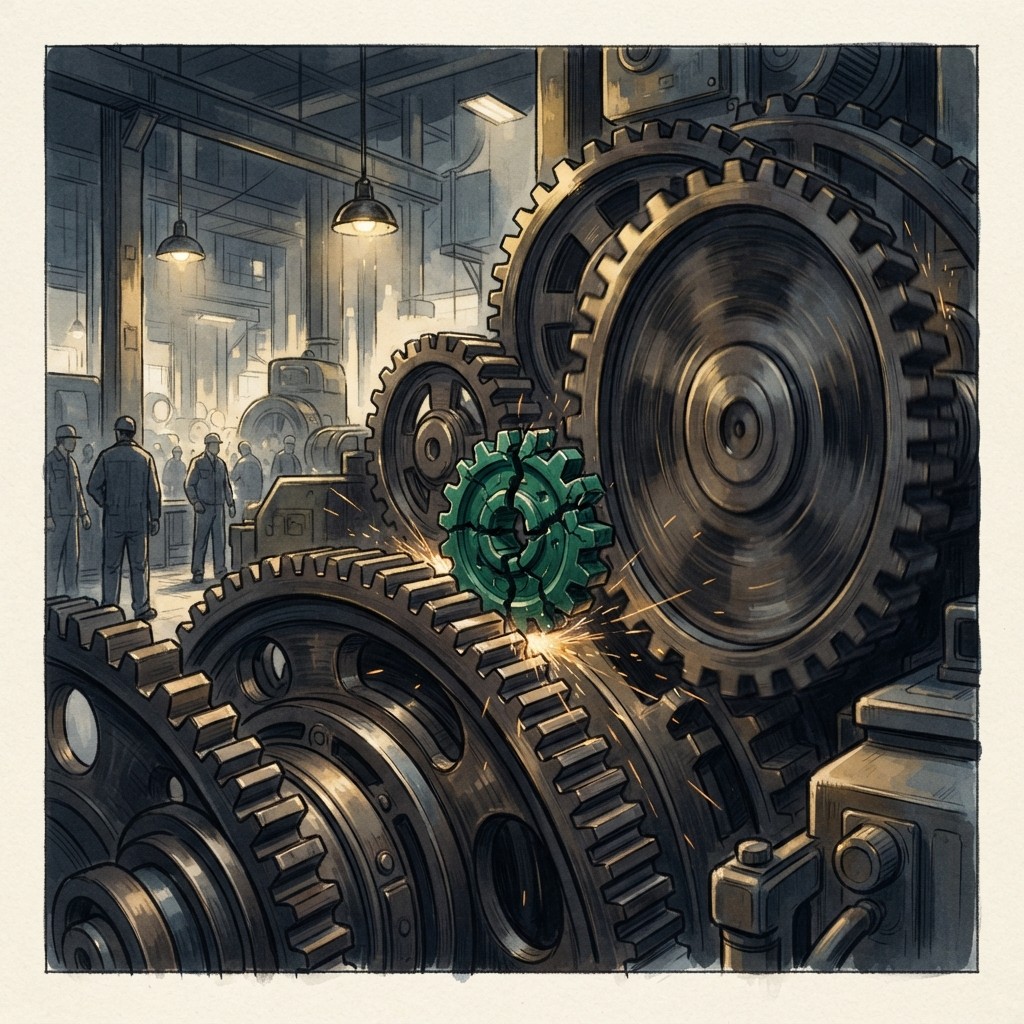
This is why the recall crisis of 2009-2010 was not a deviation from the Toyota Way. It was a structural consequence of trying to scale a culture that doesn't scale. Dilute the apprenticeship and you don't just lose factory discipline - you lose the unwritten norms about when to stop the line, when to escalate bad news, and what 'quality' even means.
What the engineers found, and what Toyota hid
The popular memory of the crisis is a runaway-software story: phantom electronics flooring the throttle. That story is false. The U.S. Department of Transportation's NHTSA-NASA study found no evidence of any electronic defect capable of producing dangerous high-speed unintended acceleration.6 The two confirmed defects were stubbornly mechanical - floor mats trapping the pedal, and accelerator pedals that stuck. The initial recalls for those covered nearly 8 million vehicles in the United States.10 The hardware, in other words, was a manageable problem.
The culture was not. According to the Department of Justice's sworn Statement of Facts, from the fall of 2009 through March 2010 Toyota told U.S. consumers and the regulator that it had 'addressed the root cause' of the unintended acceleration - while it was actively concealing the separate sticky-pedal defect it had already identified internally.4 That is the load-bearing fact of the whole episode. The defect was ordinary. The lie was not. A loyalty culture optimized to never embarrass the company upward had quietly metastasized into a culture that hid a known safety problem from the people whose job was to catch it.
| What people remember | What the record shows | |
|---|---|---|
| The defect | Runaway software / electronics | Two mechanical faults: floor mats and sticky pedals[[cite:s6]] |
| The cause of the scandal | A quality-culture breakdown | Concealing a known defect while claiming the root cause was fixed[[cite:s4]] |
| The trigger | A sudden, abrupt failure | A decade of cultural dilution from headcount nearly doubling[[cite:s7]] |
| The resolution | A clean, fast recovery | A $1.2B criminal penalty and a sworn admission of misleading regulators[[cite:s5]] |
In March 2014 Toyota signed a Deferred Prosecution Agreement, paid that penalty, and admitted in writing that it had deceived consumers and the regulator.5 That is not a story of culture self-correcting. It is a legal concession that the culture had failed at the one thing it most prided itself on: surfacing bad news fast and fixing the real root cause.
But Toyota still sells more cars than anyone - so didn't the doctrine win?
The fair objection is the scoreboard. In 2023 Toyota sold 11,233,039 vehicles worldwide, its fourth straight year as the world's best-selling automaker.8 A culture that produces that, decade after decade, has clearly worked. And that is true - which is exactly why the doctrine is so dangerous to misread. The strength of the Toyota Way is real and it is durable. The failure mode is not that it produces bad cars; it almost never does. The failure mode is that its very strengths - intense loyalty, deference up the chain, a disposition to equate quality with process adherence - become liabilities the moment the company grows faster than it can teach, or faces a problem the doctrine was never designed to surface. The doctrine wins at making cars and loses at admitting it made a bad one. Both halves are the same culture. You don't get one without the buried risk of the other.
The lesson everyone draws from Toyota is 'copy the system.' But the system Toyota's own filings describe was passed on as implicit knowledge, person to person, for decades before anyone wrote it down. That makes it nearly impossible for an outsider to install and dangerous for Toyota itself to scale fast. When you grow your headcount faster than you can apprentice the new people, you don't keep the culture and add bodies - you dilute the culture and inherit its blind spots without its discipline. Before you chase share, ask the unglamorous question: how many people can we actually teach per year, and what happens to the ones we hire beyond that line?
Toyota's culture doctrine is the best in the world at building cars and quietly terrible at one specific thing: telling the truth upward when the truth is embarrassing. Those are not two cultures. They are the same culture, seen from the assembly line and seen from the witness stand. The Green Book was never a manual you could install. It was a thirteen-page reminder that the real system lived in people - and the moment Toyota hired faster than it could teach, the doctrine kept making excellent cars while losing the ability to admit when one was flawed. That is the price of a culture you can only grow, never copy. It scales beautifully right up until you ask it to scale faster than it can teach.
When the doctrine that built a company turns on it
Culture Doctrine Canvas
A one-page canvas for the unwritten rules that actually run a company: the core beliefs, the behaviors they reward and punish, the lines it won't cross, and the moments that prove the doctrine is real. Blank to articulate your own operating culture before it drifts; filled as the worked example that decodes why the story's company behaves the way it does — even when it costs them.
Included, filled and blank, in the The Culture Doctrine Casebook. See the set → · Preview the blank →
Sources
Where this comes from — the filings, records, and reporting behind it.
- 1The Toyota Way 2001 is a 13-page internal document written in English and Japanese, known internally as the 'Green Book,' first distributed to Toyota associates worldwide in April 2001 under President Fujio Cho to codify tacit cultural knowledge previously passed down verbally.
- 2Toyota Motor Corporation's official global history site confirms that the foundations of TPS were established through trial and error at the Honsha Machinery Plant in the late 1940s and early 1950s, crediting the JIT concept to Kiichiro Toyoda, jidoka to Sakichi Toyoda, and the operational synthesis to Taiichi Ohno.
- 3Toyota Motor Corporation's official site confirms that the Toyota Way 2001 codified values and business methods 'that had been passed on as implicit knowledge' as the company's rapid growth, diversification, and globalization in the prior decade made written formalization necessary.
- 4The U.S. DOJ's March 2014 Statement of Facts establishes that from fall 2009 through March 2010, Toyota misled U.S. consumers and NHTSA by publicly claiming it had 'addressed the root cause' of unintended acceleration while actively concealing a separate sticky-pedal defect it had already identified internally.
- 5The DOJ announced a criminal charge against Toyota Motor Corporation and a Deferred Prosecution Agreement with a $1.2 billion financial penalty — the largest ever levied on an automaker at the time — for the company's deception of consumers and NHTSA regarding unintended acceleration defects.
- 6The U.S. DOT's final NHTSA-NASA study report found no evidence of an electronic defect in Toyota vehicles capable of producing dangerous high-speed unintended acceleration; the two mechanical safety defects (floor-mat entrapment and sticky pedal) remained the only confirmed causes.
- 7A peer-reviewed case study in the Journal of Organization Design (2016) documents that Toyota's growth strategy — initiated in 1995 under President Hiroshi Okuda's '2005 Vision' targeting 15% global market share — caused employee headcount to nearly double from 183,000 to 321,000 in a decade, making it increasingly difficult to socialize new hires into Toyota's philosophy, and that extensive use of temporary workers who were not integrated into Toyota's career and training system proved 'highly problematic.'
- 8Toyota Motor Corporation sold 11,233,039 vehicles globally in 2023, retaining the title of world's best-selling automaker for the fourth consecutive year, with Toyota and Lexus brands delivering a record 10,307,395 units — a 7.7% year-over-year increase.
- 9A count of the Toyota Way 2001 document finds 73 quotations making up the bulk of it; except for two quotes by Hiroshi Okuda (still running the company in 2001), all quoted authors were either retired or dead.
- 10In 2009 and 2010, Toyota recalled nearly eight million vehicles in the United States as part of the sticky pedal and pedal entrapment recalls.
More like this — beyond Toyota
New Strategically analyses as they publish: the defining moves in business, checked against the record. No noise, and one click to leave.