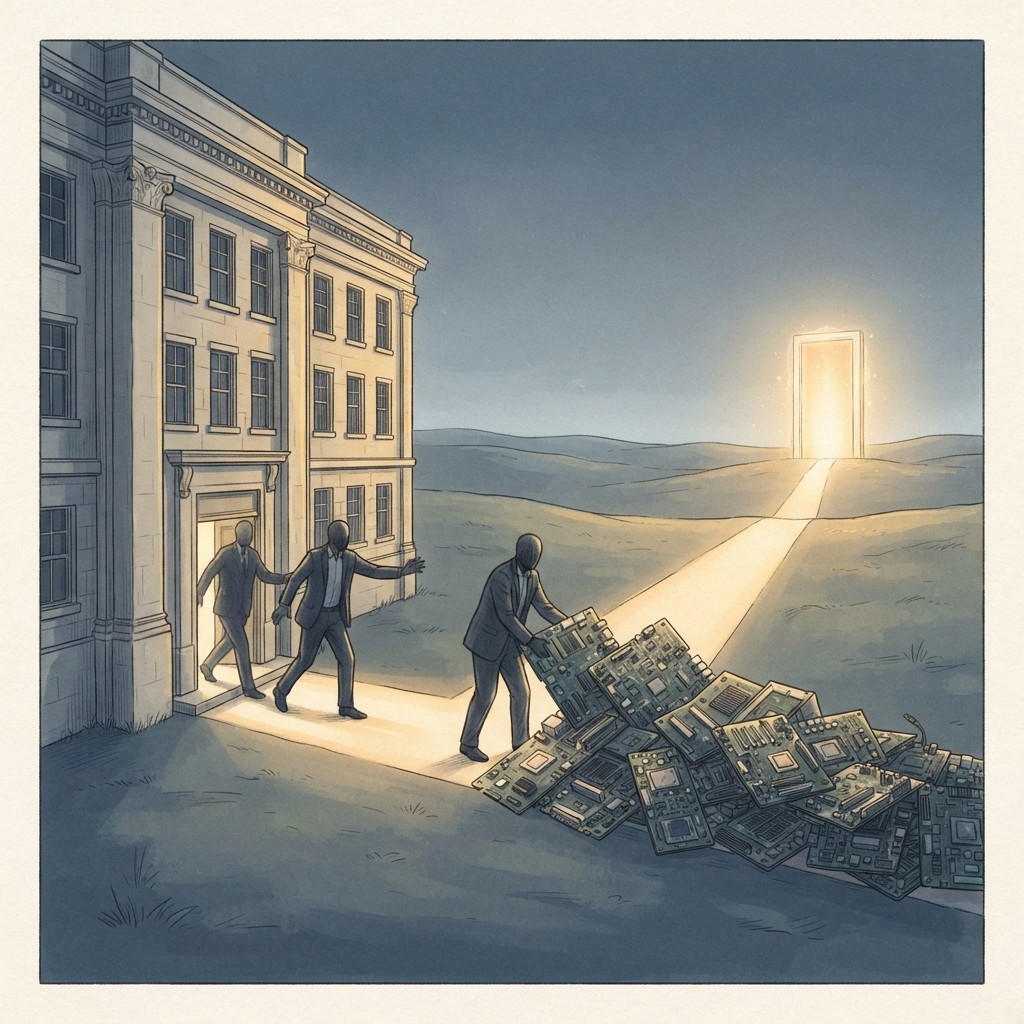
Pairs with the Counterfactual Timeline Builder — a ready-to-use strategy tool, filled for Intel. Included in the The Counterfactual Casebook →
Somewhere in 2017, in a meeting that left no public minutes, Intel was offered the deal of the century and didn't take it. The terms, as later reported: 15% of OpenAI for $1 billion in cash, with an option for another 15% if Intel agreed to build chips for the lab at cost.1 At the time it looked like a speculative bet on a nonprofit research outfit. With hindsight it looks like the moment Intel handed the future to the company that would replace it on the Dow.7 The number everyone remembers is the billion dollars Intel didn't spend. The number that matters is the one it would have owned.
The story that hardened into legend is tidy and wrong. It goes: then-CEO Bob Swan didn't believe in generative AI, so he killed the deal. Almost every clause of that sentence collapses under a date check - and the real reasons are stranger, more structural, and far more useful to understand.
The villain everyone names had the wrong job
Start with the title, because the title is the tell. The popular framing calls Bob Swan the "then-CEO" who passed on OpenAI. He wasn't. Swan joined Intel as CFO in October 2016. He didn't become interim CEO until June 2018, after Brian Krzanich resigned, and didn't take the job permanently until January 2019.2 The OpenAI talks, by Reuters' own account, ran across 2017 and 2018.1 So for the entire 2017 portion of the negotiation, the man being blamed as CEO was a finance chief - and the actual chief executive for most of that window was Krzanich. The neat 'one skeptical CEO blew it' narrative requires a CEO who didn't hold the title yet. That's not a footnote. It's the first sign the story has been compressed into a person to make it easier to tell.
“Swan joined Intel as CFO in October 2016; he was named interim CEO only on June 21, 2018, and permanent CEO on January 31, 2019.”2
There is a real claim under the bad title. People familiar with the talks told Reuters the decision-maker didn't think generative AI models would reach market soon enough to justify the bet.1 That may well be true. But notice what kind of evidence it is: anonymous, after the fact, with no on-record statement and no document behind it. It belongs in the story as a reported view, not as a confession. Treat it as fact and you've built a morality tale on a single unnamed source - which is exactly how a structural failure gets miniaturized into one man's bad guess.
The dealbreaker nobody talks about: Intel wouldn't sell to itself at cost
Here is the part the legend leaves out, and it is at least as load-bearing as anyone's opinion about AI. The deal had a second half: Intel could take an additional 15% stake if it agreed to make hardware for OpenAI at cost. And Intel's own data-center unit refused to do it.1 Read that again, because it's the whole company in miniature. The most strategically important customer of the next decade was on the table, and the internal division that would have to serve it said no - because serving it meant building chips at break-even and watching its margins shrink on its own profit-and-loss statement. The corporate strategy (own a piece of the future) collided with the divisional incentive (protect this quarter's data-center margin), and the incentive won. That isn't a CEO's flaw. It's an org chart's.
| The view, popularly blamed | The structural dealbreaker | |
|---|---|---|
| What it was | Decision-maker doubted generative AI's near-term arrival | Data-center unit refused to build hardware at cost |
| Evidence quality | Anonymous sources, no on-record confirmation | Reported as an independent dealbreaker |
| Whose failure | One executive's forecast | The incentive structure itself |
| Coverage | The whole story, in most retellings | The line most retellings skip |
This is why blaming Swan, or anyone, misses the point. A company that wanted OpenAI could have overruled a skeptical finance chief in an afternoon. What it could not easily overrule was a culture built around CPU margins, where a division is rewarded for the profit it books and punished for the profit it forgoes - even when the profit it forgoes is the entire AI era. The thesis is simple and uncomfortable: Intel didn't pass on OpenAI because one person was wrong about AI. It passed because the company was organized, all the way down, to say no to exactly this kind of bet.
A pattern, not a moment: the chips Intel bought and buried
If OpenAI were a one-off, you could call it bad luck. It wasn't. The same reflex ran through Intel's AI hardware too. In August 2016 - the year before the OpenAI talks - Intel bought the deep-learning startup Nervana; it declined to disclose the price, and contemporaneous reporting put it at 'more than $350 million.'4 Then in 2019 it bought a second AI-chip company, Habana Labs, for $2 billion.5 In January 2020 it shut Nervana down in favor of Habana.5 So inside roughly three years Intel acquired two AI-chip startups and killed one of them - having already declined the customer that could have given either a reason to exist. It kept buying the picks and shovels and kept walking away from the gold rush.
The scale of what got forfeited is now visible in the income statements. For 2024, Intel's entire data-center business - AI chips included - was projected at $13.89 billion, while analysts expected Nvidia's data-center revenue alone to hit $105.9 billion: roughly 7.6 times larger.6 The same year, Intel's stock fell more than half, it was kicked off the Dow Jones Industrial Average and replaced by - of all companies - Nvidia, and CEO Pat Gelsinger was forced out in December.7 The company that wouldn't build chips at cost for the AI lab got replaced on the index by the company that built chips for everyone.
Isn't this just hindsight dressed up as analysis?
The honest objection is that all counterfactuals cheat. In 2017, OpenAI was a research nonprofit with no product and no proof generative AI would arrive; passing on a speculative stake was a defensible call that thousands of smart people would also have made. Fair. And the temptation to inflate the regret is real - the breathless 'Intel could be worth $12 billion of OpenAI' takes from August 2024 used a roughly $80 billion valuation, when OpenAI was already worth about $157 billion by that October and reached $852 billion by April 2026.8 Any what-if math built on the smaller number understates the loss, which should make us suspicious of how the story gets told for clicks. But the steelman cuts the other way too. The case here isn't that Intel should have foreseen ChatGPT. It's that even if you couldn't, the deal still died for a reason that had nothing to do with foresight - a division protecting its margins. That failure mode doesn't require a crystal ball to avoid. It requires a company willing to let its own units lose money on purpose when the future is on the line. Intel wasn't.
The most expensive 'no' in a company is rarely spoken by the CEO. It's whispered by a division whose bonus depends on margins the new bet would dilute - so it protects the quarter and forfeits the decade, and everyone later blames a personality instead of the structure. The tell is always the same: a strategically obvious move that 'somehow' never gets made, with a tidy villain assigned after the fact. Before you blame the leader's judgment, find the unit that was asked to sell something at cost, or cannibalize its own P&L, or fund a rival product line. That's where strategy actually goes to die. The fix isn't a smarter forecast - it's the willingness to override a division's local math when the company's whole future is the thing being optimized away.
Intel didn't lose the AI era in a single meeting in 2017. It lost it the way a great company usually does - not in a dramatic mistake, but in a hundred small, locally rational refusals to lose money on purpose. The skeptical view of generative AI may have been the headline reason. The unwillingness of a profitable division to build at cost was the structural one. And the pattern of buying AI startups while declining the customer that would have used them was the pattern beneath both. The legend made it one man's bad call because that's a story you can finish in a sentence. The truth is harder and more valuable: Intel was built, top to bottom, to protect the chip it sold today - and it spent the AI decade discovering that the most dangerous thing a company can optimize is its own present.
Counterfactual Timeline Builder
A one-page canvas that runs two histories side by side: what actually happened, and the alternative that died at the fork. You pin the divergence point, trace each branch forward, and name the assumption that decided which one came true. Blank, it disciplines hindsight into a testable counterfactual instead of a what-if; filled, it shows the story's road-not-taken with enough rigor to argue about.
Included, filled and blank, in the The Counterfactual Casebook. See the set → · Preview the blank →
Sources
Where this comes from — the filings, records, and reporting behind it.
- 1Over several months in 2017 and 2018, executives at Intel and OpenAI discussed options including Intel buying a 15% stake for $1 billion in cash; Intel also discussed taking an additional 15% stake if it made hardware for OpenAI at cost; Intel ultimately declined, partly because the decision-maker did not think generative AI models would reach market soon, and partly because Intel's data center unit did not want to make products at cost.
- 2Bob Swan joined Intel as CFO in October 2016; he was named interim CEO on June 21, 2018 (after Brian Krzanich's resignation), and became permanent CEO on January 31, 2019 — meaning he held the title of CEO for none of the 2017 OpenAI discussions.
- 3Intel's Board appointed Pat Gelsinger as CEO effective February 15, 2021, replacing Bob Swan, whose tenure as full CEO ran from January 2019 to February 2021.
- 4Intel acquired Nervana Systems on August 9, 2016; Intel declined to disclose the acquisition price publicly. Contemporaneous reporting placed the figure at 'more than $350 million'; the widely-cited $408M figure comes from secondary sources, not an Intel primary filing.
- 5Intel shut down development of Nervana in January 2020, in favor of its separate acquisition of Habana Labs; Intel acquired Habana Labs in 2019 for $2 billion.
- 6Intel's entire data center business (including AI chips) was projected to generate $13.89 billion in 2024 revenue, while analysts expected Nvidia to generate $105.9 billion in data center revenue — a roughly 7.6x gap.
- 7Intel's stock dropped more than 50% in 2024; in November 2024 Intel was removed from the Dow Jones Industrial Average and replaced by Nvidia; in December 2024, CEO Pat Gelsinger was forced to retire.
- 8OpenAI was valued at approximately $157 billion in October 2024 (not the ~$80 billion cited in August 2024 comparisons with Intel), and reached a post-money valuation of $852 billion in April 2026, making retrospective stake calculations based on $80B substantially understated.
More like this — beyond Intel
New Strategically analyses as they publish: the defining moves in business, checked against the record. No noise, and one click to leave.