Pairs with the Asset-Light vs Asset-Heavy Comparator — a ready-to-use strategy tool, filled for 7-Eleven. Included in the The Asset-Light Model Casebook →
The first 7-Eleven didn't sell Slurpees, gasoline, or even a name. It sold ice. In 1927 four Dallas ice plants merged into the Southland Ice Company, and the whole convenience-store idea began as a side hustle: an employee, John Jefferson Green, noticed people wanted milk, bread, and eggs on Sundays and evenings when grocery stores were dark — so he started selling them off the ice dock.1 The stores were called Tote'm. The '7-Eleven' name didn't arrive until 1946, and it meant exactly what it said: open 7 a.m. to 11 p.m.2 Nearly a century later, the company is again trying to sell something perishable that has to move fast — and discovering, again, that fresh is expensive.
The official story is that 7-Eleven is the perfect asset-light machine: let thousands of franchisees buy the stores, run the registers, and absorb the risk, while the parent collects a fee and stays out of the capital. That's the story McDonald's-style franchising trained us to expect. It is not quite the story 7-Eleven's own filings tell.
The fee that isn't a royalty
Here is where the model quietly diverges from the textbook. A pure franchisor like McDonald's collects a royalty on a franchisee's sales — roughly 4% — plus rent on property it typically owns or leases, and otherwise stays clear of the day-to-day economics.12 7-Eleven doesn't do that. In the U.S., the company takes 50–60% of each store's gross profit — not its revenue — plus roughly 1% for advertising.3 That single word, profit, changes everything. It means corporate isn't skimming a thin, predictable toll off the top; it's a partner in the margin, rising and falling with how well each store actually sells. And it's not standing off the real estate either: 7-Eleven Inc. holds the leases and supplies the equipment, then splits the gross profit with the operator behind the counter.4 The franchisee carries the labor and the daily operating risk; the parent carries the lease, the gear, and a direct stake in performance. That is a heavier balance sheet than 'asset-light' implies.
| Pure royalty franchisor (e.g. McDonald's) | 7-Eleven U.S. | |
|---|---|---|
| What corporate collects | Royalty on revenue + rent | 50–60% of gross profit + ~1% ad fee |
| Who holds the lease | Often the franchisor, charged as rent | 7-Eleven Inc. holds leases directly |
| Who provides equipment | Franchisee buys/finances | Parent supplies equipment |
| Corporate's exposure to store performance | Indirect | Direct — shares the margin |
None of this was the original design. Southland didn't begin franchising at all until 1964, when it acquired the SpeeDee Mart chain in California and was introduced to the concept through that acquisition — nearly four decades after the ice dock.9 The chain that looks engineered for franchising backed into it. And the gross-profit split it eventually adopted is the tell: the parent wanted to be in the margin, not above it, because in convenience retail the margin is made and lost on what's on the shelf — increasingly, on what's hot, fresh, and gone by tonight.
Japan didn't import fresh food. It built the road for it first.
Walk into a 7-Eleven in Tokyo and the thesis becomes obvious. The store is a fresh-food business with a magazine rack attached: rice balls, hot counters, bakery, bento — replenished up to three times a day, item by item, by a demand system that decides what each store needs before the manager does.8 Seven-Eleven Japan didn't bolt this on. The company was established in 1973, and its core elements — dedicated temperature-controlled distribution and SKU-by-SKU inventory management — were in place from the start;10 that discipline became known as Tanpin Kanri, item-by-item demand management, refined over decades across more than 21,500 stores and now AI-forecasted.118 In FY2024 the hot-food counter alone drove a 7% rise in customer visits in a single month.6 That is the prize the U.S. business wants. And that is exactly why it can't just be shipped over.
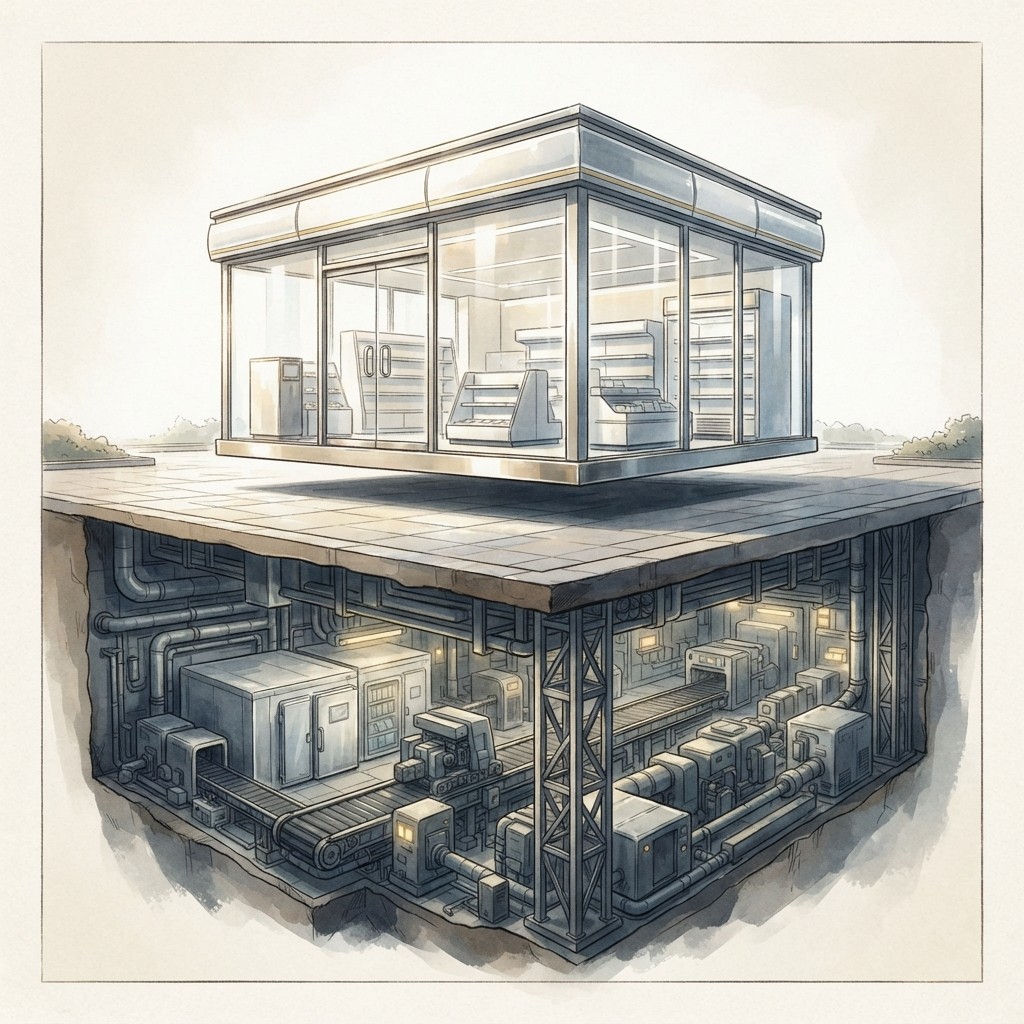
Fresh food has a brutal property the rest of the store doesn't: it's perishable, so the whole apparatus — commissaries, cold chain, multiple daily deliveries, demand forecasting — has to exist before the first onigiri sells, or it spoils. A bag of chips forgives a weekly delivery. A hot meal does not. Japan's edge isn't a recipe; it's infrastructure poured in advance and amortized over fifty years. The American stores were built for a different job — a 2,900 sq ft box optimized for shelf-stable snacks, fountain drinks, and cigarettes — and you cannot retrofit a fifty-year supply chain into them by changing the planogram.
Every term on the right is capital the asset-light model was designed to avoid. The 'New Standard' store is 4,800 sq ft versus the traditional 2,900 — a near-65% larger footprint that needs new real estate or expensive remodels.8 The supply-chain layer behind it has no shortcut: Hawaii's fresh value chain took building from 1989 alongside a Japanese partner to work at all.7 The parent funds the road; the franchisee only gets to drive on it once it's paved.
The number that proves the transplant is hard
The early returns cut both ways, and that's the honest picture. The 'New Standard' format does work where it lands: 11% ROIC and sales 18% above the system average.8 But the company is closing underperforming U.S. stores faster than it opens new ones — net store count went negative in FY24 and FY25 — and the cleanup has a price tag. In the second half of FY2024 alone, the U.S. business recorded a ¥56.7 billion loss from shutting unprofitable stores.6 That loss is the asset-light thesis meeting its bill. A pure franchisor closing a weak location loses a royalty stream. A company that holds the lease, owns the equipment, and shares the margin eats the closure.
“Japanese-style convenience is now becoming the global standard.”7
The parent is making the contradiction explicit. In March 2025, Seven & i announced it will IPO the North American business by H2 2026, sell its superstore group to Bain Capital for about ¥814.7 billion, and return roughly ¥2 trillion to shareholders by FY2030.5 Read that as a company separating its two natures: the asset-heavy, capital-hungry fresh-food build, and the listable, value-to-be-unlocked convenience network. You don't restructure this aggressively around a business that's already light. You restructure because the dream costs more than the model was built to carry.
But isn't fresh food exactly the moat worth paying for?
The strongest counter is that the heaviness is the point. Anyone can stock chips; almost no one in the U.S. can run a multiple-daily fresh-food cold chain at convenience-store scale — so the capital 7-Eleven is sinking in is precisely what a competitor can't cheaply copy, and the 18%-above-system sales of the New Standard store suggest the demand is real.8 That's fair, and it's the bull case. But it concedes the thesis rather than refuting it: if the moat is the infrastructure, then the business is no longer asset-light — it's an asset-heavy supply-chain company wearing a franchise costume. The honest read isn't that fresh food is a mistake. It's that 7-Eleven can be a great fresh-food retailer or a great asset-light franchisor, and the U.S. transplant is the expensive process of discovering it cannot, in the same stores, fully be both. Japan got to be both only because it built the road on day one. America is paving over a highway that was poured for a different car.
A franchise model offloads risk beautifully — right up until the product won't sit on a shelf. Anything perishable (fresh food, same-day delivery, live inventory) forces capital to the center: the commissary, the cold chain, the multi-daily logistics all have to exist before the first sale, and a franchisee can't fund that. So when an 'asset-light' operator moves into fresh, watch whether the parent starts holding leases, building distribution, and sharing margin instead of skimming royalties. That drift isn't a failure of execution — it's the model telling you the new product changed the business it's in. The toll-collector quietly becomes the road-builder, and the balance sheet follows.
7-Eleven began by selling something that melted, and learned that perishable goods earn their margin only if you build the cold around them first. A hundred years on, the lesson is unchanged. The franchise structure is genuinely clever — let the operator carry the counter while you carry the lease and split the gross profit. But fresh food doesn't respect that division of labor. It demands commissaries, bigger boxes, and a supply chain poured years before the first sale, and none of that fits inside 'light.' The asset-light franchise was never the prize. It was the down payment on becoming the one thing it was built to avoid — a company that owns the road, not just the toll.
When the business model isn't the one on the label
Asset-Light vs Asset-Heavy Comparator
A side-by-side matrix that pits owning the assets against renting or orchestrating them, dimension by dimension. Blank to weigh your own model choice; filled as the worked example showing why the story's company went capital-light — or planted its money in concrete and steel.
Included, filled and blank, in the The Asset-Light Model Casebook. See the set → · Preview the blank →
Sources
Where this comes from — the filings, records, and reporting behind it.
- 1Southland Ice Company was formed in 1927 in Dallas via merger of four ice plants; John Jefferson Green proposed selling groceries from an ice dock, establishing the first convenience store concept; the 7-Eleven name was adopted in 1946 to reflect 7 a.m.–11 p.m. hours.
- 2Southland Ice Company began selling milk, bread, and eggs on Sundays and evenings when grocery stores were closed; stores were called Tote'm; renamed 7-Eleven in 1946 for extended hours.
- 3In the 7-Eleven U.S. franchise model, the company takes 50–60% of gross profit (not a percentage of revenue) as its ongoing fee, plus ~1% for advertising/marketing. Franchisees do not retain all gross profit; corporate shares directly in store performance.
- 47-Eleven Inc.'s 2002 10-K confirms the gross-profit-split franchise structure: 'Franchisee gross profit expense for 2002 was $747.1 million'; franchised stores are distinct from area licensees; fresh foods are delivered daily; the company holds leases and occupancy costs are a primary OSG&A component.
- 5Seven & i Holdings (parent of 7-Eleven) announced on March 6, 2025, it will pursue an IPO of 7-Eleven Inc. (North American operations) by H2 2026; signed agreement to sell its Superstore Business Group to Bain Capital for JPY 814.7 billion (≈USD 5.37 billion); committed to return ~JPY 2 trillion in aggregate capital to shareholders by FY2030.
- 6Seven-Eleven Japan (SEJ) FY2024 results presentation confirms fresh-food strategy: hot food counter sales drove a 7% increase in sales/customers in February; Seven Café Bakery and Seven Café Tea are expanding; SEI recorded a ¥56.7 billion loss in H2 FY2024 from closing unprofitable U.S. stores.
- 77-Eleven International LLC (7IN) was founded June 2021 as a joint venture of SEJ and SEI to support and expand overseas licensees; 7-Eleven has expanded to 20 countries and regions; the Hawaii value chain for fresh food has been built since 1989 with Warabeya Nichiyo.
- 87-Eleven's 'New Standard' format stores (4,800 sq ft vs. traditional 2,900 sq ft) deliver 11% ROIC and average sales 18% above system average, but the company is closing underperforming stores faster than opening new ones — net negative U.S. store growth in FY24 and FY25. SEJ's Japan system uses up to 3 daily fresh-food deliveries and AI-powered demand forecasting across 21,500+ stores.
- 9Southland's franchising began in 1964, after it acquired SpeeDee Mart stores in California and was introduced to the franchising concept through that acquisition.
- 10Seven-Eleven Japan was established in 1973 (as York Seven, via a licensing agreement with Southland); its core strategy elements — temperature-controlled distribution, three-times-daily fresh-food delivery, and SKU-by-SKU inventory management — date to the company's establishment.
- 11Tanpin Kanri is Seven-Eleven Japan CEO Toshifumi Suzuki's signature item-by-item inventory management framework, central to SEJ's fresh-food and growth strategy.
- 12Under McDonald's franchise model, franchisees pay an ongoing royalty of roughly 4% of gross sales (5% for new U.S. locations since 2024), plus rent on property McDonald's typically owns or holds a long-term lease on.
More like this — beyond 7-Eleven
New Strategically analyses as they publish: the defining moves in business, checked against the record. No noise, and one click to leave.