Pairs with the Founder Doctrine Canvas — a ready-to-use strategy tool, filled for Berkshire Hathaway. Included in the The Founder Doctrine Casebook →
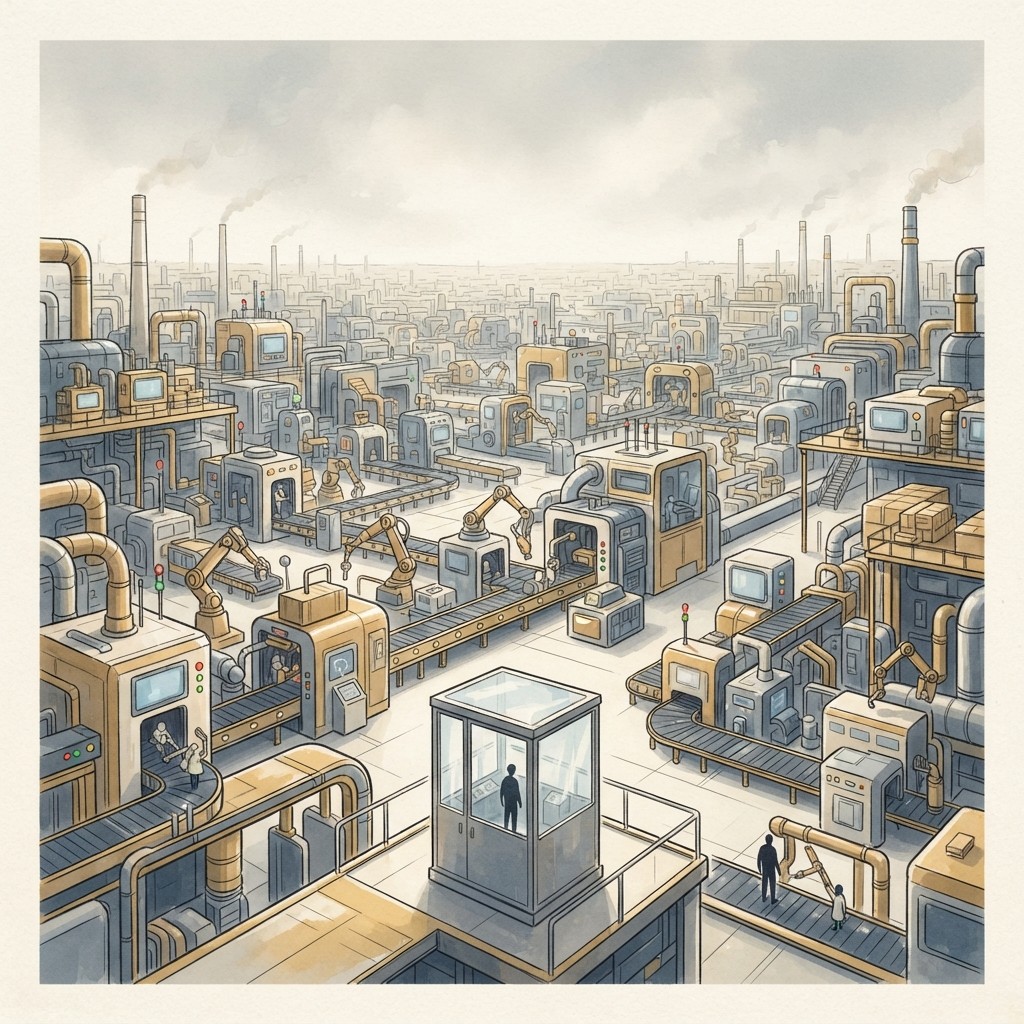
Picture the head office of one of the largest companies on earth. Now make it smaller. Smaller still. At Berkshire Hathaway, the corporate headquarters fits in a number you could seat at three dinner tables: 25 people at the end of 2015, reported around 27 by the end of 2024.34 Below them, spread across insurance, railroads, energy, candy, and dozens of other businesses, work roughly 392,400 people worldwide.2 No central marketing department. No central HR. The 10-K says so in plain language: few centralized or integrated business functions.1
The official story is that this is Warren Buffett's management philosophy — a temperament, a faith in great managers, the wisdom to hire well and then step back. That is true and it is not the whole truth. Strip the folklore away and a colder fact remains: a headquarters that small could not centrally manage that many people even if it wanted to. The autonomy isn't only a virtue Buffett chose. It's a constraint the structure makes inescapable.
The autonomy is enforced by arithmetic, not just ideology
Run the ratio and the management theory dissolves into a math problem. Two dozen-odd people at the center; nearly four hundred thousand at the edges.24 At that ratio, there is no version of 'corporate gets involved in day-to-day operations' that is physically possible. You cannot review the candy store's hiring, the railroad's safety logs, and the insurer's underwriting from a single office of 27. So you don't. The 10-K is explicit that the operating subsidiaries are run on an unusually decentralized basis, and that each subsidiary sets its own policies for attracting and retaining people.2 What reads as trust is, at the structural level, the only thing that scales: a center too thin to interfere has to delegate everything that isn't capital.
And capital is the thing the center keeps. The division of labor is the whole design. The operating CEOs run the businesses; headquarters owns one decision — where the cash goes. The 2024 10-K is precise about it: the top of the house is ultimately responsible for significant capital allocation decisions, investment activities, and choosing the CEO who heads each operating business.1 That's it. Berkshire didn't decentralize everything. It decentralized operations and centralized money. The thinness of the headquarters isn't a bug in the model — it's the proof the model is real.
| Berkshire HQ keeps | Operating subsidiaries own | |
|---|---|---|
| Where the cash goes | Yes — capital allocation, investments | No |
| Who runs each business | Picks the CEO | Everything after that |
| Day-to-day operations | Minimal involvement | Fully |
| Sales, marketing, HR, legal | Few centralized functions | Each sets its own |
| Headcount to do it all | Roughly 27 people | About 392,400 people |
The doctrine was written down before most of the businesses existed
What keeps a thin center from drifting toward a thicker one is that the restraint was codified, early and publicly. In June 1996, Buffett issued a booklet called 'An Owner's Manual' to Class A and Class B shareholders to lay out the company's economic principles — and the underlying principles in it weren't new even then. Buffett dates them to the Blue Chip Stores merger in 1983.5 So the doctrine of how Berkshire would treat owners and operators was set down more than a decade before the modern conglomerate took its shape. The businesses arrived later; the constitution came first.
That sequence matters, because most companies write their culture statement to describe what they already became. Berkshire wrote the rules first and then bought businesses that could live under them — and told the managers, in writing, that headquarters would stay out of their way. A subsidiary CEO who knows the center is structurally incapable of micromanaging, and has been told for decades it won't try, behaves differently than one who suspects oversight is one bad quarter away. The autonomy compounds because everyone believes it. The doctrine's job is to keep them believing.
“...few centralized or integrated business functions... with minimal involvement by Berkshire's corporate headquarters in the day-to-day business activities of the operating businesses.”1
Isn't this just Buffett being Buffett — and what happens when he's gone?
The honest objection is that this reframe overcorrects. A 27-person headquarters is not an accident of arithmetic that Buffett stumbled into; he built it that way on purpose, over decades, precisely because he believed in autonomy. Cause and effect are tangled: the philosophy produced the thin center as much as the thin center enforces the philosophy. Fair. But notice that the language itself has already begun to drift. The 2017 10-K boasted of 'essentially no centralized or integrated business functions.' By the 2024 10-K that had quietly softened to 'few.'81 Essentially none became few — a one-word edit that an ideology never makes by accident. Even under Buffett, modest centralization was creeping in. The model is not a law of nature. It is a discipline, and disciplines slip.
Which is why the real test isn't whether autonomy existed under Buffett — it plainly did — but whether it survives him. On May 4, 2025, Berkshire's board voted unanimously to appoint Greg Abel as President and CEO effective January 1, 2026, after Buffett recommended it at the prior day's annual meeting; Buffett stayed on as Chairman.7 The FY2025 10-K already rewrote the governance section, collapsing the old dual-vice-chairman language into a single CEO ultimately responsible for capital allocation and performance.6 The constraint that held the center thin was, in large part, the founder's own authority — the credibility that made 'we won't interfere' a promise managers trusted. Abel inherits the structure. The open question is whether he also inherits the restraint, or whether a successor with something to prove finds reasons to make 'few' centralized functions into a few more.
Cultures of autonomy die the same way: a well-meaning center adds one coordinating function, then another, each defensible on its own, until the periphery is being managed after all. Berkshire's durable trick wasn't a slogan about trusting people — it was keeping the headquarters physically too small to interfere, so that delegation was enforced by the org chart rather than by goodwill. If you want a behavior to survive a change of leadership, don't rely on the next leader sharing your values. Engineer a structure that makes the wrong behavior expensive or impossible. The watch-out: structural constraints erode quietly. A single softened word in a filing — 'essentially none' becoming 'few' — is often the first visible sign the discipline is loosening.
Berkshire's genius was never that Buffett trusted his managers. Plenty of executives say that. It was that he built a headquarters too small to do anything else — and wrote down, before the empire existed, that it never would. The autonomy ran on its own thinness. Now the thinness stays and the founder leaves, and the company gets to discover whether the discipline was the structure or the man. The 10-K already changed one word. Watch the words.
Founder Doctrine Canvas
A one-page canvas for the operating system inside a founder's head: the principles they hold, the formative experiences that forged them, and the specific strategic moves each principle produces. Blank to make your own decision rules legible to the people who execute them; filled as the worked example showing why the story's company keeps making the bets it makes — because the founder can't make any others.
Included, filled and blank, in the The Founder Doctrine Casebook. See the set → · Preview the blank →
Sources
Where this comes from — the filings, records, and reporting behind it.
- 1Berkshire's operating subsidiaries are managed on an unusually decentralized basis; there are few centralized or integrated business functions; the Chairman/CEO, Vice Chairman of Insurance, and Vice Chairman of Non-Insurance Operations are ultimately responsible for significant capital allocation decisions, investment activities, and the selection of the CEO to head each operating business.
- 2Berkshire and its operating subsidiaries employed approximately 392,400 people worldwide at the end of 2024, of which approximately 80% were in the United States and 20% were represented by unions. Consistent with Berkshire's decentralized management philosophy, each operating subsidiary establishes its own specific policies and practices for attracting and retaining personnel.
- 3Berkshire's corporate headquarters had 25 employees as of fiscal year-end 2015, against approximately 331,000 total worldwide employees — and there were essentially no centralized or integrated business functions such as sales, marketing, purchasing, legal, or human resources, with minimal involvement by headquarters in day-to-day operating business activities.
- 4As of end-2024, Berkshire Hathaway's corporate headquarters had 27 employees.Wikipedia, Berkshire Hathaway ↗ · 2025-06-24
- 5In June 1996, Berkshire's Chairman Warren E. Buffett issued a booklet entitled 'An Owner's Manual' to Class A and Class B shareholders to explain the company's broad economic principles of operation. The underlying 13 owner-related business principles were first set down at the time of the Blue Chip Stores merger in 1983.
- 6The 2025 10-K (FY2025) states Berkshire's operating subsidiaries are managed on an unusually decentralized basis with few centralized or integrated business functions, and that the CEO is ultimately responsible for significant capital allocation decisions, investment activities, and evaluating operating performance — a structural change in language from prior years that dropped the dual Vice Chairman operating titles following the CEO succession.
- 7On May 4, 2025, Berkshire's Board of Directors voted unanimously to appoint Greg Abel as President and CEO effective January 1, 2026. Buffett announced the decision at the May 3, 2025 annual shareholders meeting, recommending the board appoint Abel; Buffett retained the role of Chairman.
- 8Berkshire's 2017 10-K described headquarters involvement as 'essentially no centralized or integrated business functions (such as sales, marketing, purchasing, legal or human resources) and there is minimal involvement by Berkshire's corporate headquarters in the day-to-day business activities of the operating businesses' — language that was softened in the 2024 10-K to 'few centralized or integrated business functions.'
More like this — beyond Berkshire Hathaway
New Strategically analyses as they publish: the defining moves in business, checked against the record. No noise, and one click to leave.