Pairs with the Pricing Power Diagnostic — a ready-to-use strategy tool. Included in the The Pricing Play Casebook →
In 1991, a group of Boston restaurant owners did the math on the little card most of their customers loved, and decided they hated it. Every time a diner paid with American Express, the restaurant handed back roughly 4% of the check — while a Visa or Mastercard swipe cost it about 1.2%.4 So they stopped taking it. The boycott had a name, the 'Boston Fee Party,' and it spread to more than 250 restaurants across the country.4 It was a clean, public referendum on the only price Amex really had: the price it charged the merchant.
The story usually told is that Amex was simply the premium network that charged more, took its lumps, and carried on. That misses the actual move. Amex did not respond by cutting the merchant fee to match Visa. It responded — over the following three decades — by building two more places to charge, so that no single revolt could ever threaten the whole machine again.
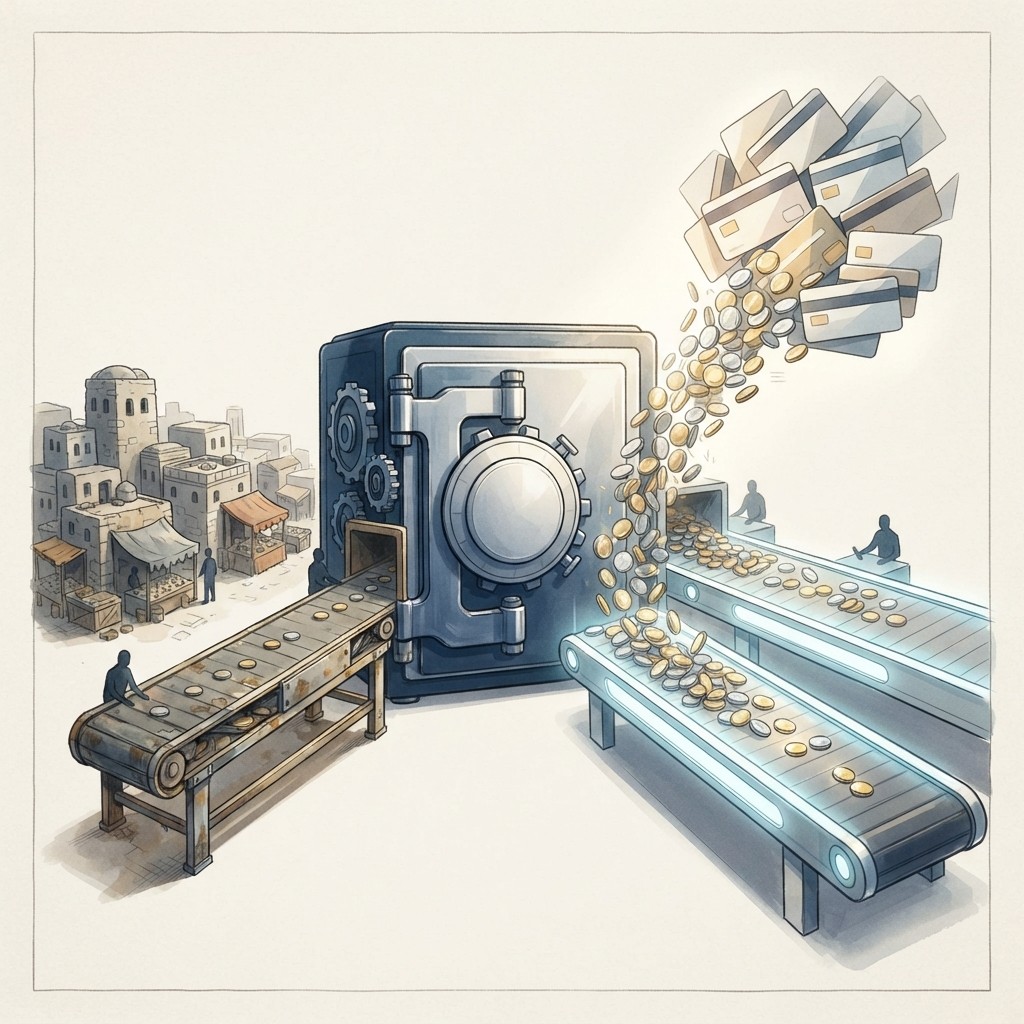
American Express isn't a network that charges merchants a premium. It's a company that learned its one price was a single point of failure — and quietly rebuilt itself to be paid three times for the same transaction: once by the merchant, once by the cardholder, and once on the borrowed balance.
The price that started a revolt
To understand the pivot you have to understand the trap Amex was in. Its model is what the company itself calls 'spend-centric' — it makes money primarily by driving spending on its cards and collecting a fee from the merchant on each transaction, a line it books as discount revenue.2 Visa and Mastercard, by contrast, let banks do the lending and live on a thinner toll. Amex sat at the high end on purpose, charging merchants more because its cardholders spent more. The flaw was that this concentrated almost all the revenue on one party — the merchant — and the merchant was the party with the least loyalty and the loudest grievance. When the fee gap is more than three to one, as it was in Boston, the merchant doesn't negotiate. He walks.
A business resting on one price has to defend that price by force, and Amex did. Since the 1950s its merchant contracts carried anti-steering provisions — rules forbidding a merchant from nudging a customer toward a cheaper card at the register.6 If you cannot stop the merchant from charging you more, you can at least stop him from steering your spenders to a rival. That rule was the load-bearing wall under the premium fee, and everyone knew it.
Amex fought for the fee — and lost before it won
The clean version of the legend says Amex took the anti-steering fight to the Supreme Court and won. The real timeline is messier and more revealing. When the Justice Department pressed the issue, Visa and Mastercard simply settled and dropped their anti-steering provisions in 2010. Amex alone refused.6 After a seven-week trial, the district court ruled against Amex in 2015. The Second Circuit reversed in 2016. Only in 2018 did the Supreme Court affirm, 5-4, that the provisions did not violate the Sherman Act — by defining the credit-card business as a single two-sided market in which an antitrust plaintiff must prove harm to both merchants and cardholders, not merchants alone.5
“The credit-card market is a single two-sided transaction market; establishing a Sherman Act violation requires showing harm to both merchants and cardholders.”5
That definition is the quiet center of the whole pricing story. The Court accepted Amex's own framing: you cannot judge the merchant fee in isolation, because the merchant fee funds the cardholder rewards that bring the high-spending customers the merchant wants in the first place. The two sides are one market. Win that point of law, and the premium merchant fee is no longer a vulnerability to be apologized for — it is the engine of a flywheel the law now refuses to take apart.
Where the second price came from
While it litigated the merchant side, Amex was busy building the customer side — and it had been since 1984, when it launched the Platinum Card, its first new card product since 1966, as an invitation-only object of status with a $250 annual fee.7 The fee looks quaint until you adjust it: $250 in 1984 is roughly $777 in 2025 dollars.7 The Platinum was never cheap. It was engineered, from day one, to extract a second price directly from the spender — and to make the spender feel chosen for the privilege.
The annual fee then climbed in deliberate steps: $450 by 2007, $550 in 2017, $695 in 2021, and $895 in September 2025.7 Nominally that's a 3.5x jump. In real terms it's far less dramatic — the card was always priced for its era. The trick was never the headline number. It was the 'coupon book' wrapped around it: airline credits, hotel credits, statement credits stacked high enough that an analytically minded buyer can tell himself the $895 pays for itself. The fee rises; the perceived value props are inflated to rise with it; the spender re-enrolls. That is the second price, and unlike the merchant, the spender doesn't walk — he renews.
| The old model (pre-1991) | The model today | |
|---|---|---|
| Who pays | The merchant, mostly | Merchant + cardholder + borrower |
| Primary lever | Discount rate on each swipe | Discount rate, card fees, and interest |
| Single point of failure | Yes — a merchant boycott hits everything | No — three independent revenue lines |
| Legal defense | Anti-steering rules under attack | Two-sided market doctrine, affirmed 2018 |
| Fastest-growing line (H1 2025) | n/a | Net card fees, +20% YoY |
Three prices, one transaction
Put the pieces together and the architecture is clean. Discount revenue still does the heavy lifting — about 55% of total revenue as of Q3 2023.2 But it no longer stands alone. The annual card fee taps the cardholder directly, and finance charges tap the same person again when he carries a balance.2 On a single Platinum dinner, Amex can earn the merchant's discount fee, a slice of the year's annual fee, and interest on the unpaid portion — three tolls on one meal. The company also pushed the volatile, fee-sensitive small-merchant relationships out to third-party processors under its OptBlue program, where the processors set the pricing and absorb the friction.3 The 2023 result was a record $60.5 billion in revenue, up 14%, propelled by discount revenue and net interest income working together rather than apart.1
And here is the tell that most older analyses miss. In the first half of 2025, net card fees grew 20% year-over-year — the fastest-growing revenue line in the company — while discount revenue grew just 6%.8 The center of gravity is moving. For most of its history Amex was a merchant-fee business that happened to sell premium cards. It is becoming a premium-card-fee business that happens to run a network. Same transaction, opposite center.
Isn't this just a luxury brand raising prices?
The fair objection is that none of this is strategy — it's just a strong brand doing what strong brands do, charging more because it can, and dressing the increases up with perks. There's truth in it. But notice what the brand explanation can't account for: the decade of litigation Amex chose to wage alone, after its rivals had folded, to defend a merchant rule from the 1950s. Luxury brands don't litigate the structure of their market to the Supreme Court. Amex did, because the merchant fee and the card fee are not two separate prices — they are two ends of the same flywheel, and the legal doctrine that the two are 'one market' is what lets the company keep pulling both levers at once.5
The honest counter cuts the other way, though. A model that increasingly leans on the cardholder's own fee is a model betting that the coupon book keeps feeling worth $895. Inflate the value props faster than the spender's actual usage, and the renewal math quietly inverts — at which point Amex has simply relocated its single point of failure from the merchant who walks to the cardholder who declines to renew. The 20% card-fee growth is either the proof the pivot works, or the early warning that it's being pushed too hard. The flywheel only spins while the perceived value stays ahead of the price.
Amex's deepest move wasn't raising prices; it was reframing the market so its single most attackable price became un-attackable. The merchant fee funds the rewards that attract the spenders the merchant wants — so judging the fee in isolation is the wrong question, and in 2018 the Supreme Court agreed. The lesson for any two-sided business: the side that screams loudest about your price may be the side subsidizing the side that makes you indispensable. Defend the linkage, not just the number. But watch the load-bearing assumption — the moment the spender stops believing the perks justify the fee, the whole structure has merely moved its weak point, not removed it.
In 1991, Amex's entire pricing strategy could be killed by a roomful of angry restaurateurs. By 2018 it had a Supreme Court ruling protecting its merchant fee, and by 2025 its fastest-growing dollar came not from the merchant at all but from the cardholder cheerfully paying $895 for the privilege of being charged. The genius was never the premium. It was refusing to let any one party hold the only price — and turning a boycott into the blueprint for three.
Pricing Power Diagnostic
A scored diagnostic of pricing power: brand pull, switching costs, substitutes, and how critical the product is to the buyer. Each dimension rated 1-5 so you can see, at a glance, whether a price rise sticks or sends customers running. Blank to grade your own offer; filled as the worked example scoring a story's business on its real ability to charge more.
Included, filled and blank, in the The Pricing Play Casebook. See the set → · Preview the blank →
Sources
Where this comes from — the filings, records, and reporting behind it.
- 1American Express's 2023 full-year revenue was a record $60.5 billion (reported basis), up 14% year-over-year, driven primarily by discount revenue and net interest income.
- 2American Express's 'spend-centric' business model focuses on generating revenues primarily by driving spending on its cards (discount revenue) and secondarily through finance charges and fees; discount revenue constituted approximately 55% of total revenue as of Q3 2023.
- 3American Express earns discount revenue from fees charged to merchants for accepting its cards; under the OptBlue program, third-party processors contract directly with small merchants and determine merchant pricing.
- 4In 1991, Boston-area restaurants stopped accepting American Express due to its fees of approximately 4% per transaction versus approximately 1.2% for Visa and Mastercard; the 'Boston Fee Party' spread to over 250 restaurants nationwide.
- 5Ohio v. American Express Co., 585 U.S. 529 (2018): The Supreme Court held 5-4 that Amex's anti-steering provisions in merchant contracts do not violate Section 1 of the Sherman Act; the Court defined the credit-card market as a single two-sided transaction market requiring harm to both merchants and cardholders to establish an antitrust violation.
- 6Amex has maintained anti-steering provisions in merchant contracts since the 1950s; Visa and Mastercard settled with the DOJ and removed their anti-steering provisions in 2010, while American Express alone continued to defend the practice through litigation culminating in the 2018 Supreme Court ruling.
- 7The American Express Platinum Card launched in 1984 as an invitation-only product with a $250 annual fee (approximately $777 in 2025 inflation-adjusted dollars); it was the first new card product Amex introduced since 1966. The annual fee rose to $450 by 2007, $550 in 2017, $695 in 2021, and $895 in September 2025.
- 8Net card fees grew 20% year-over-year in H1 2025 — the fastest-growing revenue line — while discount revenue grew only 6%, signaling a structural shift in American Express's pricing mix toward card-fee monetization.
More like this — beyond American Express
New Strategically analyses as they publish: the defining moves in business, checked against the record. No noise, and one click to leave.