Pairs with the Pricing Power Diagnostic — a ready-to-use strategy tool, filled for Tesla. Included in the Money Machine Casebook →
“What does changing how you charge cost before it starts paying?”
In July 2015, a Tesla owner who talked a friend into buying a Model S got $1,000, and the friend got $1,000 off the price.4 That is a referral payment. It has a dollar figure, a beneficiary, and a goal: acquire a customer for less than a Super Bowl spot costs. It is, by any honest accounting, a marketing expense. Tesla just never called it one - and that single act of not-naming has hardened into one of the most repeated myths in business: that Tesla built the most valuable car company on earth without spending a cent on marketing.
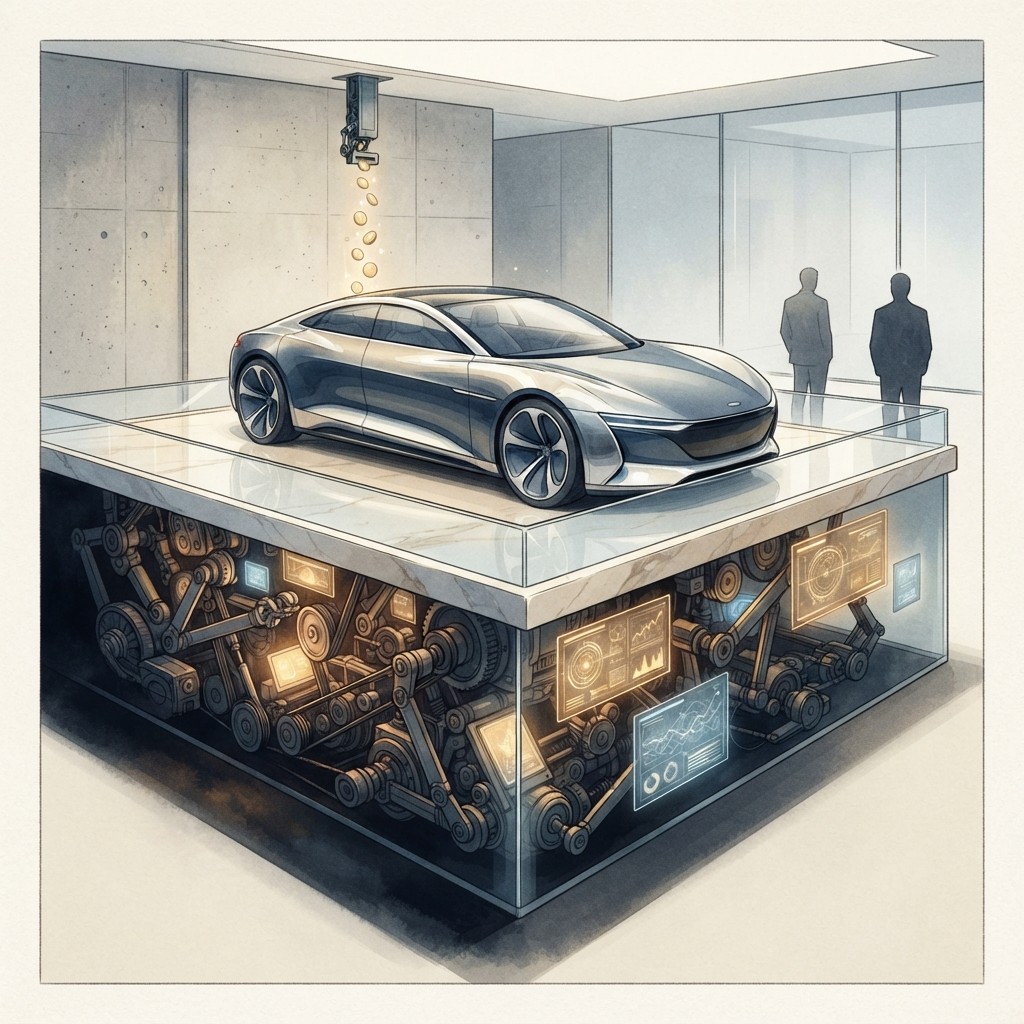
The official story is that Tesla rejected advertising on principle - that a great product sells itself and the legacy automakers' billions in TV and billboards are a confession of weakness. It is a beautiful story, and it is mostly an accounting trick. Tesla did not abolish marketing economics. It moved the spend somewhere harder to see, and stopped putting a label on it.
The program nobody calls a marketing budget
Strip away the 'zero advertising' headline and what remains is a costly, almost obsessively iterated customer-acquisition machine. The 2015 cash version was only the start. By 2019 the rewards had drifted toward genuinely expensive prizes, and on February 2, 2019, Tesla shut down what it called Phase 9.1 Note the word: Phase 9. You don't reach a ninth phase of something you don't take seriously. Less than two months later, on March 22, 2019, Tesla relaunched a restructured version - this time paying in 1,000 miles of free Supercharging for each side plus sweepstakes entries, explicitly citing the need to control cost.5 That is not a company abandoning marketing. That is a company tuning the price it pays per customer, in real time, the way a media buyer optimizes a campaign.
The pattern repeats with the regularity of a metronome. The Refer and Earn program ran from May 2023 to April 30, 2024, with awards granted after delivery and pointed exclusions - no Cybertruck, no used vehicles - the fine print of someone watching unit economics closely.6 Then on April 30, 2024, Tesla killed the program globally, with Musk saying a new one was 'a few months away.' It relaunched that August.7 Start, pause, restructure, restart - a decade of it. The thing being managed here is not whether to spend on acquisition, but how much, in what currency, and when the cost gets out of hand.
Then it actually bought ads — and had to admit it
The myth survived as long as it did partly because, for the pre-2023 era, it was roughly true: Tesla genuinely didn't buy much paid media. That ended quietly. In an SEC filing made public in April 2024, Tesla disclosed it had spent $200,000 advertising on X through February 2024 - and subsequent disclosures put full-year 2024 X ad spend at $400,000.2 The number is small. The fact is enormous. The company whose entire brand mythology rested on not advertising had become, on the record, an advertiser - on the platform its CEO happens to own. The absolute figure barely moves a financial needle, but it detonates the principle. You cannot claim to reject advertising on conviction and then file paperwork showing you bought it.
“Tesla discloses it spent $200,000 advertising on X.”2
Where the spend actually hides
Here is the move that makes 'zero advertising' impossible to falsify from the outside. Tesla's selling, general and administrative expenses came to $4.8 billion in 2023, $3.9 billion in 2022, and $4.5 billion in 2021 - and nowhere in the 10-K is advertising broken out as its own line.3 Referral credits, gallery showrooms, the salaries of the people running all those program phases: all of it can live inside that multi-billion-dollar bucket without ever surfacing as a labeled 'marketing' number. The claim 'we spend nothing on advertising' is technically a claim about a line item that doesn't exist. You can't audit a line that was never drawn. The genius isn't the absence of marketing spend. It's the absence of a place to count it.
| The 'zero advertising' legend | What the record says | |
|---|---|---|
| Referral program | A one-off, ended in 2019 | Launched July 2015, restructured through August 2024 |
| Paid media | Never buys ads | Disclosed $200K on X by Feb 2024; $400K for FY2024 |
| Marketing budget | Effectively zero | Unbroken-out, inside ~$4.8B of SG&A |
| The motive | Principle: the product sells itself | Arbitrage: cheaper acquisition than legacy media |
But didn't the strategy actually work?
The fair objection is that the semantics don't matter: whatever you call it, Tesla spent far less per car than Ford or Toyota and still sold everything it built, so the model was real even if the slogan oversold it. That's largely true, and it's the honest core of the story - referral payments and a direct-sales website almost certainly did beat the legacy playbook on cost per acquisition. But two things puncture the myth even granting it worked. First, part of Tesla's 'direct' model wasn't a choice at all: in many states, franchise laws prohibit direct auto sales, forcing Tesla into gallery-only showrooms it had to litigate to escape - winning, for instance, at the Delaware Supreme Court in May 2023.8 Constraint dressed as conviction. Second, the popular ROI figures that 'prove' the program's brilliance - the famous 42x return, the 25% of one quarter's sales - trace to no Tesla filing, earnings call, or press release at all. They're influencer math repeated until it sounded like fact. The strategy may well have been smart. The evidence offered for its genius is mostly vapor.
The most durable corporate myths aren't built on lies; they're built on omissions. Tesla never said it had no customer-acquisition cost - it said it had no 'advertising,' a word it controls the definition of, attached to a line item it never created. When a company brags about spending nothing on X, ask where X would have shown up if it had. A cost you can't find in the filing isn't a cost that doesn't exist; it's a cost someone chose not to name. The 'zero' is real. It's also a category, not a number - and the difference is where the real strategy lives.
Tesla's marketing story was always sold as a refusal: a company too good, too pure, to play the advertising game. The filings tell a duller and far more useful tale. Tesla played the game the whole time - it just paid in referral credits and Supercharging miles instead of TV spots, tuned the price up and down through nine-plus phases, eventually bought actual ads, and filed the whole thing inside a number too big and too undifferentiated to question. The myth wasn't that Tesla didn't market. It was that not naming a cost is the same as not having one. Tesla didn't reject the economics of marketing. It just declined to print the receipt.
When the official story leaves out the bill
Pricing Power Diagnostic
A scored diagnostic of pricing power: brand pull, switching costs, substitutes, and how critical the product is to the buyer. Each dimension rated 1-5 so you can see, at a glance, whether a price rise sticks or sends customers running. Blank to grade your own offer; filled as the worked example scoring a story's business on its real ability to charge more.
Included, filled and blank, in the Money Machine Casebook. See the set → · Preview the blank →
Sources
Where this comes from — the filings, records, and reporting behind it.
- 1Tesla's referral program Phase 9 ended on February 2, 2019; Tesla's own support page confirms this date and states all Phase 9 prizes were granted.
- 2Tesla disclosed in an SEC filing that it spent $200,000 advertising on X (formerly Twitter) through February 2024, and $400,000 on X ads in full-year 2024—breaking its long-held posture of zero paid advertising.
- 3Tesla's FY2023 10-K (SEC filing) shows Selling, General & Administrative expenses of $4.800 billion in 2023, $3.946 billion in 2022, and $4.517 billion in 2021; advertising is not broken out as a separate line item anywhere in the filing.
- 4Tesla's referral program launched in July 2015 for Model S owners with a $1,000 credit for the referrer and $1,000 off for the new buyer; contemporaneous Electrek coverage corroborates the launch date and reward structure.
- 5Tesla relaunched a restructured referral program on March 22, 2019—less than two months after killing Phase 9 on February 1, 2019—with 1,000 miles of free Supercharging for both parties and sweepstakes prizes, citing cost restructuring.
- 6Tesla's Refer and Earn program ran from May 22, 2023 to April 30, 2024; prior to May 11, 2023 vehicle referral awards were granted after delivery; Cybertruck and used vehicles were excluded. Tesla's own support page documents program terms.
- 7Tesla ended its referral program globally on April 30, 2024; Elon Musk stated on X that a new program was 'a few months away.' The program relaunched in August 2024. This is the most recent suspension/relaunch cycle.
- 8State franchise laws in many US states prohibit direct auto sales, forcing Tesla to use gallery-only showrooms in some jurisdictions; Tesla has fought and won legal battles in multiple states (e.g., Delaware Supreme Court overturned a ban in May 2023).
Weighing outside help with a decision like this? Hiring a pricing strategy consultant
More like this — beyond Tesla
New Strategically analyses as they publish: the defining moves in business, checked against the record. No noise, and one click to leave.