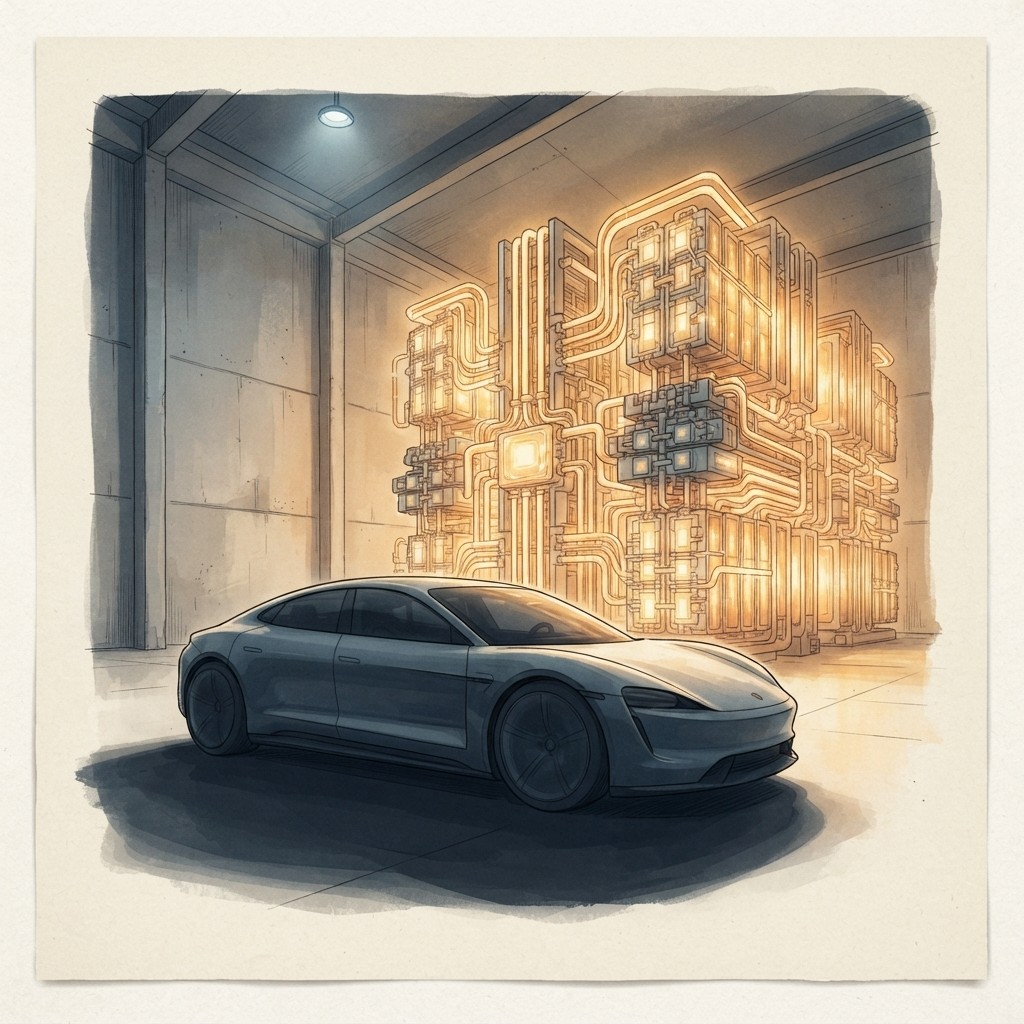
Every quarter, Tesla's rivals write checks to keep selling gas cars. The money lands on Tesla's books — and almost none of it cost a thing to make.
Pairs with the Profit-Engine Map — a ready-to-use strategy tool, filled for Tesla. Included in the Money Machine Casebook →
“Where does the money actually come from, and who sets the rate it comes in at?”
Tesla builds a car, sells it, and recognizes a few tens of thousands of dollars at an automotive gross margin of 18.4%.6 That is the business everyone watches — the delivery numbers, the price cuts, the line at the Supercharger. But buried in the same 10-K is a different kind of line item, one with no factory, no steel, no shipping, no warranty. In 2024 it was worth $2.763 billion, and almost none of it cost anything to produce.1 It is the credit Tesla earns simply for being all-electric while everyone else still isn't — and it falls, nearly intact, into gross profit. Tesla does not just sell cars. It sells the legal permission for other carmakers to keep selling the gas ones.
The official story is that Tesla is a car company that happens to be doing well. The truer story is that its two best businesses by margin are the ones that aren't cars at all — a near-zero-cost compliance credit, and a battery segment growing faster and earning more per dollar than the vehicles that made the company famous.45 Price Tesla on deliveries alone and you are valuing the wrong asset.
The line item that costs nothing to make: where a competitor's failure to electrify becomes Tesla's purest profit
Here is the mechanism, and it is almost too clean. Governments require automakers to hit emission and zero-emission targets. A company that misses can either pay a penalty or buy credits from a company that exceeded. Tesla, building only electric vehicles, generates a surplus of these credits as a byproduct of doing what it already does. It earns them under various regulations related to ZEVs, greenhouse gas, fuel economy and clean fuel, then sells them to regulated competitors who need to comply.3 The competitor's failure to electrify is, quite literally, Tesla's revenue. The cost of producing this revenue is effectively nothing — the credits are a side effect — so the money arrives at the top line and keeps going straight down to gross profit. Same penguin, opposite math: the very regulation that punishes legacy automakers pays Tesla.
| Year | Regulatory credit revenue | Cost to produce it |
|---|---|---|
| 2021 | $1,465M | Essentially zero |
| 2022 | $1,776M | Essentially zero |
| 2023 | $1,790M | Essentially zero |
| 2024 | $2,763M | Essentially zero |
It is worth being precise about what these credits are, because the popular framing — 'California ZEV subsidies' — is too small. Tesla's own filing names a multi-regime bundle: ZEVs, greenhouse gas, fuel economy, and clean fuel.3 Reporting on the earlier years traced at least four distinct streams — state ZEV programs led by California, federal CAFE and GHG programs, and EU fleet-pooling arrangements — with ZEV credits alone accounting for roughly 60% of credit revenue between mid-2012 and mid-2019.8 In other words, this isn't one fragile subsidy. It is a portfolio of compliance markets across continents, each one paying Tesla for the same underlying fact: it sells cars no one else is forced to clean up after.
While the cars got cheaper, the batteries got richer: the side project quietly out-earning the showroom on every dollar
Now look at the other business everyone treats as a side project. In 2024, Tesla's energy generation and storage revenue hit $10.086 billion, up 67% from $6.035 billion the year before, as storage deployments more than doubled to 31.4 GWh.5 That alone would be notable. The strategic point is the margin. The energy segment earned a 26.2% gross margin in 2024 — comfortably above the automotive segment's 18.4%.46 So the fastest-growing part of Tesla is also the highest-margin part, and it is the one most observers still file under 'Powerwalls and Megapacks, a hobby.' Meanwhile the core car business moved the other way: automotive gross margin fell from 23.3% in 2023 to 18.4% in 2024, on automotive revenue that declined about 6% to roughly $77 billion.6 The headline product got cheaper and thinner. The overlooked one got bigger and fatter.
“We earn tradable credits under various regulations related to ZEVs, greenhouse gas, fuel economy and clean fuel... and sell these credits to other regulated entities.”3
In any company that wears a famous product like a face, the profit engine often hides behind it. Tesla's headline is the car, but its richest dollars come from two places the public ignores: a near-zero-cost compliance credit other automakers are forced to buy, and a battery segment quietly out-earning the vehicles on margin. The discipline isn't to find the biggest revenue line — it's to ask which line keeps the most of what it earns, and which is growing while the headline shrinks. Tesla's 2024 answer was credits and energy, not cars.
Some of the energy segment's strength is the IRA's hand on the scale. Tesla disclosed that the energy segment benefited from $756 million in Section 45X manufacturing credits in 2024, versus just $115 million in 2023.4 Strip that boost out and the segment's margin expansion would have been substantially smaller. The lesson is the same one the regulatory credits teach: a meaningful slice of Tesla's most profitable lines is granted by policy, not earned on the shop floor — which is exactly what makes them so high-margin, and so exposed.
Isn't this just a temporary subsidy that's already dying?: the honest objection — and why the fade reveals more than it removes
The honest objection is the strongest one: if Tesla's best margins come from credits and tax incentives, then they live and die by policy — and policy is turning. That's not a hypothetical. In 2025, governmental and regulatory actions repealed or restricted certain credit programs tied to Tesla's products, contributing to a $1.41 billion decrease in remaining performance obligations by the end of September 2025 versus the prior year-end.7 Years ago, observers warned that this profit center was 'dangerously close to running out of power.'8 So yes — the credit stream is not eternal, and the contraction has begun. But that cuts the other way too. The point was never that credits are forever; it is that for as long as they existed, the market mispriced Tesla as a metal-bending automaker while a no-cost line quietly carried the operating result, and a battery business with better margins than the cars grew underneath it. As the credit fades, the energy engine is exactly what determines whether the durable margin survives. The credits revealed how Tesla actually made money. The batteries decide whether it keeps doing so.
Tesla's reputation is built on the thing in the driveway. Its economics, for years, were built on two things you couldn't see: a credit other carmakers were legally required to buy, and a battery business out-earning the cars on every dollar.14 The mistake the market kept making was to count the cars and ignore the rest — to value the showroom and overlook the line item with no cost, and the segment with the better margin. The cars were always the most visible business. They were rarely the best one.
Companies that profit where you'd never look
Profit-Engine Map
A one-page map that pulls a business apart into the hook that gets the customer in the door and the engine that quietly earns the margin. Use it to see where the real profit lives, how the two halves are wired together, and what breaks if the link is cut. Blank to dissect your own P&L; filled as the worked example of a business whose advertised product is not where it makes its money.
Included, filled and blank, in the Money Machine Casebook. See the set → · Preview the blank →
Sources
Where this comes from — the filings, records, and reporting behind it.
- 1Tesla's automotive regulatory credits revenue was $2,763 million in 2024, $1,790 million in 2023, and $1,776 million in 2022, per the disaggregated revenue table in Tesla's annual report.
- 2Tesla's automotive regulatory credits revenue was $1,790 million in 2023, $1,776 million in 2022, and $1,465 million in 2021; total 2023 revenues were $96,773 million; energy generation and storage revenues were $6,035 million in 2023.
- 3Tesla earns tradable credits under various regulations related to ZEVs, greenhouse gas, fuel economy, and clean fuel, and sells them to other regulated entities to comply with emission standards.
- 4Tesla's energy generation and storage segment gross profit was $2.64 billion in 2024 at a 26.2% margin, up from $1.1 billion / 18.9% in 2023; the segment benefited from $756 million in IRA Section 45X manufacturing credits in 2024 versus $115 million in 2023.
- 5Tesla's full-year 2024 energy generation and storage revenue was $10,086 million, up 67% from $6,035 million in 2023; energy storage deployments rose to 31.4 GWh in 2024 from 14.7 GWh in 2023.
- 6Tesla's total automotive gross margin was 18.4% in full-year 2024, versus 23.3% in 2023, as automotive revenues declined 6% to approximately $77 billion; the energy segment's margin of 26.2% exceeded the automotive segment's margin.
- 7In 2025, governmental and regulatory actions repealed and/or restricted certain regulatory credit programs tied to Tesla's products, contributing to a $1.41 billion decrease in remaining performance obligations as of September 30, 2025 versus December 31, 2024.
- 8Tesla's regulatory credits come from at least four distinct U.S. and international regimes: state ZEV programs (led by California), federal CAFE/GHG programs, and EU fleet-pooling arrangements; from mid-2012 to mid-2019, ZEV credits alone accounted for roughly 60% of all credit revenue.
Weighing outside help with a decision like this? Hiring a pricing strategy consultant
More like this — beyond Tesla
New Strategically analyses as they publish: the defining moves in business, checked against the record. No noise, and one click to leave.