Pairs with the Pricing Power Diagnostic — a ready-to-use strategy tool. Included in the Hidden Cost Casebook →
“What does changing how you charge cost before it starts paying?”
You open the app, tap your usual, and walk to the store with the smug confidence of someone who has beaten the line. Except the line didn't disappear. It moved — onto a metal counter behind the register, where a barista is now reading orders off a printer faster than two hands can build them, because nobody told the system to wait until you actually showed up. That little act of magic on your phone has a price. Starbucks just spent the better part of a decade not paying it, and then paid all at once.
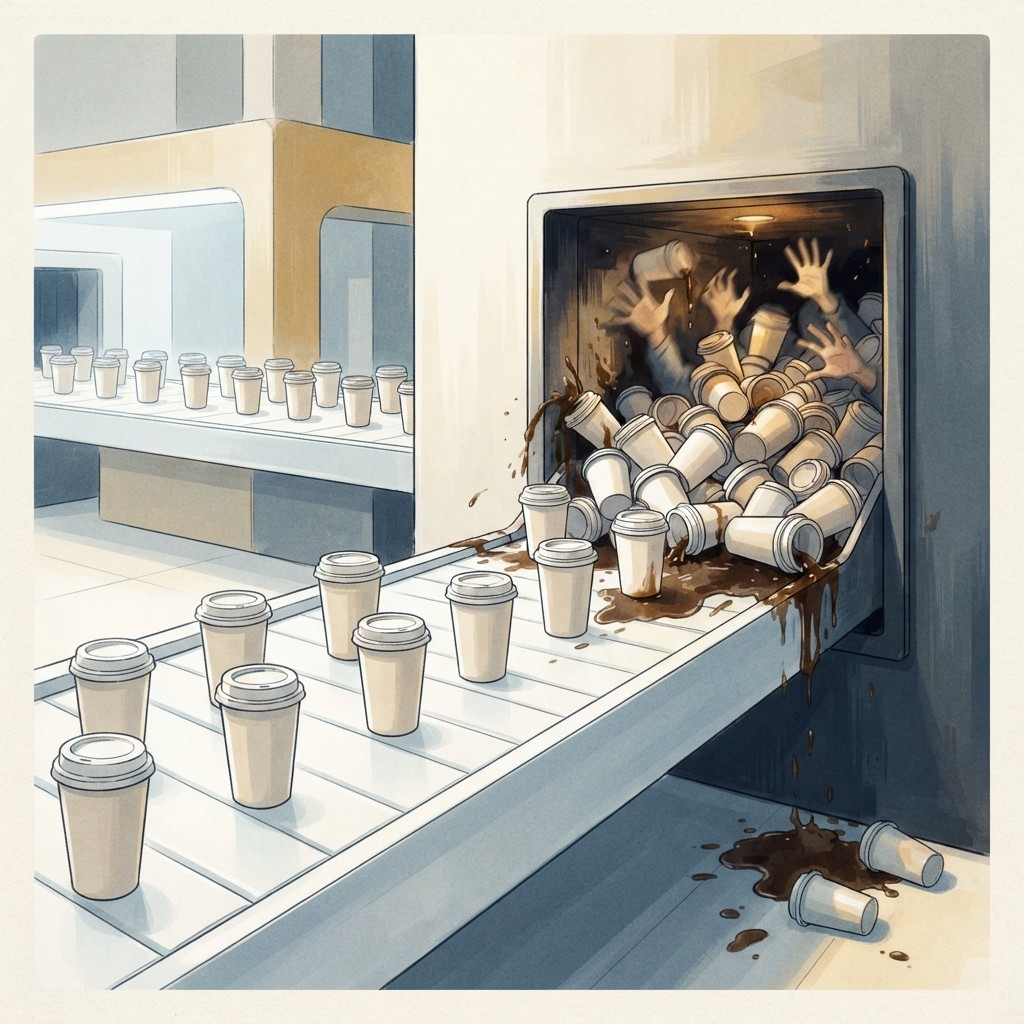
The official story is that Mobile Order & Pay removed friction: skip the line, beat the queue, frictionless coffee. The real story is that it relocated the friction to a place the customer couldn't see and the company didn't measure — and that hidden friction eventually showed up in the one place it couldn't hide, the comp-sales line.
The demand-side win that nobody is arguing with
Start with what worked, because plenty did. Starbucks piloted Mobile Order & Pay on December 3, 2014 in Portland and pushed it national through 2015.1 The pitch was never really about coffee — it was about data. Every mobile order is a logged-in customer, a known preference, a hook into Starbucks Rewards. By Q2 FY2017 the loyalty program already accounted for 36% of U.S. company-operated sales, and app-based payment had climbed to 29% of transactions.3 By Q1 FY2024 the app handled a record 31% of U.S. company-operated transactions, with 34.3 million 90-day active Rewards members.6 On the demand side, the machine did exactly what it promised: it turned anonymous foot traffic into a named, re-targetable, habit-tracked customer base. That part of the frictionless narrative is true.
What the app moved instead of removed
Here is the thesis a smart friend can repeat at dinner: Mobile Order & Pay didn't remove friction, it teleported it. A walk-in customer is a natural throttle — they arrive one at a time, they're visible, and the barista paces the work to the bodies in front of them. A mobile order arrives instantly, invisibly, and all at once. The kitchen now has two queues fighting for the same two hands, and for most of a decade Starbucks gave those queues no referee. Orders were processed first-in, first-out. Mobile floods you before the customer is even in the building, so the espresso machine is busy serving someone who is still three blocks away while the person standing at the register waits and quietly decides not to come back.
This is the part the launch math obscured. Even the revenue story was thinner than it looked: Starbucks' own CFO, presenting at the 2015 Goldman Sachs Global Retailing Conference, said the results from Mobile Order & Pay were running ahead of expectations and that the upside lay in future suggestive-selling features — not in a bigger basket at launch.8 So the app wasn't even buying a bigger basket at the start. It was buying volume and data, while quietly loading a throughput cost onto the busiest moment of the day.
| Walk-in order | Mobile order-ahead | |
|---|---|---|
| When the work hits the kitchen | When you arrive | The instant you tap, before you arrive |
| Natural pacing | Bodies arrive one at a time | Orders flood in batches |
| Average ticket at launch | Baseline | 'On par' — not higher |
| What the customer sees | The line | A crowded, confusing pick-up counter |
The quarter the hidden cost came due
For a while the cost stayed buried, because adoption was small enough to absorb. Then it wasn't. In a single year the number of stores taking 20% or more of their orders via mobile jumped from 13 to roughly 1,200.2 At that density, first-in, first-out stops being a quirk and becomes a chokepoint. In the Q1 FY2017 earnings release, then-COO Kevin Johnson attributed a 3% same-store sales result — the company's weakest since 2009 — primarily to mobile-order congestion at the handoff counter.2 The crowd at the pick-up counter was literally turning away the walk-in customer the company still needed. This was not a flagship-store curiosity. It was systemic, and the company said so on the record.
“Mobile orders were processed first-in, first-out, with no sequencing algorithm — flooding baristas before customers arrived and congesting the pick-up counter.”7
The genuinely damning detail is the date. The congestion was named as a material drag in early 2017. By Q2 FY2024, a mid-teens percentage of mobile orders were going uncompleted simply because the volume was too high to fulfill — orders abandoned, revenue evaporating at the counter.7 And it was only in January 2025, more than ten years after the Portland pilot, that a new CEO confirmed Starbucks still had no order-sequencing algorithm and was piloting one in just three stores, aiming for roughly four-minute in-store and 12-to-15-minute mobile fulfillment.7 A decade. The company that wrote the playbook on mobile order-ahead never built the one control that would have made it sustainable.
Wasn't this just COVID and a hard year for everyone?
The fair objection is that mobile order-ahead clearly worked — adoption kept climbing, loyalty kept growing, and the on-the-go customer became the core of the business, around 80% of U.S. transactions before the pandemic.4 If the app were broken, why would people keep using it? But that's exactly the trap. High adoption is what made the unmanaged throughput so dangerous, not what excused it: the more orders the app pulled in, the harder it slammed an unsequenced kitchen. The honest counter is that some of the 2024 softness is macro — consumer pullback, competition, a hard year for everyone in coffee. Granted. But Starbucks' own executives, across two different CEOs eight years apart, kept pointing at the same internal failure: a flood of mobile orders with no system to pace them. When the company tells you twice, under oath of a public earnings call, that the problem is operational, the macro story is a comfort, not an explanation.
A 'frictionless' interface almost never destroys friction — it relocates it to wherever you're not looking. Order-ahead, one-click checkout, instant approvals: each one moves the customer's wait into a queue the customer can't see, usually in operations or fulfillment. The demand side is easy to measure and easy to celebrate (transactions up, app adoption up, a record on the slide). The supply side is where the bill quietly accrues. The discipline isn't to avoid removing front-end friction — it's to instrument the place the friction lands, and to build the throttle before adoption makes the throttle mandatory. Starbucks had the data to see this in 2017 and shipped the fix in 2025. The gap between those two dates is the cost of mistaking a demand metric for the whole picture.
Mobile Order & Pay was a real breakthrough — it just wasn't the breakthrough it was sold as. It captured the customer beautifully and managed the kitchen not at all, and for ten years the company counted the first half and ignored the second. The app ended the line you could see and built a worse one you couldn't, and the worse one is the kind that doesn't complain — it just stops coming back. Frictionless was never free. Starbucks simply moved the receipt somewhere it wouldn't have to read it, and then read it anyway, a decade late, in the comp-sales line.
When the convenience has a hidden invoice
Pricing Power Diagnostic
A scored diagnostic of pricing power: brand pull, switching costs, substitutes, and how critical the product is to the buyer. Each dimension rated 1-5 so you can see, at a glance, whether a price rise sticks or sends customers running. Blank to grade your own offer; filled as the worked example scoring a story's business on its real ability to charge more.
Included, filled and blank, in the Hidden Cost Casebook. See the set → · Preview the blank →
Sources
Where this comes from — the filings, records, and reporting behind it.
- 1Starbucks launched Mobile Order & Pay on December 3, 2014 in Portland, Oregon, with national rollout planned for 2015.
- 2By Q1 FY2017, 7% of U.S. consumers used mobile order-ahead (up from 3% a year prior); 1,200 stores saw 20%+ of orders via MOP, up from only 13 stores a year earlier. COO Kevin Johnson attributed the 3% same-store sales result — the worst since 2009 — primarily to MOP-driven congestion at handoff.
- 3Mobile Order and Pay grew to 8% of U.S. transactions in Q2 FY2017; Mobile Payment (app-based pay) reached 29% of transactions; Starbucks Rewards represented 36% of U.S. company-operated sales.
- 4Prior to COVID-19, approximately 80% of Starbucks U.S. company-operated transactions were 'on-the-go' occasions; Starbucks introduced the Starbucks Pickup store format to serve mobile-order-ahead customers in major metropolitan areas.
- 5Mobile Order and Pay functionality is described in the FY2024 10-K as allowing customers to place orders in advance for pick-up; Starbucks Rewards members represent the core loyalty cohort linked to app usage; beverages constituted 74% of retail revenue in FY2024.
- 6As of Q1 FY2024 (Dec 31, 2023), 31% of total transactions at U.S. company-operated stores were made via the mobile app — a new record, up from 27% the prior year and 25% two years prior. Starbucks Rewards 90-day active members reached 34.3 million, up 13% year-over-year.
- 7By Q2 FY2024, a 'mid-teens percent' of mobile orders went uncompleted due to volume; CEO Brian Niccol confirmed in Q1 FY2025 that Starbucks had no order-sequencing algorithm (mobile processed first-in, first-out), causing counter congestion; a 3-store pilot of a sequencing algorithm was underway as of January 2025, targeting four-minute in-store and 12–15 minute mobile fulfillment.
- 8Starbucks' CFO Scott Maw stated at the 2015 Goldman Sachs Global Retailing Conference that MOP average ticket was 'on par with in-store orders' at that time, and that the company expected MOP to drive increased acquisition and retention for its loyalty program.
- 9Brian Niccol stated on the Q1 FY2025 earnings call that 'the biggest challenge is the fact that the mobile ordering has no sequencing. It's just first in, first out.' and that 'the counter area gets really crowded, congested.'
Weighing outside help with a decision like this? Hiring a pricing strategy consultant
More like this — beyond Starbucks
New Strategically analyses as they publish: the defining moves in business, checked against the record. No noise, and one click to leave.