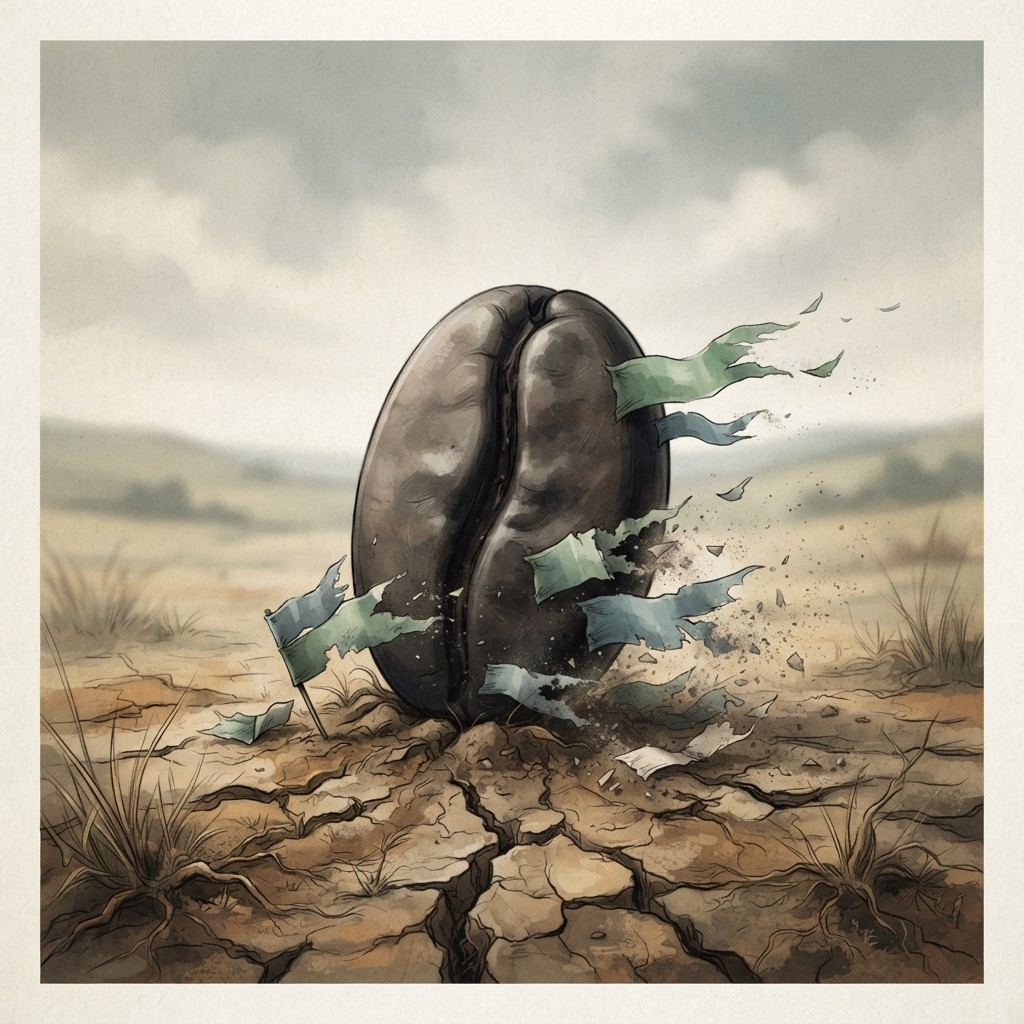
Pairs with the Crisis Response Playbook — a ready-to-use strategy tool, filled for Starbucks. Included in the Crisis Response Casebook →
“What is one more quarter of not acting worth?”
On December 9, 2021, baristas at a single store on Elmwood Avenue in Buffalo counted the ballots and got an answer: 19 to 8 in favor. The first company-owned Starbucks in the United States had a union.1 It felt like a domino falling. Within a few years, over 12,000 workers at roughly 700 stores in at least 45 states would vote the same way.6 By any normal reading of a labor campaign, that is a rout. And yet, as of late 2025, not one of those stores has a signed contract.6 The movement won almost every vote it called — and is still waiting for the one thing a union exists to deliver.
The story everyone tells is a morality play: scrappy workers organize, a giant corporation fights dirty, and either justice or capital prevails. Both versions miss the actual mechanism. Starbucks did not crush the union in a single decisive blow. It did something quieter and far more durable — it turned the fight into a process, and then made the process slow.
Even the first victory wasn't a clean sweep
Start with the founding myth, because the strategy hides inside it. The Buffalo vote is remembered as a landslide. It wasn't. Elmwood Avenue passed 19-8 — but on the very same day, a second Buffalo store on Camp Road voted 12-8 against unionizing.1 Nor was this the first Starbucks union on earth: a store in Victoria, British Columbia had joined the United Steelworkers in August 2020 and signed a three-year agreement in 2021, well before Buffalo.8 The accurate claim is narrow and specific — first company-owned U.S. store — and that precision matters, because the whole Starbucks playbook is built on precision. The company would spend the next four years winning on technicalities the public never read closely enough to notice.
The largest violation docket — and almost no consequence
Here is the part that should be impossible to reconcile. In March 2023, an NLRB administrative law judge found Starbucks had violated federal labor law in Buffalo through what he called 'egregious and widespread misconduct demonstrating a general disregard for the employees' fundamental rights' — ordering fired workers reinstated, a shuttered store reopened, and Howard Schultz himself present for a reading of worker rights notices.2 That same month, the Senate's labor committee tallied the broader record: judges had found Starbucks broke the law 130 times across six states, including firing or forcing out a dozen pro-union workers, with 70 more cases headed to trial.3 A company can amass one of the heaviest labor-violation dockets in modern memory and still control the outcome — because findings are not the same as remedies, and remedies take years.
This is the mechanism, worked down. A union drive runs on momentum: a fired organizer reinstated this month energizes the next store; a fired organizer reinstated in three years, after appeals, is a footnote to people who have long since quit and moved on. The legal labels — 'allegations,' 'charges,' 'findings,' 'remedies' — are not interchangeable, and the gaps between them are where time accumulates. Over 500 charges sounds like 500 crimes. It is not. Charges are allegations; the 130 are judge-level findings; and even those are subject to Board and appellate review, with some later vacated. Each rung down the ladder is real, and each rung takes longer than the one above it. Starbucks did not need to be innocent. It only needed the clock.
| ULP charge | ALJ finding | Enforced remedy | |
|---|---|---|---|
| What it is | An allegation filed | A judge agrees law was broken | Worker actually reinstated / store reopened |
| How many | 500+ | 130 across six states | Far fewer, often delayed |
| Can it be reversed | Dropped or dismissed | Board & courts can vacate | Stayed pending appeal |
| Speed | Fast to file | Months to years | Years, if ever |
The Supreme Court didn't clear Starbucks — it slowed the referee
The clock got a powerful new ally in June 2024. In Starbucks Corp. v. McKinney, the Supreme Court ruled 8-1 that when the NLRB asks a court for a quick injunction to reinstate fired workers, the court must apply the stricter four-factor Winter test rather than a more lenient standard.4 The case is widely misread as a vindication. It was nothing of the kind. Justice Jackson dissented in part, the Court vacated and remanded, and — crucially — it ruled on none of Starbucks' actual conduct.4 The underlying dispute even cut against the tidy narrative: the fired Memphis workers had admitted to letting a TV crew into a closed store after hours, and Starbucks' policy-violation defense was real, even as the labor board alleged the true motive was anti-union animus. The Court answered only one question — how fast the referee may act — and it answered it in the company's favor. Emergency reinstatement, the union's single fastest tool, got slower for every employer in America.
“Starbucks has not broken the law.”5
Schultz's appearance that March is its own small case study in framing. He is often said to have defied a subpoena; in fact he agreed to testify voluntarily before the committee even voted on one, appearing under its threat but not its execution.5 On the stand he was emphatic — the company 'has not broken the law' — recasting judicial findings as mere accusations, and he declined Bernie Sanders' demand to hand the union contract proposals within 14 days.5 That refusal is the whole strategy compressed into a single sentence. There is no law that says you must bargain quickly. There is only a law that says you must bargain in good faith — and good faith is, conveniently, slow to prove.
A grassroots movement runs on momentum; an incumbent with a legal department runs on duration. The asymmetry is the strategy. Workers organize on volunteer energy and turnover-prone enthusiasm that decays in months; a $100B company litigates on retained counsel and a balance sheet that doesn't get tired. So the play is rarely to defeat the union outright — it's to convert every decisive moment into a procedural one, and let attrition do the work. The caution: this is a defended position, not a free one. Each delay adds to a public violation docket, invites Senate hearings, and bets that the political and legal weather won't turn before the clock runs out. Time is a moat only until it isn't.
The honest counter: maybe the law is just slow
The fair objection is that this reads too neatly — that no one at Starbucks drew up a master plan called 'exhaust them with the calendar,' and that American labor law is simply, structurally glacial for everyone. That's true, and it's the strongest version of the company's defense. First contracts routinely take years even where both sides act in good faith; the policy-violation defense in Memphis was genuine; and Starbucks can point to rulings where the Board upheld findings that it acted lawfully, as it did after two June 2026 NLRB opinions covering Seattle and Portland stores.7 But notice what the steelman concedes. If the law is slow by default, then the rational move for a well-resourced employer is to do nothing to speed it up — and that is exactly what a bad-faith bargaining complaint, filed by the union in December 2024 after talks stalled, alleges happened.6 You don't need a conspiracy to exhaust a movement. You need only the patience to let a slow system stay slow, and the lawyers to keep it that way.
So where does that leave a movement that won almost everywhere it asked? Seven hundred stores wear the badge of a victory that hasn't paid out.6 The NLRB keeps finding violations — two more as recently as June 2026, for unlawfully interrogating workers about strike plans — and Starbucks keeps replying that the same board upheld many findings in its favor.7 Both statements are true, which is the point. The genius of the response was never a knockout. It was the discovery that in a system built on process, the side that can afford to wait usually wins — and that a $100B company can wait longer than any group of baristas can stay angry. The union got the votes. Starbucks got the years. And in a contract fight, only one of those gets ratified.
Crisis Response Playbook
A playbook for a crisis already in motion: who decides, which plays fire on which trigger, and what gets said to whom. It replaces panic and the all-hands meeting with a pre-agreed sequence each person can run alone. Blank to pre-load before a crisis hits; filled as the worked example reconstructing the plays the story's team ran — and the ones they should have.
Included, filled and blank, in the Crisis Response Casebook. See the set → · Preview the blank →
Sources
Where this comes from — the filings, records, and reporting behind it.
- 1On December 9, 2021, workers at Starbucks' Elmwood Avenue store in Buffalo, NY voted 19-8 to unionize, making it the first company-owned U.S. Starbucks to do so; a second Buffalo store (Camp Road) voted 12-8 against unionizing on the same day.
- 2On March 1, 2023, NLRB Administrative Law Judge Michael A. Rosas found Starbucks violated the National Labor Relations Act hundreds of times through 'egregious and widespread misconduct demonstrating a general disregard for the employees' fundamental rights,' ordering reinstatement of unlawfully fired workers, reopening of a closed store, and requiring Howard Schultz to read or be present at a reading of worker rights notices.
- 3The U.S. Senate HELP Committee majority staff report (March 2023) found that NLRB judges had found Starbucks broke the law 130 times across six states since organizing began in fall 2021, including firing or forcing out 12 pro-union workers, with the NLRB then taking Starbucks to trial in 70 additional cases.
- 4On June 13, 2024, the U.S. Supreme Court ruled 8-1 in Starbucks Corp. v. McKinney (602 U.S. 339) that district courts must apply the traditional four-factor Winter test — not a more lenient two-part 'reasonable cause' standard — when the NLRB seeks a Section 10(j) preliminary injunction. Justice Clarence Thomas wrote the majority; Justice Jackson partially dissented. The Court vacated and remanded; it did not rule on Starbucks' underlying conduct.
- 5Howard Schultz testified before the Senate HELP Committee on March 29, 2023 — under threat but not execution of subpoena — and stated 'unequivocally' that Starbucks 'has not broken the law,' calling NLRB ALJ Rosas' findings 'allegations' Starbucks would contest. He declined to commit to providing the union with contract proposals within 14 days as Sanders requested.
- 6As of June 2026, over 12,000 workers at 700 Starbucks stores in at least 45 U.S. states have voted to unionize with Workers United. Workers United and Starbucks have been engaged in negotiations over a national collective bargaining agreement since February 2024, but no ratified first contract exists at any store. The union filed a bad-faith bargaining complaint against Starbucks in December 2024.
- 7On June 5, 2026, the NLRB issued two rulings against Starbucks covering Seattle and Portland stores, finding the company unlawfully interrogated employees about strike plans and unlawfully disciplined union supporters; Starbucks stated the board 'upheld many of the ALJ's findings that Starbucks acted lawfully' and it was evaluating options on remaining claims.
- 8A Victoria, British Columbia Starbucks store joined United Steelworkers in August 2020 — before the December 2021 Buffalo vote — and signed a three-year collective bargaining agreement in 2021, making the Buffalo vote the first U.S. company-owned Starbucks union, not the first globally.Wikipedia / Starbucks unions, Starbucks unions ↗ · 2026-06-24
Weighing outside help with a decision like this? Hiring a supply chain strategy consultant
More like this — beyond Starbucks
New Strategically analyses as they publish: the defining moves in business, checked against the record. No noise, and one click to leave.