Pairs with the Culture Doctrine Canvas — a ready-to-use strategy tool. Included in the Culture Doctrine Casebook →
“What does your doctrine refuse, and can you pay for it in a bad year?”
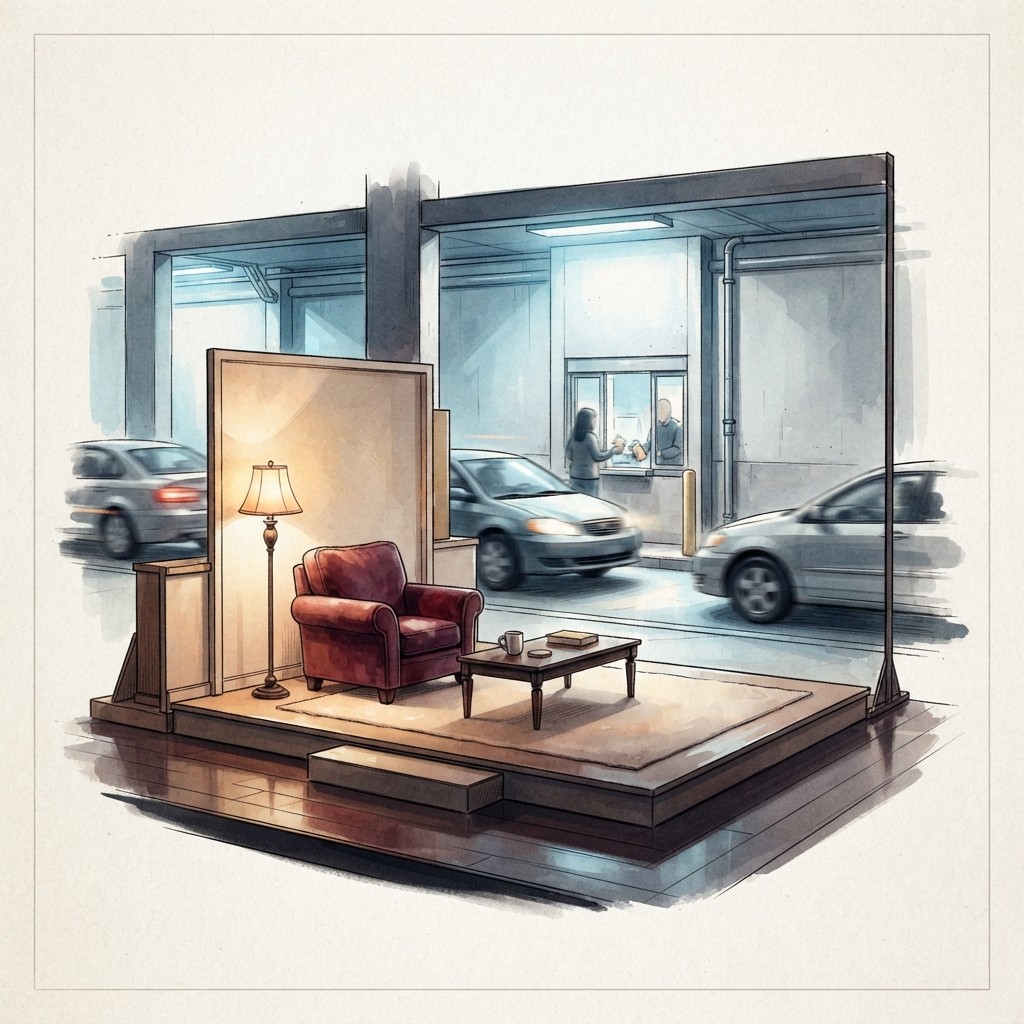
Picture the Starbucks of the brand's own mythology: a leather armchair, a stranger's open laptop, a barista who knows your name, the soft hum of a place that is neither home nor office but a public living room between the two. Now picture the actual store most Americans meet today — a counter stacked with mobile orders nobody is waiting for, a line of idling cars at the window, no seat worth taking. By 2024, mobile app and drive-thru orders made up more than 70% of sales at Starbucks' roughly 9,500 company-operated U.S. stores, and 70% of all U.S. locations have a drive-thru.5 The living room had quietly become a pickup window. The company just kept calling it a living room.
The official story is that Starbucks built the 'third place' — a warm civic hangout between home and work — and then accidentally lost it to the pandemic and the app. Nearly every part of that is wrong. Starbucks didn't invent the third place; it borrowed the idea. It never fully met the definition it claimed. And it didn't lose the third place to COVID — it had been walking away from it for two decades, on purpose, store by store.
The phrase was a sociologist's, not a barista's
The third place isn't a Starbucks idea. It's an academic one. Sociologist Ray Oldenburg coined the term in his 1989 book 'The Great Good Place,' arguing that informal gathering spots — cafés, bars, barbershops — matter because they hold a community together and keep a democracy talking to itself.1 Starbucks didn't appear in the public record using the phrase until its 1995 Annual Report, where Howard Schultz described the stores as a space 'somewhere in between' home and work 'where you can sit back and be yourself.'9 That's six years after the book. The doctrine everyone treats as Starbucks' founding genius was a commercialization of someone else's framework — adopted after the concept already existed, and dressed up as origin.
“Somewhere in between... where you can sit back and be yourself.”2
Here is the thesis, plainly: the 'third place' at Starbucks was always a corporate adaptation of Oldenburg's idea, never a faithful build of it — and the company's two-decade drift toward drive-thru and mobile is the proof that the doctrine was marketing mythology long before anyone admitted it. The interesting part isn't that Starbucks borrowed a phrase. It's that the borrowed phrase failed the source's own test.
Oldenburg's own rule disqualified the company that quoted him
Read the original criteria and the gap opens fast. A true third place, Oldenburg argued, is free or very inexpensive, built around conversation, and — this is the part Starbucks could never satisfy — local. He explicitly held that chain establishments run by large corporations are 'less hardy' third places than independently owned ones, because they pull cash flow out of the very communities a third place is supposed to knit together.16 A national chain selling four-dollar drinks under a uniform interior was, by the doctrine's founding text, the weak version. Starbucks didn't quietly sidestep this. It quoted the man whose definition ruled it out, and built one of the most successful brand stories in retail history on top of the contradiction.
| Oldenburg's criteria | Starbucks in practice | |
|---|---|---|
| Cost of entry | Free or very inexpensive | A purchase, repeated |
| Center of gravity | Conversation between regulars | Throughput and the order queue |
| Ownership | Local, independent | National corporate chain |
| Oldenburg's verdict on the form | The 'hardy' third place | The 'less hardy' kind |
The drift wasn't the pandemic. It was the strategy.
The convenient version of events says COVID broke the third place — that lockdowns trained everyone to grab and go, and the cozy café was collateral damage. The numbers don't support a sudden fall. By 2005, more than half of new Starbucks store openings were drive-thru locations.7 That's fifteen years before the pandemic, and it's the opposite of a place built to linger in. A drive-thru is the architectural negation of a third place: you never leave the car, you never meet a regular, you never sit back and be yourself — you transact and depart. The company spent two decades optimizing for the order that requires no seat, and then expressed surprise when the seats stopped mattering. The pandemic didn't corrupt the doctrine. It accelerated a choice already two decades deep.
Then the bill arrived. New CEO Brian Niccol had already published an open letter on September 10, 2024 — before the quarter closed — promising to make stores 'inviting places to linger, with comfortable seating' and to draw 'a clear distinction between to-go and for-here service.'4 When Q4 FY2024 results followed in October, they confirmed how far the drift had gone: global comparable store sales down 7% and GAAP earnings per share down 25% year-over-year.3 Strip the warmth from that sentence and it's an admission: the lingering had gone, the seating wasn't comfortable, and the two kinds of customer had been blended into a queue that served neither. 'Back to Starbucks' is the tell. You can only go back to a place you actually left — and the letter quietly confirms how far the company had already drifted from the thing it kept selling.
But didn't Starbucks invent café culture in America?
The fair objection is that this is too cynical. Schultz really did bring the Italian espresso-bar model home — he confirms his 1983 Milan trip as the inspiration for the coffeehouse vision — and millions of people genuinely did meet, study, and linger in Starbucks stores for years.8 All true. The brand created a category and a habit, and the experience was real for the people who had it. But 'real for some customers' is not the same as 'a faithful build of the doctrine.' A company can deliver a pleasant café and still be running marketing mythology if the operating system underneath is steadily engineered against the thing the marketing promises. The proof isn't in whether anyone ever lingered. It's in where the capital went: into drive-thru lanes and mobile throughput, year after year, while the story stayed fixed on the armchair. The vision was sincere in 1995. The strategy stopped serving it long before anyone said so out loud.
Every brand has a stated doctrine — the warm sentence in the annual report, the word in the founder's keynote. The doctrine that actually governs the company is the one revealed by capital allocation: where the new stores go, what the app is optimized for, which customer the floor plan is built to serve. When the framed doctrine and the funded doctrine diverge, the framed one becomes mythology — and it can survive for years, because customers buy the story before they audit the building. The danger isn't lying; it's drift. Starbucks didn't decide to abandon the third place. It just kept funding throughput and kept narrating community, until a 7% sales drop made the gap impossible to keep papering over. Audit your own company the hard way: list what you say you are, then list what your last ten capital decisions actually built. Where the two lists disagree, that's the doctrine you're really running.
So the most honest reading of 'Back to Starbucks' is the most surprising one: it isn't a revival. It's a first attempt. For thirty years the company owned the language of the third place without ever fully building the thing the language described — borrowing a sociologist's idea, failing his own test, and quietly engineering the café out of the café while the story held. Now, with comfortable seating written into a CEO's letter and the for-here line drawn back in, Starbucks is finally trying to make true the thing it spent a generation only claiming. The genius was never the place. It was the story about the place — and the story sold so well that almost nobody noticed the building had been walking the other way the whole time.
Culture Doctrine Canvas
A one-page canvas for the unwritten rules that actually run a company: the core beliefs, the behaviors they reward and punish, the lines it won't cross, and the moments that prove the doctrine is real. Blank to articulate your own operating culture before it drifts; filled as the worked example that decodes why the story's company behaves the way it does — even when it costs them.
Included, filled and blank, in the Culture Doctrine Casebook. See the set → · Preview the blank →
Sources
Where this comes from — the filings, records, and reporting behind it.
- 1Ray Oldenburg coined the term 'third place' in his 1989 book 'The Great Good Place,' arguing these informal gathering spaces are important for democracy and civic engagement; the book is the primary source for the concept Starbucks later appropriated.Marlowe & Company (publisher), The Great Good Place: Cafés, Coffee Shops, Bookstores, Bars, Hair Salons and Other Hangouts at the Heart of a Community · 1989
- 2Howard Schultz explicitly used the phrase 'third place' in Starbucks' 1995 Annual Report, describing stores as a space 'somewhere in between' home and work 'where you can sit back and be yourself' — the earliest documented use of the term in a Starbucks primary corporate document.
- 3Starbucks' Q4 FY2024 SEC 8-K filing shows global comparable store sales declined 7% and GAAP EPS fell 25% year-over-year, the financial crisis that prompted CEO Brian Niccol's 'Back to Starbucks' pivot explicitly framed around reclaiming the third-place identity.
- 4Brian Niccol's September 10, 2024 open letter—published on Starbucks' own press site—committed to making stores 'inviting places to linger, with comfortable seating' and a 'clear distinction between to-go and for-here service,' representing the company's formal acknowledgment that the third-place experience had been abandoned.
- 5Mobile app and drive-thru orders made up more than 70% of Starbucks' sales at its approximately 9,500 company-operated U.S. stores by 2024, and 70% of all U.S. locations have a drive-thru option — quantitative evidence the third-place doctrine had been operationally abandoned long before the 2024 crisis.
- 6Oldenburg explicitly stated that chain establishments run by large corporations are 'less hardy' third places than local, independently owned establishments, as they divert cash flow away from local communities — a direct academic refutation of Starbucks' core brand claim, sourced to the Wikipedia synthesis of Oldenburg's own text.
- 7By 2005, more than half of new Starbucks store openings were drive-thru locations — evidence the drift from third-place principles began at least 15 years before the pandemic, not as a COVID-era aberration.
- 8Howard Schultz confirmed his 1983 trip to Milan as the experiential inspiration for the coffeehouse model at Starbucks Leadership Experience 2025, and Starbucks' own press release on the same event positions the third-place concept as the company's founding identity — the most recent primary-company reaffirmation of the doctrine.
- 9Howard Schultz described Starbucks stores as 'somewhere in between' home and work 'where you can sit back and be yourself' — a 'third place' — in language quoted in the academic strategy casebook Hitt et al. (2001), which attributed the passage to Schultz and the early Starbucks corporate narrative.
Weighing outside help with a decision like this? Hiring a post-merger integration consultant
More like this — beyond Starbucks
New Strategically analyses as they publish: the defining moves in business, checked against the record. No noise, and one click to leave.