Pairs with the Pricing Power Diagnostic — a ready-to-use strategy tool, filled for BASF. Included in the The Exposure Casebook →
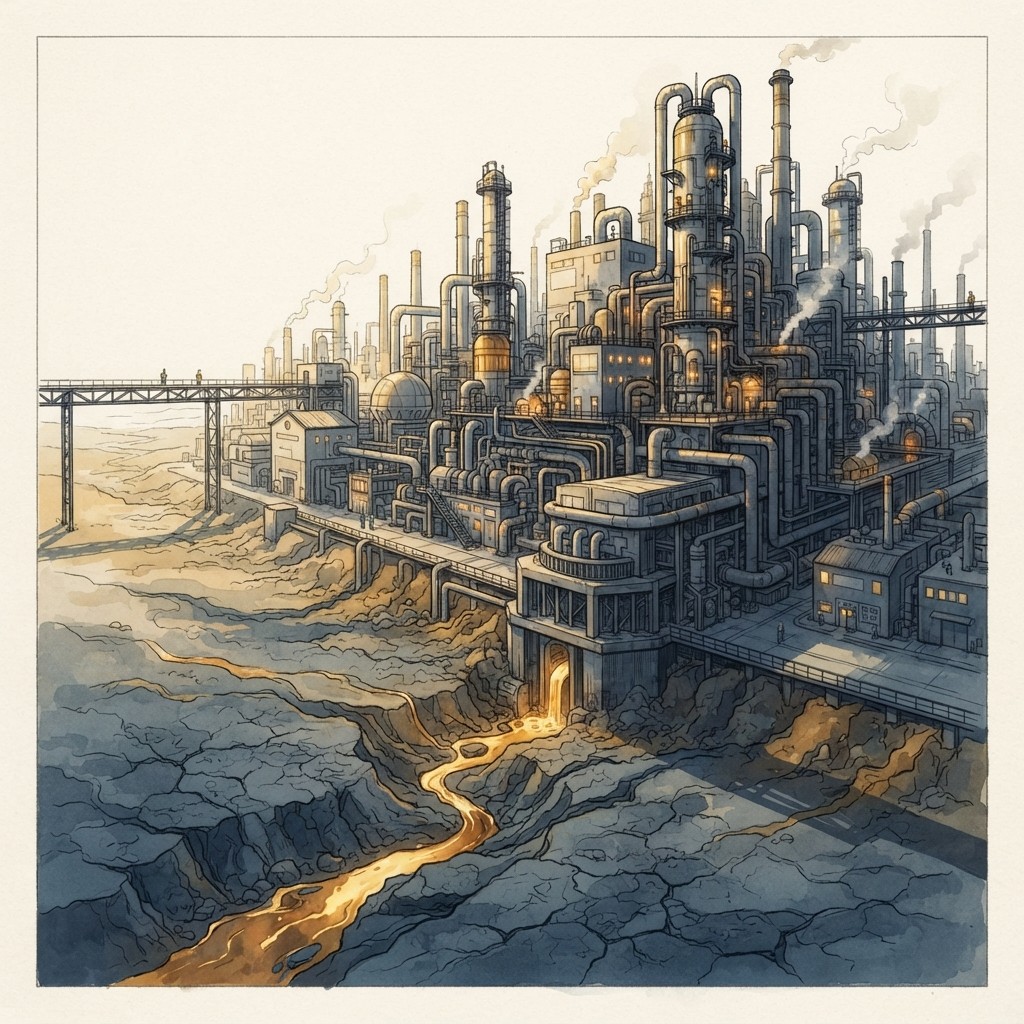
On a ten-square-kilometre stretch of the Rhine sits the single most integrated chemical plant on earth. Ludwigshafen runs on a principle called the Verbund: the waste heat from one reaction becomes the input to the next, pipes feed pipes, and almost nothing is allowed to escape unused. It is a cathedral of efficiency. And like most cathedrals, it was built for a world that no longer exists - one in which the fuel feeding the whole system, natural gas, was reliably, structurally cheap.
The official story is that BASF was hit by an energy shock and has been managing through it. That framing is comforting and wrong in the part that matters. A shock is something you wait out. What BASF is facing is not a spike that reverts - it is a permanent re-pricing of the one input its flagship site was optimised to consume.
Here is the thesis a smart friend can repeat at dinner: BASF didn't just get an expensive gas bill. The energy crisis revealed that Ludwigshafen's entire competitive model was a bet on cheap European gas - and that bet has been called.
The efficiency that became the exposure
Natural gas supplies most of BASF's own steam and power generation - roughly 77 to 79% of it - and the group burned through tens of millions of MWh a year to run its sites.3 At Ludwigshafen, gas isn't just fuel; it's feedstock and energy at once, woven into the Verbund so tightly that you cannot cleanly separate the cost of making molecules from the cost of heating them. The site alone consumed about 2.2 billion cubic metres of gas in 2022 - the bulk of BASF's entire European footprint of roughly 3 Bcm.4 When gas was cheap, that concentration was the moat: nobody could match the energy economics of a fully integrated site at that scale. When gas became expensive, the exact same concentration became the wound. The plant was engineered to extract maximum value from a cheap input, which is another way of saying it was engineered to suffer maximally when the input stopped being cheap.
And the numbers arrived fast. By the second quarter of 2022, BASF's energy costs were running more than 260% above the prior year.7 Across the full year the additional energy bill came to €3.2 billion group-wide - of which Europe was about 84%, and higher gas costs at Ludwigshafen alone accounted for roughly 69% of the entire global increase.1 One site on one river was driving more than two-thirds of a multinational's energy pain.
Why this isn't a spike that reverts
The tempting read is that 2022 was the peak and the worst is over. It is half true. By 2023 the average gas price in Northwestern Europe had fallen to €40.52/MWh - roughly two-thirds below the 2022 level. That is real relief. But read the same disclosure to its end and the comfort drains away: that 'relieved' price was still more than twice the 2015-2020 average, and more than five times the U.S. price.2 That last multiple is the whole story. It isn't a temporary divergence; it is the new baseline. A BASF plant in Europe and a competitor's plant on the U.S. Gulf Coast now buy the same molecule of gas at prices that differ by a factor of five, year after year, with no policy lever in sight that closes the gap.
| The reassuring read | What the number actually says | |
|---|---|---|
| 2023 NW Europe gas price | Down ~two-thirds from 2022 | €40.52/MWh - still elevated |
| vs. 2015–2020 average | Back toward normal | More than 2x the old normal |
| vs. U.S. price | A temporary divergence | More than 5x - the new baseline |
| Implication for Ludwigshafen | Wait it out | Re-price the cost basis permanently |
The clearest evidence that management itself has stopped treating this as temporary is what it has spent. A temporary problem gets a one-off response. BASF has run three of them in sequence: about €500 million announced in October 2022, a further roughly €200 million aimed specifically at Ludwigshafen in early 2023, and then an additional €1 billion Ludwigshafen programme in February 2024 - a cumulative target north of €2.1 billion in annual savings by the end of 2026.5 You do not launch your third structural cost-cutting programme in eighteen months to bridge a passing storm. You do it when you have quietly concluded the storm is the new climate.
“If gas supplies had fallen below 50% of 2021 levels, we would have been forced to idle the entire Ludwigshafen site.”6
The steelman: maybe the site is more resilient than the headlines
The honest counter is that the 'near-shutdown' story badly understates how fast BASF adapted. That dramatic 50%-or-idle line described a past condition - April 2022 - not a live threat. By the time the CEO repeated it in April 2023, the threshold for keeping Ludwigshafen running had already dropped to around 30% of normal gas volumes, with a projection toward roughly 10% by that autumn.6 That is not a company on the edge of collapse; that is an engineering organisation rapidly rebuilding its tolerance for scarcity. So the bears who say 'Ludwigshafen is about to go dark' are wrong, and obviously so.
But survivability is not the same as competitiveness, and conflating the two is the trap. A second fair objection cuts the other way: BASF's own 2023 reporting attributes its German loss not to energy prices alone, but to a stack of causes - low capacity utilisation, weak demand in customer industries, and elevated energy costs together.8 That is true, and it should make us careful: energy is not the only thing hurting Ludwigshafen. But it sharpens rather than softens the point. Demand is cyclical and will return. The five-times gas-price gap is structural and won't.2 When the cycle turns and competitors on cheaper energy roar back to full utilisation, the European site doesn't get to share that recovery on equal terms - it carries a permanent cost handicap into every up-cycle from here. The plant can keep running on 10% of normal gas. It just can't run profitably against a rival paying a fifth of the price.
The deepest integration is the deepest exposure. A system engineered to wring maximum value from a cheap input is, by construction, the system most damaged when that input re-prices - because every reaction, pipe, and process was tuned to assume the old number. Ludwigshafen's Verbund didn't fail; it did exactly what it was designed to do, which is convert energy economics into product economics with brutal fidelity. That's wonderful when energy is cheap and ruinous when it isn't. Before celebrating an asset's efficiency, ask the harder question: efficient at converting what, and what happens to the whole machine if the price of that one thing moves against you and stays there? Operational excellence can quietly become a single-input concentration risk wearing a nicer name.
BASF built the most efficient chemical site on the planet on top of an assumption nobody thought to write down: that European gas would stay cheap. For half a century that assumption held, and the Verbund turned it into one of the great industrial advantages in the world. The assumption broke in 2022, and the same machinery that compounded the advantage now compounds the disadvantage with equal precision. Three cost-cutting programmes and €2.1 billion of targeted savings aren't BASF waiting out a storm. They're BASF doing the arithmetic on a moat that ran, all along, on the one thing it never controlled - and discovering what it costs to build perfection around someone else's price.
When the input you built around turns on you
Pricing Power Diagnostic
A scored diagnostic of pricing power: brand pull, switching costs, substitutes, and how critical the product is to the buyer. Each dimension rated 1-5 so you can see, at a glance, whether a price rise sticks or sends customers running. Blank to grade your own offer; filled as the worked example scoring a story's business on its real ability to charge more.
Included, filled and blank, in the The Exposure Casebook. See the set → · Preview the blank →
Sources
Where this comes from — the filings, records, and reporting behind it.
- 1BASF's group-wide additional energy costs in 2022 were €3.2 billion, with Europe accounting for approximately 84% of that increase; higher natural gas costs at Ludwigshafen accounted for 69% of the global energy cost increase.
- 2The annual average gas price in Northwestern Europe in 2023 was €40.52/MWh—around two-thirds below 2022's level but still more than twice the 2015–2020 average and more than five times the U.S. price.BASF SE, BASF Report 2023 — Economic Environment ↗ · 2024-02-23
- 3BASF's total group energy consumption was 52.9 million MWh in 2022 (down from 58.8 million MWh in 2021) and 50.1 million MWh in 2023, with natural gas accounting for ~77–79% of own steam and power generation.
- 4Gas consumption across all BASF sites in Europe was approximately 3 Bcm (32 TWh) in 2022; Ludwigshafen alone accounted for 2.2 Bcm (24 TWh).
- 5BASF launched three successive cost-reduction programmes targeting Ludwigshafen/Europe: ~€500M in October 2022, ~€200M in February 2023, and an additional €1 billion in February 2024; cumulative annual savings target exceeds €2.1 billion from end of 2026.
- 6CEO Brudermüller stated at the April 2023 annual press conference that in April 2022, if gas supplies had fallen below 50% of 2021 levels, BASF would have been forced to idle the entire Ludwigshafen site; by the time of speaking, the threshold had been reduced to ~30%, with a projected further reduction to ~10% by autumn 2023.
- 7BASF's second-quarter 2022 results showed energy costs leaping more than 260% year on year; the company announced a €500 million annual cost-reduction plan focused on European—primarily Ludwigshafen—operations in October 2022.
- 8In 2023, BASF still posted a loss in Germany—primarily due to substantial negative earnings at Ludwigshafen—driven by low demand and elevated energy costs, despite making positive earnings in most other significant countries.
More like this — beyond BASF
New Strategically analyses as they publish: the defining moves in business, checked against the record. No noise, and one click to leave.