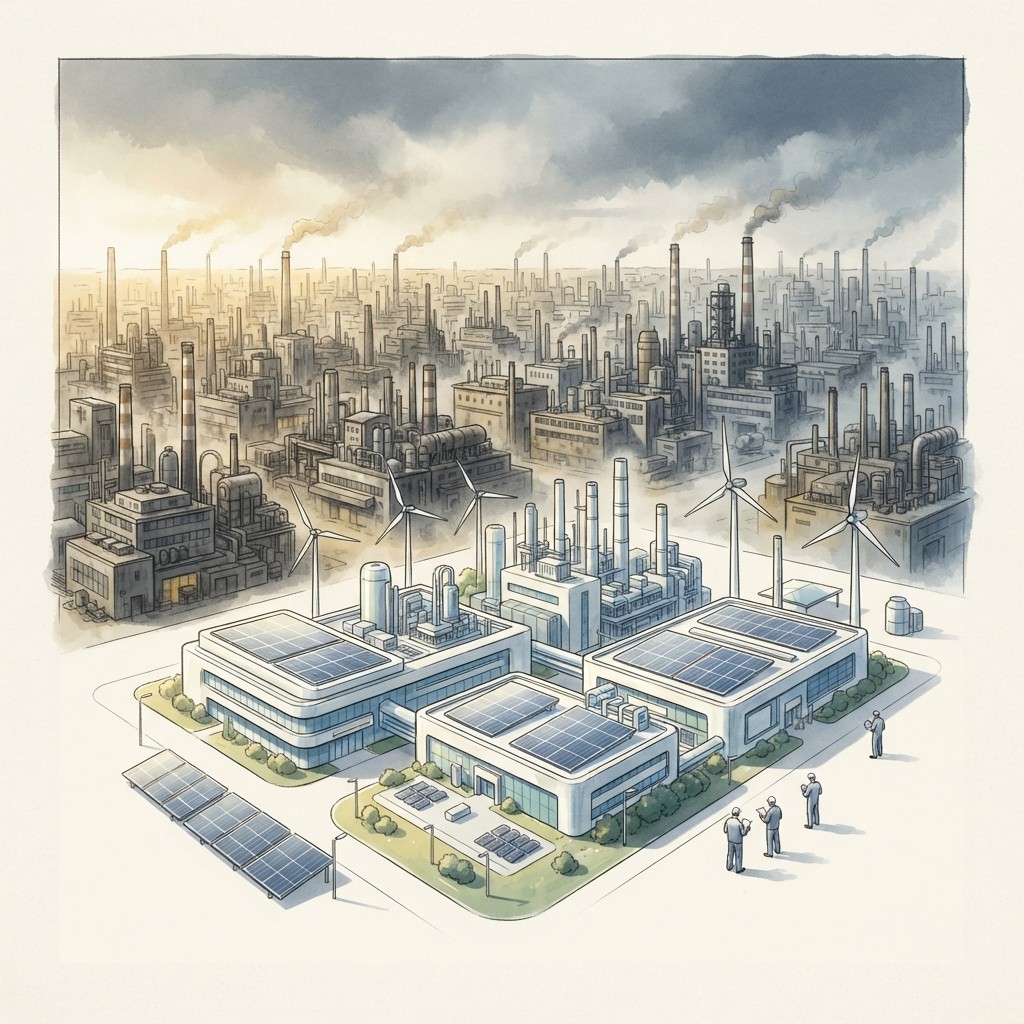
Pairs with the Market-Entry Gambit Canvas — a ready-to-use strategy tool. Included in the Market-Entry Gambit Casebook →
“How fast can this actually be done?”
On 26 March 2026, BASF cut the ribbon on a chemical complex in Zhanjiang, on China's southern coast, that it had spent around €8.7 billion building.4 It was finished on schedule and, by the company's own account, well below its original budget of up to €10 billion13 — a sentence rarely written about a megaproject of any kind.4 But the truly unusual thing is what the site does not have: a Chinese partner. In the world's most crowded chemical market — one where, as recently as the 1990s, foreign chemical companies were only permitted to build production sites in joint ventures with Chinese partners — BASF walked in alone and built the whole thing under its own roof.114
The official story is that this is a big bet on Chinese demand — the obvious move into a market that, by BASF's own reckoning, is about half the global chemical industry.7 That's true, and it's the least interesting thing about it. The real story is that BASF didn't enter the Chinese market at all in the usual sense. It exported the one thing competitors cannot buy off the shelf, and rebuilt it on its own land.
Here is the thesis a smart friend could repeat at dinner: BASF's Zhanjiang gambit isn't a market-entry bet, it's a structural arbitrage — it took a 160-year-old integration model rivals can't easily copy, and rebuilt it on wholly-owned, fully renewable-powered Chinese soil, turning the most competitive chemical market on earth into a moat of its own making.
The thing that's 160 years old and can't be bought
To understand the gambit you have to understand the asset, and the asset is older than you'd guess. When Friedrich Engelhorn set up the company in 1865, the founding idea was to integrate every production stage at a single location.3 BASF calls Ludwigshafen — where the plant was built from day one, across the Rhine from the Mannheim address where the corporation was legally registered1 — 'the cradle of the Verbund idea.'3 Verbund is the principle that one plant's by-products and waste heat become the next plant's feedstock and energy, so a sprawling complex behaves like a single organism rather than a row of separate factories.
This is the part that matters for strategy. A chemical process can be licensed; a steam cracker can be bought from any engineering contractor. What cannot be bought is the physical interconnection of dozens of plants engineered as one system — the pipes, the heat loops, the deliberate placement of every unit so its outputs feed its neighbors. That web is the moat, and it only exists if you build the whole site at once, as a system, with no partner whose plant sits outside the loop. Most rivals can match any single BASF plant. None can cheaply assemble the whole integrated organism. That's why BASF didn't license, didn't partner, didn't bolt on. It cloned the organism.
“The Verbund principle is developed from the idea, behind the company's foundation, of integrating all production stages at one location.”3
Why 'alone' was the whole point
BASF has been active in Greater China for well over a century — the relationship reaches back to 1885, when a company director traveled to China to sell BASF dyes, long before WTO accession made China fashionable.9 And it already knew the partnership route intimately: its Nanjing operation is BASF-YPC Company Limited, a 50-50 joint venture with Sinopec founded in 2000.10 So Zhanjiang's wholly-owned structure wasn't naïveté about how China works. It was a deliberate choice, dictated by the asset.4
A joint venture is fine when what you're sharing is a market. It is poison when what you're protecting is an integrated system. The moment a partner owns part of the complex, the interconnection has a seam — a plant whose economics, governance, and incentives sit outside the loop — and the organism stops behaving like one organism. Verbund only pays if every unit is yours to optimise against every other. So BASF accepted the harder, lonelier path: solely under its own responsibility, third-largest Verbund site it operates anywhere, behind only Ludwigshafen and Antwerp.4 The seam that would have made China easier to enter is exactly the seam that would have made the moat leak.
| Nanjing (the JV) | Zhanjiang (the gambit) | |
|---|---|---|
| Ownership | 50-50 with Sinopec | Wholly owned by BASF |
| What's being shared | Market access | Nothing |
| The integration loop | Has a partner-shaped seam | Closed, end to end |
| What it protects | A foothold | The Verbund moat itself |
Building a moat on free wind
BASF then added a second layer of arbitrage that has nothing to do with chemistry and everything to do with where the cost curve is going. The Zhanjiang complex runs on 100% renewable electricity — sourced through an offshore wind venture with Mingyang, power-purchase agreements, and on-site solar.8 Its steam cracker is, according to BASF, the first in the world with its main compressors powered entirely by renewable energy — a company-asserted first — with a million tonnes a year of ethylene capacity.88 And it's flex-feed: it can run on naphtha or butane, switching to whichever is cheaper, a flexibility single-feed competitors don't have.8
Stack those together and the picture sharpens. A rival in the same market is exposed to one feedstock and to grid power; BASF can route around feedstock spikes and has locked its energy cost into a renewable base it largely owns. In a commodity market where everyone makes the same molecule, the only durable edge is to make it for less, more flexibly, more cleanly — and the integrated, self-powered, feed-flexible organism does exactly that. The crowdedness of the market isn't the threat. It's the backdrop against which a structurally lower-cost producer compounds.
The conventional market-entry question is 'how do we win local share?' — and the conventional answer is a local partner who lowers the entry cost. BASF asked a different question: what do we own that this market structurally cannot copy, and how do we plant it whole on local soil? The answer was a 160-year-old integration model that only works if nobody owns a piece of it. So the partner who'd make entry cheaper was precisely the partner who'd make the advantage leak. When your edge is a system rather than a product, the gambit isn't to share the cost of entry — it's to refuse to.
It loses money in 2026. Read that as confidence.
Here's the honest counter, and it's a real one: BASF made this bet from a position of weakness, not strength. In 2023 group sales had collapsed by more than €18 billion year on year and return on capital had cratered from 10% to 4.5%.2 Sinking €8.7 billion into a single coastal megaproject while your core European business is bleeding margin is not obviously prudent — it's a concentration of capital and geopolitical exposure in one location at the worst possible moment in the cycle. And the site itself isn't earning yet. BASF's own CTO told analysts the complex will run slightly negative EBITDA in 2026, weighed down by startup costs.6 A skeptic can fairly say: this is a wounded company doubling down on China just as China gets harder, and praying the cycle turns.
That objection has teeth, and the geopolitical risk is genuinely unhedgeable. But it misreads the negative EBITDA. A startup that loses money on schedule while ramping is not a failing investment — it's an investment that hasn't reached the part it was built for. The plan is explicit: the EBITDA inflection comes in 2027, with a target of €1–1.2 billion of EBITDA on €4–5 billion of sales by 2030.6 And the trend it's riding is already there: across the prior decade BASF's Greater China sales volumes grew at a 6% annual clip and EBITDA before special items at 11%, while the region delivered roughly 14% of group sales — €8.2 billion — against a market that is half the world's.7 The bet isn't that China is easy. It's that being structurally cheaper than everyone else in the biggest market on earth is worth a few years of red ink to set up.
Most companies enter a crowded market by lowering the cost of getting in — a partner, a foothold, a toe in the water. BASF did the opposite. It paid full price to plant the one thing the market couldn't reproduce, kept every piece of it under one roof, and wired it to free wind. Zhanjiang isn't a chemical plant on Chinese soil. It's a 160-year-old idea, cloned whole, dropped into the only market big enough to make it pay — and the loneliness of the wholly-owned structure isn't the cost of the gambit. It's the moat.
When the moat is the system, not the product
Market-Entry Gambit Canvas
A one-page canvas for staging an entry into a market you don't own yet: the beachhead you take first, the wedge that gets you in cheaply, the sequence that turns a foothold into a position, and the incumbent's likely counter-move. Blank to plan your own entry; filled as the worked example showing how the story's challenger picked its landing spot and walked the rest in.
Included, filled and blank, in the Market-Entry Gambit Casebook. See the set → · Preview the blank →
Sources
Where this comes from — the filings, records, and reporting behind it.
- 1BASF was legally founded as a stock corporation ('Badische Anilin- & Sodafabrik') on 6 April 1865 in Mannheim by Friedrich Engelhorn, but the plant was built across the Rhine in Ludwigshafen because no suitable site could be secured on the Baden (Mannheim) side of the river.
- 2BASF's 2023 annual sales were €68,902 million, a decrease of €18,424 million vs. 2022, driven by lower prices and volumes; EBIT was €2,240 million and ROCE fell to 4.5% (from 10.0% in 2022).BASF SE, BASF Report 2023 — Results of Operations ↗ · 2024-02-23
- 3The Verbund concept originates in Engelhorn's 1865 founding idea of integrating all production stages at one location; Ludwigshafen is described by BASF as 'the cradle of the Verbund idea,' and the concept was later replicated at other global sites.
- 4BASF inaugurated its Zhanjiang Verbund site on 26 March 2026; the project was completed on schedule and 'well below the original budget,' with total investment of approximately €8.7 billion; the site is BASF's seventh Verbund site globally, its third-largest after Ludwigshafen and Antwerp, and is operated solely under BASF's responsibility (not a joint venture).
- 5Key Zhanjiang milestones per BASF's own site page: MoU signed Berlin July 2018; Verbund site project commenced November 2019; first engineering plastics plant inaugurated September 2022; TPU plant inaugurated January 2024; first Verbund core products November 2025; steam cracker started January 2026.
- 6BASF CTO Stephan Kothrade stated at a June 9 2026 analyst call that Zhanjiang capex from 2019 to 2028 totals €8.7 billion, 'considerably below the original budget'; the site will deliver 'slightly negative EBITDA' in 2026 due to startup costs, with the inflection to positive EBITDA expected in 2027, and a target of €1–1.2 billion EBITDA and €4–5 billion in sales by 2030.
- 7In 2025, Greater China accounted for ~14% of BASF's global sales (€8.2 billion) but ~50% of the global chemical market; BASF employed almost 13,000 people in the region. Between 2015 and 2025, BASF's Greater China sales volumes grew at a CAGR of 6% and EBITDA before special items at 11% annually.
- 8The Zhanjiang steam cracker — the first in the world with main compressors powered entirely by renewable energy — has 1 million tonnes/year ethylene capacity and a flex-feed design (naphtha and butane), giving feedstock flexibility that single-feed competitors lack. The site runs on 100% renewable electricity via offshore wind JV with Mingyang (500 MW planned), PPAs, and on-site solar.
- 9BASF's China engagement dates to 1885, when a BASF director traveled to China to sell dyes; the company published 'The History of BASF in China from 1885 to Today' to mark its 150th anniversary in 2015.
- 10BASF-YPC Company Limited is a 50-50 joint venture between BASF and SINOPEC, founded in 2000, operating the Verbund site in Nanjing.
- 11In the early 1990s, foreign chemical companies were only permitted to build production sites in China in joint ventures with Chinese partners, making the chemicals sector a historically JV-mandated industry.
- 12BASF's November 2019 press release described Zhanjiang as the company's 'US$10 billion investment project' and its largest investment, 'estimated up to US$10 billion upon completion'; that was the original budget, not the final cost, which came to approximately €8.7 billion.
- 13In total, BASF will invest up to €10 billion. (2019 entry: The total investment is up to €10 billion by 2030.)BASF, Our engagement in China ↗ · 2026-10-13
Weighing outside help with a decision like this? Hiring a commercial due diligence provider
More like this — beyond BASF
New Strategically analyses as they publish: the defining moves in business, checked against the record. No noise, and one click to leave.