Pairs with the Moat Anatomy Canvas — a ready-to-use strategy tool, filled for Honda. Included in the The Moat Anatomy Casebook →
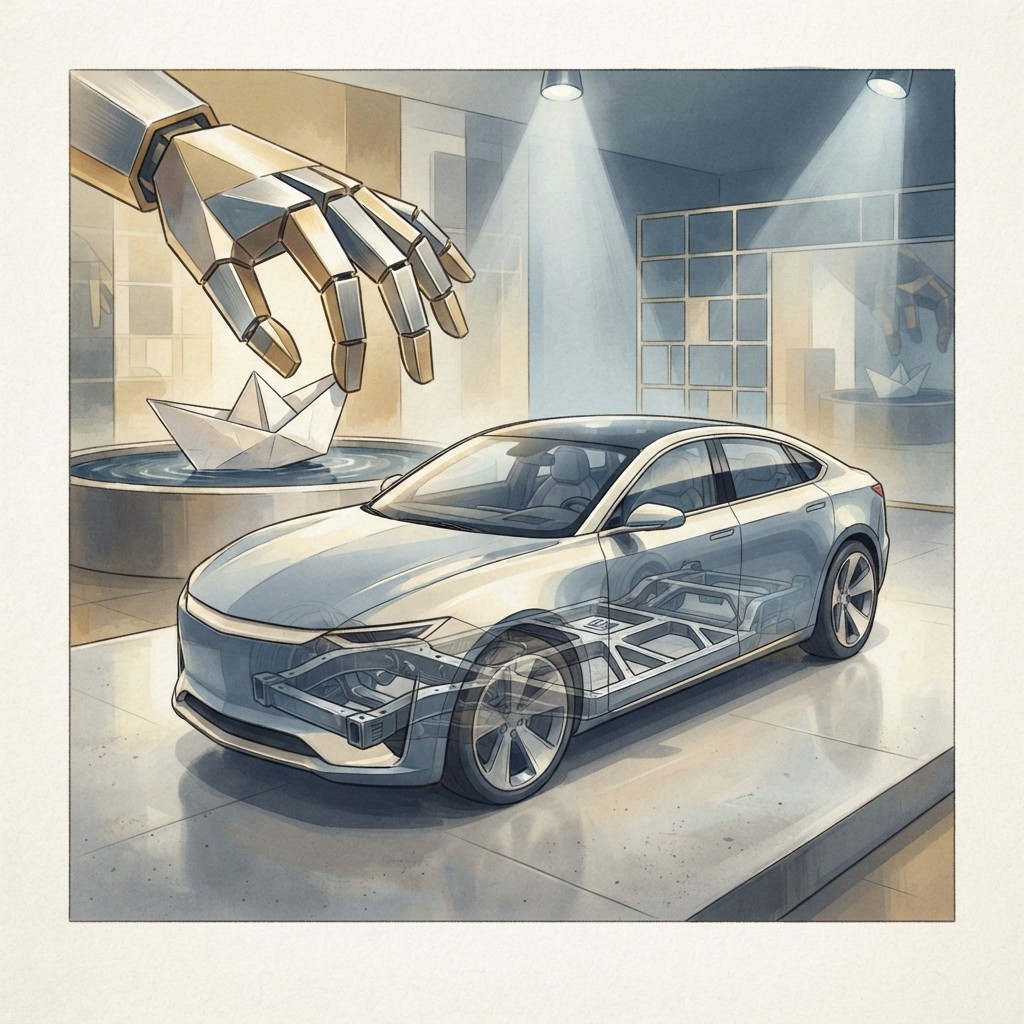
The Honda Prologue, the company's flagship electric SUV, started rolling out of a factory in early 2024 — and it isn't really a Honda underneath. Its skateboard, its battery, its drivetrain architecture all belong to General Motors' Ultium platform; the same goes for the Acura ZDX.6 The company famous for going it alone shipped its first big EV to American driveways riding on a rival's bones. Hold that image, because it sits awkwardly beside the legend everyone repeats about Honda.
The official story is that Honda is the lone wolf of the car industry — the engineer's company that never merges, never bends, never lets anyone else touch its engines. It's a beautiful story. It is also, in the places that matter, a managed myth. Honda borrows platforms when it suits it, enters joint ventures when the math works, and when its biggest deal in decades fell apart, it fell apart because Honda was pushing too hard to consolidate — not refusing to.
Here is the thesis, plainly: Honda's independence isn't an immutable strategic posture. It's a brand asset — built, dated, and deployed like any other piece of marketing — and the company will trade pieces of its actual independence whenever the engineering or economics demand it.
The independence slogan has a birthday — and it's recent
People assume Honda's independent streak runs back to Soichiro Honda's workbench. It doesn't run nearly that far. The phrase most often cited as proof — the 'Power of Dreams' brand line — is a 21st-century declaration. Honda's own history page is unusually candid about what the slogan is for: it 'clearly states the company's will of spirited independence in an era of mergers and acquisitions.'3 Read that again. It's not a founding principle handed down by the founder. It's a positioning statement, written in response to a specific wave of industry consolidation, to tell the world which side Honda wanted to be seen on.
“[The slogan] clearly states the company's will of spirited independence in an era of mergers and acquisitions.”3
What Soichiro Honda actually left behind is gentler and has nothing to do with mergers. The 'Three Joys' — the joy of buying, the joy of selling, the joy of producing — appeared in a company newsletter in 1951, three years after he founded the firm, and they're about customers and craftsmen being satisfied, not about corporate sovereignty.2 The founding philosophy is 'Respect for the Individual' plus those Three Joys.1 Somewhere along the way, a 1951 statement about making people happy got quietly fused with a 2000s slogan about resisting M&A, and the blend hardened into folklore. The independence isn't in the DNA. It was bolted on later, with intent.
Watch what Honda does, not what it says
Strip away the slogan and look at the deals, and a very different company appears — one that allies constantly when the engineering calls for it. The GM tie-up isn't a one-off vehicle program. Honda and GM stood up a separate joint venture, Fuel Cell Systems Manufacturing LLC, to build hydrogen fuel cells together, and Honda partnered with LG Energy Solution on a 40 GWh battery gigafactory in Ohio.7 That's a platform borrowed, a fuel-cell business shared, and a battery plant co-owned. None of it looks like a company that won't let outsiders near its powertrain.
| The independence myth | What Honda actually did | |
|---|---|---|
| EV platform | Builds its own, alone | Prologue & Acura ZDX on GM's Ultium architecture |
| Hydrogen | Proprietary, in-house | FCSM — a joint venture with GM |
| Batteries | Solo capacity | 40 GWh gigafactory with LG Energy Solution in Ohio |
| Posture | Refuses to combine | Drove a holding-company merger with Nissan in 2024 |
The Prologue isn't a quiet experiment, either. It went into production at GM's Ramos Arizpe plant in January 2024, reached U.S. driveways that March, and moved more than 25,000 units in its first stretch through that November.6 This is a company that handed a rival the most strategically sensitive layer of an electric car — the platform — and sold the result in volume. 'Spirited independence' is the tagline. Pragmatic interdependence is the operating model.
The Nissan deal didn't die from Honda's restraint. It died from Honda's appetite.
The cleanest evidence that the independence story is upside down is the deal everyone read as proof of it. In December 2024, Nissan and Honda signed a memorandum of understanding to fold their businesses together under a single holding company — a genuine, SEC-filed move toward integration.4 If Honda were the immovable lone wolf, it would never have been at that table. It wasn't just at the table; it was driving.
Then it broke. At board meetings on February 13, 2025, the roughly $60 billion combination was scrapped. The reason wasn't that Honda recoiled from consolidation. It was that Honda proposed turning Nissan into a subsidiary via share exchange — making Nissan a unit of Honda rather than an equal partner under a neutral holding company — and Nissan refused to be absorbed.5 Honda, carrying a market value nearly five times Nissan's, behaved exactly like the bigger fish: it wanted to swallow, not to share.5 The 'fiercely independent' company killed its own merger by trying to own the other side outright. That's not isolationism. That's an acquirer who couldn't get the price.
But isn't the independence still real where it counts?
The fair objection is that none of this disproves a genuine independent streak. Honda is one of the largest carmakers on earth — its consolidated revenue hit JPY 20,428.8 billion for the year ended March 2024, up nearly 21%8 — and it has stayed unmerged for three quarters of a century while peers paired off into Renault-Nissan and Stellantis. It still designs its own engines, runs its own racing program, and walked away from Nissan rather than accept terms it disliked. Surely that's not nothing.
It isn't nothing — but it's a different thing than the myth claims. Honda's behavior is consistent with a company that guards control, not one that refuses partners. It will share a battery plant, a fuel-cell venture, even an EV platform, as long as it keeps the steering wheel. What it won't do is become someone else's subsidiary — and, as Nissan learned, it would much rather make you its subsidiary instead. That's not a philosophy of independence. It's a preference for being the senior partner, dressed up in founder-era language it was never actually given.
When a company's 'eternal principle' turns out to have a launch date, treat it as positioning, not posture. The tell is always the same: read the deals, not the deck. Honda's independence narrative was authored in the 2000s to answer an M&A wave, then back-dated onto a 1951 newsletter about customer satisfaction. Meanwhile the actual moves — Ultium platforms, a fuel-cell JV, a co-owned gigafactory, a takeover bid for Nissan — describe a pragmatic operator who shares freely as long as it stays in charge. The lesson for anyone reading a competitor or a partner: when the brand story and the contract history disagree, the contracts are telling the truth.
Honda's real strategic identity was never 'we go it alone.' It's 'we stay in command.' The Prologue rides on GM's bones because the bones were good and Honda kept the badge. The Nissan deal died because Honda offered subordination dressed as union, and the other side noticed. The 'spirited independence' that sells so well in advertising is, on inspection, the most flexible thing the company owns — traded piece by piece whenever the engineering or the economics make a better case than the myth. The lone wolf was always willing to hunt in a pack. It just insisted on leading it.
When the official story isn't the real one
Moat Anatomy Canvas
A one-page canvas that dissects a moat instead of asserting it: where the advantage comes from, how much of the market it covers, how long it would take to copy, and what keeps it from eroding. Blank to dissect your own claimed edge; filled as the worked example tracing the structure of the story's defensible advantage. Use it to tell a real moat from a head start.
Included, filled and blank, in the The Moat Anatomy Casebook. See the set → · Preview the blank →
Sources
Where this comes from — the filings, records, and reporting behind it.
- 1Honda Motor Co., Ltd. was founded in 1948; its Honda Philosophy—'Respect for the Individual' and 'The Three Joys'—was established by founders Soichiro Honda and Takeo Fujisawa.
- 2Soichiro Honda articulated 'The Three Joys'—joy of producing, joy of selling, joy of buying—in Honda Monthly No. 4 (1951), a company newsletter written three years after founding Honda Motor Co.Honda Motor Co., Ltd. / Honda Monthly, Honda Monthly No. 4: The Three Joys (1951) · 1951
- 3Honda's 'Power of Dreams' global brand slogan 'clearly states the company's will of spirited independence in an era of mergers and acquisitions'—adopted in the 21st century, not by Soichiro Honda himself.
- 4On December 23, 2024, Nissan signed a Memorandum of Understanding with Honda to initiate discussions about integrating their two businesses under a holding company structure. This MOU was filed with the SEC under Rule 425.
- 5Honda and Nissan held board meetings on February 13, 2025 and decided to end merger discussions; a key reason was Honda's proposal to transition to a parent-subsidiary structure via share exchange, which Nissan rejected. Honda had a market value nearly five times that of Nissan.
- 6The Honda Prologue and Acura ZDX are both built on General Motors' Ultium architecture (BEV3 platform); the Prologue entered production at GM's Ramos Arizpe plant in January 2024, with initial U.S. deliveries in March 2024. U.S. Prologue sales through November 2024 totaled 25,132 units.
- 7Beyond the Prologue/ZDX vehicles, Honda and GM formed Fuel Cell Systems Manufacturing LLC (FCSM) for hydrogen fuel cell production; Honda also partnered with LG Energy Solution to establish a 40 GWh gigafactory in Ohio set to begin production in 2025.
- 8Honda's consolidated sales revenue for the fiscal year ended March 31, 2024 was JPY 20,428.8 billion, a 20.8% increase from the prior fiscal year. Honda adopted IFRS for consolidated financial statements from the year ended March 31, 2015.
More like this — beyond Honda
New Strategically analyses as they publish: the defining moves in business, checked against the record. No noise, and one click to leave.