Pairs with the Adjacency / Synergy Map — a ready-to-use strategy tool. Included in the The Adjacency Expansion Casebook →
In 1946, in a bombed-out Japan, a mechanic sold the wreckage of his piston-ring business to Toyota for ¥450,000 and used the cash to open a research shed.6 He called it the Honda Technical Research Institute, and its first product was a motor you bolted onto a bicycle so you could ride to market on petrol instead of legs.1 Sixty-nine years later, the company that grew out of that shed handed a customer the keys to a $5-million business jet of its own design.4 The temptation is to call that a diversification miracle. It is the wrong word entirely.
The official story is that Honda is a master diversifier — that it leapt from motorcycles to cars to lawnmowers to aircraft, conquering each new market by sheer ambition. Strip that story down and you find it isn't a story about many businesses at all. It's a story about one obsession, sold over and over in different bodies.
Honda never sold a motorcycle. It sold the engine inside it.
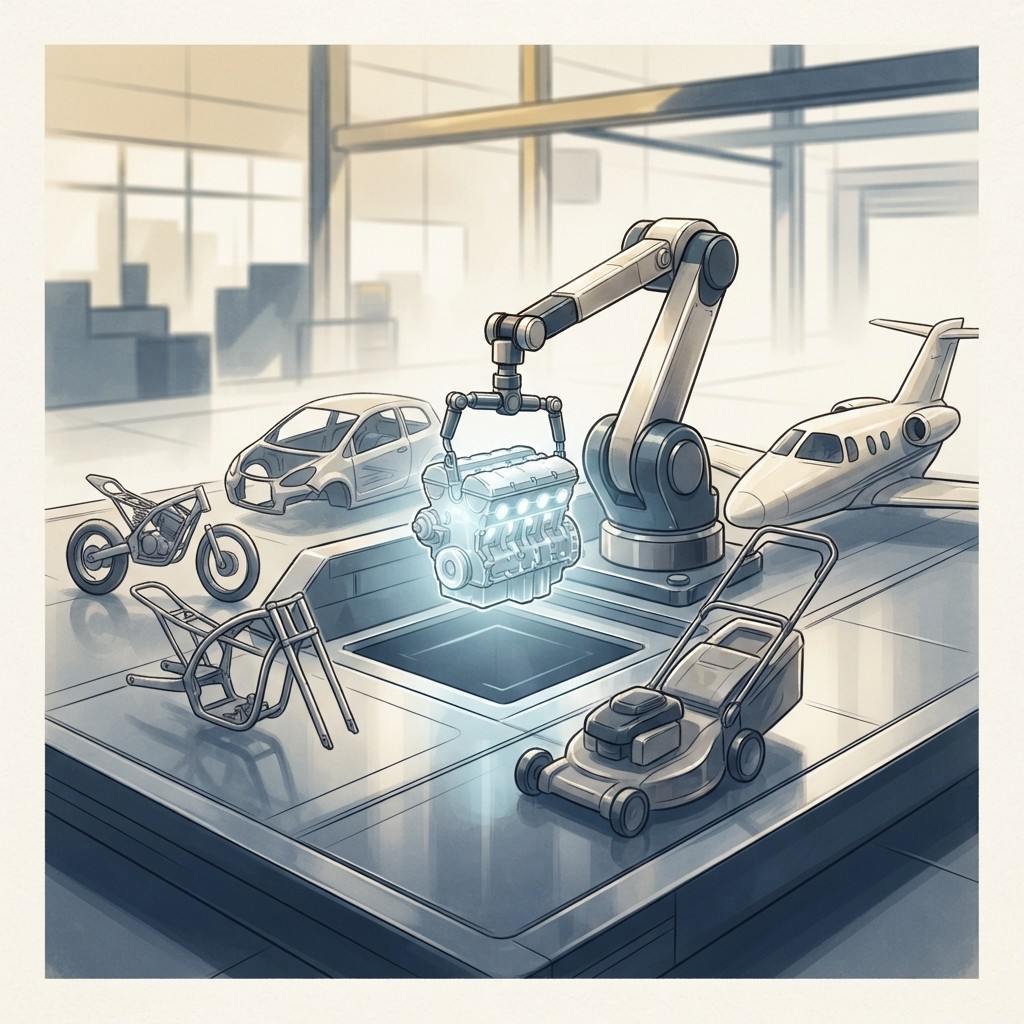
Here is the thesis a smart friend can repeat at dinner: Honda's expansion was never a portfolio of bets across industries. It was a single competency — proprietary internal-combustion engineering, and later aerodynamics — pushed into whatever object could carry it. The motorcycle was the first vessel. The car was the next. The lawnmower, the generator, the outboard motor, and finally the jet were all the same R&D wearing new sheet metal.9 The categories are the costume. The engine is the actor.
Watch the sequence and the deepening becomes obvious. Honda began mass-producing motorcycles with the Dream D-Type in 1949, and by 1957 it was the top Japanese motorcycle maker by production volume.2 Then it took the same combustion knowledge and built a car around it — the Civic in 1972, the Accord in 1976.3 Each move looks like a leap into a new market. Each is really the same powertrain expertise asked to do a harder job. The company didn't acquire a car competency; it extended the one it already had.
The jet wasn't a leap. It was a 17-year-old secret.
Nothing exposes the real pattern like the airplane, because nothing looks more like a wild swing. A car company building a business jet sounds like a CEO's vanity. But the chronology kills that reading. Honda's aircraft research began as a top-secret project inside Honda R&D in 1986 — four engineers, no announcement.4 Lead designer Michimasa Fujino developed the HondaJet concept in 1997. The proof-of-concept first flew on December 3, 2003.4 Honda Aircraft Company wasn't even formally established until 20065, and FAA type certification didn't arrive until December 2015.4 That is nearly three decades of quiet, compounding R&D before a paying customer ever sat down.
The popular telling — 'the carmaker that suddenly built a jet' — erases the part that matters. There was no sudden. There was a company that had spent decades learning to make engines — and, from 1986, to shape airflow around them — and that quietly decided to apply both to the one vehicle where engineering precision matters most. The HondaJet is not evidence Honda can wander into anything. It is evidence Honda only ever did one thing, and got patient enough to do it at altitude.
| What it looks like | What it actually is | |
|---|---|---|
| Motorcycle (1949) | Entry into two-wheelers | A compact combustion engine, mobile |
| Car (1972) | Leap into automobiles | The same powertrain, scaled up |
| Power equipment | Unrelated diversification | The same engine, stationary |
| HondaJet (2003) | Surprise aerospace bet | Engine + aerodynamics, 17 years in secret |
Wasn't a lot of this just luck and improvisation?
The honest objection is that this picture is too clean — that 'one coherent competency, patiently deepened' is a tidy story imposed after the fact. And the best evidence for the objection is Honda's own US entry. A 1975 BCG report commissioned by the British government portrayed Honda's American conquest as a masterclass in deliberate scale economics. Richard Pascale's 1984 account, built on interviews with the executives who were actually there, found the opposite: 'miscalculation, serendipity, and organizational learning.'7 Honda, on this telling, stumbled into its success rather than engineering it.
That tension is real, and the resolution is not to pick a side. A Harvard Business School working paper synthesizing both accounts concludes that later scholars found Honda's American strategy is best described as simultaneously deliberate and emergent — neither story alone is sufficient.8 And notice what that actually concedes. The market entries were improvised; what was not improvised was the engine underneath them. Honda could afford to fumble its way through dealers, models, and marketing precisely because the one thing it never had to improvise was the core technology. The competency was the deliberate part. The path it took to market was the emergent part. The flywheel runs on the engine; the road can be a mess.
“...the result of miscalculation, serendipity, and organizational learning — not the deliberate scale strategy attributed to Honda.”7
Most diversification fails because it chases attractive markets — and an attractive market you have no edge in is just a fight you'll lose against incumbents who do. Honda did the inverse: it found the one thing it was genuinely best in the world at (making engines, then shaping air around them) and asked, relentlessly, 'what else could carry this?' The product categories looked unrelated because the market labels them by what they DO — ride, drive, mow, fly — while Honda organized itself around what they all NEED. The discipline isn't 'enter new markets.' It's 'never enter a market your core competency can't underwrite.' The caution: this only works if the competency is real and deep enough to win on. A shallow capability stretched across four industries is just four ways to be mediocre.
There's one more piece of evidence the diversification story misses. When Honda finally built in America, it wasn't even first to sell cars there — it had been importing them since 197010 — and Toyota and Nissan (then selling under the Datsun badge) had been on US roads since the late 1950s.11 What Honda was first at, in 1982, was building cars locally, at Marysville, Ohio.3 Even its famous American milestone was about manufacturing depth, not market novelty. The pattern holds all the way down: Honda's whole history is a company being mistaken for a wanderer when it was really a digger.
So the next time someone marvels that a motorcycle company built a jet, hand them the real sentence. Honda never expanded beyond its core. It expanded its core until the core could fly. The motorcycles, the Accords, the generators, the HondaJet — strip away the bodywork and you find the same shed in 1946, the same obsession with the thing that makes power move. Diversification spreads a company thin across markets it half-understands. Honda did the opposite, for seventy years, and called it a portfolio only because the rest of us couldn't see the engine under all the different skins.
Companies that grew by deepening, not wandering
Adjacency / Synergy Map
A one-page canvas for an adjacency play: the new business next door, the shared assets that justify entering it, the synergies that actually transfer versus the ones that evaporate on contact, and the dis-synergies nobody put on the deck. Blank to test your own expansion; filled as the worked example showing where the story's 'natural adjacency' was real and where it was wishful.
Included, filled and blank, in the The Adjacency Expansion Casebook. See the set → · Preview the blank →
Sources
Where this comes from — the filings, records, and reporting behind it.
- 1Honda Motor Co., Ltd. is incorporated on September 24, 1948, as a successor to the unincorporated enterprise established in 1946 by Soichiro Honda to manufacture motors for motorized bicycles.
- 2In 1949, Honda began mass production of motorcycles with the Dream D-Type; by 1957 Honda was the top Japanese motorcycle manufacturer by production volume; Honda established American Honda Motor Co. in the United States in 1959.
- 3Honda launched the Civic in 1972 and the Accord in 1976, establishing its automobile business; in 1982 it became the first Japanese automaker to begin local auto production in the US (Accord at Marysville, Ohio); the Acura brand was established in 1986.
- 4Honda's aircraft research began as a top-secret project within Honda R&D in 1986, starting with four engineers; lead designer Michimasa Fujino developed the HondaJet concept in 1997; the proof-of-concept first flew December 3, 2003; FAA type certificate received December 2015; first delivery December 23, 2015.
- 5Honda's official corporate history states aircraft and engine R&D has been a core theme since 1986, with the HondaJet's first flight in 2003 and Honda Aircraft Company established in 2006.
- 6Honda sold the salvageable remains of his piston-ring business to Toyota for ¥450,000 and used the proceeds to found the Honda Technical Research Institute in October 1946, the operational precursor to Honda Motor Co.
- 7Richard Pascale's 1984 account, based on interviews with the Honda executives responsible for the US market entry, concluded Honda's success was the result of 'miscalculation, serendipity, and organizational learning' — not the deliberate scale strategy the BCG 1975 report attributed to Honda.
- 8An HBS working paper synthesizing the BCG and Pascale accounts concludes that subsequent scholars (Rumelt, Mair, Otahara) found Honda's strategy in America is better described as both deliberate AND emergent — neither account alone is sufficient.
- 9Honda began manufacturing small engines for use in power equipment products in 1953; in 1973 Honda introduced generators, tillers, and outboard motors into the US market; lawnmowers followed in 1979.
- 10Honda first introduced passenger cars to the North American market in 1970 with sales of the Honda N600 sedan through 32 dealers in the western United States.
- 11Toyota entered the US passenger car market in 1957 with the Toyopet Crown, re-entered in 1964 with the Corona, and by 1969 was selling over 100,000 vehicles per year in the US; Nissan (as Datsun) began selling cars in the US in 1958.
More like this — beyond Honda
New Strategically analyses as they publish: the defining moves in business, checked against the record. No noise, and one click to leave.